
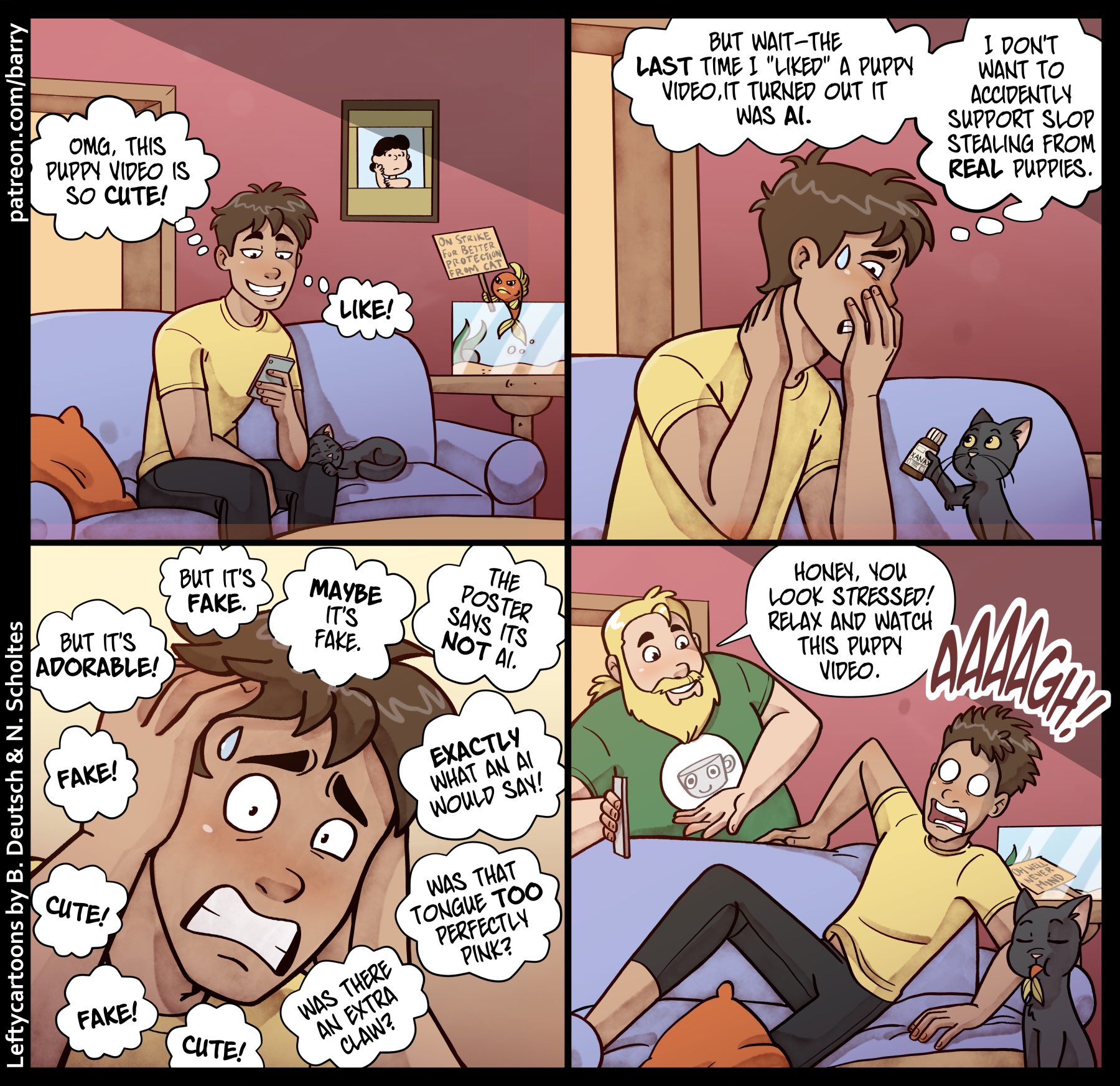
Another collaboration with Nadine Scholtes! (Nadine and I have done an AI-themed cartoon once before).
I’m in my fifties, and therefore suspect myself anytime I don’t like a new technology. Is it really bad, or am I, in the manner of generations of older people before me, just hating the new tech because it is new? Is it just my inner Grampa Simpson coming out?
But man, they’re just shoving AI down our throats so hard!
There have been a few times when I’ve shared something adorable or funny only to find out that it’s an AI fake. Now I hesitate. I’ve become the person in this cartoon, except that I fortunately have a bit more chill. We can’t just enjoy that cute video of bunnies hopping on a trampoline; we have to investigate it for signs of being fake. (The bunny video, which got tens of millions of views, was AI-generated.)
And this effects how we watch real videos. Danqing Shi and co-authors, in a study published in Scientific Reports, wrote:
These findings have significant overarching implications – they suggest that our behavior changes not only when we engage with an AI-generated video, but as soon as we are aware that videos can be fake. With the increasing prevalence and growing awareness of AI-generated content, this is likely to change how people interact with the video medium altogether. While one can argue this is true for other generated content, videos have been, for years, considered one of the most reliable forms of evidence, underpinning critical societal processes from fair trials to democratic discourse. While it is well-known that generative AI endangers the reliability of evidence, our results highlight a secondary, perhaps more insidious risk: the mere possibility of AI fabrication already changes how we witness and interact with the world.
A paper on the MIT Media Lab website had similar findings; just knowing that videos might be AI changes how we view all videos, including real videos.
We conducted a two-phase study (𝑁 = 100), comparing participants first exposed to AI-generated videos to a control group viewing human-generated videos, before both groups transitioned to human-generated content. Despite clear disclosure, the AI-exposure group reported increased doubt about subsequent videos’ authenticity, reduced judgment confidence, greater perceptual disruption, and lower social connectedness.
When I wrote this cartoon, I was intending to do a light, funny cartoon for once. Wacky faces! A character surrounded by his own thought balloon! But the reality behind this cartoon has some very dark implications.
I frequently encounter AI-suspicion from the opposite angle: It’s become routine for people to knowingly declare that our cartoons are obviously AI-generated. In particular, all the background gags — especially things that change from panel to panel, like t-shirts or graffiti — are proof that we don’t draw these ourselves. When I tell them our cartoons are drawn by humans, they sometimes believe me. Sometimes.
TRANSCRIPT OF CARTOON
PANEL 1
A young man sits on a couch, smiling at a video on his phone. A black cat sleeps beside him.
MAN (thinking): OMG, this puppy video is so cute!
MAN (thinking): Like!
PANEL 2
The man suddenly looks anxious, one hand pressed to his face.
MAN (thinking): But wait—the last time I “liked” a puppy video, it turned out it was AI.
MAN (thinking): I don’t want to accidentally support slop stealing from real puppies.
Nearby, the black cat holds up a bottle of Xanax.
PANEL 3
Extreme close-up of the increasingly frantic man. Thought balloons circle around his head:
But it’s adorable!
Fake!
Cute!
But it’s fake.
Maybe it’s fake.
The poster says it’s not AI.
Exactly what an AI would say!
Was that tongue too perfectly pink?
Was there an extra claw?
Fake!
Cute!
PANEL 4
A bearded man approaches, holding out his phone for the first man to see. The first man recoils in horror.
BEARDED MAN: Honey, you look stressed! Relax and watch this puppy video.
MAN: AAAAAGH!
CHICKEN FAT WATCH
In panel one, a goldfish is half out of its aquarium, picketing with a sign reading, ON STRIKE FOR BETTER PROTECTION FROM CAT. A framed portrait of Lucy from Peanuts is on the wall.
In panel two, the cat offers the stressed man a bottle labeled XANAX.
In the final panel, the goldfish’s abandoned sign now reads, OH WELL NEVER MIND. The black cat is contentedly eating the goldfish.



I would think the goldfish would want to strike to protest how quickly they die and get replaced by rich cartoonists.
Impressively deep cut there Beth! :-p
I find anti-AI sentiment weird. It would be one thing if someone was having their job displaced by AI (I have sympathy for artists), or if the fake video being passed off as being real would have ramifications, or could otherwise articulate some reason why the thing being made by AI was actually bad, but take the example from the comic… Why would it matter if the video was AI or not? Was the animal not cute? Was it not doing a cute thing? Was it not amusing?
@Corso: People are having their jobs displaced by AI.
@Corso I think there are two main issues people have with AI videos. First, not only are people used to “seeing is believing” and it is a little disturbing that this is no longer so, but also it means something different if the cuteness is a real animal doing something an animal might actually do rather than something someone dreamed up and had AI implement that never happened. Also, I think people are anxious about AI videos even when looking at cute AI puppies because they don’t like being fooled, and they can see how this tech is going to be used (is already used?) to manipulate real people to think, feel, and do things and it makes them (rightfully in my opinion) nervous.
It’s an ordinary human thing to be interested not only in what a thing is, but how it’s made.
That’s why people who collect wine care about where the grapes come from and how the wine was made. They might not be able to tell the difference in a blind taste test, but they don’t just want the flavor of the drink; they want the flavor of the wine plus the story about where the wine came from.
I kind of find it funny that three people gave four very different reasons why they think that people have issues with AI. Problem is that all four explanations don’t really explain what we’re seeing when it comes to the anti-AI sentiment we’re seeing (and was depicted, the person wasn’t curious whether the image was AI or not, he was described as frantic and horrified) and in particular when looking at the example provided: online pet videos, which are notoriously stolen, scrubbed, and reused. I’m not going to attribute malice to anyone, but it feels like something where people feel a kind of a default opposition to something, and they’re searching for justifications to their feelings.
When AI was first coming to the scene, when AI Will Smith was attempting to eat it’s first plate of spaghetti, people hated it… AI can’t do hands, AI can’t do faces, this will never look good. I think that’s the etymology of “slop”. But then, as the product got better, the concerns shifted to things like theft… Which, like I said was a novel take for citizens of the internet, who had not only previously unknowingly enjoyed the products of theft, but had gleefully partaken of websites and apps devoted entirely to the pirating of IP. And now, we’re kind of settling into the idea that we don’t like being deceived. Which I suppose is probably the most understandable justification, but I wonder – Would you be more accepting of AI generated cartoons that straight up said they were AI generated?
He was obviously frantic about his inability to be sure if an image of cute dogs is AI or real. How did you read the cartoon and not understand that?
And yes, there are multiple reasons people criticize AI. That’s not at all surprising; AI is large, and there are a lot of people.
This particular cartoon is focused on the anxiety caused by it being increasingly hard to know if a video or photo we look at is real or AI. That’s not the only or even the major concern about AI, but it’s the one that was interesting me as I wrote this cartoon.
I think you misunderstood what I was writing (and possibly other comments as well). I wasn’t saying, in a general way, “why [I] think people have issues with AI.” I was answering your specific question:
It’s fine for you to ask that, of course, but unfair of you to then twist answers to your question into statements about why people dislike AI in general.
“I kind of find it funny that three people gave four very different reasons why they think that people have issues with AI. ”
Did you know it’s possible for something to be bad in several different ways at the same time?
“I kind of find it funny that three people gave four very different reasons why they think that people have issues with AI. ”
This wasn’t asked in a vacuum, you asked it on a forum where people can see what other people write before they post their own comment. Maybe they didn’t want to repeat things and AI has a host of ethical problems associated with it?
Because I read your text description of the comic:
I’m sorry if this wasn’t clear, but when I asked “Why would it matter if the video was AI or not? Was the animal not cute? Was it not doing a cute thing? Was it not amusing?” I wasn’t asking the direct “why might someone want to know if a video was AI or not?” I was asking: “Why would someone become neurotic over it?”
Because I’m seeing that in real life, there are people out there making anti-AI sentiment their entire personality. People I know, in real life, on Facebook, are posting daily posters against slop. You said it yourself: AI “hunters” are out there saying that your personally crafted comics are AI because your backgrounds aren’t consistent, despite that being your running gag for decades, and they don’t always believe you when you tell them so. I’m legitimately curious, because I don’t understand it, and all the things people say feel like excuses. Not that they say is technically wrong, or that what they’re saying is illegitimate… But the amount of attention this topic gathers, and the amount of effort people are putting into opposition, it feels at least partially artificial. I don’t know. Your mileage may vary, I’m aware I’m 100% talking about vibes.
When you wrote:
I was taking you as distinguishing between two possibilities: 1) Curiosity over if the image is AI, or 2)being generally frantic and horrified, but not interested in if the image is AI or not.
I now think I misunderstood you, and you were actually distinguishing between 1) Curiosity over if the image is AI, or 2) being frantic and horrified over if the image was AI.
If that’s correct, then your reading of the cartoon was fine, and the problem was me misreading your comment. Sorry about that!
IMO, some anti-ai folks are going over the top in their reactions to AI, but mainly I object to people being mean. I don’t think the arguments against ai are clear-cut enough to justify the high level of hostility and contempt I’ve seen some anti-ai people hold for ai users.
Yes, I’d consider that better. I don’t think all AI use needs labeling – if a script is proofread by AI, or if someone used AI to generate a reference picture of a particular thing, I don’t think that requires disclosure. But if the final words or images of a completed comic were substantively written or drawn by AI, that should be disclosed.
But I still consider it problematic for economic reasons, as I described in this post. But although I’d like to be wrong, I expect human cartoonists to lose that fight. In the future, I think most comics will be drawn by AI, and relatively few people will be paid to actually draw comics themselves. Which makes me unhappy, but the world isn’t designed for my happiness.
Yes, sorry… I could have been clearer and this is better. I think there’s a distinction to be made between curiosity over whether something is AI or not, and stress over whether something is AI or not. There’s a desire to know behind both, but absent a reason to be stressed, like the economic argument, or something like a deepfake of a real person, the curiosity feels very human and natural, and the stress feels unhealthy and obsessive.
Personally, I feel like I’ve been duped when I like a cute puppy doing something cute that turns out to have been AI generated. I don’t like feeling like I’ve been tricked.
It’s like during the peak low-fat era when people would feed me mediocre food and ask, How was that? and I, being polite, would say, “It was good,” and then they would lol gotcha I didn’t use cream or butter, it was creamed cauliflower or whatever. Not only was the food subpar, they had conned me.
Now people making these AI videos aren’t my friends, so the level of broken trust is nowhere near the same. But it turns what should be enjoyable into a bitter memory.
Magicians who can bend spoons admit they’re doing tricks. This is why they dislike people like Uri Geller who pretend they’re using “real” magic or powerful brainwaves.
I love CGI special effects in a movie. I really liked Peter Jackson’s remake of King Kong because the special effects went so far beyond the 1933 stop-motion shots (although I enjoy the original film). But Jackson didn’t pretend his ape was real.
That’s my problem with AI. The people who spread it are trying to fool us into the believing the fake puppy is real.
Some republican candidates have been using AI and deep fakes to misrepresent their Democratic opponents. It’s dishonest.
“The people who spread it are trying to fool us into the believing the fake puppy is real.”
Yes! Exactly.
Nothing beats seeing actual cute puppy antics in person. Videos are one step removed from that. They are missing a dimension – depth. AI videos are also faking that depth, but because they are created almost instantaneously they are also missing yet another dimension – real time. We might not notice it at first, but when you watch several you can feel it. For art, these deficiencies are even more consequential.
AIs are the children of the amazing computer models that allow us to predict the weather. We’ve come to take for granted that we know what the weather will be over the next few days with 90% certainty. I still remember the anxiety among the teachers when a surprise blizzard blew in when I was in second grade. They had to arrange for buses to drop each child at their house because it was coming down so thick and fast. It then snowed the three days. No one had seen it coming. That could not happen today.
However, the other parents of the various AI systems are men like Elon Musk and Peter Theil, who don’t recognize anyone except their fellow billionaires as fully human. Their prejudices and immorality are built into the algorithms. That’s dangerous.
My biggest problem with AI is that it isn’t AI. ITS LLM’s and algorithmic programs. These have been around for quite a while. My second biggest problem is that it sucks for most of what it’s claimed to be able to do.
“AI” is not AI as we’ve come to think of it over the last 80 years.
Associated Press headline:
Consumer apprehension grows as US retailers adopt AI-assisted pricing tools
Adam Smith, The Theory of Moral Sentiments (1759), first sentence. (Those who say that Adam Smith reduces human motivation to simply a profit motive have not read Adam Smith.)
I also have negative feelings upon learning/suspecting that cute pet videos are faked. And I also struggle to explain my feelings.
Maybe it’s empathy? Dogs in particular seem to express clear emotions, and I feel as though I can share those emotions. I feel a mutual connection. Upon reflection, this is almost certainly a delusion: Obviously a videoed dog cannot know that I share its joy. And likely even the dogs at the dog park are unaware that I’m observing them. But so long as no one causes me to reflect, I happily engage in this delusion of a mutual connection. If I then learn that the dog I was observing never really existed, that it never experienced the joy that I was enjoying, I feel jilted.
Compare: Various publishers announce that they’re planning to issue some eagerly anticipated book, only to back down in chagrined when it’s announced that the book was created by/with A.I. I ask myself, “Who cares? It’s the same book, regardless of author, right?” Admittedly, I don’t read much fiction. (These days, mostly Superbutch and Trump press releases.) But if I derived pleasure from thinking that I was sharing an experience with a real live author—building a connection between the author’s mind and my own—then learning that there never really was an author’s mind to connect with would drain the experience. All my fantasies about sitting around a fire chatting with the author and sharing ideas and reactions would be for naught. Of course, those fantasies were ALWAYS mostly fantasies. But learning that the author was A.I. renders them complete fantasies.
In short, much satisfaction comes from delusion. Learning that something is a delusion deprives me of that satisfaction. Maybe that’s what I’m experiencing when I learn about fake pet videos.
I’ll be honest, I mainly hate AI instinctively. I’m sure I could rationalize that instinct pretty well if I tried hard enough. But for now, the instinct is strong and clear enough that I don’t feel the need to rationalize it in words.
Maybe ask Claude to gin up some rationalizations?