
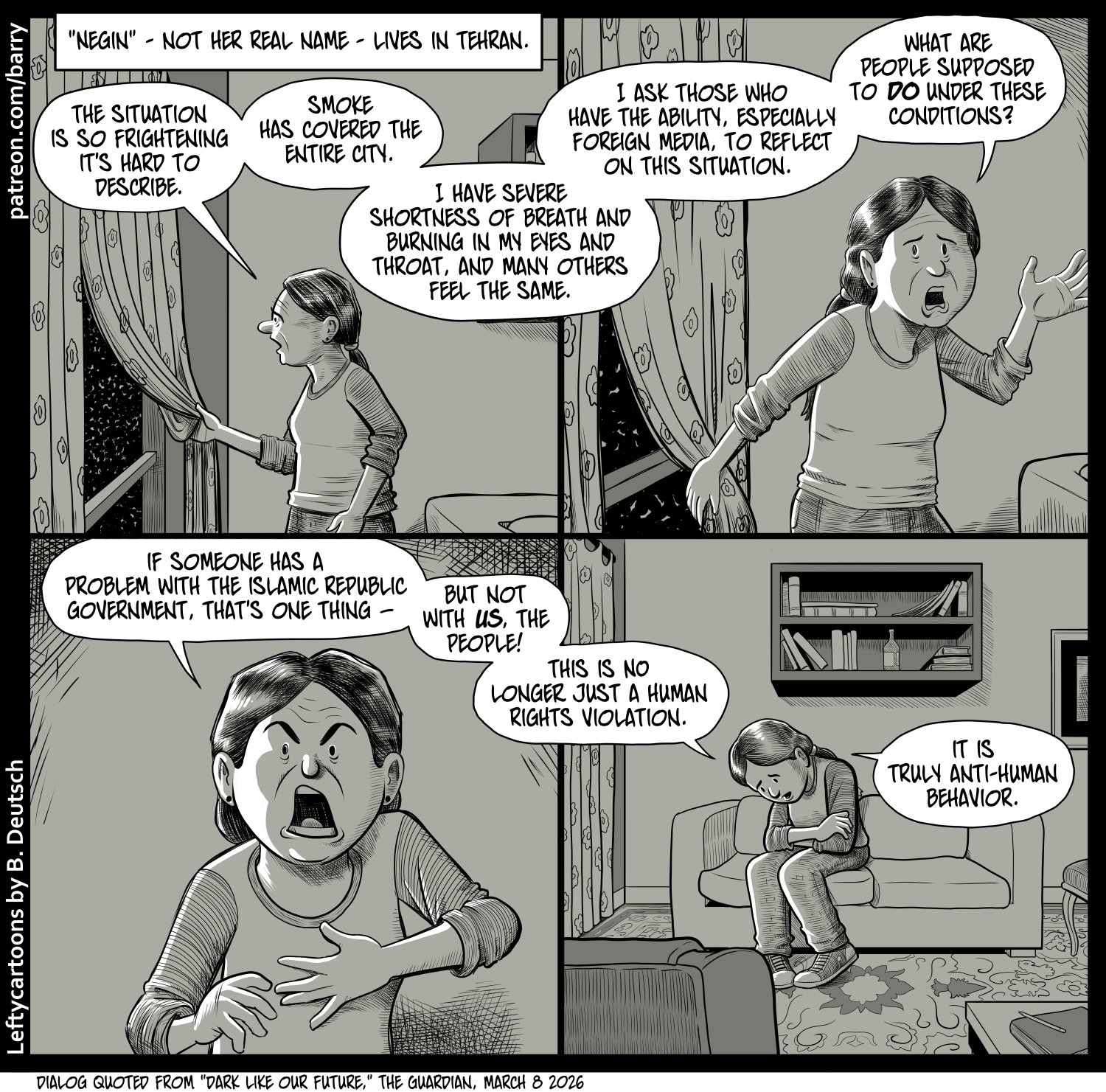
All dialog in this strip is quoted from “Dark Like Our Future” by Deepa Parent in The Guardian. From the article:
Thick black smoke was still rising in the sky, soot covered the streets and cars, balconies filled with black gunk, and the toxic air had filled the lungs as Tehran woke up after a night of airstrikes on the city’s oil depots on Sunday.
In messages and voice notes sent to the Guardian, people described the situation in their homes and on the streets, some calling it “apocalyptic”. With the sun blotted out, disoriented people in Iran’s capital had to turn on their lights to see through the gloom.
Four oil depots and a petroleum logistics site in and around Tehran were hit.
People in Tehran will be sick from this, and dying earlier from this, for years to come.
Any response to the war on Iran I could make seems so inadequate next to the enormity of the damage we’re doing – and the enormity of our leadership’s delusions.
But I still felt I should say something. “Theresa’s Daughter” wrote:
It’s easy to feel like our voices don’t matter. That without thousands or millions of followers, without a blue checkmark next to our names, what we say won’t change anything. But that’s exactly what people in power want us to believe. They want us to think we’re too small to make a difference. They want us to forget that history isn’t just something in books — it’s being written right now. And if we stay silent, they get to write it however they choose.
Our leadership seems completely indifferent to the suffering they cause. Talking about the sinking of an unarmed Iranian military ship, in which over a hundred people died, President Trump said that no effort was made to capture the ship because “It’s more fun to sink them.”
I read Daniel Larison’s post “The Poisoning of Tehran,” in which he quoted “Nagin” extensively. (The Guardian described Negin as “an activist and former political prisoner.”) I decided I should do a cartoon amplifying Negin’s voice. Obviously, the amplification I can provide is trivial, compared to a huge outlet like The Guardian or a well-known writer like Larison – but we all do what we can with the tools we have, right?
This obviously isn’t the usual sort of strip I do, so I’m interested in what people think. Was this good? Or a misstep?
TRANSCRIPT OF CARTOON
This cartoon has four panels, all showing a woman in her thirties in a modest but nice apartment.
PANEL 1
The woman pulls back a curtain, looking at the darkness outside.
CAPTION: “Negin” – not her real name – lives in Tehran.
NEGIN: The situation is so frightening it’s hard to describe. Smoke has covered the city. I have severe shortness of breath and burning in my eyes and throat, and many others feel the same.
PANEL 2
Negin turns away from the window and speaks directly to us.
NEGIN: I ask those who have the ability, especially foreign media, to reflect on this situation. What are people supposed to do under these conditions?
PANEL 3
Negin speaks angrily.
NEGIN: If someone has a problem with the Islamic Republic government, that’s one thing – But not with us, the people! This is no longer just a human rights violation.
PANEL 4
Negin sits on the sofa, slumping and looking down.
NEGIN: It is truly anti-human behavior.
A footnote below the cartoon says “Dialog quoted from “Dark Like Our Future,” The Guardian, march 8 2026.”




> “This obviously isn’t the usual sort of strip I do, so I’m interested in what people think. Was this good? Or a misstep?”
If by “good,” you simply mean an accurate depiction of how most non-political civilians of a country feel when the consequences of their government’s involvement in a war reach the homefront — like Southerners felt when Sherman reached Atlanta, like the Germans and the Japanese felt when U.S. military might struck their city — your cartoon is right on (“Not my fault, so why am I being punished?”).
I don’t see it as a big moral issue — that’s just the way war works.
Dreidel
Yes, who could possibly see war as a “big moral issue” :rollseyes:
With this comment — “the consequences of their government’s involvement in a war reach the homefront” — Dreidel seems to be implying that Iran did something to cause Trump to attack the country. Can he explain what that is?
Because there’s a real difference between Sherman attacking the South (a region that went to war against its own government, for the right to continue enslaving people) and Iran being attacked by Trump because Trump’s approval ratings were in the toilet.
(I know Trump has given various explanations — he “had a feeling,” which US Intelligence does not support, that Iran was going to attack the US; or he “had a feeling” that Iran was going to acquire a nuclear weapon (weapons of mass destruction?) — but in fact this looks like a Hail Mary pass to stave off a massive GOP defeat in the midterms.)
That’s the way war works. That’s why it should be a last resort, not something that you do because some demented wannabe dictator has a feeling. Hundreds of children have died already. How many more need to die because Trump wanted to distract people from his multiple other horrors and raise oil prices to help Putin’s economy?
Iran has done some shitty stuff, there’s no doubt about it. Mostly to its own citizens, and secondarily to its neighbours, and only at a distant remove to countries in the West and the USA (Argentina has suffered more at Iran’s hands than the USA has, for the record). But in international law a preemptive war can only be justified when there’s an imminent threat. Although the language is contested, and I am sure Trump and his minions not only have zero interest in international law but an active contempt for it, I have seen plenty of commentators claiming this war was justified because Iran was about to develop nuclear weapons. There’s a great deal of evidence that this is in fact not the case, not least Trump’s own claim last year that Iranian nuclear weapons were “obliterated” in June. But even if we steelman the argument, just owning a nuclear bomb, as grave as it is, isn’t an “imminent threat” under any reasonable definition of the war. Just possessing a weapon, even a very deadly weapon, isn’t in itself threatening. Even possessing a weapon when the owner has a history of violent behaviour isn’t itself an imminent threat – it might be a concern, or a worry, or even a potential threat, but this is all short of the threshhold required to justify preemptive war.
The “preemptive war” doctrine is merely meant to intend that somebody who is about to be attacked isn’t required by law to sit passively and wait as armies or missiles bear down on them, before taking action. If Trump (or anybody else) had clear evidence that Iran was actually preparing to launch a nuclear weapon, then attacking them first would be legal. But even then it would only be justified to the extent that is necessary to end the threat. I don’t see how blowing up power stations in Teheran stops Iran’s putative development, let alone deployment, of nuclear weapons.
But I know that I’ve already given more thought to this than anybody inside the White House has. In a sense there’s no point talking about international law, or even morality, because Trump has done us the favour of demonstrating very clearly that he doesn’t believe any constraints, legal or moral, apply to the exercise of American power. The pursuit of American national interests, no matter how destructive or violence to the rest of the world, is seen as an untramelled good.
If Iran had a nuclear bomb, the US would leave it alone. Consider North Korea or, conversely, Ukraine. So I’m sure that they were/are working on developing and/or buying a bomb. It’s the only way to have any security against the US.
They certainly were working on one at some point, I don’t think anybody doubts that. What I doubt is that it was anywhere near complete, let alone weaponised, let alone ready for an actual detonation two weeks ago. Or in June 2025, for that matter.
Hell, the Shah was trying to develop Iranian nuclear weapons, despite being a pro-American ruler who presumably wasn’t worried about an American invasion. Under both regimes Iran has always aspired to be a regional power, and obviously nukes go a long way towards that. Sadly.
No, we have not barely stopped Iran from getting nukes by bombing them multiple times. That’s a right wing fantasy. If nothing else, do we really have that good of intelligence to be able to know just the perfect dramatic moment and the perfect place to bomb to stop them from developing nukes?
Nonetheless, if I were the dictator of a minor power somewhere–anywhere–in the world, I’d want a nuke. Not to use, but to keep the US from bombing my country at random moments. (The leaders of Iran, I fear, do in fact want to have nukes to use or at least threaten their neighbors with. I’m not saying that it would be good for the world or even Iran to have nukes, but I totally understand why they would want them. Unfortuantely.)
“No, we have not barely stopped Iran from getting nukes by bombing them multiple times. ”
I’m not sure if this is a response to a claim you think I made, but just in case – I don’t think this is the case.
It’s not a good thing for the region or the world for Iran to have nukes, but to my mind the best solution is containment, not eradication. Let them have their boutique selection of nukes but let them realise that if they use them, there will be consequences that outweigh whatever benefit they might hope to get. This works for North Korea, so it’d work for Iran too.
“They certainly were working on one at some point, I don’t think anybody doubts that…” But not for many years. That hasn’t stopped numerous US presidents, not to mention pundits, from claiming that they were doing so. Obama claimed that Iran had a “nuclear weapons program” during his first campaign, but he was lying. Later he just said “nuclear program,” with “weapons” implied; he was still lying. His successors did the same.
Another misleading bit of rhetoric I’ve been hearing is that Iranians have suffered “47 years of oppression.” The number is more like 72 years, since the US and the UK overthrew an elected government and replaced it with a murderous dictatorship, but it wouldn’t do to mention that. The Shah’s secret police, SAVAK, was trained by Israel. But that was okay, because it meant that Iran was part of the “Free World.” The US has never been concerned about the well-being or freedom of the Iranian people, and whenever someone talks about “47 years of oppression,” you know you’re listening to someone who doesn’t care about them.
“The number is more like 72 years, since the US and the UK overthrew an elected government and replaced it with a murderous dictatorship, but it wouldn’t do to mention that. ”
That implies that Iranians didn’t experience oppression before 1953, when they were jointly occupied by the USSR and the UK during WW2, or during the interwar era when a military officer seized power and proclaimed himself Shah, or before that when the country was governed by warlords, or before that when it was invaded by Russia… etc etc etc. Iran hasn’t had much experience of democracy.
Even the Mossadeqh era wasn’t quite as democratic as it’s sometimes made out to be by apologists for the 1979 revolution – Mossadeqh was a nationalist, which is what made the USA and the UK angry at him, but it’s not clear he was truly a democrat. In 1952, a year before he was deposed, he managed to get Parliament to grant him “temporary” powers to rule by decree without reference to constitutional checks.
Really it’s centuries of oppression, with some brief semi-democratic interludes.
@Watcher: I meant that as agreement to your statement, “What I doubt is that it was anywhere near complete, let alone weaponised, let alone ready for an actual detonation two weeks ago. Or in June 2025, for that matter.” Sorry for being confusing!
Oh! Well then, thank you for clarifying, and sorry to be a bit defensive.
“Was this good? Or a misstep?”
This was you doing what you can with the tools you have.
Dreidel: “I don’t see it as a big moral issue — that’s just the way war works.”
Whether or not one thinks it was worth the cost, the US civil war did achieve something good – the end of slavery in the US. Likewise the attacks on Germany and Japan brought a catastrophic world war to an end, and ushered in an era of relative peace for most of the world which has lasted to this day.
What do you think Trump’s war has or will achieve?
Because I predict one of two outcomes.
Either the regime will survive, rebuild its offensive capability, and carry on aggressing against its neighbors as before.
Or it will fall, resulting in utter chaos in the country for years or decades, and possibly allowing Islamic State or some equally bad actor to gain control.
This is what happened when the US intervened in Lebanon, in Iraq, in Libya, in Afganistan. How many times must chaos be the result before people realise that chaos is the intent?
@daran: I get where you are coming from. But – and call me an idealist – I don’t think that the fall of dictatorships inevitably results in chaos. That is the dictator’s own logic that they use to justify being a dictator – apres moi, le deluge – and I am not comfortable just accepting it as a universal truth, because it means accepting dictatorships as an inevitable fact of life, and I don’t want to do that.
Watcher, dictatorships can and do fall, and there are even examples of dictatorships peacefully transitioning to democracies, no chaos required.
But as Daran points out, US interventions in the middle-east have a shitty track record – and, frankly, they were all run by more competent administrations than this one. (Low bar.) We don’t have to believe that dictatorships are an inevitable fact of life to believe that the current policy is a shitshow that has very little chance of leading anywhere good.
Even if we modify this theory with “in the Middle East”, I’m still uncomfortable with it. Yes I’ve heard this theory – that the correct path to transition from dictatorship to democracy (in the Middle East, if you prefer) is self-contained, with no intervention from the West, and that chaos only comes when the West (or the USA specifically) dips its wick in.
The problem is when the transition begins, as we saw in Egypt, Syria, Libya etc, and have to some degree seen in Iran, the people trying to bring down the dictatorship don’t usually seem to subscribe to this theory of Western intervention as toxic. They openly and actively call for the West to get involved, usually militarily. It’s hard to look a democracy activist in the eye and say “Hey, I really want you to succeed, but I think if I helped you out, it would mean chaos”. Especially when the person on the ground, with the most skin in the game and the most knowledge, doesn’t agree with you. And especially as the anti-democratic forces rack up kills and atrocities, and you in the West do nothing, out of belief that the help that the suffering people are begging for will actually hurt them.
Just to clarify, Watcher, what is it you think the US and Israel should do?
Are you saying that what the US and Israel has done so far is a policy you approve of? (I suspect your answer is “no” but don’t want to assume.)
Or are you calling for a “boots on the ground” approach?
Or for (as an Iranian living in the US, interviewed by the BBC, called for) “targeted strikes aimed at state infrastructure and key leaders rather than civilians?” That’s the best option of the military options I’ve seen, imo, and in theory I’d favor that, given that many Iranians clearly want that, and given how dire the situation in Iran is.
But pragmatically, I don’t trust Trump and Bibi to be that disciplined or limited in their approach, and they haven’t been so far. (Also, although I’m sure they exist somewhere, I haven’t seen any Iranian calling for US and Israeli military intervention. A lot of Iranians – including Iranians who are anti-antisemitism – seem to loathe Israel).
***
1) Your argument seems like the “do something!” school of thought, which treats the horribleness of any reign as by itself making military attacks obligatory if we want to be moral.
The problem is, that treats the US (and in this case Israeli) military like a magic wand that can solve any problem, ignoring the fact that history indicates that the military is actually more like a flamethrower. It is not precise, and historically (not only in the middle east) it’s been a terrible tool for positive regime change. The Iranian despotism is genuinely evil, but that doesn’t mean the US actually is able to replace it without making things worse.
2) Military intervention isn’t the only possible intervention. The choice you present between “invade with the military or be heartless and do ‘no intervention’ ” is a false choice. Admittedly, diplomatic and other non-military interventions aren’t guaranteed to succeed – but neither are military interventions. There is no intervention that is guaranteed to succeed, but there are some interventions that are less likely to make things even worse, and we’re ignoring them.
For example, I’ve seeing a lot of Iranians (see the #DigitalBlackOutIran hashtag on various social media) calling for the US to restore internet access to Iran, to allow Iranians to communicate more effectively with each other and with the outside. I’ve seen people claim that this can be done with satellites using direct-to-cell technology, and it should be done – but as far as I can, the US isn’t even trying.
3) I don’t really know what is to be done.
@Watcher, I don’t have much to add to what Amersand has already said, but to be clear: I don’t think the fall of dictatorships inevitably results in chaos, nor do I think that chaos only comes when the USA dips its wick in. I do think that when the USA dips its wick, and a regime falls as a result, then the consequence is inevitably chaos.
And just to be clear, I don’t think the UK is any more benign that the US. It’s just that the UK doesn’t do a whole lot of wick-dipping on its own these days.
And yes, I would look an Iranian democracy activist in the eye and say this.
I think that there’s a cultural difference between the left and the right where the right tends to appreciate a more decisive action, and the left tends to appreciate a more measured response. I think both sides might even like that characterization. The problem is often in how that manifests at the extreme, where the right acts out half cocked, and the left gets paralyzed by indecision, letting perfect be the enemy of the good. I think both sides wouldn’t appreciate the characterization.
I’m going to focus on the latter because I think we’ve done a great job articulating how the former has impacted this situation.
I think it’s obvious that at some point we crossed a threshold to where someone did ought to have done something in Iran. It’s possible (unlikely, but possible, using the most favorable numbers for each, at the very least it’s not incomparable) that more civilians were killed by the Iranian regime in the 2026 protests than by the Israeli regime in Gaza. But it sounds like no one is sure on exactly what “something” should have been. Waiting for a perfect bloodless outcome amounts to the paralysis I was talking about… I don’t think it’s likely that there was going to be a bloodless way to overthrow the Ayatollah, particularly since tens of thousands of people were already dead.
I think this can be understood as a modified trolley exercise: If America did nothing, tens of thousands of people were going to die as their violent leadership cracked down on their protests. If America does something, tens of thousands of people are going to die in the conflict, but perhaps there’s a better chance of regime change to something the people of Iran might actually like. Do we pull that lever?
And I think that’s the sticking point for a lot of people who can’t articulate granular examples of the reason why they’re outraged (even if the commentariat here could)… It’s not the way the lever was pulled, it’s that the lever was pulled. And now, because America is an active participant, because that lever was pulled, there’s a responsibility for the outcome that you wouldn’t have had if America had instead allowed the Iranian regime to continue to kill their own people en masse.
As a complete non-participant… I’m not sure this wasn’t the right thing to do, and I’m hopeful that the world is better for it at the other end.
I also think that
Is a little naïve. Technically completely true: Of course there’s a spectrum of possible interactions and interventions, and none of them are guaranteed to fail or succeed. But some avenues are probably more likely to succeed than others, and if one were pushed to articulate what the non-violent options might look like, one might feel a little bit foolish in the exercise, particularly against the backdrop of who the Ayatollah was, what he’d done, what he was actively doing, and America’s history of non-violent intervention attempts. I mean…. Really? Sanctions? Again? Or were we going to send in diplomats? Pallets of cash? I think realistically, even if we wanted to argue against the specific actions taken, the only effective avenues were going to be some level of kinetic.
This discussion of the downfall of the Islamic Republic and the creation of whatever will take its place, does not take into account the fact that Iran’s government has spent years preparing for just this eventuality, in terms both of a strategy for how to wage an asymmetrical war and a process for decentralizing power so that the death of any one person in the government, including the Supreme Leaders, will not lead to the implosion of the entire structure. It also does not take into account the fact that there does not seem to be an organized opposition that is ready to step into power should the Islamic Republic fall. I know there’s a lot of talk about Reza Pahlavi, but the situation surrounding him is far from simple and far too complex for me to go into in a blog comment. It’s clear to me that neither Trump nor Netanyahu had any concrete plan to realize regime change, which only increases the likelihood of the Islamic Republic’s survival. Oh, and about nuclear weapons, Mojtaba Khamenei, the new Supreme Leader has issued a statement—and whether he actually said this or it’s in his name—to the effect that his father was the one who, for religious reasons kept Iran from developing a nuclear weapon. Whether you believe him or not about his father’s position, this signals that Iran, at the very least, no longer feels bound even to pretend they are not headed in that direction.
I am no fan of the Islamic Republic, but it seems to me that they have outmaneuvered Israel and the United States strategically in a lot of ways, even though, in the end, there is little chance that they will be able to declare anything resembling a conventional victory. Was some kind of military intervention necessary, especially after January? I don’t know. Maybe. But on whose terms? No one intervenes in that way for purely humanitarian, altruistic reasons, and while I know there were people in Iran calling for some kind of intervention, did they really mean the kind they got? That’s also hard to answer, especially since it’s so difficult to get any word in or our of Iran.
I see the point, and I don’t think it’s unreasonable, but I disagree. I think it pays to remember that governments are made out of people, and I doubt very much that the people making up the government of Iran meant to maneuver themselves into being killed. I think their calculus was to make their deaths irrelevant on the idea that their regime was a bunch of replaceable cogs. But this isn’t necessarily a situation where it doesn’t matter how many heads you cut off because three more will take their places, Iran is in a unique situation where the native Syrian people are so opposed to their government, the Muslim occupiers, that I think there is a better chance of this succeeding than in many other nations where something like this has been attempted before. There are a finite number of people in the regime because they aren’t going to be replaced from the populace.
I’m not saying it’s going to happen, I’m not saying there weren’t going to be more effective ways to implement this. I don’t even know what level of likeliness this has to succeed, I just don’t think history is a good guide for this specific situation. And I’m cautiously optimistic. Again… The status quo was abhorrent.
I do think you’re absolutely right in that we’ll see what the people of Iran say after the internet is restored, and that will colour how we view this going forward.
Corso:
I think the leaders of Iran knew very well, though, that Israel—and perhaps the United States as well—wanted them dead and that, given how deeply Israel had already infiltrated the country, that they could be targeted at any moment. In other words, I don’t think that they maneuvered themselves into being killed, but that they understood the likelihood of it. I also think it underestimates the Iranians to say that they thought of their “regime [as] a bunch of replaceable cogs.” The distributed, decentralized structure of the Islamic Republic is built into their constitution, into the very purpose of the Islamic Revolutionary Guard, which is to protect the regime, not be loyal to one person or persons. Is there corruption there? Sure. Are the people in power in Iran people, with all their flaws and self-interests, etc? Sure. Will the Islamic Republic eventually fall apart if the US and Israel keep at it long enough? Sure. My point is simply that the system over there was built, strategically built, to withstand this kind of attack and that we need to weigh the ultimate cost of that success, because it is already much more than Trump (and probably Netanyahu) bargained for, against what that success will look like and whether or not it will truly benefit the Iranian people.
I am also intrigued by this statement:
First, I assume you meant Iranian, not Syrian. More than that, though, I would like to understand more fully what you mean by this. This is my confusion: The Muslim conquest happened in the 7th century CE. It seems odd, at this point, 13 or 14 centuries after the fact, to call them occupiers. And I wonder whom you mean by the “native Iranians” who stand in opposition to these occupiers? I’ll wait for you to answer, if you choose to, before I say more because I don’t want unintentionally to put words in your mouth.
Persian, not Syrian. I can’t even blame that on spellcheck. The difference I was trying, poorly, to articulate is the difference between the kind of Muslims the Iranians were pre and post the 1979 Islamic revolution. I’m not saying that the Shah was unambiguously good, but I will say the Ayatollahs have been unambiguously worse, and whatever legitimacy for a mandate they had during the revolution is dead, buried and salted. Unlike the Palestianians, who are more than willing to encourage their young men into the meat grinder, the moderate majority of Iranians, particularly the generation that remembers what it was like to have women in bathing suits at beaches, are not. There is a finite number of regimists, regardless of what their constitution says.
I don’t think that’s quite right. The point that this is more than what Trump or Netanyahu bargained for. Netanyahu at the very least seems like an intelligent and pragmatic person, regardless of what you think of his ideology. The idea that he wasn’t aware of the makeup of the Iranian regime is belied by how good he is at killing them. Assume that he knew it would be difficult, but that he thought it was the right thing to do anyway. For Trump… I don’t know how his head works. But I don’t think many of his advisors would be surprised by how this has played out, there are many competent thinkers in the DOW. What have the surprises been? I feel like this has all played out very obviously.
I think the entire world has a vested interest in removing the regime, and that the case for that is obvious. That removing the regime could also benefit the people of Iran is a happy coincidence, but that case is also obvious. What I’m not sure of is how heavily the will of the Iranian people matters…. Were they fully supportive of the regime, was Israel and America going to continue to allow Iran to fund terrorism the world over? I think if we’re going to be honest about this, the Iranian people’s desire for regime change probably enabled America and Israel to do what they’ve wanted to do for a very long time.
The question is whether this is going to be effective, and what comes next. Is there a new revolution? Is it successful? What does the new regime look like? I don’t know. But like I said earlier: The status quo was intolerable, and I don’t think that there were many reasonable alternatives that had a significantly better chance for success. If someone wants to articulate something, I’m all ears, but I think we have to wait and see how this plays out.
Kudos to Richard for, nice as pie, lending the rope here, is all I will say.
“But perhaps there’s a better chance of regime change…”
I’m sure that in 2011, there were people were giving advice like this to President Obama. No one in power in 2011 was worried enough about the possibility that attacking Libya and getting rid of Gaddafi would make things much worse. People were making the same “we have to protect civilians, you cowards!” argument that you are. People who said that attacking Libya had a significant chance of destabilizing the whole region were not taken seriously by the people in power.
Fifteen years later, are the civilians in Libya better off?
How about the civilians in neighboring countries?
To be an accurate analogy, the trolly exercise should be modified to have a third possible outcome, which is: Hundreds of thousands more people die than would have if we hadn’t yanked the lever.
Many, many more people die, the people of Iran are not freed, world oil and food shocks mean that hundreds of thousands more people die worldwide. Millions of Iranian refugees pour into surrounding countries, a refugee crisis that could last decades. If the Iranian regime actually falls, dozens of different actors will attempt to get control of Iran’s weaponry, with regional effects that could last years or decades.
(More reading: The Iran War’s Terrible Effects | 5 Places Where the Iran War Could Get Worse.)
Yes, this is speculative – as is your belief that everything in Iran is likely to turn out swell. We don’t know what’s going to happen – but frankly, disaster and things being made worse, not just in Iran but in many countries, is much more likely than what you think will happen.
Obama was much more competent than Trump is, and that didn’t stop him from being a stupid asshole about Libya in ways that have made hundreds of thousands of lives worse. (Arguably the same is true of Bill Clinton and Somalia. And let’s not forget “Mission Accomplished.”).
Even in the best of circumstances, with a smarter administration, with full assistance from NATO, the chances of pulling off a humanitarian regime change is very low. With a staggeringly incompetent Trump and his lackies in charge, and other world powers staying the hell away because they can see the disaster coming, the chances are dismal.
Corso, what’s your paradigm for a case in which U.S. military intervention worked to bring about our humanitarian aims?
“Just to clarify, Watcher, what is it you think the US and Israel should do?”
I think Israel should disband itself and hand its so-called land back to the Palestinian state. But I suspect that’s not what you are really asking.
I don’t really have a specific prescription for this situation. I feel torn. I can’t really subscribe to the school of thought that intervention is obviously, tautologically, evidently wrong but I also don’t want to associate myself with the idea that it’s obviously right either. (And this goes for non-military forms of intervention too – for example, economic sanctions).
I guess I just distrust the self-assurance of people (mostly, but not all, on the left) who claim intervention is always disastrous. But I also distrust the self-assurance of people (mostly, but not all, on the right) who claim intervention is a great idea.
Ultimately I think when a situation like the current Iranian situation breaks out, the USA and the West more generally will have dirty hands regardless of what action they take – or do not take. Intervention leads to moral responsibility for the outcome of the intervention. But conscious non-intervention – as we saw in Bosnia and Rwanda – leads to moral responsibility for inaction in the face of atrocities. The West in general, and the USA in particular, a still villified for doing nothing while Tutsis and Bosnians were murdered, thirty years later.
@Kate: Probably the most clean-cut recent case is the US and NATO intervention in the Kosovo war, which stopped ethnocide in Kosovo. (Didn’t prevent it, unfortunately, but stopped it).
The Liberia intervention in 2003 is also often cited as successful, although I admit I know less about that one.
@Corso: I’m breaking my self-imposed ban on talking to you to say that I am not sure that it is true that “I think the entire world has a vested interest in removing the regime, and that the case for that is obvious. ” Iran’s main violence was against its own people. It participated as an auxiliary to civil conflicts in Syria and Iraq, and to a lesser extent Lebanon and Yemen, and to a very minor degree Ukraine, but it’s pretty clear that those conflicts would have happened without Iran sticking its oar in – at worst, Iranian involvement exacerbated them. It’s worth noting that in Iraq, one of Iran’s main roles was actually to fight against ISIS – they were temporarily an ally of convenience to the USA, although of course never side publicly declared that. (Iran’s conflict with ISIS was not at all based on principle but simply due to ISIS’ sectarian hostility to Iran’s proxies in Iraq, but still). But to the 90% of the world that is not part of the Middle East, Iran was not a threat. I’m repeating myself, but the country that Iran has done the most to harm outside the Middle East is Argentina, not anywhere in Europe or North America. The Iranian regime was violent, autocratic and repressive, and it was not often a good faith actor. But it isn’t accurate to call it some kind of global threat. I’m not even sure that, within the Middle East, it was the biggest destabilising force, although granted it’s a strong contender for that title.
@Richard: “. This is my confusion: The Muslim conquest happened in the 7th century CE. It seems odd, at this point, 13 or 14 centuries after the fact, to call them occupiers. ” A lot of right wing ethno-nationalist Western commentators tend to fetishise the pre-Islamic civilisations of the Middle East and even fantasise about them reasserting themselves, presumably as part of some ill-defined rollback of Islam. This isn’t unique to the Zoroastrians of Iran, you also hear it about the Greeks of Turkey, the Copts of Egypt, etc.
“I can’t really subscribe to the school of thought that intervention is obviously, tautologically, evidently wrong”
This is a straw man. Nobody has argued that intervention in the Middle East is tautologically or even obviously wrong. Ampersand has cited evidence of the catastrophic consequences of previous interventions in the regions. All I’m seeing from your side is wishful thinking.
“I guess I just distrust the self-assurance of people (mostly, but not all, on the left) who claim intervention is always disastrous.”
I have not claimed – nor as far as I can see, has Ampersand – that intervention is always disastrous. My claim is more limited: Since the Second World War, military intervention in the Middle East by the United States has always been a disaster for its inhabitants. Feel free to posit a counterexample.
To suggest that this intervention – by the most corrupt, malicious and incompetent US administration in history – will somehow turn out well is delusional.
“To suggest that this intervention – by the most corrupt, malicious and incompetent US administration in history – will somehow turn out well is delusional.”
Well, since we are throwing around accusations of strawmanning, I never suggested that, let alone actually said it.
Perhaps Daran got what you’d said mixed up with what Corso said?
Kate:
Depends what you want to count. Korea is probably the best example – Without the US, Pyongyang would also control South Korea, and I don’t think it takes a lot of imagination as to why that might be bad. Maybe Kuwait, following the Gulf War. Kosovo when the Serbs were ethnically cleansing the Albanians? Panama in ’89? Germany and Japan in WWII?
That last one…. Obviously America was going to counterattack after WWII, and we all know the prevailing narrative there, but less talked about is just how awful life was for the average Japanese citizen during the time before Emperor Hirohito made the humanity declaration. The Empire was in many ways just as regressive as the Ayatollah, they just worshiped themselves and had a standing military.
[…]
Albania, Australia, Bulgaria, Denmark, France, India, Kenya, Sweden, Thailand, and the United States may have something to say about that.
Iran’s danger isn’t in their direct commitment of terrorism, it’s in their financial support of it, and their propping of organizations and regimes that would have failed if not for their materiel support. Almost every major terrorist organization in operation owes some of their capability to Iranian oil money, from Hezbollah to the Houthis to Hamas to Shi’ite militias to al-Qaeda (although that last one is only alleged).
Amp:
On the likelihood of success:
I also never said that I think that it was likely.
What I said was: “[…] some avenues are probably more likely to succeed than others” and “I’m not saying it’s going to happen, I’m not saying there weren’t going to be more effective ways to implement this. I don’t even know what level of likeliness this has to succeed, I just don’t think history is a good guide for this specific situation.”
I stand by all that. For the record… I don’t think a positive outcome is more likely than not to happen, but I don’t think it’s impossible, and there’s reasons why this might turn out better than Libya.
No, Libya is not better off, but I don’t think the determining factor is the capability of the American head of state. I think the difference between operations like Libya, Somalia, Iran and Afghanistan and Japan, Korea, Kosovo and Kuwait are a confluence of two factors: Short term continuing assistance and a popular local faction willing to work with America. The latter probably being more important.
If someone with popular support stuck their neck out, and America decided to support them, then I might be willing to say that there’s a stronger likelihood of success here. But so far, I don’t think we’ve seen someone come forward, and I don’t know what America’s appetite for ongoing support is going to be.
Fair enough, I’m sorry I misunderstood you.
I think your trolley problem model – in which you didn’t seem to realize, or at least didn’t consider important enough to acknowledge, the chance that things could get worse – made me see you as perhaps more optimistic than you are.
“Really it’s centuries of oppression, with some brief semi-democratic interludes.”
As you know, the US and the UK stomped on those semi-democratic interludes because even that was too democratic for our liking. (I wonder if that’s why you called them “semi-democratic”?)
“Korea is probably the best example – Without the US, Pyongyang would also control South Korea, and I don’t think it takes a lot of imagination as to why that might be bad. Maybe Kuwait, following the Gulf War. Kosovo when the Serbs were ethnically cleansing the Albanians? Panama in ’89? Germany and Japan in WWII?”
The history of Korea is a bit more complicated than that, you know. The US and the USSR divided the peninsula at the 38th parallel, which led directly to the Korean Civil War, followed by decades of murderous dictatorship in the South. That dictatorship ended as a result of hard work by South Koreans, without foreign intervention; the US watched that change nervously, and has worked assiduously ever since to foster hostility and block reconciliation between the Koreas. While I wouldn’t have wanted Pyongyang to control the whole peninsula either, US intervention has mostly been counterproductive. We tend to respond to situations we dislike by trying to strangle the new regimes with sanctions and blockades and often overt terrorism, as in Cuba and the rest of Latin America. If our intentions had really been good, we could have done better, but our intentions weren’t good. In general I think you’re overlooking the greater fondness of the US for dictatorships in most of the world, including the Middle East, with ongoing undermining of movements toward democracy or even more open societies.
@Duncan: All that you are saying is true, but nonetheless – I think it’s correct that without UN intervention (which was mostly US troops, although not entirely) the North would probably have overrun the South in 1950, and while the fact that they didn’t didn’t mean everything was awesome in the South, it’s nonetheless a good thing that it didn’t happen.
The major qualifier to Korea as a “good” intervention is that the US drew the war out in the hope of overthrowing the North Korean regime, which turned out not to be possible, so there was a lot of wasted effort, blood, guts, etc. But I think it’s still, on balance, a good thing that the intervention happened.
” (I wonder if that’s why you called them “semi-democratic”?)”
I call them semi-democratic because even under Mossadeqh Iran had a lot of political features that would be viewed as regressive in a democracy. E.g. Mossadeqh’s ability to pass laws by decree bypassing parliament, or the Shah’s ability to veto legislation. Similarly even at the very beginning of the Revolution, when the guardianship-of-the-jurist hadn’t yet become a constitutional principle, formal democracy was still quite weak due to the power of various violent actors. And the transition from semi-democracy during the early revolution to non-democracy during the mid-to-late revolution cannot really be put on the USA, let alone the UK – I don’t think anybody believes the USA was maneuvering the Clerics into power in 1979-1980.
But I don’t think the USA and UK necessarily intervene -because- of democracy. The UK removed the Qajari dynasty and replaced it with the Pahlavi dynasty despite the Qajaris being steadfastly autocratic.
I agree that the role of the USA and UK (and Russia, if we’re looking far enough back) in Iran has been almost entirely negative. I just don’t want to create a countermyth where the only thing standing between Iran and democracy is foreign intervention. Iranian monarchs and clerics have their own anti-democratic ideologies and dynamics that would exist even if the USA and UK and Russia had kept their hands off.
I thought I’d share some links to articles, newsletters, etc., often but not always written by Iranians:
* The Factory Was Always The Target: Provides historical context for yesterday’s strikes against Iranian steel plants.
* Mina’s Substack: Political and historical analysis of the dynamic within Iran
* These Things Are True: Provides translations of what Iranians are writing within Iran about the war and related issues. It opens a window those of who don’t read Persian would not otherwise have.
* The Iranist: I don’t have much to say about this, since I just subscribed, but I subscribed because it seemed worth checking out.
* The Guarded Domains: Another newsletter by an Iranian who translates into English what people in Iran are writing.
* IranAnalytica
The list obviously reflects in some ways my own biases. Still, I offer it not because I agree with everything I read on these sites, but because I think it’s important to remember that there is actually quite a robust discussion going on in Iran and among Iranians about the war, about what they think should happen after the war, about the Islamic Republic, and more, that both the internet blackout the Islamic Republic has imposed and the fact that it’s taking place in Persian make it difficult for us in the US, and in the West in general, to know about.
@Watcher: “A lot of right wing ethno-nationalist Western commentators tend to fetishise the pre-Islamic civilisations of the Middle East and even fantasise about them reasserting themselves, presumably as part of some ill-defined rollback of Islam. This isn’t unique to the Zoroastrians of Iran, you also hear it about the Greeks of Turkey, the Copts of Egypt, etc.” That’s a new one on me. Thanks for telling me about it.
Thanks for the links, Richard. I read some of “These Things Are True” after you linked it in your newsletter, and was really struck by it; I’ll check out the other links.
Watcher:
bolding added.
Me:
Watcher:
You did not, and I apologise. The fragment of your post I quoted omitted the bold portion, which forecloses this interpretation, but even without it, it was unwarranted.