Vida’s 2011 Count is Up…

…and the results are not much different from last year. Women are still profoundly under represented in literary magazine publishing. This is not surprising, since as Erin Belieu writes:

[W]e know that significant cultural change takes time.

We also know that this is a conversation that’s not going away; when we talk to other writers, when we talk to our writing students, we know things are in the process of changing for the better, that our literary culture’s consciousness has been raised. And we believe we’ve begun to see hopeful signs. Yes, many literary outlets still produced their phallocentric Best Books list this year. But notice how careful most of them were to create some context for their lists’ inherent subjectivity.  The word “Best” now has a permanent asterisk next to it, no matter where you line up in our writing community’s gender debate. And to acknowledge your bias is one step toward opening your mind. We’ve come a long way since Publishers’ Weekly breezily dismissed the total absence of women in their top ten list of 2009.

I wrote about why the count matters to me personally in this post, and I am happy and humbled (really) that Vida published a couple of quotes from it with their charts.

Cross posted on It’s All Connected.

Posted in Writing | Comments Off on Vida’s 2011 Count is Up…

A Short Story for Today

If you have not yet had the opportunity to read Amanda Ching’s marvelous dystopian short story “ILU-486,” you need to clear ten minutes and do so. Now. A brief excerpt:

Rachel Saunders had three kids and two bedrooms. Both boys were fast asleep in the bigger one, and her oldest, Peyton, was bedded down in the other room. Rachel had given up a bedroom when Peyton had turned thirteen, and now she used the couch out in the living/dining room. Right now she sat in the kitchen window and stared out at the fire escape.

She’d gotten home about an hour ago, had a shower, checked to make sure the kids weren’t dead, and then paid a few bills. She watched about fifteen minutes of the newest report on the congressional hearing about the gallows proposal.

Rachel wasn’t sure what she thought of the gallows. It wasn’t like they didn’t already have the death penalty. And this seemed barbaric and horrible, displaying bodies for everyone to see. Wasn’t that something they used to do in the middle ages?

Senator Collux had appeared on the screen arguing for the gallows. “There’s a reason this technique has been around since time immemorial,” Senator Collux said, waving a hand.“In all of the states where it’s been initiated—Utah, Texas, South Carolina, Iowa—it’s been directly linked to a downturn in contraceptive smuggling and illegal abortion. If this is what it takes to preserve the lives of innocent Virginians who don’t have the opportunity to defend themselves, then I am all for it. And if it provides solace to the victims of other violent crimes, that’s even better.”

He used the example of the man who had raped and killed fifteen nuns with a ball peen hammer last year. He’d confessed. When they’d found the man, he’d been wearing a wimple with the nun’s face skin still in it. If there was anyone in this universe that deserved the public’s ire, it was this man. This monster, Collux argued, deserved to be humanely executed and displayed on the gallows for everyone to see. But only for three weeks. Any longer was in danger of spreading pestilence.

Rachel shrugged and turned the television off. Then she stared at the fire escape, biting all of her cuticles into ragged bleeding tears.

She was worried because she’d taken three large white pills a day ago, and while she was clotting and cramping and the like, if she didn’t get taken care of soon, she was going to have to explain the miscarriage to the police. They would find out. She didn’t know how they did, but she was already on warning. Sally swore they had detectors in the sewer pipes, but that sounded ridiculous.

The instructions said to wait. Don’t pack a bag. Don’t tell anyone. Don’t plan for childcare. Nothing bad will happen. Just wait. Pretend nothing is amiss. We come to you.

There was more, of course. She understood that she had taken mifepristone, and that if she hadn’t yet miscarried, then she’d need the second drug. More importantly, she needed to get rid of the evidence. Terminating a fetus in any way was a crime, even if it was an accident. According to the cop she saw last time, there were no accidents, only what he called “accidents”, with finger quotes.

Rachel hadn’t been sure what he had meant by that. What she did know was that she had three kids, a bad job, and an ex-boyfriend who’d thought condoms were the devil. He’d said that once, that condoms were the devil, and when she had laughed at him, he’d smacked her one across the face. She might have been happy, or at least okay with marrying him for the added income until that had happened. Then three days later, the bruise still fresh on her face, she’d taken the test, seen the pink lines, and thanked god she hadn’t used the local clinic for the free pregnancy test. Sure it was free, but the moment it was positive, you were entered in the free natal care monitoring system.

She’d done what she’d heard whispered about at work in the diner, put a red kerchief on her window sill and closed the sash, just letting it hang there, and after about three days she’d noticed it was gone. In its place was a little flowerpot with a little violet sitting precariously on the ledge. She’d found the packet with the pills and the paper inside the dirt, under the roots, and almost wept with relief.

Now, she waited for something to happen. Maybe the cops would come. Maybe it was all a set-up. Her kids slept on. She could hear her upstairs neighbor kick on his video game machine and load some game with a lot of machine guns.

There was a knock at her door, and Rachel felt her heart almost stutter. She plodded to the door. Maybe she could just ignore it and it would all go away. She was in the process of reaching for the doorknob when she was seized with a cramp and she had to freeze, suck in a breath. No, there was no going back, not since she’d swallowed a few pills the day before.

She swung the door open and was grabbed by the arms before she could even say anything.

“This won’t take long,” someone hissed in her ear. “We love you. Every part of you belongs to you.”

Posted in Abortion & reproductive rights, Fiction | 11 Comments

Congrats to Mandolin for Yet Another Nebula Award Nomination!

Mandolin’s story “Fields of Gold,” which is sadly not available online but was published in this year’s Eclipse anthology, has been nominated for a Nebula award, in the “Novelette” category.

You can read “Fields of Gold” online here. (It’s a pdf file.)

As I’m sure you’ll recall, last year Mandolin won a Nebula for her novella “The Lady Who Plucked Red Flowers beneath the Queen’s Window,” making her one of the youngest ever Nebula winners.

Yay Mandolin!

Posted in Mandolin's fiction & poems | 16 Comments

Ten Responses To The Phrase “Man Up”

I loved this video of Guante performing:

A transcript of the video is available on Guante’s website.

Posted in crossposted on TADA, Men and masculinity | 12 Comments

Rachel Swirsky’s Reflections on 2012 Online (Jan 1 – Feb 15)

Hey y’all!

I just finished reading the stories from the first six weeks of the year on all the online venues that I plan to frequent. I haven’t finished reading Asimov’s and Interzone yet, but that’ll have to wait a bit.

I looked at 38 stories from Apex, Beneath Ceaseless Skies, Clarkesworld, Giganotosaurus, Lightspeed, Strange Horizons, Subterranean, and Tor.com.

MY FAVORITE:

Aftermath” by Joy Kennedy-O’Neill (Strange Horizons) – This extremely affecting story features zombies–which you’re probably sick of (I am)–but it looks at them through the lends of reconciliation. How do people move on after a civil war, an apartheid, a genocide, a zombie attack–where neighbors kill each other and subsequently have to live side by side? The emotional and character work here is very skillful. I found it hard to read; it made me cry.

HIGHLY RECOMMENDED:

Calibrated Allies” by Marissa Lingen (Beneath Ceaseless Skies) – An intricately plotted story about what happens when a free man from an enslaved culture (equivalent to our Carribean) goes to the Fatherland to study automata and encounters a rebellion instead. This one didn’t get me emotionally, although the character work is done well enough and I did like him, but it’s intellectually engaging and an interesting story qua story.

All the Flavors” by Ken Liu (Giganotosaurus) – Ken Liu’s novella follows the story of a little girl in post-civil-war Idaho City as she encounters a group of Chinese gold miners and learns their stories. The story starts flipping perspective midway through. Honestly, this story is a total mess. It’s not a novella; it’s notes for a novel. The beginning is structurally sound; as it progresses, it fails to sustain itself, and eventually sort of decays into little bits, ends abruptly, and then has an author’s note. But that does’t really matter–it’s notes for a *really cool* novel. The scenes that are fully realized are done extremely well, balancing character and plot perfectly. This could be a really good historical lit novel (it reminds me a bit of Geling Yan’s The Lost Daughter of Happiness) and/or a really good science fictional novel that’s heavier on the characterization than the genre elements (Maureen McHugh’s China Mountain Zhang, Will McIntosh’s Soft Apocalypse).

Swift, Brutal Retaliation” by Meghan McCarron (Tor.com) – Two little girls must figure out how to cope with their brother’s recent death when he begins to haunt them as they embark on a prank war. This story is exquisitely well-written in terms of prose and character detail with the kind of really intensely well-described, mundane detail about how people (especially children) think that I’ve come to associate with Meghan McCarron’s work. The characters are keenly observed and tenderly treated. The haunting at the story’s center throws everything into high emotional relief.

Bear in Contradicting Landscape” by David J. Schwartz (Apex Magazine) – A writer encounters one of his creations and tries to understand the newly mutable nature of his reality. I was very resistant to the premise of this story because it’s been treated so poorly in the past, but this was a treatment I found thoughtful. The metafictional elements are clever in the way they weave with the character’s confusion (is his girlfriend real or another invention?) and provide an interesting, analytical level to the story.* I was very taken by the imagery about rabbits and about tattoos. (There were three stories about intense tattoos this month and I thought this one had the most surprising and lovely imagery.) The ending didn’t really work, but it was still a satisfying story.

RECOMMENDED:

Her Words Like Hunting Vixens Spring” by Brooke Bolander (Lightspeed) – In the newly settled West, Santa Muerte leads a girl through the desert so that she can avenge her fiance’s murder victims, girls who have come back as spirit foxes. The language is tight and lilting and makes the story a pleasure to read. The imagery is very strange and the story is very unpredictable in a good way–it feels fresh.

What Everyone Remembers” by Rahul Kanakia (Clarkesworld) – In a post-apocalyptic world, a sentient cockroach-like entity that’s been genetically engineered by humans to survive in the new environment, learns about and adapts to the world. The cockroach character is written in a curious, empathetic, but not overly human way, and the story does an excellent job of rendering the world from its perspective, both in the way we see glimpses of what’s happening outside the story’s scope and in the way that the story engages the senses.

The Five Elements of the Heart Mind” by Ken Liu (Lightspeed)** – When a woman’s spaceship is destroyed, she launches an escape pod and lands on a planet that practices some elements of traditional Chinese medicine. By dint of a science fictional device, the medicine works. The science fiction idea is interesting and the story has a plot that’s interesting to read. Although there are no real surprises here (the plotline is predictable and while the biology of the science fictional element is neat, it’s not surprising in a way that makes the story unusual–someone else might have written the story exactly the same way, just with a different science fictional conceit), it’s an entertaining trad-sci-fi read.

Recognizing Gabe: un cuento de hadas” by Alberto Yanez (Strange Horizons) – A story about a trans boy growing up in a family that initially accepts his gender identity because of the intervention of his fairy godmother. This story is engaging and well-written, but what won me over was the handling of the ending.

OF NOTE:

The Chastisement of Your Peace” by Tracy Canfield (Strange Horizons)
All the Painted Stars” by Gwendolyn Clare (Clarkesworld)
In the Cold” by Kelly Jennings (Strange Horizons)
The Last Gorgon” by Rajan Khanna (Beneath Ceaseless Skies)
Seerauber” by Maria Dahvana Headley (Subterranean Online)
Mother Doesn’t Trust Us Anymore” by Patricia Russo (Giganotosaurus)

*If I were being snarky, I’d say this story manages to do in many fewer words what Helen Oyoyemi’s Mister Fox only achieved (albeit with gorgeous prose and some really beautiful moments) with massive amounts of redundancy and repetition. Well, okay, I guess I’m being snarky.

**Ken Liu, will you stop dominating every list with your awesome for like thirty seconds? Come on, dude, you’re making the rest of us look bad.

Posted in Uncategorized | 5 Comments

Why Am I a Poet?

I’m reading two books right now, Roger Rosenblatt’s Kayak Morning and Venus Khoury-Ghata’s She Says (translated by Marilyn Hacker). The first is a meditation on grief; the second, a book of poems the first section of which, “Words,” is basically a mythologization of language. Each of them, for different reasons, has thrown me back onto the question of why, when I think of myself as a writer, I think of myself as a poet. Or, perhaps a more accurate way to ask this question is this: why, when I think about writing something, my first inclination, regardless of what I want to write about, is to turn it into a poem and only after the poem or poems that I try to write fail do I even consider that another form might be a more appropriate choice. In “Words,” Khoury-Ghata writes:

          Words
blind flight in the darkness
fireflies wheeling in on themselves
pebbles in the pocket of an absentminded dead man
projectiles against the cemetery wall
they broke up into alphabets
ate a different earth     on each continent

There is something about the way writing a poem focuses my attention on words, not on content per se, but on the meaning and sound and rhythm of individual words, and how they join to create sentences that also have meaning and sound and rhythm, and how the form of a poem–whether the verse is formal or “free” (which is really just another kind of form)–shapes that meaning and sound and rhythm into a music that, in turn, both shapes and transcends the overall content that is the aggregate of these meanings and sounds and rhythms. There is something about all this, and I think Khoury-Gata has captured it in her second line, “blind flight in the darkness.” Following the forms of language for their own sake is a kind of blind flight because forms are constantly evolving and you never know where they will take you, and then to be blind in the dark, which makes the dark redundant because even if it is lifted, you would not be able to see what is in front of you–or does the line mean that it is the darkness that blinds you?

Words do blind us. At the same time, though, without words we would live in the darkness of seeing and knowing without being able to name what we see and what we know; and so darkness would also be silence, and silence, ultimately–or, rather, the ultimate silence–is death. And so words are “pebbles in the pocket of an absentminded dead man.” They do him no good. And words are “projectiles against the cemetery wall,” that with which we try to shatter the silence of death, not just in the very narrow sense of wanting our words to outlive us–and all of us, not just writers, want someone to remember who we were after we are gone, to keep alive in their own lives the words we used in ours–but also in the here and now, the conversations we have, the jokes we tell, the bargains we strike, the loves we profess, because each of those uses to which we put our words is a way of insisting, affirming, proving that both we and the people to whom we are talking are here, that we and they exist, that we are in relation to them and that this relationship is precious, crucial, the opposite–or at least an attempt to be the opposite–of a “blind flight into darkness.”

Even oppressive language, the language of the oppressor, partakes in this dynamic. I do not mean by this that oppressive language is any less unjust than it is, or that it is not often deadly, literally fatal, to those who are being oppressed, or that it should somehow be accommodated, or fought against any less strongly because it is part of this dynamic. I mean merely to acknowledge the fact that the language of oppression, in its very existence, demonstrates that the oppressor needs the oppressed, that, without the oppressed, the oppressor would not, could not, exist. I know this is not a new idea, but it’s one that I think about when I ask myself why I am a poet, because I do see my work as being in opposition to the language of oppression, and then I think, What would it mean for me as a poet if suddenly there were no oppression to oppose? On the one hand, this is a meaningless question. Oppression is not going to disappear overnight. On the other hand, though, I don’t know how to think about myself as a poet and about my relationship to language without asking it.

///

In Kayak Morning, Roger Rosenblatt writes, “All I have to keep me afloat, all I have ever had, is writing.” In the most immediate sense, he is talking about how writing has helped him deal with the death of his daughter, but he also means it more broadly, in terms of his life in general; and it is in this latter sense that I identify with him. Writing poetry quite literally saved my life. When I was college freshman, I went through a period of deep, deep depression. I remember spending hours on the phone with a friend of mine from high school, talking about how pointless my life felt, how pointless I felt. In one of those conversations, she asked me, simply, “Are you writing?” I told her no. “Maybe you should be,” she said. She was the only person in the world at that time who could’ve known to say such a thing, and so I listened to her, and I started writing again Not poems, or at least not good poems. Just ramblings that I sometimes chopped up into lines. But the ramblings, even more than talking to her, made me feel less alone, less estranged from myself–which was where my loneliness was coming from–and I felt stronger, strong enough at one point to tell my friend I loved her. It was the first time I’d ever said those words to another human being and meant them as much for myself as for the other person. It didn’t matter to me what my friend said back; it just felt good to love her, to know the feeling as love–to name it, in other words–and to name it to her as being for her. It would be some time before I wrote the poem for her that was rooted in that love, and it was a love she would eventually reject, but when she told me she loved me too at the end of that phone conversation, I knew I would survive.

And so I can think of no better answer to the question that is the title of this post except to say that poetry, more than any other genre in which I have written, has given me the strength to say what I need to survive.

Cross posted on It’s All Connected.

Posted in Writing | 1 Comment

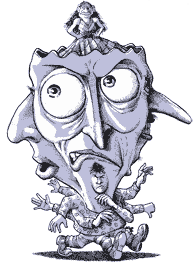
First drawing of the troll for Hereville book 2

The troll is a very fun character to ink. Especially that huge long curve under his belly; getting that line right, when I can get it right, is loads of fun. (Yes, this is what I find fun).

This shows both the rough sketch of the character on the page, and the completed drawing. (Jake hasn’t colored it yet, obviously).

Posted in Syndicated feeds | 4 Comments

“As If Married”

In the 9th Circuit’s recent Prop 8 opinion, the Court noted:

“… ‘marriage’ is the name that society gives to the relationship that matters most between two adults. A rose by any other name may smell as sweet, but to the couple desiring to enter into a lifelong committed relationship, a marriage by the name ‘registered domestic partnership’ does not.”

As someone in a legal civil union with my same-sex partner, I think about this issue a lot.

In Illinois, the state Department of Revenue is requiring same-sex couples in civil unions to file their state taxes as married. Because of the Defense of Marriage Act (DOMA), however, same-sex couples in legal civil unions cannot file their federal taxes as married; they must file as single individuals. Complicating matters, in order to complete an Illinois tax return, one has to include numbers from one’s federal return.

What this tangibly means is that people in same-sex civil unions will have to:

a) Complete and file a federal tax return as an individual;
b) Complete (but not actually file) a separate “fake” federal tax return “as if married” in order to get certain numbers to use on the Illinois return; and
c) Complete and file a state of Illinois tax return as married.

Whew!

Aside from the extra time, effort, and cost that same-sex couples in Illinois will have to go through in filing their returns this year, isn’t that phrase, “as if married,” interesting?

The Illinois Department of Revenue, in its guidance to same-sex couples, actually used the lingo “as-if-married” to describe the federal filing status of same-sex couples in legal civil unions.

Civil unions and domestic partnerships are, for some, a compromise between giving same-sex couples the rights of marriage while preserving the word marriage for man-woman couples. They are supposed to be the thing that grants same-sex couples dignity while still letting people know that marriage is for the Normal People, or for the couples who are capable of procreation, or for couples who have the genitalia of those who are capable of procreating together even if they actually can’t procreate together. Or…. something.

Yet, to me, this practical, tax-filing application of civil union/marriage law really illustrates what an absurd nod-and-a-wink “it’s marriage, but not really marriage” scheme this separate-and-unequal arrangement really is.

The marriage/civil union arrangement makes a distinction between couples based, not on actual procreative ability, but on the gender composition of the partners in the relationship. Following from that distinction, the state (but not the federal government) funnels the same rights to these “different” couples through two separate licenses: a marriage license for the man-woman couples and a civil union license for the same-sex couples (or, to man-woman couples who choose the civil union license).

In this way, is the legal status of same-sex relationships in a constant state of flux.

Sometimes they are marriages. Sometimes they are civil unions. Sometimes they are “as-if-married”-types of relationships. And, sometimes, the partners in legal civil unions are complete legal strangers, say, when state borders are crossed, when certain forms have to be filled out, or when the federal government is involved.

Yet, if one can concede that a relationship is deserving of the same state-level rights as something called by a different name, is it really coherent or justifiable to call it by a different name? (Or, to treat it differently in different states, although that’s a separate issue).

If a state granted licenses that allowed people to ride hoverboards on roadways would it make sense for the state to create two separate categories of licenses that granted the exact same rights? Imagine: The Generic Recreational License (for redheads only) and The Super FunTimes Hoverboard Permit (for everyone else). Sure, both licenses allow people to operate hoverboards and we all know that the licenses are the exact same except for the names.

But, wouldn’t people wonder why the redheads are singled out in this way? Like, why couldn’t they just call their licenses The Super Fun Times Hoverboard Permit too?

People would have legitimate reasons for asking why it had to be called something different if its legal effect was the same. People would have legitimate reasons for asking what people had against redheads. Or, saying, “if you’re concerned about safety, then actually make the license hinge on a person’s safety record rather than hair color.”

I’m sure to some it seems silly that so much fuss is being made, on both sides of the marriage issue, over “just a word.” I don’t agree with Judge Reinhardt that “marriage” is for all people the relationship between two adults that “matters most,” but the ferocity with which the word is fought over does demonstrate that the word is very important to many people. My point here is to suggest that the “same-sex couples can have everything except the word marriage” position begs a big question:

If same-sex couples are deserving of the same rights as man-woman couples, are same-sex couples really different enough from man-woman couples to justify calling their relationships something different?

[Cross-posted: Family Scholar’s Blog, Fannie’s Room]

Posted in Families structures, divorce, etc, Lesbian, Gay, Bi, Trans and Queer issues, Same-Sex Marriage | 4 Comments

Why Do People Keep Calling Me A Racist? An Explanation For (Some) White People

why-do-people-keep-calling-me-a-racist-an-explanation-for-some-white-people

I’m posting this here on ABW even though the conversation originated on Tumblr and most of the context is there because I think some might find it illuminating. I often come across white people who are convinced they are not racist and warriors for social justice but, by their actions and words, reveal themselves to be… not that.

This type of person can usually be found railing against angry blogs like mine and the one under discussion below because in said blogs we say bad things about white people. And it’s just not fair, you know? Not right. Not all white people are racists, and I’m a racist for even suggesting such a thing!

You know the type.

Thing is, people like are using the tools of racism and oppression (sometimes without knowing it) to bolster their claims of being against racism and oppression. All white totally assured, in their own minds, of being the true good person in the scenario.

One such person goes by ReasonableBro on Tumblr. He first came to my attention because someone reblogged this post from the Tumblr Dumb Things White People Say. The original post discusses harassment the blogger’s mother (who is of black Caribbean descent) has had to deal with for two years. ReasonableBro responded by saying that racism was not a factor and also DTWPS is a terrible, racist blog.

I sent him a message filled with my usual snark, and at the end of a long, nonsensical chain of craziness, he asked me to explain exactly why people keep calling him a racist. I decided to oblige and this is the result.

ETA: After my response to him went live on Tumblr Mr. Reasonable went back and deleted all of the posts in relation to my conversation with him and his original reply to DTWPS. I don’t know if maybe he doesn’t understand how Tumblr works, but his deleting his posts does not delete the reblogs of his posts, which quote him. At any rate, I have updated this post to point to said reblogs but not one word of his posts have been changed, just so you know.


It’s taken me a few days to get to this because of work. But your repeated reblogging in my direction has not allowed me to forget that I promised you answer to the question of why I and others have called you a racist. The answer is long. If you choose not to read it all the way through I can’t force you. But I suggest that you do.

To begin, I’m quoting you from here.

That isn’t a racism thing, it’s a sexism thing.

Most of the beginning of your rant is a further expanding on this thesis, but I don’t need to quote any more of it in order to say: you’re wrong.

The first assumption you made is that the post in question was attempting to say that the kind of harassment the OP’s mom faced was due only to race. The OP did not say that. The OP did say “This is the upper level workforce for black women” but just because she said Black doesn’t mean that it somehow erases Women.

Yes, sexism is definitely at play here. Your assertion that race has nothing to do with it because this kind of thing happens to women of all races betrays your ignorance. You can’t erase the fact that this happened to a black woman. And you can’t erase that the motivators for the harasser acting the way he did are likely rooted in race.

If you understood any kind of sociology about how black women are seen by white men due to both historical bullshit baggage carried in multiple cultures and present societal climates then you would know that part of the reason this harasser thought he could lay claim to the OP’s mom is that he didn’t see her as a full person, and that’s more than likely to do with a combination of her race and gender, not just one or the other.

It doesn’t matter that this kind of thing happens to white women as well. That still does not erase race from this equation. It does not even mean that if we were to somehow “solve” sexism that same woman would not have that same problem with that same man.

Beyond all that, by attempting to dismiss the OP’s lived experience, not to mention the lived experience of her mother and millions of other women of color by claiming that race really has no role in this particular issue you’re being ignorant and an asshole. You, a white man, do not get to decide for women or people of color where sexism and racism happen or where they happen together. Not your experience and not your call.

I have feels for your mum, you on the other hand are a cunt.

Earlier in your screed you called America the most sexist country and seemed to feel that sexism is wrong. So what’s up with throwing this gendered insult around? It’s just another way I can tell you’re not as enlightened as you pretend. If you’re really interested in promoting harmony and not prejudice you wouldn’t go calling someone a cunt.

Stop spreading hate and furthering racial isolationism with your shitty blog.

The irony is that people like you make people like the OP want to isolate themselves from white people because this is the level of discourse that comes from a person supposedly committed to racial harmony. Friends like you we don’t need.

Based on something you said in one of your other responses to me I am coming to understand that you have some kind of specific beef with this blog and get mad when people come out and defend it. So I’m going to explain to you where I’m coming from on this issue.

I don’t follow dumbthingswhitepplsay but I see a lot of the posts because several of my friends do. I don’t think that I know the person who runs it. In general, I find myself in agreement with the posts I see. I have no vested interest in the blog itself except that it’s always good to have more voices of color in the conversation.

So, having said all that, here’s what I think of your opinion of this blog: you’re butthurt because it doesn’t cater to your delicate fee fees. You think that because you are no fan of racism that you can’t fall prey to racist thinking, unconscious or otherwise. You want cookies for not liking racism and this blog doesn’t give them. This blog doesn’t reward you in any for being what you consider a good person and that pisses you off so much that you engage in hate speech in order to rail against this blog’s supposed prejudice and hate.

Do you see where you went wrong in there?

Whenever I see white people getting angry about the tone of a POC’s blog or stance on the issue of race, especially when that white person is supposedly an ally, it’s a huge clue that said white person is not actually an ally. I believe that you’re against racism on some level, but you’re not willing to take yourself out of the center of your feelings about it. Your fight against racism is all about you and how it makes you feel, it’s not about the people who actually experience racism.

Your anger at this blog stems from the fact that it explicitly takes you our of the center and says that it actively does not need you. Why do you need to be needed by this blog or by any anti-racist entity or person? Why must you be the center?

And how do I know you think of yourself as the center? Because you keep talking about you you you.

It’s very existence offends me, not as a white person but as a human being in support of multiculturalism and racial assimilation. I actually haven’t been as disgusted at self-righteousness since one of my dumbass facebook friends said “Victoria is becoming one of the shittiest places in the world to live” because “whites are becoming a minority”.

…Your idea of engaging in “nice dialogue with every white person who does something even mildly racist” has not made me appreciate what you do here. Australia [where I live] is arguably the most racist country in the western world, I have to argue with racist white idiots once a week at the very least. I am one of only people I know in my generation who will defend the native aboriginal populace in an argument.

It goes on. And while it’s a positive that you recognize the issues faced by people of color in your country, what’s not positive is how you seem to feel that your struggle on their behalf is just as harmful and emotionally draining as actually being one of those people. You are also desperate to receive props for it. You may not think you think this way, but that is how it comes off.

Especially when you get into “racism against whites” because, yeah: no. If you understood racism at all other than in a surface way that’s centered on you, then you would understand that prejudice against white people for being white is just prejudice. Race-based, yes, but not racism. Because racism requires a structure of societal power to back it.

Race-based prejudice isn’t good, but it’s still not racism. Any white person claiming that others are being racist toward them is trying to center the dialogue on themselves.

It’s not about you, son. It’s never about you.

Your citing of Will Shetterly1 also marks you as being a clueless douchecanoe, because he is the King of the Clueless Douchecanoes.

My dream is to live in a world where total multiculturalism is so abundant that no country has any racial majority.

Of course you do, because you’re white.

You’re hoping for a world where the differences between peoples will be erased and we’ll all just be a cultreless, raceless blob of sameness. Making everyone the same does not equate to racial harmony.

Not least because you cannot make everyone the same. It will never work out. And even when people are the “same” in terms of the created construct of “race”, folks will still find ways to separate out others for bullshit reasons.

I hope for a world where people recognize and celebrate differences instead of being afraid or wary of them.

Living in a country where one “race” is in the majority and another in the minority isn’t the basic problem, the basic problem arises when either of those groups shapes culture in order to further the myth that the group is superior in some way. That can happen even if the jerk race in question is in the minority. See South Africa and Apartheid for more information.

In that world, the white systematic oppression machine you supremacists describe will no longer exist, and the power to promote prejudices will be ranked for individuals, not entire races.

ahahahahaaaaaaaa no. Any decent understanding of history would tell you that this just wouldn’t happen. At least, not simply because no particular “race” would be in the majority. It doesn’t always take a majority of people in order to create a supremacy, just enough power.

That you don’t get this is so very white of you. You have no idea of the real roots of racism, supremacy, prejudice, and culture. In fact, you don’t have to. You don’t deeply examine these issues because you don’t have to. You know how I know? Because of the fantasy story you just spun out right there. Clear indicator.

You have a problem with the way the american mainstream media portrays black people, take it up with Rupert Murdoch, not his entire race.

As to why DTWPS or any other anti-racist blog or person doesn’t just focus on specific media moguls or other individuals instead of just focusing on the “race” of white people, my guess would be because Rupert Murdoch isn’t the only problem.

The reason one talks about “white people” is because white people (as a group) are a problem. Unless you, as a white person, are actively fighting against racism not only by yelling at your friends for saying stupid things but by also examining your own self for the cobwebs of ingrained prejudice and stereotypical or wrong thinking, then you’re contributing to the problem. Hell yeah the media is part of it, but so are consumers of media who don’t even spend 5 minutes in a day thinking about the messages being fed to them.

When you, as a white person, begin to actually analyze the externals AND the internals and start to get it, you will cease to be offended by blogs that are like “Ahhhh white people omg!” because 1) you’ll also be saying AHHH WHITE PEOPLE and 2) you’ll know you’re not the white people in question.

You seem to be under the impression that the poster behind DTWPS and I want you to hate your whiteness and piss on your ancestors2 and have white guilt. This is a vastly ignorant understanding of what’s going on here. Let me explain what I do want.

I want you and other white people to understand what racism really is, how it really harms, and how it is actually active in our world, in our culture, and in our lives. I want white people to be angry that it happens, ashamed that such a thing could happen and that they could be unconsciously part of perpetuating it, then turn that feeling into positive action. There’s no purpose for me or any other person for y’all to sit around feeling guilty and beating yourselves about the head over it. Acknowledge it, understand it, then do something about it. That’s what I want.

Part of understanding racism is to know that, as a white person, your knowledge does not trump my experience. Part of being an anti-racist ally is to know when to let voices of color speak first and loudest and when it’s appropriate for your voice to lead. It’s about understanding how to fight against racism without centering the conversation around yourself. It’s about knowing that it isn’t about you, no matter how many feelings you have on the subject.

You mentioned something about “colored superiors” here too. That made me laugh. The way in which I am superior to you based solely on my color is that I have a superior understanding of what it means to be the target of racism. That’s not a superiority anyone would voluntarily seek.

And finally, you asked:

I’m just curious as to why everyone who disagrees with dumbthingswhitepeoplesay are racist. This is never really explained. We have all been saying basically the same thing, which is that the blog does nothing but make PoC angry at white people for no reason, rather than actually fighting racism by targeting actual racists.

For No Reason. Really? There’s no reason for people of color to be angry at white people? When we have you, who is supposedly fighting racism by telling people of color how they’re allowed to express their anger and lived experiences, by dictating to us how we’re allowed to relate to white people such as yourself, by claiming that racism doesn’t affect a situation that you yourself have never been in? I think that’s plenty of reason to be angry at white people, if we are angry.

Your feelings are hurt by her blog? Got three words for that: BOO FUCKING HOO. A blog that spells out actual things going down in the world that hurt people of color both physically and emotionally and YOUR feelings are hurt? GOSH.

My feelings are hurt on a daily basis by racism, usually by people who don’t even think they’re being racist. And on a rare day when I’m not being hurt by racism I get to contend with sexism, or maybe some homophobia for extra fun. That is the reality of many people’s lives, not just mine. So don’t fucking talk to me about feelings, son.

You want to know why you’re labeled a racist? For me, it’s not even because you disagreed with DTWPS, it’s because of the way you disagreed, the words you used in disagreement, and the attitude you’ve displayed throughout the entire arm of the interaction I’ve seen. It’s not about that blog or my need to defend it — I don’t have one — it’s about your stupid ass somehow thinking that you’re really against racism when all you are is against that which makes you feel uncomfortable. You don’t care what makes those affected by racism uncomfortable at all.

And that’s the last thing I have to say to you ever.

Why Do People Keep Calling Me A Racist? An Explanation For (Some) White People — Originally posted at The Angry Black Woman

Footnotes

  1. Do Not Engage! ::throws salt and sage at her digital borders to ward him off::
  2. I had to change this link to point to my Tumblr blog because this is one of the posts Mr. Reasonable deleted.

Posted in Syndicated feeds | 53 Comments

Book two in progress: A Couple of Fruma Outfits

Hereville book two is now completely written and laid out (although there are a couple of pages I want to go back and fix), and I’m now at long last drawing actual pages. A bunch of pages are partway drawn, a few pages are complete, and — much to my excitement — the front cover is complete.

Unfortunately, I don’t think the publisher wants me to show you any of that stuff just yet. Definitely not the cover. Maybe I’ll start showing pages next week.

Meanwhile, here’s a couple of outfits that Fruma will wear in book 2:

Posted in Syndicated feeds | 2 Comments