
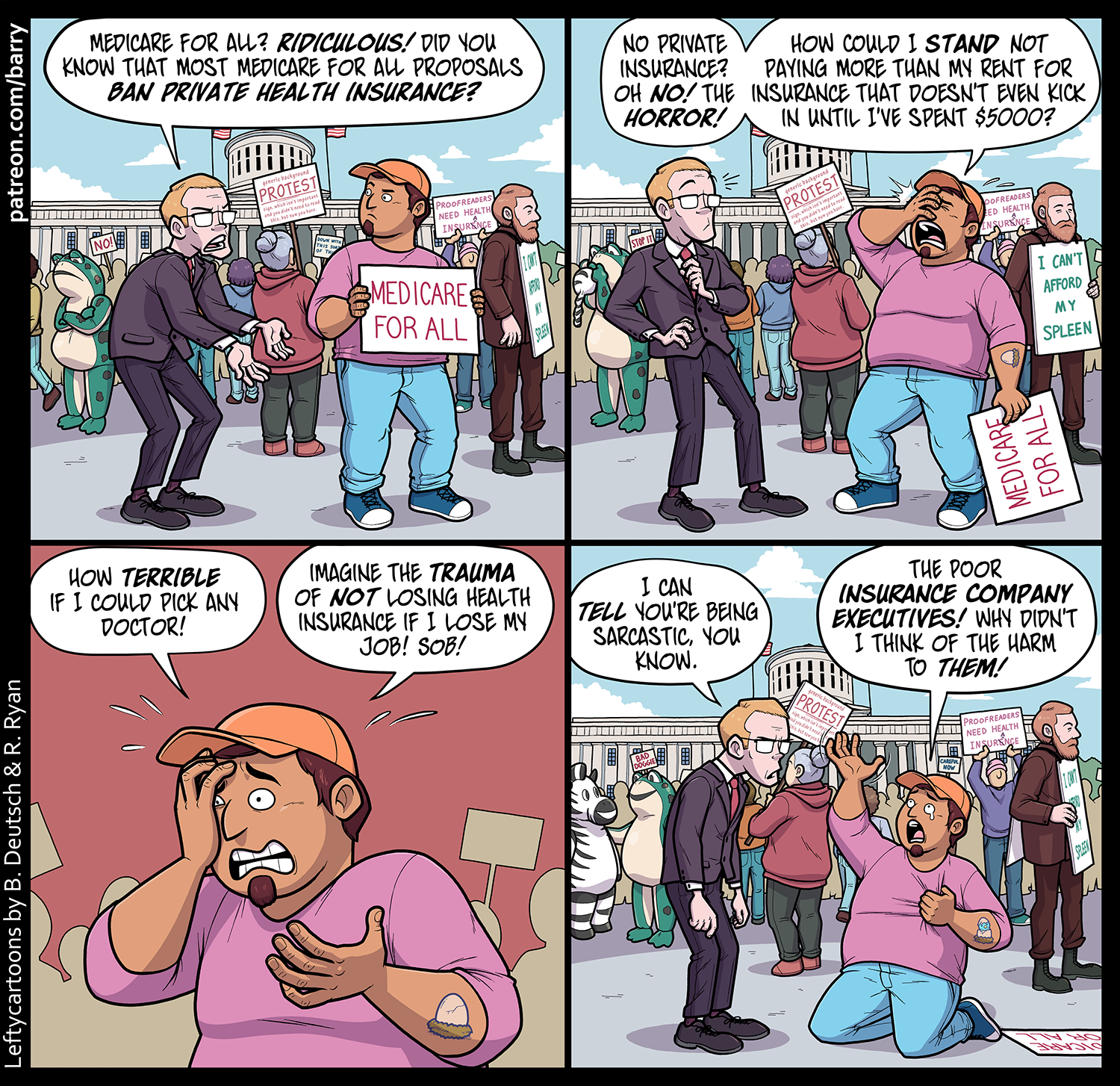
Another collab with the terrific R.E. Ryan.
“I Can’t Afford My Spleen” might be a good title for the eventual book collection.
I love the way R.E. drew this, especially the suit-and-tie guy in the last panel, with his quietly sour expression and disappointed slump.
This cartoon feels a bit Doonesbury-ish to me, particularly in the way the fourth panel works, with a extra piece of dialog following the punchline.
I have a shelf full of Doonesbury collections that I used to reread pretty often. (As I’ve gotten older I’m rereading much less than I once did; I blame the internet. Who has time to read with the torrential flood of new content available every minute on our screens?)
Nonetheless, I think Doonesbury – which has now been running an incredible fifty-five years (although it’s now Sundays only, the other six days are reruns) is a singular achievement in cartooning. Very few daily strips have found success with such a distinctive voice and dry sense of humor. And it’s certainly been a big influence on my writing.
I admit, Medicare For All is not going to pass through Congress this year, or the next, or the year after that. But I refuse to give up – someday we could have a better Congress. And we will, almost unavoidably, have a better President. Things have changed; they can change again. (I’d kind of like that on a t-shirt.)
And when that happens… then this cartoon will feel more of the moment. Whooo!
(There may be other advantages as well.)
Happily, Bernie Sanders hasn’t given up on Medicare For All, either – as of this writing, his most recent MFA bill was put forward in April 2025, and gathered sixteen cosponsors.
Sanders, on this issue, is aligned with most Americans. A new survey from Data For Progress found that:
65% of voters support a Medicare for All system — described as a “national health insurance program…that would cover all Americans and replace most private health insurance plans.” This includes majorities of Democrats (78%) and Independents (71%), and a plurality of Republicans (49%).
Even after being exposed to arguments that MFA “would raise taxes and give the government too much control over health care,” 58% of voters still supported it.
TRANSCRIPT OF CARTOON
This cartoon has four panels, all showing a protest in front of a state government capital building, with marchers holding placards. We’re focused on two people talking, on a thin blonde man in a suit, the other a fatter guy in a pink shirt, carrying a sign that says “MEDICARE FOR ALL.”
PANEL 1
Suit, with an annoyed expression, is talking at Pinkshirt.
SUIT: Medicare For All? Ridiculous! Did you know that most Medicare For All proposals ban private health insurance?
PANEL 2
Pinkshirt slaps a palm over his face and looks horrified. Suit is startled.
PINKSHIRT: No private insurance? Oh no! The horror! How could I stand not paying more than my rent for insurance that doesn’t even kick in until I’ve spent $5000?
PANEL 3
A close up of Pinkshirt, wide-eyed and sweating.
PINKSHIRT: How terrible if I could pick any doctor! Imagine the trauma of not losing health insurance if I lose my job! Sob!
PANEL 4
Pinkshirt had fallen dramatically to his knees. Suit scowls at Pinkshirt.
SUIT: I can tell you’re being sarcastic, you know.
PINKSHIRT: The poor insurance company executives! Why didn’t I think of the harm to them!
CHICKEN FAT WATCH
“Chicken fat” is obsolete cartoonist lingo for fun but irrelevant details in the art.
In panel 1, an inflatable frog costume has a frown on its face. In panel 2, the frog has started to blow up a balloon with zebra stripes. In panel 4, the inflatable zebra has joined the inflatable frog, and both are smiling.
The tattoo on Pinkshirt’s arm at first shows an egg in the nest. Then, in the next panel, cracks have appeared in the egg. In the final panel, an adorable chick has hatched.
Protest signs:
“generic background PROTEST sign, which isn’t important and you didn’t need to read this, but now you have.”
“Down with this sort of thing.”
“Proofreaders need health insurence,” with the “e” in the last word crossed out and replaced with an “a.”
“No!”
“Bad Doggie”
“Careful Now”
“I Can’t Afford My Spleen”




I’d like to see a wealth tax to pay for Medicare for All and other programs.
Plenty of countries with public healthcare have private health insurance too.
You’d need to start pouring concrete and constructing entirely new public hospitals to change your current system for real.
Also shouldn’t you be making a comic on how invading a allied democratic country risking WWIII to steal natural resources, would be a bad thing?
I think every country with public healthcare has some sort of private health insurance system, although often it’s relatively small.
Yeah, that’s true. I was responding to the premise of a specific argument – that M4A would mean no more private insurance – without considering if the premise of the argument was even true. My bad. I might add a “kicker” panel addressing that at some point.
If I think of a comic on that subject. I try to do comics based on inspiration, rather than what I feel I should be doing comics about. Trying to force inspiration doesn’t usually lead to good comics.
For the record: Canadian. I like my system.
But I don’t know how you get out of yours, because while the people who are either uninsured or underinsured can absolutely respond to this likelihood the way depicted above, the people for who the system works have a system that will almost certainly work better than the public option, and I don’t think they’re being unreasonable.
Last year Americans collectively spent 5.3 trillion on healthcare, from which insurance companies raked about 70 billion. Their margin (1.3%) isn’t really the problem. Neither are the salaries of their CEOs at 143 million (0.003%).
The problem is that there are so many people either uninsured or underinsured, that if you actually opened the system up to everyone, the drain on resources, both in terms of actually being served, and the costs of being served would probably break the system and bankrupt the country. That 5.3 trillion is more than the entire income tax revenue of the United States. Sure, you wouldn’t have to pay the insurance premiums, but your tax rates would have to more than double to make up what’s already being spent, and then increase again to cover the uptake in services.
And on top of costs, there’s also supply. Up here in Canada, we recently passed legislation that added dental care to our healthcare system, and our dentists have been absolutely overloaded ever since. While the people who never had coverage get their work done, and the market flexes to accommodate it, this is uncomfortable, the average wait time for a new customer is something like a year. Eventually the market will adjust and we’ll all have better dental care, but in the meantime, that’s rough.
I think that’s a microcosm of what you’d go through, maybe the costs won’t scale up 1:1 because hopefully a single-payer desk could better control costs, but at the end of the day, there’s only so many doctors, there’s only so much production, and if you look at specific things like knee replacements, I think you’d end up going from what’s basically a nonexistent waiting list to years.
And while that’s great for the uninsured and underinsured, because “years” is better than “never”, I completely and utterly understand the trepidation from people for who the system currently works.
Amp:
Is the premise that M4A in principle would eliminate private health insurance or is it that specific M4A proposals from American proponents would do so?
And who would those people be? I ask this as a fully ensured person.
@Dianne: People who own for-profit healthcare companies seem to like the profits it generates them.
People fear change and they fear the unknown. It is easy to convince people that a public heathcare system will be worse than what they have, even if what they have is not really working for them. Also many Americans don’t realize that they are paying more in taxes + benefits than many people pay in higher taxes in social democracies. When I moved out of the US to a place with higher taxes and publicly supported healthcare, this was one of the first things I noticed (that my overall outlays for benefits and taxes were not hugely different than when I lived in the US). Health insurance is REALLY expensive in the US, and there are lots of extra costs (co-pays, deductibles, restrictions on where I can go and who I can see) that I no longer worry about. Plus, many Americans don’t realize how much nicer it is to have insurance that isn’t tied to an employer.
There will be winners and losers in any change to the US system. I think the winners will likely outnumber the losers with a public system, though the losers might be people unaccustomed to being losers in this context. The megarich will always be able to pay their way into more medical care.
@Corso, when I left the US (from a large city), I already had hugely long wait times for many medical things, since in my city many practices stopped taking insurance altogether (so-called boutique practices) or didn’t take mine. The supply of insurance-covered healthcare already was outstripped by demand, and this was quite a while ago. Family and friends tell me things have only gotten worse on that front. Without the rise of walk-in urgent care clinics, the supply gaps in the US healthcare system would have been more obvious, but of course those only work for people who can pay $100-200 or more out of pocket on short notice.