
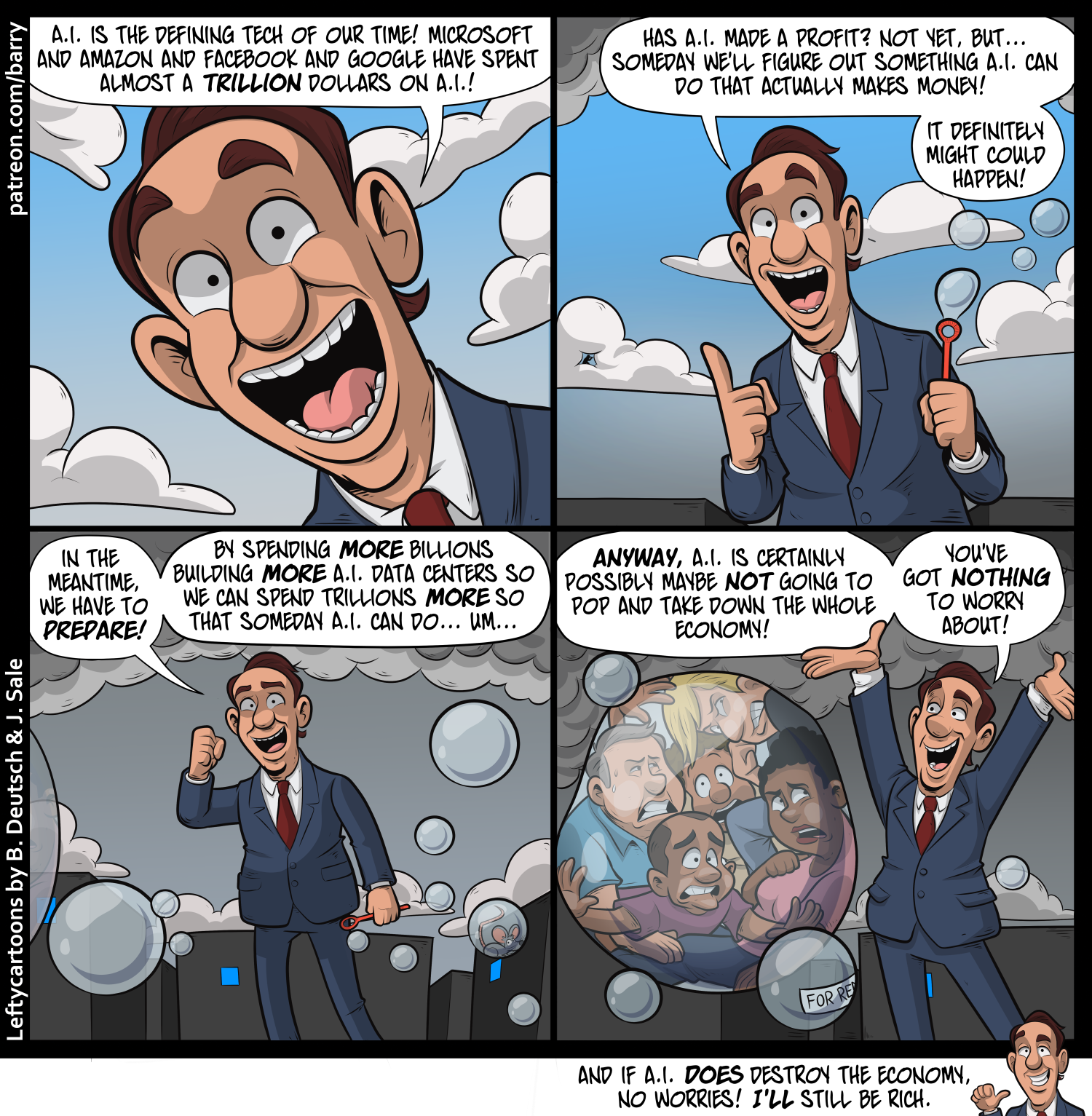
This cartoon is drawn by new guest artist Jamie Sale, who did a terrific job.
I’d originally written the script so the camera would pan out until we saw that the speaker was in a giant bubble. Then I realized that sends the wrong message, because it implies that the people pushing A.I. are putting themselves at economic risk. But that’s not it at all; they’re gonna be fine.
I mean, no doubt some of them will be downgraded from “inconceivably wealthy” to “stupid rich.” It’ll be a blow to their egos and maybe even their social standing. But at the end of the day, none of them are facing any real risk; their lives will remain secure and comfortable.
It’s the rest of us they’re putting at risk.
So I did a last minute rewrite. Jamie had already done initial sketches of the cartoon, but cheerfully went along with my third-act change of direction.
Hedge fund manager Harris “Kuppy” Kupperman ran the numbers:
Simply put, at the current trajectory, we’re going to hit a wall, and soon. There just isn’t enough revenue and there never can be enough revenue. The world just doesn’t have the ability to pay for this much AI. It isn’t about making the product better or charging more for the product. There just isn’t enough revenue to cover the current capex spend. …
At the end of the day, this AI cycle feels less like a revolution and more like a rerun. I’ve seen this story before—fiber in 2000, shale in 2014, cannabis in 2019. Each time, the technology or product was real, even transformative. But the capital cycle was brutal, the math unforgiving, and the equity holders were ultimately incinerated. AI will be no different. The datacenters will be built, the chips will hum, and some of the capacity will eventually prove mind-blowingly useful. But the investors footing the bill today will regret ever making the investment. That’s how bubbles end—not with a bang of innovation, but with the slow, grinding realization of negative returns, for years into the future. When shareholders finally wake up to the fact that AI isn’t generating cash flow, only burning it, the guillotine will fall—on management, on the stocks, and on the broader market that bet its future on a fantasy.
TRANSCRIPT OF CARTOON
This cartoon has four panels. Each of the panels shows a businessman in a suit grinning as he speaks to us.
PANEL 1
A close up of a businessman grinning. In the background, a bright blue sky with fluffy clouds.
MAN: A.I. Is the defining tech of our time! Microsoft and amazon and facebook and google have spent almost a trillion dollars on A.I.!
PANEL 2
The camera has pulled back a little. We can see the man is holding a bubble blower, bubbles streaming from it.
MAN: Has A.I. made a profit? Not yet, but… Someday we’ll figure out something A.I. can do that actually makes money! It definitely might could happen!
PANEL 3
The man continues grinning, pumping his fist, as the air around him turns gray and forbidding and the bubbles stream out.
MAN: In the meantime, We have to prepare! By spending more billions building more A.I. data centers so we can spend trillions more so that someday A.I. can do… Um…
PANEL 4
We can now see that the man is talking to a huge bubble floating in the air. The bubble has been packed fill with ordinary looking people, shoved in like sardines in a can. They looked panicked and unhappy.
MAN: Anyway, A.I. is certainly possibly maybe not going to pop and take down the whole economy! You’ve got nothing to worry about!
CHICKEN FAT WATCH
“Chicken fat” is old-fashioned cartoonist lingo for little extras in the art.
Panel 2 – In a tiny window in a cloud is a tiny, teeny silhouette of a spy with binoculars.
Panel 3 – One of the bubbles has a mouse in it.
Panel 4 – One of the bubbles has a “for rent” sign.




What does he mean “marijuana in 2019”?
Kuppy avoided the heck out of the mortgage/debt bubble I see. Wonder why. . .
Watcher, I think he was referring to this.
Hmm, that’s a new one on me, thanks Amp.
I expect AI to end up being sort of like Amazon: No real use case, no ability to make an independent profit, but something that the oligarchs want and which therefore will “succeed” and make us all worse off by doing so.
what does this crowd make of this? These folks think the headlong rush to AI is dangerous.
https://ifanyonebuildsit.com/
My opinion is…
AI as generally understood is not going to happen in the foreseeable future.
The folks who are warning of humanity’s doom at the virtual hands of AI are wrong. Both because AI isn’t happening anytime soon, if ever, and because non-human intelligence doesn’t automatically lead to humanity’s extinction. To paraphrase… these folks have assumed two can openers.
I’ve come to accept that although, in the true sense of the word, what we have is not actually Artificial Intelligence, the term AI for this stuff has become so universal that it’s just exhausting to keep trying to correct people, so I’ve given up.
A blogger I follow refuses to call them “AI” and instead calls them “LLM chat interfaces.”
I personally hate AI, but I don’t agree it has no use case that can earn money (unfortunately!). I’m in a field, law, in which people are obsessed with it.
Someone said, “I want robots to do my dishes, so I have more time for writing–not for robots to do my writing so I have more time for dishes.” I totally agree. But alas, AI is good at a certain kind of writing and that does indeed save time and money.
Yeah LLM is a more accurate term.
@schroeder and watcher: Yeah, the tech bros seem to think that they’ve invented the Matrix or Hal when really they’ve just built a really large predictive text program.
@Dianne: I think part of it is less self-delusion than just marketing – I admit that “AI” is a snappier product description than “LLM”.
My company is using A.I. internally to actual good effect. We manage other companies’ mainframe processes, networks, servers, etc. Since things don’t work perfectly, we get a lot of incident request tickets that are generated when something fails. We have started using A.I. to analyze them. Use cases:
1) When 2 device down, 6 interface down, and 6 BGP alerts occur we used to get 14 tickets generated. Now A.I. suppresses all but 2 of them and we know the actual issue is that a circuit is down and we’re not wasting time and labor looking at 14 different tickets and multiple different possible causes.
2) When the same kind of ticket is generated multiple times over the course of a month you’d have 4 different engineers seeing them. Now A.I. correlates those tickets so that we all know that there’s a repetitive issue going on.
Those are just the use cases I’m personally familiar with. Other groups have their own use cases (e.g., for mainframe jobs that fail).
In my old field, A.I. is helping analyze protein structures and compare them to various chemical drug structures to see how a given drug might help prevent or treat disease – and in the case where existing drugs are less effective or not effective, suggest alternate chemical structures for drugs that might work.
That doesn’t mean that corporations like Microsoft or Google are going to quickly recoup their capital expenses in building massive new data centers and make huge profits. Nor does it mean that those or other companies (or governmental or NGO entities) are not going to use it for malign purposes. But A.I. is definitely providing benefits.
What I want is to require that these data centers provide their own power through whatever combination of natural gas, nuclear, wind/solar, and battery backup can be most effectively employed. Keep them off the grid. And no massive tax concessions to companies with gross revenue exceeding that of most nations’ GDP.
Schroeder4213:
Do I love that or what? I need to start using that.
One thing we’ve learned is that one of the newest things in data processing – LLMs/A.I. – confirms one of the oldest things in data processing: “Garbage In, Garbage Out”.
A quick search on the ‘net will show you case after case where a judge has checked over a filing from a law firm and found multiple examples of citations that simply don’t exist – in many cases, even the journal or case that the citation is from doesn’t exist. Sometimes A.I. just makes $h!t up. And people don’t check.