
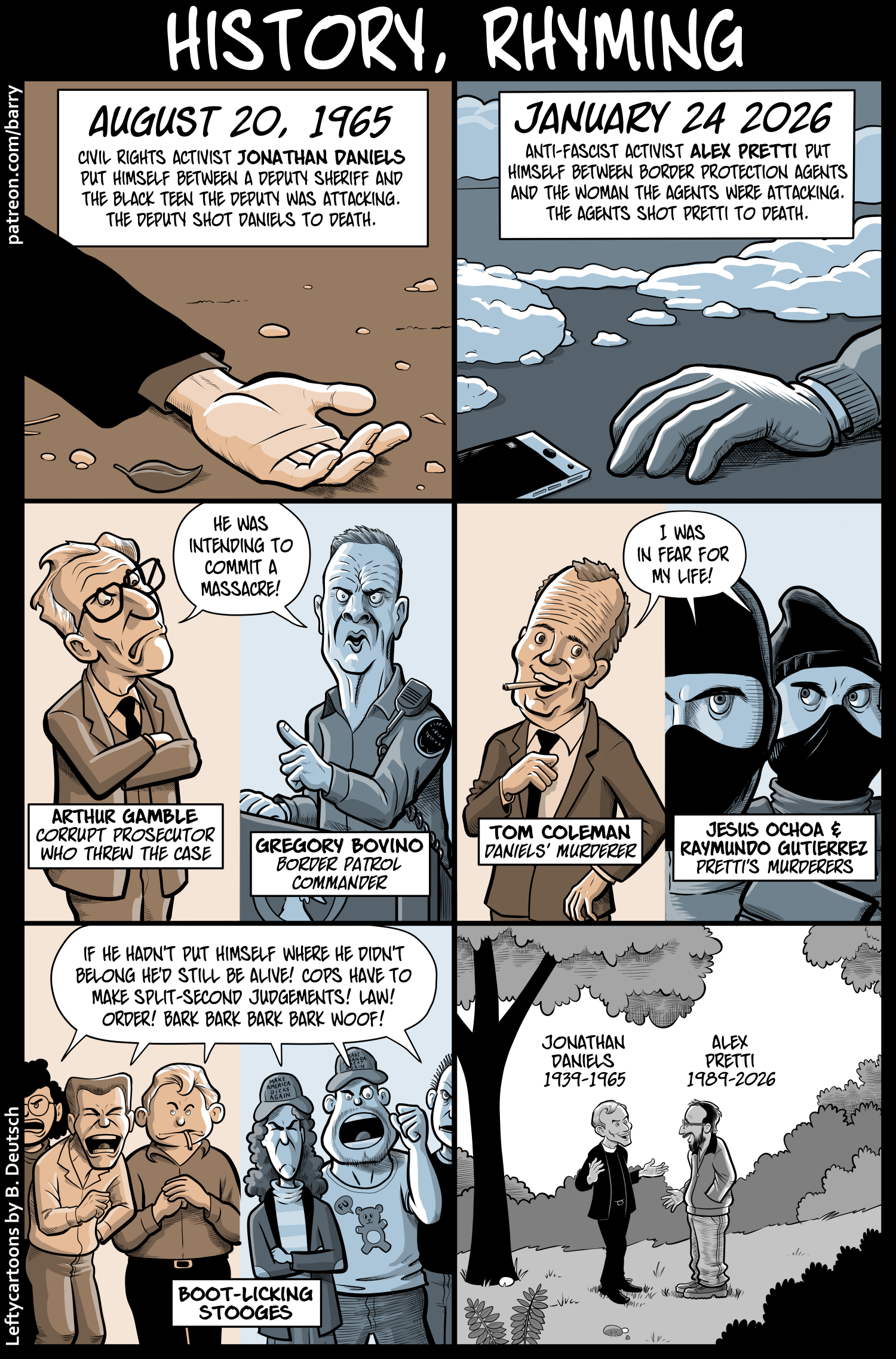
The title is a reference to an aphorism that’s often mistakenly attributed to Mark Twain: “History doesn’t repeat itself but it often rhymes.”
Like many people, I found myself reading a lot of analysis, and squinting at blurry videos, after the murders of Renee Good and, just eighteen days later, Alex Pretti. Both were shot to death by Department of Homeland Security (DHS) agents while multiple people recorded it on video. In both cases, the Federal government baldly lied about what had happened, vilifying both victims as attempted murderers who were stopped just in time by heroic agents acting in self-defense.
The brazenness of the lying was, in the way, the most shocking part. If this is how much they lie when they know there are multiple videos, how much do they lie when there are no recordings to contradict them? (Renee Good and Alex Pretti aren’t the only people killed by DHS agents this year, but as far as I know none of the other deaths were so thoroughly filmed.)
I don’t remember why I started reading about Jonathan Daniels. But I began fixating on the similarities between his murder and Pretti’s. I wouldn’t say nothing’s changed since 1965, but too much remains tragically the same.
The end of this strip troubles me a bit. I believe that when we die, we cease to exist, except in the memories and thoughts of people still living. So I went back and forth a bit on the final panel, which can be easily read as implying I believe in an afterlife.
But I do take comfort imagining Alex Pretti and Jonathan Daniels meeting, as impossible as that is, and finding a lot to talk about. I know that’s just my imagination, but if others take comfort from believing these two heroes are in Heaven, that’s fine with me.
I couldn’t find any good photographs of Arthur Gamble as he would have appeared in 1965, so his face is almost entirely made up. And I didn’t bother looking up the faces of Pretti’s murderers, since I’d decided to draw them masked. The other four caricatures here – Bovino, Coleman, Daniels and Pretti – are my best attempts, as limited as they are. I hope I did them justice.
This is obviously a motivated judgement on my part, but I searched out photos I found that both Pretti and Daniels had great smiles – not toothpaste commercial smiles, but welcoming smiles that made me wish I’d been friends with them.
Bovino’s face wasn’t as beloved by me, but I did find him fascinating to draw.
TRANSCRIPT OF CARTOON
This cartoon has six panels. A caption at the top says “History, Rhyming.”
PANEL 1
A close up of someone’s hand lying limply on the ground, in sepia tones.
CAPTION: August 20, 1965: Civil rights activist Jonathan Daniels put himself between a deputy sheriff and the black teen the deputy was attacking. The deputy shot Daniels to death.
PANEL 2
A close up of a gloved hand lying limply on snowy pavement, a cell phone lying nearby. Drawn in blue tones.
CAPTION: January 24 2026: Anti-fascist activist Alex Pretti put himself between border protection agents and the woman the agents were attacking. The agents shot Pretti to death.
PANEL 3
This panel is divided in two, sepia on the left and blues on the right. On the sepia side, a man inn a suit sneers. On the right side, a man in a border patrol uniform sneers.
BOTH (in unison): He was intended to commit a massacre!
CAPTION (sepia side): Arthur Gamble: Corrupt prosecutor who threw the case.
CAPTION (blue side): Gregory Bovino: Border Patrol Commander.
PANEL 4
Another panel divided into sepia and blue sides. On the sepia side is a cheerful middle-aged man in a suit. On the right side are two masked Border Patrol agents.
ALL THREE (unison): I was in fear for my life!
CAPTION (sepia side): Tom Coleman, Daniels’ murderer.
CAPTION (blue side): Jesus Ochoa and Raymundo Gutierrez, Pretti’s murderers.
PANEL 5
On the sepia side, three people with 1960s haircuts are angrily yelling. On the blue side, same thing except with current-day hair and clothes.
ALL (unison): If he hadn’t put himself where he didn’t belong he’d still be alive! Cops have to make split-second judgements! Law! Order! Bark bark bark bark woof!
CAPTION: Boot-licking stooges.
PANEL 6
In a clearing, surrounded by grass, trees, and shrubs, two men talk to each other. The men are distant from us. One, dressed in black and wearing a clerical collar, is identified as “Jonathan Daniels, 1939-1965.” The other, wearing a comfy looking winter jacket and baggy jeans, is identified as “Alex Pretti, 1989-2026.”
CHICKEN FAT WATCH
“Chicken fat” is obscure cartoonists’ lingo for little details hidden in the art. I drew almost no chicken fat here – the tone of the strip felt wrong for it – but in panel five, two of the modern day people are wearing MAGA hats that say “Make America Dicks Again.” One man’s t-shirt shows a teddy bear saying “FU.”



This is a really good comic, and really sad.
It’s so weird that Pretti’s murderers were Latinx.
Why? When I used to live in DC we joked that the informal motto of INS was “I’m in, we’re full” since so many of the really strict enforcers were immigrants themselves. There are plenty of Latinx folks who believe in Trump’s policies.
I agree with beth. This is a great comic and really sad.
Thank you all. I’m pleased with how this comic came out.
There are a disproportionate number of Latines in Border Patrol and ICE (and also in the US military). A recent study of Latines in BP/ICE found that the most common reason given is that they need the economic opportunity. The article quotes one woman who describes applying for lots of government agencies, and ICE was the one that got back to her.
And for obvious reasons, BP/ICE are eager to hire Spanish speakers. BP/ICE apparently recruits very heavily in Puerto Rico; I’ve seen Puerto Ricans write about how BP/ICE recruitment posters are everywhere.
So I am embarassed to ask this but… should I be saying Latine, rather than Latinx?
I admit from outside the Americas it’s not that easy to keep abrest of Latin-American identity issues, although I realise that’s an excuse.
There’s no universal word that all Latine (Latinx Latino Latina) people agree on. My anecdotal observation is that a lot of people who would have said “Latinx” a few years ago have switched to “Latine” now, but some people still use “Latinx” and that’s fine.
Thank you Amp
This is also anecdotal–though I think it is backed by research–but most Latino/Latina people I know really don’t like Latinx because “x” is not a proper ending in Spanish, so it feels like trying to force a linguistic convention from English on to Spanish. I have no information one way or the other, but Latine seems better, if only because at least “e” is a vowel. (Also, of course, there are some Latino/Latina people who prefer Latinx–just a small minority.)
Also, when I hear Latinx, my brain says it in the same way as “Mister F” from Arrested Development (Latin X!).
“Also, when I hear Latinx, my brain says it in the same way as “Mister F” from Arrested Development (Latin X!).”
That seems like a point in its favour!
“Latinx”? “Latine”?
Why not just use the long-standing term “Latino,” and not worry that this word is now somehow sexist and excludes women?
Is the generic term “man” for “the human race” now considered taboo and dismissive of human females?
Dreidel
“Why not just use the long-standing term “Latino,” and not worry that this word is now somehow sexist and excludes women?”
Because that’s not what the people who the term applies to want to do.
“Is the generic term “man” for “the human race” now considered taboo and dismissive of human females?”
I was told by my primary school teachers in the 80s that this term wasn’t really appropriate anymore.
If you look closely at the polls conservatives cite to claim that “Latinos loathe the word Latinx” and so forth, the most common finding isn’t people loathing words other people use to refer to themselves. It’s live and let live. Most Latines, according to the surveys, don’t want to police what terms other Latines use to refer to themselves.
Dreidel, you talk about terms being “considered taboo.” But when it comes to “Latinx” and “Latine,” it’s not the left trying to make terms taboo. I’ve
almostnever seen a leftist get angry because someone else used the words “Latino” or “Latina.” But many conservatives seem really pissed at anyone saying “Latinx.”“Is the generic term “man” for “the human race” now considered taboo and dismissive of human females?”
Yes, and it has been since about 1979. It led to such sentences as this: “In his natural state, man competes for food, shelter, and women.” (Written on the blackboard — remember blackboards? — by my anthropology professor.)
In my own writing, I use simply “Latin,’ because I’m writing in English, which mostly doesn’t gender adjectives or nouns as Spanish (among other languages) does. “Latin” in this sense mostly predates “Latino” in US English usage. When I was growing up, for example, “Latin lover” was a common journalistic term. It didn’t refer to Mark Anthony or Julius Caesar. When I speak Spanish, which I do more often than English nowadays, I gender words appropriately.
Dreidel, how do you feel about the PC/Woke canceling of the long-standing suffix -ess? (Poetess, actress, Jewess, Negress…?)
@Duncan: Sadly, “actress” is still used quite often, although I don’t really see why.
I think it persists because “actress” is still used by all the award shows (Oscars, Emmys, Tonys, Golden Globes, etc). And honestly, making it a single category – so half the number of actors win awards each year – would be kind of a bummer.
Sure, but they could say “male actor” and “female actor” rather than “actor” and “actress”.
If they did that, they’d have to face a zillion triggered right-wingers screaming about how the [***] awards are run by woke fascists. And under Trump, the FCC would probably pressure the networks to not carry the awards at all.
I usually use “actor” for all genders, but when the person is a trans woman then I use “actress” to make it clear I am gendering her correctly.
I believe the BAFTAs got rid of gendered categories recently, in part due to Sam Smith not submitting their work for consideration one year as neither gender category seemed appropriate to them (they are non-binary). I don’t want non-binary people to be excluded, but I also don’t want women to win many fewer awards, which seems quite likely as an outcome.
But I don’t see any way around it, and ultimately non-binary exclusion is the more pressing issues in terms of awards I would say. Hopefully more mutually categories based on the type of performance (rather than type of performer) could be added to increase the number of individuals being awarded.
I mean in my mind outraging MAGA goons is an upside, not a downside.
@dragon: The way to solve this is the way many global Green parties have with their co-leaderships – have two awards, one which is reserved for people who are not men, and one which is competitive for people regardless of gender.