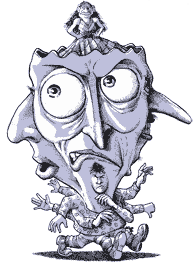
This is why Science Fiction can’t have nice things

this-is-why-science-fiction-cant-have-nice-things

SFSignal: Here is the table of contents for a new anthology called The Mammoth Book of Mindblowing SF, it is edited by Mike Ashley.

The General SF Reading Public: WTF there are only men in that anthology.

Many SFSignal Commenters: OMG this is messed up! Only men? Boo.

Some Black Chick: Yeah and also: no POC.

Many Other SFSignal Commenters: EVEN WORSE, omg.

Paul Di Filippo1: Dear Friends of SF–

I generally steer clear of controversies in my senescense, having participated in more than my share as a card-carrying cyberpunk2–but I simply cannot allow the unanimity of asinine comments on exhibit here to go unremarked-upon3.

Every single commenter here seems to me to be committing a logical fallacy of tremendous dimension, one so big it distorts entire worldviews:

DEMANDING THAT EVERY SINGLE INSTANCE OF EVERYTHING COMPOSITE SHOULD BE ABSOLUTELY STATISTICALLY REPRESENTATIVE OF THE COMPOSITION OF THE ENTIRE COSMOS4

You know what:  a potato field is not likely to contain corn plants5.  A pine forest might feature an oak or three, but be 99% pine trees6.  The Beatles were 4 white guys7.  Sonic Youth has no people of color8My ream of copy paper is all white, with no sheets of lettuce included9!

Variety is great.  Heterogeniety is great.  Bias and prejudice suck.  A genre–VIEWED AS A WHOLE–must feature a million different voices to be accurate and interesting10.

BUT NOT EVERY SINGLE BOOK OR MAGAZINE OR BAND OR WORK OF ART NEEDS TO CONFORM TO THE LATEST CENSUS RESULTS11.

SFSignal Commenters: WTH was that shit?

Paul Di Filippo: But let me reiterate that there is no law of the universe or of sensible human culture that demands that every institution or product fully represent every possible choice in its compositional makeup12.

If you go to a restaurant, do you demand to see the staff of the kitchen to ensure that they represent the full spectrum or genders and races and ethnicities13?  I hope not!  You order food and if you like it you patronize the place again.  (We’re omitting elements of atmosphere, price, fellow customers, etc. here14.)

If this particular anthology delivers stories that fulfill its premise and title, then it’s done its job15.  If you or someone else chooses not to support its existence because it does not meet extra-literary criteria16, then that is perhaps a morally superior, wonderfully principled, honorable stance17.  Or perhaps it’s an addled, PC, chip-on-the-shoulder stance18.  But there was never any obligation or constraint on Mike Ashely to satisfy these demands19.

Now, if you got the annual LOCUS survey of books published and pointed out to me that there were N number of anthologies published in 2008 featuring Y number of stories, and that only X percent of these stories were written by folks who were not WASP males, and then you argued that X percent was way too low, I would consider you had the beginnings of a rational argument and gripe20.

SFSignal Commenters: Are you HIGH?

Some Black Chick: Dear Paul Di Filippo, What the hell is wrong with you?

Paul Di Filippo: I’d like to raise two matters: First, how are anthologies assembled?  By 1)  an editor’s reference to his past reading experience, for reprints; 2) “invitation only” for new stories; 3) “open call” for new stories.

The book in question was assembled by a combo of 1) and 2).  Obviously, Mike Ashley recalled only stories by men and invited stories only from males21.  (Or possibly, invited women who did not respond or qualify22.)  This resulted in a men-only book.  Is this sexism23, or is it a function of the phenomenon illustrated in the SEINFELD episode of the big-breasted waitresses?  Elaine was incensed that a certain diner featured only big-breasted waitresses–until she discovered that all the women were the owner’s daughters.  In other words, what seemed to be sexism was “family bias.”  Mike relied on his “family connections,” to the dead or living24.  And that family included no women.  Limited family maybe, but sexism?  Your call25.

Second, I think in any such argument it’s always useful to ask “whose ox is being gored?” and to “follow the money.”26

I don’t want to cast aspersions on anyone’s motives, or attempt to mind-read27.  But I have to say that when ANY WRITER (not just female writers or writers of color) complains about being excluded from a venue and cites issues of platonic principle and idealism, I always first posit underlying jealousy28 and a desire for status underneath all the lofty hypothetical talk29.  Why do I posit such a cynical thing30?  Because I’m a fucking writer31, and guilty as all others32!  I vividly recall my sense of exclusion from the “adult table” after having had one or two stories published, but before being able to sell regularly33.  Hell, I still feel this way, being without a major publisher34.

Now there’s nothing wrong with wanting a place at the table for one’s personal, individual works.  If a writer did not believe in her stuff, why would she bother?  And if you believe in your stuff, you’ll want it to get the best possible treatment.  But to cloak one’s personal gripes, however subconsciously, in the cloak of solidarity with all downtrodden is just plain disingenuous–to use the nicest word35.

I really wonder, as an unperformable thought experiment, whether if the MAMMOTH book had included a token one or two writers of color or female gender, if these writers would have returned their paychecks or even spoken out when the current controversy arose36.

“Walk it like you talk it” remains the operative phrase37.

SFSignal Commenters: What. The. Hell?

Paul Di Filippo: I don’t have time to answer all your petty questions about my ridiculous statements, I have a story to write! Email me if you want, but I have more important things to take care of. *flounce!*38

SFSignal Commenters: What. The. Hell? No, just no.

Paul Di Filippo: Oh, also, Walt Whitman is gay, so therefore you won’t mind if I quote from him. What does Walt Whitman being gay have to do with anything here? Well, Some Black Chick said that he hated men! Okay, bye for realz now! *flounce again!*39

SFSignal Commenters: [attempt to pick up the pieces of the conversation and return it to something resembling sense, all the while on the lookout for further resurgences of greater internet fuckwaddery.]

The End.

And now a word from our sponsor…


Your ad could be here, right now.

Footnotes

  1. Who is, incidentally — or perhaps not — in the anthology in question
  2. this is the part where he tries to position himself above everyone else in the conversation — oh, ho ho silly beings. I will lower myself to your level, but only this once!
  3. if he allowed it, it would be like some free speech or something.
  4. notice how actually no one was demanding this.
  5. what?
  6. And this is relevant to the discussion how?
  7. and strawmen have no brains, what the hell is your point, Paul?
  8. So, I’m given to understand that women and people of color SF writers are like lettuce in copy paper? The Othering going on here is just astounding.
  9. But viewed as just a section we don’t need all that pesky diversity! Gotta have some safe spaces for the white men.
  10. I again wonder who ever suggested this? Oh wait, no one. Okay then.
  11. Show me a universe or sensible society where a deliberate selection is uniform by accident.
  12. No, but that’s because I assume that any business that wishes to stay in business will conform to laws that say it’s illegal to discriminate on the basis of several factors, including gender and race. SF anthologies are not subject to this law. Nor should they be. But it would explain the variation in how I approach two completely different and unrelated situations such as you have posited here.
  13. also omitting anything that makes any damn sense at all.
  14. if that job is presenting its readers with a heteronormative, white and male view of SF, then yes. If it claims to be presenting the “The 21 Finest Stories of Awesome Science Fiction”, then no.
  15. Here’s what you don’t get: the specifics about the authors are not extra-literary, Paul. Who a writer is, where a writer comes from, how they see and experience the world, all feeds into their writing. I thought you were a writer, surely you understand this.
  16. Only inasmuch as it doesn’t exclude and marginalized oppressed groups, yeah.
  17. Oh, you’re about to pull THIS argument out?
  18. Nope, there sure wasn’t. And look what he produced: 21 stories of the same old monochromatic maleness.
  19. Actually, I believe people have done this and more and left out the bad algebra to boot.
  20. Yes, obviously, and if you had any damn sense you would see why that’s extremely problematic.
  21. I guess they don’t qualify if they only write stories about “people and feelings and crap”.
  22. Yes.
  23. And while it’s acceptable to have your family staff your restaurant, if you’re putting together an anthology of “best” stories and you only ever choose authors you’ve heard of, you’re not really choosing a best, are you? You’re choosing the best of a narrow subset of stories. That is: the best by white men whose writing appeals to someone who can’t be bothered to read anything by women or people of color.
  24. Oh good. Cuz I say: yes. Or, at the very, very least: bias borne out of lazy ignorance.
  25. Yeah because women and POC don’t have money to spend, or when they do they don’t buy books. I think they buy pretty dresses and “bling”.
  26. Liar. Cuz you’re about to do just that.
  27. ABW takes off her earrings.
  28. So, let me see if I rightly understand you: the only reason anyone would ever have to complain about this kind of thing is jealousy and a desire to be included? Even when the people complaining are readers, not writers? Even when the writers complaining are not just women and people of color but white men? Even when other publishers and editors are like: “Dude, that’s not right.”? Even when ALL of those groups get together to call this out as a problem it all comes down to some jealous, whiny women and darkies causing a fuss because they want to be included? Listen, Paul, I have something very important to say: FUCK YOU, ASSHOLE. You are NOT, I repeat: NOT allowed to dismiss the concerns of readers and writers and editors and fans and lovers of the genre and those who strive to erase racism and sexism and other forms of prejudice just because they have an issue with an anthology you are in. Seems to me that the reason this upsets you so much, the reason you obviously find it so threatening, is that if someone were to judge your writing up against that of, say, Octavia Butler, Nisi Shawl, Nnedi Okorafor, Samuel R. Delany, Stephen Barnes, Tobias Buckell, L. Timmel Duchamp, Elizabeth Hand, Nancy Kress, Connie Willis, Yoon Ha Lee, or any number of the amazing women and POC writers in this field, it would be found wanting and you’d find yourself in fewer anthologies. And while I strive to see more diverse voices in anthologies just for its own sake, I have to say that the idea of them edging you out is just buttercream icing on the cupcake. Because I don’t care how good a writer you are, this genre and this community does not need people like you spewing this utter, utter bullshit all over its public places. What we need are people who don’t use the term PC like it’s a dirty word, who don’t compare women and minorities to pieces of lettuce, who don’t stomp into conversations around contentious and important issues and proceed to pull down their pants and wave their asses around with vigor. Get out of my genre, dude! We do not need your crazy!
  29. because you’re projecting?
  30. Wait, you mis-spelled that last word. Should be: wanker
  31. yeah, projection. Look, our issues are not yours, Paul.
  32. …if sitting at the adult table means being next to creepy uncle Paul who no one ever leaves you in a room alone with then, um, yeah I’ll stay over here at the kids table.
  33. No comment.
  34. THANK GOD YOU’RE USING THE NICE WORDS.
  35. I guess we’ll never know, since the editor doesn’t believe in tokenism. But good to know that if there had been some women or people of color in there, they’d just be tokens and undeserving! Also of note: had there been any women or POC, we would not be having this conversation because the controversy would not have arisen. People don’t get all upset when anthologies are inclusive. Well, normal, sensible people.
  36. Indeed. It just doesn’t mean what you think it means.
  37. This one is paraphrased.
  38. Yes, paraphrased. But yes, Walt Whitman and gayness did randomly come up.
Posted in Race, racism and related issues, Syndicated feeds | 30 Comments

Two Excellent Dollhouse Posts

I wanted to point out two excellent Dollhouse posts you should read (after you’ve read all of Maia’s Dollhouse posts here, I mean).

At Asking The Wrong Questions, Abigail discusses the original, unaired pilot episode, “Echo,” and also the unaired “Epitaph One” episode, and what they tell us about Whedon’s intention for the show (before Fox’s executives have at it).

“Echo”‘s emphasis on free will or its absence has the effect of downplaying the sexual aspect of the dollhouse. My biggest problem with the seemingly endless barrage of criticism directed at Dollhouse for allegedly failing to acknowledge that the dolls are being raped is that it seemed fairly clear to me–especially from those episodes intended to move the overarching story forward like “Man on the Street” or “A Spy in the House of Love”–that in the story Whedon was trying to tell sexual rape was merely a specific instance of the greater act of rape being committed against the actives–the rape of their mind, the complete stripping away of their personality and free will.

Via Abigail, I read this excellent post at Tiger Beatdown, which is a feminist defense of Dollhouse.

Whedon has done a lot of shows about magically powerful women and the men who protect them (Buffy had Giles, River had Simon and Mal), which is sweet – hey, at least they aren’t actively seeking to take power away from those women – but also paternalistic and troubling, and in Dollhouse he seems to know and specifically address just how creepy it is. Lots of parallels have been drawn between the “handler,” Boyd, who is a protective father figure to Echo, and Giles, who is a protective father figure to Buffy, and those parallels are correct. However, this time around, Boyd is also directly invested in keeping Echo powerless: he’s the guy in the creepy van, who takes her back to the Dollhouse to have her self taken away once she’s served her purpose, and if she were a whole person, she might not need him at all. The question of whether he loves her enough to help her free herself is continually raised. Paul Ballard, the FBI agent who wants to “save” Echo, is also implicated: a hero, sure, but also weirdly and sexually preoccupied with “saving” a girl he doesn’t know so that she will love him, a person just as involved in projecting his desires onto a blank slate as any Dollhouse client. The show doesn’t steer around that fact. You don’t hate these men – you love them, in fact – but Whedon is far more willing than ever before to implicate them in the oppression that he condemns. He’s toyed with ambiguity and complicity before, but this time around, ambiguity and complicity are what the show is about.

Because then, there’s Topher, the programmer, who is responsible for constructing the artificial personalities and implanting them in the dolls, who is a dorky blonde guy just like Whedon and who speaks in distinctly Whedonian cadences and lines, and who we are encouraged to dislike more than almost anyone else in the series. What you hear, when you hear Topher speaking about how difficult it is to construct a believable personality, how all of his creations have to be full and nuanced and have reasons for how they behave, how achievement is fueled by lack and he gave her asthma because that made her a more complete person and blah blah blah, is noted feminist auteur Joss Whedon reflecting, very consciously and very obviously, on his life’s work – hiring gorgeous women and making them into who he wants them to be – and saying that sometimes, he feels kind of icky about it.

Dollhouse is interesting on all these levels, and Sady’s defense of Dollhouse is the most convincing defense I’ve read.

But I still think the show is, on the whole, kind of a failure. Fascinating themes are set up, but not stuck with and sometimes pointlessly undermined, replaced by boring cliches. For example, Sady is right that the character of Paul, in season one, is a brilliant and vicious critique of the male rescuer-hero. So why did they completely undermine that in the season finale, letting Paul become a conventional, and boring, heroic figure?

And no matter who’s fault it is (Fox’s or Joss’s), it’s impossible to ignore that too many Dollhouse episodes are not just filler, but extremely conventional filler.

Still, even though it’s a failure, it’s an interesting failure, which for me makes it TV worth watching. I’m looking forward to season 2.

Posted in Buffy, Whedon, etc. | 1 Comment

Between You and Your Doctor

I find it just wonderful that conservatives are still pulling out the “A government bureaucrat between you and your doctor” canard in their fight against health care reform. I guess I can see that argument working during the Clinton years, when things weren’t quite as bleak as they are now (although, being a teenage dependent with two well-off parents, I never had to worry about health insurance during the Clinton years, so what do I know?). But relying on it again now? Balls, folks: that takes some.

For a little under twenty years, I’ve been dealing with chronic pain. (No, not my back problems. I’m going to refrain from discussing my specific condition itself in order to keep the focus on the politics.) Because this condition is hard to diagnose and often misunderstood, I’ve gone without treatment for most of my life. In fact, the only two times I’ve had regular treatment for it were in college and grad school, when I had the twin luxuries of student health insurance and autonomy from my parents. In college, the doctor I found was well-meaning, but ineffective. In grad school I had a great doctor, and together we started to make progress. But then I finished grad school.

For about a year, I went untreated again until a flare-up made me realize that I needed to find a doctor despite the cost. My husband and I did some budgeting – I currently subscribe to Blue Shield’s cheapest plan, which only covers basic exams and major disasters – and found a doctor who charged a sliding scale. She was awful. For a few months, I went untreated again, and had another flare-up. It turned out that a friend of mine has a similar condition, and she gave me the name of her specialist.

Here’s where the story gets interesting.

I made an appointment with the specialist – and loved her. Within ten minutes of our first appointment, she’d described my condition with eerie accuracy and outlined what sounded like an effective treatment plan, with options that I’d barely even known about. Her bedside manner and level of expertise were terrific; she put even my grad school doctor to shame. At the end of the appointment we talked money. My current insurance didn’t cover regular office visits, so I’d be paying completely out of pocket. I gulped at her office visit fee – even paying for that first appointment was going to be interesting. I talked to my husband and we agreed that I’d have to get a new insurance plan. If we ditched the cable, the Netflix subscription, and a couple other amenities here and there, we could pay more for something better.

I looked at other Blue Shield plans while my husband looked at Kaiser. I figured that while I was getting a new plan, I might as well search for something that covered maternity. I looked at plans going up to $200, $250 a month – nope, nope, nope. Blue Shield doesn’t like its members having babies.

Meanwhile, my husband found a Kaiser PPO (at least, we thought it was a PPO, but I guess that’s kind of rare for Kaiser) just barely within our price range. It was $139 a month – yikes, but okay. It had a fairly good maternity plan. We called their office to find out if this doctor was in their network. They didn’t know. They gave us a regional number to call. We called. No, this doctor was not in their network.

Next we tried Blue Cross. I don’t even remember what plan we eventually found, because the whole website was so labyrinthine. We didn’t bother calling them before we filled out the form because, hey, everyone takes Blue Cross, right? The application took all morning – and we even left off in the middle because I needed to dig up some old information.

Later that day, I talked to the doctor to reschedule our next appointment, since it was taking so long to find a new plan. I asked if she took Blue Cross (just to be absolutely sure – because everyone takes Blue Cross!). “Uh, some of their plans,” she said. “I don’t know, some but not others. It’s all very strange. I don’t even handle that part of it.”

We called Blue Cross. No, the plan we’d selected didn’t cover her. Were there any plans in our price range that did? Tappa tappa tap, pause. No, there were not.

So we went back and called Blue Shield, told them I was already a member. We asked for any plans at all that covered this one doctor. Damn the cost! We’d use our savings! We’d move into a smaller apartment! We’d rob a bank if we had to! What was the doctor’s name again? We spelled it. Nope, they said. Blue Shield of California does not cover this doctor at all.

We called the doctor again, canceled the appointment, told her we just couldn’t afford her. I still owe her for our first (now useless) meeting – $150 down the drain. I cried, I was so disappointed. All that work, all that hope, for nothing.

I’ll probably never know why no insurance plan would touch her. She wasn’t some bizarre, esoteric practitioner or anything; my best guess is that only employer-paid plans cover her. But when I hear conservatives trotting out the specter of “a government bureaucrat between you and your doctor,” I have to laugh. Because right now, at this moment, I am gritting my teeth through 20-year-old pain while the doctor who could have treated me goes about her business 2 miles from my apartment. Bureaucrats are standing between me and my doctor.

On the one hand, if conservatives are going to try to block affordable health care, the least they could do is come up with a less insulting argument. On the other, I guess it’s to my advantage that they’re making themselves look like total idiots.

We’ll go ahead and give Pacificare and Aetna a call, but I think my course of action now is to go for the original Kaiser plan we found and hope that there’s a doctor as good as this one in their network. (Of course, the maternity coverage raises some troubling questions. Does Kaiser have midwives? Doulas? Birthing centers? Will I have to give birth on my back? But I’m not pregnant, so I can cross that bridge when I come to it.) If we ever get a national health plan in place, then sign me up – but I’m not holding my breath. My one wish for those who oppose it is that they someday experience health insurance that is comparable to mine.

(A note on comments: because I know what types of comments posts like these tend to receive, I am declaring myself Queen Tyrant on this thread and will delete offensive comments without warnings or justification.)

(Cross-posted at Modern Mitzvot.)

Posted in Conservative zaniness, right-wingers, etc., Elections and politics, Health Care and Related Issues | 34 Comments

The Sound and Serious Arguments Against Cash For Clunkers

Conor Friedersdorf, one of my favorite conservative bloggers, highlights two “sound” and “serious” arguments against the cash for clunkers, or CARS, program, which offers car buyers a government-financed rebate when they trade in a car for a higher-mileage car (some limitations apply). The traded-in “clunker” is turned into scrap metal.

The first serious argument Conor quotes comes from Radley Balko (a blogger I read religiously — seriously, if you’re not reading Radley, you’re missing one of the best bloggers on the planet). Radley, in the midst of a post critiquing the Daily Show, writes:

There’s also the laughable idea that the government is ordering the destruction of tens of thousands of used automobiles it paid people thousands of dollars to exchange . . . for new cars that may get no more than an added four miles per gallon. And all in the name of saving energy. I’m no television comedy writer, but if they wanted to, the creative minds at TDS could certainly have gotten some mileage (sorry) out of the idea that the government’s energy savings equation looks something like this:

(all of the energy that went into making the old car) + (the energy it will take to destroy it) + (all of the energy it took to make the new car) + ($3,500) < an extra four miles per gallon!

Obviously, Radley’s tone was a bit tongue in cheek, but since it’s one of the two “serious” arguments Conor chose to quote, I’ll address it seriously. There are two problems with the formula Radley presents.

It’s true that some trade-ins would qualify for just a four mile per hour difference — and it was based mostly on that, a month ago, I thought the CARS program sucked. But in practice, it appears consumers are eager for more substantial improvements:

Transportation Secretary Ray LaHood said the average mileage of new vehicles purchased through the program is 9.6 miles per gallon higher than for the vehicles traded in for scrap. Buyers of new cars and trucks that get 10 mpg better than their trade-ins get the $4,500 rebate. People whose cars get between 4 mpg and 10 mpg better fuel efficiency qualify for a smaller $3,500 rebate.

LaHood said some 80 percent of the traded-in vehicles are pickups or SUVs, meaning many gas-guzzlers are being taken off the road.

I’d argue for more stringent mileage requirements, but regardless, clearly the CARS program has been doing much better than just 4mpg. To imply that CARS gets an improvement of just 4pmg isn’t a “serious” argument.

Radley’s formula is also mistaken because it includes costs that would have been incurred regardless of whether or not the CARS program existed. For instance, “all of the energy that went into making the old car” was expended before the CARS program began, which makes it a sunk cost; blaming that energy cost on the CARS program is irrational.

Similarly, many of the new cars would eventually have been manufactured and sold at a later date — when the sales wouldn’t do as much good for the environment (because sooner is better than later), and when the economy might not need the boost as much. To whatever degree the CARS program displaces demand from other times, rather than creating it, it wrong to hold CARS responsible for “all of the energy it took to make the new car.”

Working out ecological benefits of government programs is hard. But on the whole, this program appears to be, if not perfect, definitely beneficial. That’s worth something.

Conor then quotes National Review’s Rich Lowry:

The fundamental mistake is to think that the government can magically induce economic activity with no countervailing downside. The Clunkers program is really just shifting around sales, creating the illusion of a demand for cars conjured out of nowhere. To the extent the program has enticed people to speed up or delay their purchases to take advantage of the rebate, it has borrowed demand from earlier this year or the future for a burst of sales in the summer of 2009.

This is a less intelligent argument than Radley’s (presumably reflecting the big drop in economic literacy when one shifts from reading Reason to reading NR). But first, let’s note that this argument entirely contradicts Radley’s argument. If — as Rich claims — “the Clunkers program is just shifting around sales,” without creating any new demand, then none of the “energy it took to make the new car” can be blamed on CARS, since the new car would have been created regardless. If Conor noticed the contradiction, he didn’t mention it in his post.

That aside, Rich is correct that there’s a downside. Specifically, the downside is the billion dollars it cost taxpayers (soon to be three billion, once the Senate votes to extend the CARS program). Stimulus costs money — even stimulus that’s beneficial in the long run. This isn’t news.

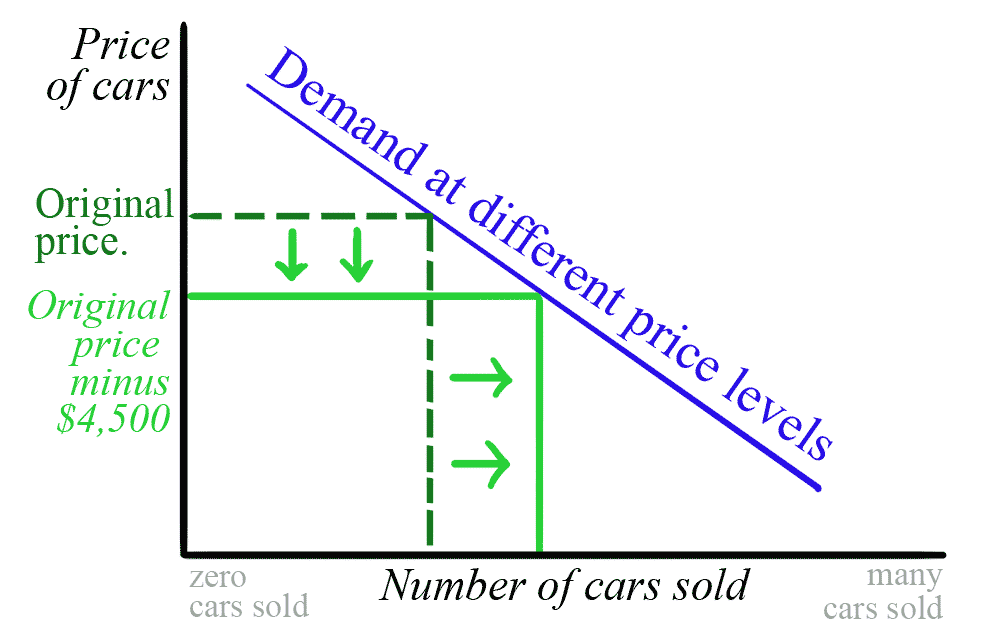
The rest of Rich’s argument is preposterous. For Rich’s argument to be true, we’d have to believe that demand for cars at the current price, and demand for cars at the current price minus $4500, are the same.

There are inevitably going to be some prospective car-buyers who won’t trade in their current car at current prices now or in the future, but who will do so if the price is $4500 lower. To illustrate this, I’ve done something I haven’t done since college: I’ve drawn a supply and demand graph. (Well, really, just demand.)

This is very basic economics. As prices drop, demand increases, leading to increased sales. That in turn leads manufacturers to produce more cars (supply goes up), which will get them to hire more workers, or at least slow down layoffs.

Aren’t conservatives supposed to know about supply and demand? Apparently, that’s not something they teach writers for the National Review.

It’s true that some of the increased sales due to CARS are sales displaced from other times — either pent-up demand from the past year, or people who would have bought a new car anyway, sometime in the future. Contrary to what Rich thinks, displaced sales are a strong argument in favor of CARS, because the economy needs the stimulus more now than it will a year from now. (We hope.)

But some of the demand must be new demand, created by lower prices. Unless we assume basic economics have ceased to function.

There’s a lot I’d criticize about the CARS program — it should have been more stringent about improved mileage, it should have included older cars, and perhaps it should have been extended to used car buyers, as well. (I’m not sure about that last point only because I’m not sure how much lower the stimulus effect would have been.) But on the whole, the program appears to be a success. If the arguments Conor quoted are the “sound” and “serious” arguments against the program, then cash for clunkers looks pretty damned good.

Posted in Economics and the like | 12 Comments

Quote of the Century

If you like the Post Office and the Department of Motor Vehicles and you think they’re run well, just wait till you see Medicare, Medicaid and health care done by the government.

Arthur Laffer

Yeah, that would be really bad. What’s next? The government taking over the Army? Or our schools? Or — gasp — Social Security? Say it ain’t so!

And yes, we are talking about that Arthur Laffer, the inventor of supply-side economics. I can’t imagine why that hasn’t worked out.

(Via publius.)

Posted in Health Care and Related Issues | 15 Comments

Wells Fargo Sued For Racist Lending Practices

Actually, Wells Fargo has been getting sued quite a lot. First the NAACP, then Baltimore, and now Illinois.

The New York Times has some statements from former Wells Fargo employees, describing how the system works. Some of the details are jaw-dropping:

Wells Fargo, Ms. Jacobson said in an interview, saw the black community as fertile ground for subprime mortgages, as working-class blacks were hungry to be a part of the nation’s home-owning mania. Loan officers, she said, pushed customers who could have qualified for prime loans into subprime mortgages. Another loan officer stated in an affidavit filed last week that employees had referred to blacks as “mud people” and to subprime lending as “ghetto loans.”

“We just went right after them,” said Ms. Jacobson, who is white and said she was once the bank’s top-producing subprime loan officer nationally. “Wells Fargo mortgage had an emerging-markets unit that specifically targeted black churches, because it figured church leaders had a lot of influence and could convince congregants to take out subprime loans.” […]

Mr. Paschal, who is black and worked as a loan officer in Wells Fargo’s office in Annandale, Va., from 1997 to 2007, offers a sort of primer on Wells Fargo’s subprime marketing strategy by race.

In 2001, he states in his affidavit, Wells Fargo created a unit in the mid-Atlantic region to push expensive refinancing loans on black customers, particularly those living in Baltimore, southeast Washington and Prince George’s County, Md. […]

“They referred to subprime loans made in minority communities as ghetto loans and minority customers as ‘those people have bad credit’, ‘those people don’t pay their bills’ and ‘mud people,’ ” Mr. Paschal said in his affidavit. […]

Both loan officers said the bank had given bonuses to loan officers who referred borrowers who should have qualified for a prime loan to the subprime division.

One example given: Loan officers would falsely claim that Black borrowers had declined to provide documentation of their income, which “flipped” the loan from prime to subprime.

As The Chicago Reporter Blog points out, Wells Fargo isn’t alone. Throughout the industry, Blacks get loans on worse terms than whites with lower earnings.

Wells Fargo is not the only lender giving high-cost loans more often to its highest-earning black customers. Nationwide, African Americans earning more than $300,000 were more likely to get high-cost loans than Asian, Latino and white borrowers earning less than $40,000, according to a Reporter analysis last November.

While income may not accurately reflect credit worthiness, fair lending advocates often point to the racial disparities between wealthy blacks and lower-income individuals of other races and ethnicities as red flags.

I hope these suits encourage a lot of other attorney generals to go rooting through records for evidence of lending racism.

* * *

One thing to keep in mind: It’s not like the lending market just suddenly turned racist now. It’s been like this all along; it’s just that sub-prime lending has made it especially evident.

(Thanks to Brian for reminding me of this story.)

Posted in Economics and the like, Race, racism and related issues | 32 Comments

Should Yeshiva University Have Been Forced To Allow Same-Sex Couples In Its Married Dormitory?

Robert Anthony Maranto, who supports equal marriage for same-sex couples but is worried about religious rights, wrote “Do Gay Rights Trump Religion?”. From Professor Maranto’s essay:

…a number of recent court and bureaucratic decisions [have forced] faith-based institutions to embrace gay rights, no matter their sacred beliefs.

Yeshiva University was ordered to allow same-sex couples in its married dormitory. In Boston, Catholic Charities ended adoptions after the state supreme court forced it to place children with gay and lesbian couples. In short, many intellectuals not only want to permit same-sex marriage; they want to stigmatize religious dissenters as either bigots or fools.

First of all, it’s obvious Maranto’s examples don’t warrant his unkind conclusion. If I want anti-discrimination laws to apply to all businesses and student groups equally, that isn’t because I want to stigmatize religious people; it’s because I sincerely think that it’s important for queers to be treated as equal members of society at all levels. It would have been kinder, and also more accurate, for Professor Maranto to assume that those who want equal rights act out of a desire for equality, not a desire to stigmatize. ((Even where people do criticize or even stigmatize others for bigotry, I’d argue that their purpose is still equality; the stigmatization is a means towards the end of equality.))

(If I said supermarkets shouldn’t be allowed to refuse gay customers, would Professor Maranto conclude my goal is to stigmatize grocery owners?)

Now let’s consider Professor Maranto’s examples, Yeshiva University and Catholic Charities of Boston.

I support narrow exemptions to anti-discrimination laws; for instance, no religious congregation should be forced to perform same-sex weddings, nor should individual ministers (or rabbis, or priests, or imams, etc) be forced to conduct such ceremonies. ((Of course, many congregations and officiants freely choose to conduct same-sex ceremonies.)) A wedding in a church (shul, etc) is a religious ceremony, and the government shouldn’t intrude on that cermony. Similarly, no independent minister should be forced to participate in a wedding she doesn’t want to participate in. ((Of course, there’s no legal need to pass a law stating these exemptions, since they’re already implicit in the First Amendment’s guarantee of freedom of religion. But if passing a law restating this right would make religious people feel more secure and comfortable, then I’m all for it.))

But Professor Maranto’s examples aren’t narrow, and he doesn’t suggest any limits on his proposed exemption.

For example, when people read that “Yeshiva University was ordered to allow same-sex couples in its married dormitory,” I think many of them imagine a place for formal religious instruction, a college where religious Jews go to combine religious practice with education, or to learn to become Orthodox rabbis.

In fact, the Yeshiva University lawsuit concerned student housing at the Albert Einstein College of Medicine, which is owned by Y.U.. Albert Einstein College isn’t a religious school — it’s a secular medical school which accepts students regardless of ethnicity or religion, and which prides itself on diversity.

Furthermore, Albert Einstein College is located in one of the most expensive housing markets in the country. The difference between having access to cheap student housing, or not, could be the difference between being able to complete a medical school education or not. Why should going to medical school be cheaper for straight married couples? When weighing these conflicts, we have to consider not only freedom of worship, but also if lesbian and gay students are being treated fairly.

I don’t want to intrude on anyone’s religious freedom. But state anti-discrimination laws applying to a secular medical school don’t limit any Jew’s ability to worship as she pleases. The claim of a religious exemption shouldn’t mean that essentially secular businesses are exempt from the same laws all other businesses follow.

Regarding Catholic Charities of Boston, Professor Maranto’s summary is simply wrong; there was no order from the Massachusetts Supreme Court. Quoting Morris Thurston:

Catholic Charities in Boston was not forced to close its doors–indeed it is still very active. (See its website at www.ccab.org.) Rather, Catholic Charities voluntarily ceased providing adoption service in Massachusetts. According to the Boston Globe, Catholic Charities elected to close its doors in protest over the legalization of gay marriage in Massachusetts and because it was reluctant to undertake a lawsuit that might be lost.

LDS Family Services still operates in Massachusetts, as it does in California. There are several differences between LDSFS and Catholic Charities. LDSFS does not take federal and state funds; Catholic Charities does. LDSFS facilities only voluntary adoptions and permits the birth mother to approve the adoptive parents. Catholic Charities handled non-voluntary adoptions (where the state seizes the children) and normally did not accommodate birth mother approval. Catholic Charities had contracts with the state and was, in effect, acting as an agent of the state. LDSFS does not. To date, LDS Family Services has never been forced to place any children with a gay couple, and has never been sued for not doing so.

These details aside, it’s unclear why adoption is a case where religious freedoms should trump the legitimate desire of states to ensure equal treatment. Requiring adoption businesses — especially those that act as agents of the state — to treat gays equally, does not prevent Catholics and others from worshiping as they choose. And as Scot at Utah Cog points out in an excellent post, the adoption rates in Massachusetts didn’t go down as a result of Catholic Charities of Boston’s choice.

* * *

In his editorial, Professor Maranto doesn’t describe the standards he used to decide that Yeshiva University and Catholic Charities should be exempt from anti-discrimination laws. Nor does he say if he wants this exemption applied across the board, or if he thinks that lesbians and gays are the only people whose legal protections should be weakened in the name of religious freedom.

But as far as I can infer from his examples, he simply thinks that all groups or businesses owned or run by religious institutions should get a “get out of discrimination laws free” card, at least when it comes to discrimination against gays. But this supposed “right” of religions, if it is applied without limits, could easily have far-reaching and unfair consequences.

For instance, what happens when a nurse or doctor at a Church-owned hospital decides not to acknowlege a patient’s same-sex partner or spouse? (And if Professor Maranto says that no, hospitals shouldn’t discriminate that way, then why is it less of an affront to religion to forbid discrimination in a hospital, than it is to forbid discrimination in a secular medical school, or in an adoption agency?)

What prevents a small business owner who wants to discriminate from simply forming a “church” to be the legal owner of her business?

Religious institutions are sometimes huge and wealthy, and the biggest ones can own dozens of businesses. I would never want the government to intrude on anyone’s right to worship as they please, but it goes too far to say that any business owned by a church — no matter how secular that business is in practice — should be exempt from anti-discrimination law. To say that would be to say that the right of religions to discriminate — not to worship as they please, but to discriminate as they please — trumps the right of lesbian and gay people to be treated as equal members of society, with equal dignity.

Posted in Lesbian, Gay, Bi, Trans and Queer issues | 41 Comments

We Have Always Been at War With Eastasia

The most savage yells of all came from the schoolchildren. The speech had been proceeding for perhaps twenty minutes when a messenger hurried on to the platform and a scrap of paper was slipped into the speaker’s hand. He unrolled and read it without pausing in his speech. Nothing altered in his voice or manner, or in the content of what he was saying, but suddenly the names were different. Without words said, a wave of understanding rippled through the crowd. Oceania was at war with Eastasia! The next moment there was a tremendous commotion. The banners and posters with which the square was decorated were all wrong! Quite half of them had the wrong faces on them. It was sabotage! The agents of Goldstein had been at work! There was a riotous interlude while posters were ripped from the walls, banners torn to shreds and trampled underfoot. The Spies performed prodigies of activity in clambering over the rooftops and cutting the streamers that fluttered from the chimneys. But within two or three minutes it was all over. The orator, still gripping the neck of the microphone, his shoulders hunched forward, his free hand clawing at the air, had gone straight on with his speech. One minute more, and the feral roars of rage were again bursting from the crowd. The Hate continued exactly as before, except that the target had been changed.

The thing that impressed Winston in looking back was that the speaker had switched from one line to the other actually in midsentence, not only without a pause, but without even breaking the syntax.

–George Orwell, 1984

There’s an old legal saying: If you’ve got the law on your side, pound the law. If you’ve got the facts on your side, pound the facts. If you don’t have the law or the facts on your side, pound the table.

As you no doubt have read, in the health care debate, the right has decided their interests are best served by pounding the table, sending astroturf-enhanced teabaggers to town hall meetings, where they are to shout down anyone they disagree with, that being the hallmark of someone comfortable with the rectitude of one’s opinions.

This has, of course, been cheered in greater wingnuttia. But Thers has a nice catch: it seems that this sort of behavior was shocking — shocking! — when the hypothetical agents provoctateur were liberals:

So they will try to co-opt. They will try to disrupt. They will certainly try toincite. When they try, politely put a camera in their face and politely ask them what the hell they think that they’re doing. Ask them loudly, from the diaphragm: it carries better that way, and the only thing that these people hate more than sunlight is sunlight and the interested gaze of a lot of people not inclined to humor them.

Of course, you may not remember the scenes of liberals shouting down participants at tea parties, because we, uh, didn’t. (Why would we interfere with them? We thought they were hilarious!) But that didn’t keep the right from being Very Very Concerned About The Liberal Threat To Democracy.

Of course, when conservatives engage in precisely those horrible behaviors, they’re cheered. Because, you know, that’s what they do.

I’ve never been a fan of disrupting meetings, whether you’re a Teabagger or a member of Code Pink. It doesn’t make you look smart, organized, and powerful. It makes you look deranged and afraid that your opinions are not strong enough to stand on their own merit.

The right is, I think, unable to defend their do-nothing approach to health care reform. And they can’t actually propose reform, as the right has pretty much defined any government involvement in anything not related to the military as pure socialism. And so, faced with a public that does want health care reform of some sort, the right is reduced to shouting people down and threatening that the government is going to kill grandpa once they get him off of Medicare and on to some nefarious government-run program.

It’s too bad. Health care reform is precisely the type of legislation that cries out for an older version of the GOP, one that wasn’t opposed to government, but did want to sharpen their pencils and do the cost/benefit analysis before leaping into anything. But that Republican Party is dead and gone; its last major figure, George H.W. Bush, sired the man who ultimately dealt that party its death blow. What passes for Republicanism now is a weird mix of populism and corporatism. It’s a shame. But it can’t be helped. And it’s why the Democrats need to remember that on health care, they’re on their own.

Posted in Elections and politics | 2 Comments

We Have Feelings Too or The Cost OF Being A POC in Race Discussions

we-have-feelings-too-or-the-cost-of-being-a-poc-in-race-discussions

Originally I wasn’t going to write any posts for IBARW. Then it was just going to be the one. I’m up to three* now. Because it’s been that kind of week. And since this post is about emotion it’s probably not going to be as polished as some of my other pieces. Or as polite. But, that’s the risk you take when you talk about race and racism with a POC. One of the things people tend to say to me (especially after they’ve tried to hammer sense into someone’s head for hours only to discover that bigotry can be a security blanket to some people) is that they don’t know how I keep my calm in these conversations. And I tend to wave it off, because really I don’t see a point in talking about the emotional impact of participating in these discussions. No, that’s a lie. I do talk about it. In safe spaces, behind closed doors with people I know I can trust. Because that’s the only place it’s (generally) acceptable to show weakness as an anti-racist POC. Otherwise the slurs and the misconceptions and the appropriation and the fucking fail will make you cry in front of people who have already made it clear that your feelings don’t matter to them.

Because if they cared about the feelings of POC they wouldn’t use racial slurs, they wouldn’t insist that we have no right to dictate the treatment of our cultural icons, they wouldn’t say that we were too angry (By the way, who stays calm and patient when someone is shitting on their shoe?) to discuss things “rationally”, they wouldn’t insist that being called out on their bigoted statements is more painful than being the target of bigotry. Basically they’d treat us the way they want to be treated and stop expecting POC to meekly accept being spit on, their culture, music, and religion picked apart for a moment’s entertainment, their families dehumanized and disrespected, their history and their literature discounted and ignored…all without ever once expressing their anger or their hurt. Because that’s the wrong tone. And of course when POC say “Turnabout is fair play, if I can’t talk about my emotions then yours don’t count either” suddenly we’re so cruel or we’re attacking or we’re still not using the right tone if we want to end racism. Because clearly if we’re calm enough and nice enough in the face of offensive behavior then everything will get better right? After all that’s usually what’s implied someone trots out MLK Jr. as an example of how POC should behave in the face of racism. I heartily suggest the next person to feel that urge spend some quality time reading Letter From a Birmingham Jail and recognize that nonviolent protests didn’t include smiling sweetly and eating shit.

I’m going to let you in on a little secret. Now this might shock and/or offend some people, but I have to say that today is not a day when I give a fuck. Because when POC have teaching moments? It costs us. Sometimes a little. Sometimes a lot. It’s a sacrifice that we choose to make in an effort to improve things. It’s a moment (or more) out of our lives that we knowingly open ourselves up to things that any sane person would want to avoid under normal circumstances. Because there is no other option. Oh, we could leave the people saying awful things to wallow in ignorance. But in the long run isolationism is not actually a helpful position. Especially since we are living in a global society, and there really is nowhere to withdraw to for the long haul. So, we wade in when we can, and we try to make sure that if even if the person saying offensive things doesn’t get it; other people reading will have access to the right information. And sometimes when the fail is too big and the pain is too acute? We get sarcastic and snark the stupid. Because you have to do something to ease the trauma when you’re 100 comments in and people are still insisting that the 65 links to respectable websites, 23 bits of anecdata, and the entire weight of history are all wrong and it’s the fault of POC that racism isn’t gone because they insist on being people of color instead of “normal” white people. It’s hard enough to stand strong in the face of willful stupidity, don’t expect us to be nice about it too. Gallows humor is often the best coping mechanism available. For the record, anger is a perfectly valid emotion but don’t get confused…we have others too…you just don’t get to see them.

* This post is actually a couple of days old so I think my count is 4 or 5 posts now. Originally I wasn’t going to post this here, but after reading some of the responses to IBARW I think it’s important that a wider audience sees this and gets a little reminder of our reality.

And now a word from our sponsor…


Your ad could be here, right now.

Posted in Race, racism and related issues, Syndicated feeds | 8 Comments

Open Thread, doing really neat things with sand edition

This is an open thread. Go wild! Self-linking is like a double-entendre about masturbation: always appreciated.

* * *

I love the interwebs. Time from not even knowing an art form exists, to seeing that there are dozens of examples of it on Youtube: 30 seconds.

  1. Immigration Raids Routinely Ignore Fourth Amendment.
  2. The American Family, Kate & Allie, and Co-Parenting.
  3. Research data on racial profiling ignored by mainstream media.
  4. Olbermann’s and O’Reilly’s corporate owners shut them both up, because GE didn’t like being criticized on TV. Thank goodness for a free press! (And shame on Olbermann and O’Reilly for going along with it.)
  5. Apparently, only 25% or so of white Southerners think that Obama was born in the USA.
  6. The Fat Woman Stereotype. (Via this post on “The Challenge of Writing Fat-Friendly Fiction.“)
  7. Are Fat Rights today where Gay Rights were 30 years ago?
  8. The Birthers are right! Finally, a compelling argument proving that Obama is not a natural-born American.
  9. “The National Organization for Marriage is right. Gay marriage IS a religious freedom issue. They’ve just identified the wrong party as victim.”
  10. What if modern-day Republicans had been around when firefighting was made into a government function, instead of left to the free market?
  11. How Medical Innovation Really Happens. Hint: It’s not all the free market.
  12. In 28 of 33 Gitmo detainee cases heard so far, federal judges have found insufficient evidence to support keeping them in prison.” Also, poll shows that Americans favor torture more than the people of almost all other nations. Plus, we tortured a young teenage boy. In short, we suck and we’re evil.
  13. The argument for a free market in selling human kidneys.
  14. The argument against a free market in kidneys.
  15. The Future Of Book Banning?
  16. Links about polyamory.
  17. Power Your Car With Pee
  18. The best of The Question (a superhero character). “The plastic tips at the end of shoelaces are called aglets, and their true purpose is sinister.”
  19. This magazine design is so much cooler than I’ll ever be:

Oh, and here’s some dancey fun for the Buffy/Angel fanatics among (amongst?) us, via Buffyfest:

Posted in Link farms | 23 Comments