Open Thread and Link Farm: Invisible Giants Controlling Our Every Move Edition

    As usual, feel free to post what you want, when you want, in whatever state of undress you want, and accompanied by whatever music you like. (That link is to a youtube mix I played while putting this post together).

    Anyone got any plans for 2015? I plan to finish the third Hereville book in February, and it’ll be in stores in November. I’m thinking that maybe I’ll burn down my room and start anew, if I can figure out how to do that without catching the rest of the house on fire. Look for a LOT more political cartoons from me in 2015, as well, and also a new comic called “Superbutch,” which takes place in the 1940s and features a Lois-Lane-style reporter trying to uncover the secret identity of a lesbian superhero, to be drawn by Becky Hawkins. And more blogging, I hope.


  1. The Roast Duck Bureaucracy – Open City Local governments are often much more harmful to free enterprise than the national government. There’s also some ugly racial implications of having mostly-white Americans certifying the healthiness of immigrant cuisines that they may not understand at all.
  2. Racial Bias, Even When We Have Good Intentions – NYTimes.com
  3. Guest post: The moment he realized how horribly wrong he had been
  4. Study: White people see “black” Americans as less competent than “African Americans” – Vox
  5. A Free-Market Argument for the Social Safety Net | Thing of Things
  6. A lot of people are discussing Scott Aaronson’s comment 171, in which he argues that the acute pain he suffered as a male nerd means he doesn’t have male privilege.

    “Hi there, shy, nerdy boys. Your suffering was and is real. I really fucking hope that it got better, or at least is getting better, At the same time, I want you to understand that that very real suffering does not cancel out male privilege…”

    Here’s another post on the same subject, from a different blog: Compassion, Men, and Me

    And here’s a third: Neither empathy nor trauma are zero sum | Inexorable Progress

  7. A cultural history of inflation in America – Lawyers, Guns & Money : Lawyers, Guns & Money “Overall prices in the American economy were about the same at the beginning of FDR’s presidency as they had been at the end of George Washington’s second term.”
  8. 6 Police Interactions That Were Different When They Were White | Scott Woods Makes Lists
  9. Ancient Trees: Beth Moon’s 14-Year Quest to Photograph the World’s Most Majestic Trees | Colossal
  10. Bizarro Back Issues: Batman’s Deadly New Year! (1972)
  11. The odds of Greece leaving the euro have never been higher – The Washington Post
  12. Want to reduce teen pregnancy and abortion? Start with long-term birth control. – The Washington Post
  13. “Trigger warnings are designed to help survivors avoid reminders of their trauma, thereby preventing emotional discomfort. Yet avoidance reinforces PTSD. Conversely, systematic exposure to triggers and the memories they provoke is the most effective means of overcoming the disorder.
  14. Obama is unpopular. He’s also accomplished an incredible amount. – Vox
  15. Michael Ramirez’s Pro-Torture Cartoon – The Atlantic
  16. How an embryo turns into a baby, in one hypnotic GIF – Vox
  17. Tamara Loertscher: Wisconsin mother is thrown in jail for refusing drug treatment she says she didn’t need.
  18. Forbidden Topic in Health Policy Debate: Cost Effectiveness | The Incidental Economist
  19. “The complaint claims that administrators read books written by sex-differentiated teaching specialists who believe that boys are better at math because their bodies receive daily jolts of testosterone, while girls have equal skills only “a few days per month” when they experience “increased estrogen during the menstrual cycle.”
  20. Rape apologists, in an attempt to silence victims, hurt an innocent man
  21. When Speaking to Men about False Accusations
  22. Rolling Stone didn’t just fail readers — it failed Jackie, too – Vox
  23. Rolling Stone and UVA: How sensationalism has betrayed survivors of sexual violence
  24. New Evidence Emerges of Wage-Fixing by DreamWorks, Pixar and Blue Sky | Cartoon Brew
  25. The Backlash Against Serial’s ‘White Privilege’—and Why It’s Wrong – The Atlantic
  26. Book Review: On The Road | Slate Star Codex “I too enjoy life. Yet somehow this has never led me to get my friend to marry a woman in order to take her life savings, then leave her stranded in a strange city five hundred miles from home after the money runs out.”
  27. Chris Rock is right: White Americans are a lot less racist than they used to be. – The Washington Post
  28. “Afterwards, poking around the corpse, it was discovered that it was 185 years old, and that it had survived the Civil War — its hide contained 9 musket balls that had been shot at it by Confederate troops. And the hunters are smiling, without a hint of shame or guilt or even doubt that it was appropriate to butcher such a magnificent beast.” Update: Hoax, hoax, hoax. Thanks to Doug S. for the correction.
  29. Why Orson Scott Card Should Keep His Job | Thing of Things A reprinted post on Ozy’s blog gives me and some other folks a chance to rehash some old arguments about free speech.
  30. “And if Rolling Stone was so eager to keep Jackie’s story in the piece that they were ready to run it against her will, that suggests their willingness to bend their fact-checking standards may have had less to do with some feminist “sensitivity” to a survivor’s request and more to do with not wanting to risk losing a particularly shocking tale of a gang rape that would help their article go viral in the way it ultimately did.”
  31. I love this wonderful 1904 comic strip by the immortal Windsor McCay. (Source)

McCay Winsor How He Escaped From His Border 1904

Posted in Link farms | 288 Comments

Some Brain Teasers From Scientific American

This article in Scientific American, by Keith Stanovich, makes some solid points about the limits of IQ.

No doubt you know several folks with perfectly respectable IQs who repeatedly make poor decisions. The behavior of such people tells us that we are missing something important by treating intelligence as if it encompassed all cognitive abilities.

I highly recommend going over to SA and reading the whole article. But just for fun, here are some “brain teasers” that Mr. Stanovich included in his article, along with his answers, given in the footnotes.


1. Jack is looking at Anne, but Anne is looking at George. Jack is married, but George is not. Is a married person looking at an unmarried person?

A) Yes
B) No
C) Cannot be determined

Answer. ((More than 80 percent of people choose C. But the correct answer is A. Here is how to think it through logically: Anne is the only person whose marital status is unknown. You need to consider both possibilities, either married or unmarried, to determine whether you have enough information to draw a conclusion. If Anne is married, the answer is A: she would be the married person who is looking at an unmarried person (George). If Anne is not married, the answer is still A: in this case, Jack is the married person, and he is looking at Anne, the unmarried person. ))

2. A bat and a ball cost $1.10 in total. The bat costs $1 more than the ball. How much does the ball cost?

Answer. ((Many people give the first response that comes to mind—10 cents. But if they thought a little harder, they would realize that this cannot be right: the bat would then have to cost $1.10, for a total of $1.20.))

3. I’m going to skip question three, because although it illustrates an interesting and important finding about how partisanship kills thoughtfulness, it’s not fun as a stand-alone brain-teaser. But you can read it at Scientific American. ((Filler footnote.))

4. Imagine that XYZ viral syndrome is a serious condition that affects one person in 1,000. Imagine also that the test to diagnose the disease always indicates correctly that a person who has the XYZ virus actually has it. Finally, suppose that this test occasionally misidentifies a healthy individual as having XYZ. The test has a false-positive rate of 5 percent, meaning that the test wrongly indicates that the XYZ virus is present in 5 percent of the cases where the person does not have the virus.

Next we choose a person at random and administer the test, and the person tests positive for XYZ syndrome. Assuming we know nothing else about that individual’s medical history, what is the probability (expressed as a percentage ranging from zero to 100) that the individual really has XYZ?

Answer. ((The most common answer is 95 percent. But that is wrong. People tend to ignore the first part of the setup, which states that only one person in 1,000 will actually have XYZ syndrome. If the other 999 (who do not have the disease) are tested, the 5 percent false-positive rate means that approximately 50 of them (0.05 times 999) will be told they have XYZ. Thus, for every 51 patients who test positive for XYZ, only one will actually have it. Because of the relatively low base rate of the disease and the relatively high false-positive rate, most people who test positive for XYZ syndrome will not have it. The answer to the question, then, is that the probability a person who tests positive for XYZ syndrome actually has it is one in 51, or approximately 2 percent.))

5. An experiment is conducted to test the efficacy of a new medical treatment. Picture a 2 x 2 matrix that summarizes the results as follows:

Improvement No Improvement
Treatment Given 200 75
No Treatment Given 50 15

As you can see, 200 patients were given the experimental treatment and improved; 75 were given the treatment and did not improve; 50 were not given the treatment and improved; and 15 were not given the treatment and did not improve. Answer this question with a yes or no: Was the treatment effective?

Answer. ((Most people will say yes. They focus on the large number of patients (200) in whom treatment led to improvement and on the fact that of those who received treatment, more patients improved (200) than failed to improve (75). Because the probability of improvement (200 out of 275 treated, or 200/275 = 0.727) seems high, people tend to believe the treatment works. But this reflects an error in scientific thinking: an inability to consider the control group, something that (disturbingly) even physicians are often guilty of. In the control group, improvement occurred even when the treatment was not given. The probability of improvement with no treatment (50 out of 65 not treated, or 50/65 = 0.769) is even higher than the probability of improvement with treatment, meaning that the treatment being tested can be judged to be completely ineffective.))

puzzle

6. As seen in the diagram, four cards are sitting on a table. Each card has a letter on one side and a number on the other. Two cards are letter-side up, and two of the cards are number-side up. The rule to be tested is this: for these four cards, if a card has a vowel on its letter side, it has an even number on its number side. Your task is to decide which card or cards must be turned over to find out whether the rule is true or false. Indicate which cards must be turned over.

Answer. ((Most people get the answer wrong, and it has been devilishly hard to figure out why. About half of them say you should pick A and 8: a vowel to see if there is an even number on its reverse side and an even number to see if there is a vowel on its reverse. Another 20 percent choose to turn over the A card only, and another 20 percent turn over other incorrect combinations. That means that 90 percent of people get it wrong.

Let’s see where people tend to run into trouble. They are okay with the letter cards: most people correctly choose A. The difficulty is in the number cards: most people mistakenly choose 8. Why is it wrong to choose 8? Read the rule again: it says that a vowel must have an even number on the back, but it says nothing about whether an even number must have a vowel on the back or what kind of number a consonant must have. (It is because the rule says nothing about consonants, by the way, that there is no need to see what is on the back of the K.) So finding a consonant on the back of the 8 would say nothing about whether the rule is true or false. In contrast, the 5 card, which most people do not choose, is essential. The 5 card might have a vowel on the back. And if it does, the rule would be shown to be false because that would mean that not all vowels have even numbers on the back. In short, to show that the rule is not false, the 5 card must be turned over.))

Posted in Mind-blowing Miscellania and other Neat Stuff | 16 Comments

Let’s discuss the Into The Woods movie!

into-the-woods-cast

(Spoilers ahead! Also, the above image collage was swiped from ArtInsights Magazine.)

I saw Into The Woods on Christmas, as part of my annual “Chinese food & a movie” Christmas tradition. Some thoughts:

into-the-woods-wolf-red

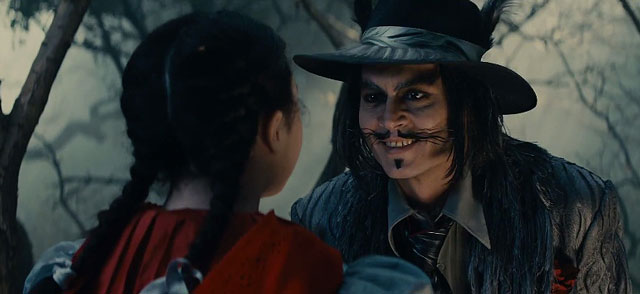
1) Johnny Depp played the Wolf as well as anyone who can’t sing could play the Wolf. Which, put another way, means that there were a thousand actors who could have played the Wolf much better. But, fortunately, it’s a small part. And I’m sure that having Depp’s name on the project helped get the movie financed, and there aren’t a thousand actors we could say that for.

into-the-woods-movie-screenshot-meryl-streep-witch-11

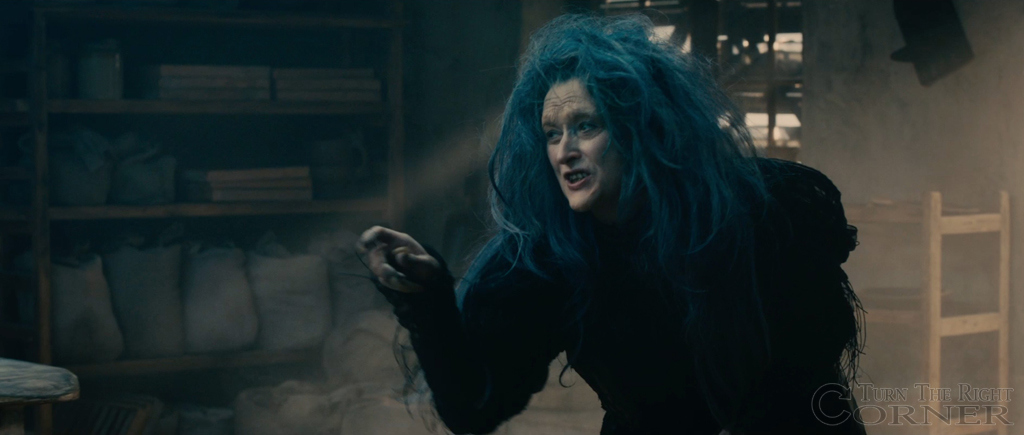
2) Let’s face it, Meryl Streep can’t sing as well as Bernadette Peters (who originated the part on Broadway) did. But “doesn’t sing as well as Bernadette Peters” is hardly an insult! Streep doesn’t have that kind of powerhouse voice, but she sings well. What she brought was a acting performance that was nuanced and made the Witch into a fascinatingly eccentric character who could also be heartbreaking. This was a movie performance, full of tiny tics and quick expressions that only a camera could catch, and I thought it was enjoyable as hell. (I loved the moment when the Witch punished Rapunzel cruelly and unjustly – we could see on Streep’s face that it was breaking the Witch’s heart to do it, but also that she wouldn’t relent.)

3) Say, was it just me, or did the Witch’s exit seem less like she got her powers back and teleported away from this mess (which is what happens to her in the stage show), and more like she died by being sucked into a tar pit?

4) There is no reason in the world, other than Hollywood’s endless racism and lack of imagination, for this movie (or the original play, alas) to have an all-white cast. Why do movies feel like they’d rather die than show us a diverse cast? (And please don’t say “they cast the best people for the roles.” I thought the whole cast was good, but Streep was the only one who turned in a performance so unique that you couldn’t imagine anyone else doing the role.)

5) I really can’t see why they wrote Rapunzel’s PTSD and death out. It didn’t seem to gain them anything, and it made what the Witch did to Rapunzel less harmful, as well as lowering the Witch’s emotional stakes in the last act. As it is, I honestly can’t remember what happened to Rapunzel and her Prince. Did they even appear in the second act of the movie? Did they just escape the giant and run off?

6) The child (well, early teen) actors who played Red Riding Hood and Jack both sang very well, but having them look that young meant that the sexual awakening elements of both their adventures had to be deemphasized in the staging (especially with Disney as producer). Oh, well.

7) Really loved the decision to have the costumes be from centuries apart – ranging from the Renaissance-era Rapunzel all the way to the Wolf’s zoot suit. Not locking the costumes down to any one period is a really cool approach for a fairy tale movie, since fairy tales take place in all periods.

8) The only person from the original Broadway cast I missed was Joanna Gleason. Emily Blunt did a fine job as the Baker’s Wife, but I don’t think anyone will ever match Gleason’s performance.

9) I thought Anna Kendrick (Cinderella) and James Corden (the Baker) were, alongside Streep, the stand-out cast members.

10) I was kind of surprised at how little I missed the Mysterious Man and “No More.” I did miss the reprise of “Agony,” but as funny as it is, it doesn’t add all that much to the story, so I can see why they cut it.

11) I’m planning to see this again, probably next week.

Your thoughts?

into-the-woods-red

Posted in Popular (and unpopular) culture | 43 Comments

Being called racist or sexist does not “destroy” people, and, Joseph Levine’s defense of calling someone an awful human being

On drawing breaks lately, I’ve been leaving comments on Ozy’s blog, which I feel a bit guilty about since I’ve been neglecting my own blog. (Leaving comments on someone else’s blog is, somehow, easier and quicker for me than writing posts on my own.)

Anyway, on a thread over there, “Jiro” wrote:

Because of the tremendous power of an accusation of racism or sexism, you’ve created a tool that anyone not a white male can use to destroy their enemies, and it’s in the nature of an unfair but effective tool that it will be used.

I replied:

I think your premise – that “an accusation of sexism or racism” is “a tool that anyone not a white male can use to destroy their enemies” – is a ridiculous exaggeration of reality.

Look, I’ve had critics suggest that my work is sexist and/or racist. It happens. It’s not fun. But it didn’t destroy my career or my life, because I’m too obscure for stuff like that to stick to me.

But the same is true for people who are anything but obscure. A whole bunch of writers – including some quite prominent and respected writers, like Jay Caspian Kang – have argued that the hit podcast “Serial” is racist. Yet Serial is getting a second season, and it’s a safe bet that Sarah Koenig’s income and career prospects have improved because of “Serial.”

The New Yorker called the sitcom “2 Broke Girls” “so racist it is less offensive than baffling,” and that just got renewed for a 4th season.

I can think of lots of SF/F novelists who have, fairly or not, been criticized for sexism and/or racism: Paolo Bacigalupi, NK Jemisin, Saladin Ahmed, Vox Day, Larry Correia, Piers Anthony. In the movie/TV world, there’s Charlie Sheen, Chris Rock, Alex Balwin, Nicholas Cage, Sean Penn, Woody Allen, Aaron Sorkin…. I could go on and on with examples.

Your claim that an accusation of sexism or racism is a career-ending weapon, is contradicted by real life.

Jiro then admitted that they had been hyperbolic, but wrote that

It creates a system where someone who isn’t a white male can attack any work they don’t like in a way that is much more effective than and will be uncritically accepted by a much wider audience than a normal criticism that doesn’t have the added oomph of accusing something of being racist or sexist.

(Obviously, go read the original thread to read Jiro’s full statements in full context).

I responded:

I think there are three factors which are likely to make criticism harmful.

First, criticism that is so openly disdainful that it sends a clear message that the creator of the work, and anyone who enjoys that work, is an awful, evil person.

Unfortunately, this style of criticism is pretty popular, especially on some areas of the internet.

Second, people who seek out opportunities to be furious, either because they enjoy righteous indignation, or because they believe it’s politically expedient. So even small slights are interpreted without any charity and treated as major issues. This second factor combines very harmfully with the first factor.

And third, criticism that would be trivial or even reasonable on its own, but which is amplified by social media into a tsunami of criticism that is usually entirely disproportionate to the original offense. “Shirtstorm” is the obvious example.

Absent these factors, I don’t think that criticism of racism or sexism in a work is especially harmful. And with these factors, even criticism that doesn’t mention racism or sexism can be harmful.

Coincidentally, about a half-hour after writing the above, I read an interesting and persuasive defense of calling someone an awful person. Philosophy professor Joseph Levine was discussing an infamous tweet by Stephen Salaita, in which Salaita wrote:

Let’s cut to the chase:

If you’re defending #Israel right now you’re an awful human being.

11:46 PM – 8 Jul 2014

This and other tweets Salaita wrote made a lot of people mad, and caused a university to yank away a job offer.

Commenting on Salaita’s tweet, Levine wrote (and this is just a small part, I’d highly recommend reading Levine’s entire article):

Obviously, if Salaita had been tweeting instead about supporters of the 9/11 attacks as “awful human beings” no one would have been upset.

I locate the source of my initial ambivalence at precisely this point. While I shared his moral outrage… I balked at taking the next step and severely indicting the character of those who disagreed. I resolved my ambivalence by reasoning my way to the following twofold conclusion regarding the claim in the tweet: The claim itself is not true, but it ought to be, and that is the deeper truth that legitimates the breach of civility.

Why isn’t it true? Why doesn’t it follow from supporting morally monstrous actions that one is oneself a moral monster? Because the moral evaluation of character depends not only on what one does but also on the epistemic context in which one does it. In particular, we normally apply what we might call a “reasonable person” test. If a reasonable person, given the information available to her, including the evaluative perspectives available to her, could act a certain way, then even if what she does is in fact morally condemnable, that condemnation doesn’t carry over to her character as well.

By the information available I just mean the obvious — what she’s likely to know about the facts of the situation. But one brings more than just an opinion about the facts to bear in making a moral evaluation; one evaluates the facts from within a moral perspective, a system of values and a scheme of interpretation of the facts in light of those values. A person does not derive her moral perspective on her own, but develops it over time through her social interaction with parents, teachers, other role models and her wider social circle. This is why we judge racists today much more harshly than those who lived long ago; we expect more today. […]

But then this brings me to the second part of my answer: It ought to be true. Or rather, it ought to have been true, and I look forward to the day in which it is true. For if you let individuals off the hook in this case because they pass the reasonable person test, then you have to indict the social-political perspective from which such actions can seem moral and reasonable. No, these people aren’t awful, but what does it say about our society that we can support such [a view] without being awful?

Whether or not you agree with Levine about Israel, Levine’s approach here can be applied to virtually any issue. (Indeed, I have edited Levine’s quote – my edits are marked with ellipses and brackets – to make his argument more “generic,” rather than an argument specifically about Israel.)

For example, I think that being against marriage equality is a bigoted viewpoint. I don’t think it would be a socially acceptable viewpoint in any society that wasn’t homophobic. But given that people were raised in a homophobic society which taught them lies about lgb people, I can understand that someone can be against marriage equality without being an essentially awful human being.

Or a gun rights advocate might say: I think that being against the right to own and bear arms is, in its essence, an anti-liberty position. I don’t think it would be a socially acceptable viewpoint in any society that truly valued liberty. But given that people were raised in our liberal society, in which people are taught lies about guns, and are also taught (falsely) that we can rely on the government to defend us in need, I can understand that someone can be against gun rights without being an essentially awful human being.

Levine goes on to argue that incivility may be pragmatically justified:

Expressing moral outrage in this way — intentionally breaching civility by refusing to merely engage in calm persuasion — is itself part of the very process by which social-political perspectives shift. If it ought to have been true that only awful human beings would support this [view], how do we move society toward that point? One way is reasoned argument, no doubt. But it’s also important to exhibit the perspective, and not just argue for it; to adopt the perspective and provocatively manifest how things look from within it. When you do that, something like Salaita’s controversial tweet is likely to come out.

Is Levine correct? If some people act like Salaita – that is, if we treat people who disagree about a controversial issue as moral monsters – can that bring positive change about faster? My intuition tells me that Levine may be right, and that a mix of approaches – some civil and logical, some shrill and unforgiving – might create change faster than civility on its own will. If so, that’s not a conclusion that makes me happy.

Posted in Civility & norms of discourse, Palestine & Israel | 161 Comments

How a Hereville panel is made

Hi, folks!

I’m sorry I have been so absent from Alas lately. My absence will continue until around Mid-February, which is when (if all goes well) I expect to complete the main bulk of work on the new “Hereville” graphic novel. Until then, however, carving out time for creating anything other than Hereville will be difficult.

In the new year, though, I plan to return to posting here – and, I hope, to do a lot more political cartooning, all of which I’d post here on “Alas.” Meanwhile, I still read all the comments (even the ones from trolls! Hi, trolls!), and I hope to find the time to write an actual post here sometime soon.

Meanwhile, here’s a bit of what I’m doing on Hereville 3 (in progress). It’s from page 45, a panel in which Mirka is running fast down the porch stairs.

As you can see, it involves work not only by me, but also by my wonderful collaborators Adrian Wallace (who draws the environments) and Jake Richmond (who does the colors). We also use a computer model of Mirka’s house which was created years ago by Mr. Matthew Nolan.

how-herevill-is-made

Transcript of image:
Continue reading

Posted in Hereville | 6 Comments

Running a Literary Reading Series and the Politics of Inclusion

This post has a very specific purpose: to ask those who might be interested to offer feedback on the draft vision statement that appears at the end. The statement is for a small literary reading series called First Tuesdays that I run in my neighborhood in Queens. While I am very interested in hearing people’s suggestions for and critiques of this draft, however, I am not interested in discussing whether people think such a statement is or should be necessary. I take its necessity as axiomatic, and so if you do not, I will ask that you please not comment. Thanks.

Background

First Tuesdays is an open-mic, featured-reader series, meaning that people from the community and surrounding areas come to share some of their work for the first hour or so and then we get to listen to a featured reader, who is usually (but not always) a published author, share her or his work for the last twenty to thirty minutes. I took over hosting the series three years ago, but First Tuesdays has been located at Terraza Cafe, a wonderful bar and live music venue in Elmhurst, NY for about ten years. The series, in other words, has a long history and, as you might expect, a core group of people has, over the years, coalesced into a strong and supportive community.

Last month, in November, I read on Harriet, The Poetry Foundation’s blog, an open invitation to meeting called “Enough is Enough: A Meeting on Sexism and Accountability in NYC Poetry Communities.” They called the meeting, they said, because they were

fed up with the reality of sexual violence, intimidation, and misogyny that continues to exist in our poetry circles. We are speaking out against the dominant culture that silences and undermines voices of dissent. We are questioning harmful power dynamics within the poetry community. We are determined to forge a more respectful, alert, and conscientious community.

When I read this, I was concerned. As far as I knew, First Tuesdays was not suffer from the dynamics the Enough-is-Enough organizers were describing. Nor had I heard even a whisper about such things in the literary community in Queens, in which First Tuesdays has played a pretty central role. Of course, the fact that I did not know about it, or had not been perceptive enough to see it, did not mean it wasn’t happening. So I decided to go to the meeting and see what I could learn. Continue reading

Posted in Writing | 17 Comments

Just One Complaint While I am Doing End-of-Semester Grading

So I’m sitting in my office earlier today, waiting for students to hand in their final assignments, which for some include assignments on which I gave them extensions. One student, who has done barely a stitch of work all semester, rushes in with headphones on and music blasting loud enough that I can hear it. He puts his bag down and pulls out a manila pocket folder stuffed with paper. He has, he says, made up or rewritten all the work he missed or failed over the course of the semester. I’m not in the mood to argue with him about the fact that he has never once come to ask me for an extension of any kind, so I take the folder, wish him a good holiday, and put it in my bag to look at later.

Well, it’s now later, and I just finished going through his work. Aside from the fact that most of it is so late that it wouldn’t count anyway—since, as I said, he never once came to ask about an extension—and aside from the fact that (because he never bothered to pay attention) he ended up doing assignments I changed or eliminated over the course of the semester, he managed to do every single assignment incorrectly, including plagiarizing significant portions of the first page of his final paper. He even failed almost every single one of the online, untimed, open-book self-quizzes I assigned for each of the chapters that we read. And he did self-quizzes for at least three chapters I didn’t assign, and he failed those too.

Except that I am really annoyed because I had to go through everything he handed in—since he has so clearly failed the course, I wanted to make sure everything is properly documented—I have to say that there is something almost admirable about his consistency, in a very ironic and sad sort of way.

ETA: Okay, a second complaint. I thought, perhaps, I needed to step away from the stack of papers I was grading because I was starting to have to read some sentences two and three times before they made sense. So I did walk away, but when I came back, the first sentence of the paper in front of me still read: “Since back from the beginning of time, mankind has always had different parts of their lives.”

One more ETA: Now that I am done with the grading, I feel obliged to say that this student’s paper did get better–and, in places, much better–than this first sentence would seem to indicate. That does not change, however, the effect that first sentence had on me when I read it, walked away, and then read it again.

Posted in Education | 16 Comments

“So no I don’t always believe them and yeah I let them know that.”

This is a very seasoned detective, 15 years in a sex crimes unit. When I asked him sort of what happens when victims come in to report an assault to the criminal justice system, this is what he said. He said: “The stuff they say makes no sense” — referring to victims — “So no I don’t always believe them and yeah I let them know that. And then they say ‘Nevermind. I don’t want to do this.’ Okay, then. Complainant refused to prosecute; case closed.”

So now let’s loop in the rape victim advocate perspective: “It’s hard trying to stop what police do to victims. They don’t believe them and they treat them so bad that the victims give up. It happens over and over again.”

So now let’s loop in the victim’s perspective. In reference to her interactions with her law enforcement officer, she said the following. She said: “He didn’t believe me and he treated me badly. It didn’t surprise me when he said there wasn’t enough to go on to do anything. It didn’t surprise me, but it still hurt.”

From “The Neurobiology of Sexual Assault,” a presentation given by Professor Rebecca Campbell to the National Institute of Justice (transcript).

Professor Campbell’s research was an attempt to investigate why the police could be so certain that most of the victims reporting rape and sexual assault were lying, while she was so certain that most were not.

What she found was that there are certain neurological events during a sexual assault that explain most of the officer’s complaints:

Tonic Immobility, also known as “rape-induced paralysis”:

…the most marked characteristic of tonic immobility is muscular paralysis. A victim in a state of tonic immobility cannot move. She cannot move her hands. She cannot move her arms. She cannot move her legs. She cannot move her torso. She cannot move her head. She is paralyzed in that state of incredible fear.

Research suggests that between 12 and 50 percent of rape victims experience tonic immobility during a sexual assault, and most data suggests that the rate is actually closer to the 50 percent than the 12 percent.

How stress hormones make it difficult for the brain to encode and consolidate memories:

That’s why memory can be slow and difficult — because the encoding and the consolidation went down in a fragmented way. It went down on little tiny post-it notes and they were put in all different places in the mind. And you have to sort through all of it, and it’s not well-organized, because remember I told you to put some of them in folders that had nothing to do with this. I told you to put one in the pencil jar. It’s not where it’s supposed to be. It takes a while to find all the pieces and put them together. So that’s why victims, when they’re trying to talk about this assault, it comes out slow and difficult.

“Flat affect” and “strange emotions” from victims:

So the behavior that they see is due to a hormonal soup. Remember how we talked about how those hormones can sometimes even be working at cross-purposes. Which hormones are released at which levels? We don’t know yet. We don’t have data on that, but we know that there’s a lot — that those are the four main ones that are being released and that they can kind of put the body at cross-purposes. So what is often interpreted as a victim being cavalier because she’s just sitting there or interpreted as lying because she seems so cavalier and not upset about it, is very likely attributable to the opiate levels in her body, because those will be released at the time of the assault and they can stay very elevated for 96 hours post assault. So the key thing that practitioners need to know is that there is, in fact, a wide reaction of emotional reactions to sexual assault, and it can be helpful to normalize those reactions for victims, because they don’t understand why they’re behaving that way either.

What I’d ask for commenters is:

  1. Please read the transcript or watch the video
  2. Please don’t be a jerk. That doesn’t mean agree, but it does mean that if you disagree, please disagree in a non-jerky way.


Posted in Uncategorized | 36 Comments

Living While Trans — Snapshots of Daily Corrosion

Not too long ago, Autumn Sandeen wrote about an experience she had trying to get a consumer discount she qualified for.  Sandeen is a career Navy veteran.  She’s the real deal, when it comes to standing up for herself and others like her.  For instance, to protest Don’t Ask Don’t Tell, She handcuffed herself to the White House fence, alongside Dan Choi and others, knowing that she would likely be arrested and booked as though she were a man — a terrifying prospect for any trans woman — and then she wrote about how the arresting officers and custodial personnel treated her.

This was a much smaller matter.  She learned that her phone company had a discount program for veterans, and she applied for it.  Her DD214 (the official documentation of her discharge) has her old name on it, but she also has a copy of the court order for her name change.  So she sent both. Her DD214 with her old name, and a copy of the court order changing her old name to her new name, the new name being the name on her account with the phone company.

The phone company couldn’t figure it out.

Suppose that you serve in the military and get discharged, and then get married and take the last name of your spouse.  In such a circumstance, to get your veteran’s discount from the phone company with an unchanged DD214, you’d have to do exactly what Sandeen did. ((Since drafting this, I have been told that married people can actually get their DD214 changed.  The Department of Defense refuses to change the DD214 for trans people because it is an “historical document”… but the DoD changes the DD214 for people who change their names through marriage. Go figure.))

I received a post card back stating the discount was denied. The reason was because the name on my DD214 didn’t match my name.

She called them.

I talked to a very nice customer service agent, explaining my confusion of being denied the discount. She put me on hold and talked offline to their discounts office, and they reaffirmed that I was denied the benefit because the name on my DD214 didn’t match my current name. She, in a tone which indicated, “I don’t understand how this person with a male name could somehow be you” was clearly confused.

Sandeen outed herself. She explained, explicitly, that she was trans.  The rep called a supervisor onto the line.

I explained why my billing name didn’t match my DD214 name. After putting me on hold, he came back on the line to tell me for processing I needed to send in a copy of my change document.

That would be the copy of the court order which she included, originally, with the DD214.  She explained that she had already submitted it.

He again put me on hold, and came back on the line and said, they did have my change of name document on file as I’d sent it in with my DD214.

He apologized.

The process took Sandeen about 40 minutes.

It wasn’t the end of the world.  Sandeen worked through it.  It just took 40 minutes more of her life that it took out of most other people’s.

It seemed familiar to me.

Recently, I paid off a car which I bought a few years ago, before I transitioned.  The bank which loaned me the money sent me the title… in my old name, despite the fact that I had, in the interim, changed my name with the bank.  They explained that they “had to” do it that way, because that was the name on the loan.

So, I took the signed-over title to my friendly and helpful town clerk (who is, in fact, friendly and helpful) and asked her how to get the title in my new name.  Her first thought was that I could sign my old name and sign it over to myself in my new name, but then she pointed out that I’d have to pay the retitling fee, and that didn’t seem fair. Also, I pointed out, part of the process of my changing my name was that the court had ordered me not to use the old name on legal documents, and so it didn’t seem like a good idea to sign my old name to a document with a current date on it.  She agreed.  She called the state DMV, and they said it should not be a problem, and directed her to the appropriate form.  There would be no charge.  I filled it out and sent it in.

Awhile later I got a letter from the state:  they could not process my title request, because I needed to get the old owner to sign it over to the new owner.

A few days later, when I had time during business hours, I drove over to town hall again.  I showed the letter to the town clerk.  She sighed. She called the DMV.  She explained the situation.  They said they would have to get a supervisor.  She explained it to the supervisor, who put her on hold.  We chatted while she was on hold.

“This should not take so long,” she said, “they work in the same room.”

As a police officer, I have access on duty to the state motor vehicle files.  I sometimes run my own name and DOB or my own license plate in order to check that the connection is working.  I know perfectly well that under my vitals a list of previous names comes up.  I’m not happy about it, but there it is.  It’s one reason I fear being pulled over.

“I can tell you what happened,” I offered.  She waited expectantly. “They ran my name, and looked at the previous name, and then they looked at my gender marker, which I have not changed because in order to change it the state requires me to answer questions about what is between my legs, which I think is none of the state’s business, and then they had to have a discussion about it.”  (“Discussion” was the word I chose in an effort to be polite.  I’ve listened to office workers discuss a trans person’s entry, and there’s usually some laughter involved.  Not the light-hearted kind.)

Her mouth twisted. We resigned ourselves to a wait.

Fortunately, there was a practical limit; the DMV offices were due to close.  After a few minutes they came back on the line and told her that it would be fine, and there would be no need for further paperwork.

Now, we provided them with no more information than they already had in front of them, available in my own records, which pop up when you run my name.  It was theoretically within their power to save me, and the town clerk, and ultimately their clerk, this trouble.

But, apparently, a male name and a female name could only be a title transfer, and it was less trouble to stuff an envelope with a form letter than it was to run my name and DOB and read the screen.

Total time and trouble:  for me, about an hour, and for the town and state employees, about half an hour.  Fortunately, there was no other impact.  I wasn’t, for instance, prevented from selling my car because I did not have a title I could sign over to the buyer.  I was “lucky,” if you squint hard and tilt your head sideways.

When I transitioned, I had to change my name with various financial institutions.  The procedure varied.  Most wanted me to send them a copy of the court order, which I did, and then they changed my name.  One simply changed it after I answered the security questions.  One, my actual bricks-and-mortar bank, told me that they could not change the name on my account even though I was standing in front of the manager, showing her the original court order with the fancy crimped seal over the judge’s actual signature, together with the new driver’s license which my state had issued in my name on the strength of exact same copy of the original court order.  No, she told me, I would have to go to the Social Security Administration and get them to change my name in their system, and then I would have to bring that paperwork back, and then they would change my name on my account.

I had a better idea.  I checked with my wife, re-routed the automatic paycheck deposit… and we closed the account.

Then we opened a new account with a different local credit union… using my state-issued driver’s license and nothing else.  They didn’t need to see the fancy court order, because they didn’t know that I had once had a different name.  It would show up in a credit check, but they didn’t need to do a credit check, because they weren’t extending me credit, I was giving them money.  They didn’t need to know that I had once had a different name, apparently, to take my money and store it for me and make more money with it in the meantime.  And the other bank, the one where we closed our account… they didn’t need to know about the name change, either, in order to give us our money back.

What did it cost us?  Measurably, not much; a few hours of time.  Less tangibly, the knowledge that we don’t fit, that procedures are not designed for us, that when we need to do something in our lives which involves our IDs, we should budget more time, and carry more proof of who we are, and be prepared to answer invasive questions about our genitals.

Later, I took the court order to the Social Security Administration. They changed my name.  I also showed them a letter from my doctor certifying that I had undergone irreversible medical treatment, and they changed my gender marker.

At the end of her story, Sandeen advocated and asked a rhetorical question:

I told him their intake process felt both discriminatorily sexist – as more women than men change their names at marriage – and transphobic.
Intentional sexism or transphobia? Probably not. But a process or policy doesn’t have to be intentional to be discriminatory, does it?

The bank manager who told me I had to go through the Social Security Administration was expressive and thoughtful and sincere and helpful and looked up the nearest SSA office and printed out directions and hours for me.  I don’t think her bank’s policy was intentionally discriminatory.

But the result was.

Grace

Posted in Lesbian, Gay, Bi, Trans and Queer issues, Transsexual and Transgender related issues | 9 Comments

…and maybe they won’t kill you

Ijeoma Oluo, in a series of tweets:

Don’t play in the park with toy guns and maybe they won’t kill you.
Don’t ask for help after a car accident and maybe they won’t kill you.
Don’t wear a hoodie and maybe they won’t kill you.
Don’t cosplay with a toy sword and maybe they won’t kill you.
Don’t shop at Walmart and maybe they won’t kill you.
Don’t take the BART and maybe they won’t kill you.
Don’t ride your bike and maybe they won’t kill you.
Don’t reach for your cell phone and maybe they won’t kill you.
Don’t go to your friend’s birthday party and maybe they won’t kill you.
Don’t sit on your front stoop and maybe they won’t kill you.
Don’t “startle” them and maybe they won’t kill you.
Don’t “look around suspiciously” and maybe they won’t kill you.
Don’t walk on a bridge with your family and maybe they won’t kill you.
Don’t play “cops and robbers” with your buddiesand maybe they won’t kill you.
Don’t work in a warehouse repairing instruments and maybe they won’t kill you.
Don’t 
stand in your grandma’s bathroom and maybe they won’t kill you.
Don’t 
pray with your daughters in public and maybe they won’t kill you.
Don’t 
go to your bachelor party and maybe they won’t kill you.
Don’t 
have an ex boyfriend who might be a suspect and maybe they won’t kill you.
Don’t 
call for medical help for your sister and maybe they won’t kill her.
Don’t 
hang out in the park with your friends and maybe they won’t kill you.
Don’t 
get a flat tire and maybe they won’t kill you.
Don’t 
park in a fire lane and maybe they won’t kill you.
Don’t 
reach for your wallet and maybe they won’t kill you.
Don’t 
let your medical alert device go off and maybe they won’t kill you.
I’m done for today. My heart can’t handle any more.

This is the context. And every fucking time it happens, white people pop up to explain why it’s fine, it’s okay, none of that is important and black people have nothing to complain about.

Don’t comment if you can’t handle not being a jerk about this. You’re discussing people’s lives and deaths. Show some respect.

Posted in police brutality, Race, racism and related issues | 41 Comments