Brief Updates: Mind Meld, Dark Matter Zine, Little Faces

A couple of brief updates:

I. Mind Meld in the Tardis

Even though I was late turning it in (due to finding a four-day-old kitten in our backyard and trying to figure out how to take care of it!), Mind Meld has kindly published my entry on Where I Would Take the Tardis.

I want to go on a between-TV-episodes trip. I want to go on a boring trip.

II. Dark Matter Interview

I was also recently interviewed by Dark Matter zine about my participation as the reprint editor for the Women Destroy Science Fiction issue of Lightspeed magazzine. The interview was a lot of fun and included other people who’d been working on the issue, Galen Dara and Wendy N. Wagner.

I said I’d put together a list of reference materials for the interview, and I still will, although it’s of course massively late now. ;)

III. Little Reprinted Faces

Earlier this year, Strange Horizons asked me to choose a story for their quarterly reprint slot. I picked Vonda McIntyre’s completely awesome “Little Faces.”

I wrote an intro about it, which couldn’t do the story justice:

Vonda N. McIntyre is a sophisticated feminist science fiction writer and “Little Faces” is a sophisticated feminist science fiction story, operating on many levels, including attention-grabbing science, an interesting plot, and political and social critique that blends into the character’s emotional arc.

The story does more than treat readers to flashy visuals and awesome far-future stuff. For instance, it analyzes serious issues, like female-on-female violence and the meaning of consent. It plays with the audience’s expectations by defaulting female instead of male.

If I were a better person, I might write about that.

Instead, I’m going to write about alien sex.

And I’m very pleased that the story is now online (again, since it was originally published online) for people to enjoy:

The blood woke Yalnis. It ran between her thighs, warm and slick, cooling, sticky. She pushed back from the stain on the silk, bleary with sleep and love, rousing to shock and stabbing pain.

She flung off the covers and scrambled out of bed. She cried out as the web of nerves tore apart. Her companions shrieked a chaotic chorus.

It’s also in audio.

Posted in Uncategorized | 14 Comments

A Comment Posted On The “Boycott Moreland Farmers Pantry” Page

moreland-farmers-pantry

So some Portlanders are organizing a boycott of Moreland Farmers Pantry, a not-yet-open grocery specializing in GMO-free foods, because it has been discovered that the owners of the story are anti-marriage-equality and have said so in Facebook postings. (A secondary issue is that one of the store’s co-owners linked to a libertarian article arguing that stores should have the legal right to refuse to serve gay customers). The boycott includes publishing a list of vendors who are working with MFP, so that readers can encourage those vendors to cut off relations with the not-yet-open store.

Here’s the comment I posted on their facebook page about a half-hour ago. (Regular “Alas” readers will notice that I adapted some text from a post I wrote about Mozilla last week.)

Speaking as a Portlander who has gathered signatures, made phone calls, and knocked on doors to support marriage equality, I very much disagree with this boycott.

Do you really think trying to drive people who disagree with us out of business is a good way to persuade people who disagree with us? Is a society in which people are economically punished for speaking out on a currently live controversy, the kind of society you want?

Three reasons I think this boycott is misguided:

1. It goes against what I think of as a “free speech culture” to try and drive small stores out of business because of the owners’ statements on current political controversies. Although there’s no government censorship going on here, we can and should want more from a society than just “no one was thrown in jail.” Truly open and free speech – substantive free speech – won’t exist if people are afraid of being economically destroyed if they speak out on current issues.

2) It doesn’t actually advance the cause of marriage equality in any significant way. If anything, it hurts the cause, by giving our opponents ammunition for their “gay bullies” argument.

3) It encourages people to think of politics as a matter of maintaining personal purity through choosing the correct store to shop at, rather than making meaningful change.

(I totally acknowledge that you have a free speech right to criticize, and to boycott, the Childs. But I likewise have a right to criticize your boycott.)

The owners of the boycott page deleted my comment. I wanted to ask them why, but they’ve blocked me from leaving any other comments, so I can’t.

Local restaurant owner Nick Zukin has publicly (and intemperately) disagreed with the boycott, on similar grounds to my objection, and some folks on Facebook have suggested that his restaurant should now be boycotted in turn.

Posted in Free speech, censorship, copyright law, etc. | 33 Comments

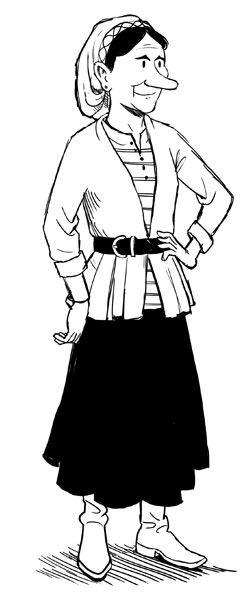
Fruma costume design for Hereville book 3

fruma-outfit

I can just make up outfits on the fly, rather than stopping drawing pages to design an outfit, but the resulting clothing tends to be extremely repetitive and bland. Much better to try and think the outfit through, and wind up with something that doesn’t look exactly like all the other outfits I’ve drawn Fruma in. (Although it’s clear that Fruma likes horizontal stripes, since I think this is the third or fourth time I’ve used horizontal strips in one of her outfits.) I haven’t shown Fruma wearing boots before, but this story takes place in the autumn, so I think boots make sense.

I like this outfit; it seems to occupy a point partway between frumpy and pirate.

Posted in Hereville | 3 Comments

Annie Oakley, Historical Cranky Lady

When I originally wrote this, the crowd-funding campaign for funding this book was still ongoing. It’s over now—but yay, it succeeded! Here’s what I wrote about it.

Cranky Ladies of History: Annie Oakley

Several months ago, Tehani Wessely and Tansy Rayner Roberts contacted me and asked if I would consider writing a story for their anthology, Cranky Ladies of History. “That sounds awesome,” I said, and also, “I so don’t have time.” But I agreed to do it anyway, partially because I (and all SFWAns, but especially me) owe Tansy Rayner Roberts a huge debt for her work on the interim issue of the Bulletin, which she co-edited brilliantly and in a ridiculously short amount of time. But also because this was an easy favor to grant—because come on, Cranky Ladies of History, how cool is that?

Cranky Ladies of History had met its crowd funding goal. They also had a blog tour where the anthology’s writers blogged about the cranky ladies they chose to crank about.

I spent some time in IM talking to Tansy about which Cranky Lady I should pick. Tzu Shi? Agrippina? Mary Anning? Ada Lovelace? Eventually, we decided on Annie Oakley.

You Can’t Get a Man with a Gun

If you don’t know who she is, Annie Oakley was a sharpshooter with Buffalo Bill’s Wild West Show. She grew up in poverty which necessitated that she learn to shoot so that she could help feed the family. After joining the Wild West Show, Annie became a hugely successful performer, especially groundbreaking as a woman.

She had a complicated relationship with feminism: she taught women to shoot, and she advocated for women to be allowed in the army. On other important women’s rights issues of the day, she wasn’t in synch with the feminist position. For instance, she opposed women’s suffrage.

Although the musical that was made about her life story, Annie Get Your Gun, includes the song, “You Can’t Get a Man with a Gun,” she sort of did. She married Frank Butler after beating him in a shooting competition.

I Can Do Anything You Can Do Better

With her gun, Annie Oakley could:

Shoot distant targets by sighting through a mirror

Shoot holes in thrown playing cards before they landed

Snuff a candle

Shoot a cigarette out of a man’s mouth

Shoot the cork off of a bottle

There’s No Business Like Show Business

Annie Oakley was an extremely highly paid performer, and she’s been called America’s first female superstar. One interesting aspect of her show biz persona was her conservative dress style. Pictures show a stiff, strong-featured woman with long brown hair, wearing loose blouses and calf-length skirts with boots. She often wears fringe, bolo ties, and a wide-brimmed cowboy hat.

In the photographs that don’t look posed, she stands in a masculine style, displaying no submissiveness or apology.

Doin’ What Comes Nat’rally

I first learned about Annie Oakley as a kid from the musical, Annie Get Your Gun, which is a fictionalized version of her life. I wonder whether the real Annie Oakley might be annoyed by the way it’s shaped around her relationship with a man. The plot begins when she meets Frank Butler and ends when they go to the altar.

The music is by Irving Berlin and the book is by Dorothy and Herbert Fields. It’s an old-fashioned musical with racist moments such as the song “I An Injun, Too.” Songs like “Doin’ What Comes Nat’rally” also romanticize the poverty she grew up in while maintaining a condescending attitude toward the rural poor.

The musical also features a lot of hits, including “There’s No Business Like Show Business.”

My father had an abbreviated medley of songs from Annie Get Your Gun on a piano roll for his 88-key upright player piano. While he pumped, I used to sit on the rug behind the piano bench, and sing along.

In college, I saw the show on Broadway with Bernadette Peters as the lead. I have a soft spot in my heart for “Anything You Can Do, I Can Do Better.”

The greatest woman rifle shot the world has ever produced

There’s a lot of research ahead of me as I decide what to write about Annie, her gun, and all those shot up playing cards. I don’t yet know what story I have to tell about her, but I look forward to the books and documentaries that will help me find it.

Posted in Uncategorized | 5 Comments

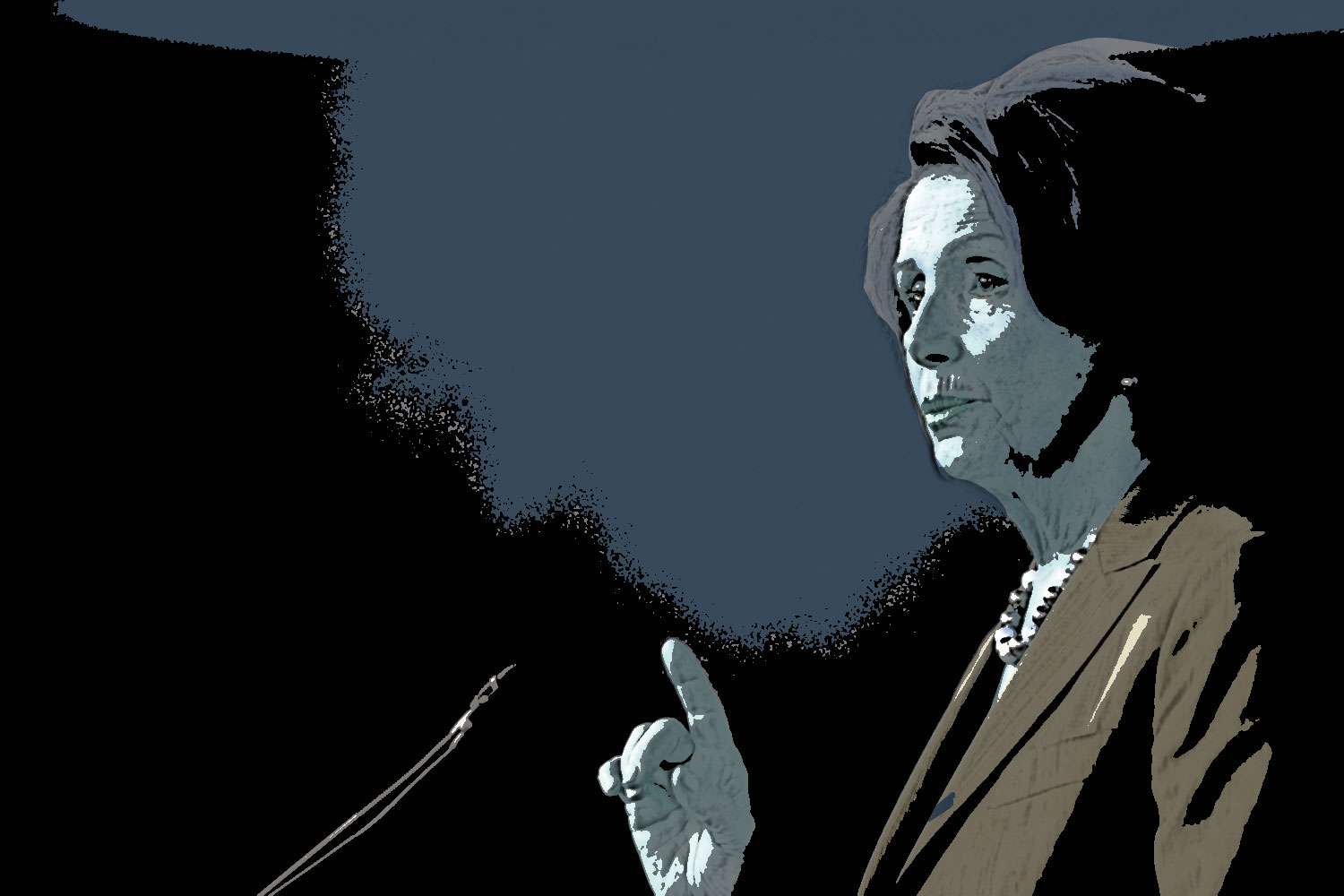
Pelosi didn’t say Congress would have to vote for the ACA to know what’s in it

pelosi

In another thread, Ron wrote:

The ACA is one example, when even the then-Speaker of the House said that Congress would have to vote for it to find out what’s in it…

Ron, regarding that Pelosi quote, here’s how Politico reported it the day Pelosi said it:

Pelosi: People won’t appreciate reform until it passes

Speaker Nancy Pelosi said Tuesday that people won’t appreciate how great the Democrat’s health plan is until after it passes.

“You’ve heard about the controversies, the process about the bill…but I don’t know if you’ve heard that it is legislation for the future – not just about health care for America, but about a healthier America,” she told the National Association of Counties annual legislative conference, which has drawn about 2,000 local officials to Washington. “But we have to pass the bill so that you can find out what is in it – away from the fog of the controversy.”

During a 20-minute speech, she touted benefits she thinks will be tangible to the audience’s employers. She said there’s support for public health infrastructure and investments in community health centers that will reduce uncompensated care that hospitals now need to deliver.

“You know as well as anyone that our current system is unsustainable,” said Pelosi (D-Calif.). “The final health care legislation, which will soon be passed by the Congress, will deliver successful reforms at the local level.”

She was saying that Americans won’t fully appreciate everything they get from Obamacare until it’s been implemented and in place for a while. She was NOT saying “Congress would have to vote for it to find out what’s in it.” There is simply no reasonable interpretation of Pelosi’s quote, in context, which would lead a fair observer to conclude she was saying Congress didn’t know what it voted for. (Indeed, if you read the full text of her speech, she had just spent two paragraphs describing some of the ACA’s specific effects.)

I can understand why you’d be mistaken about that – the media (and in particular right-wing media) has lied about what Pelosi said, if not from day one, then certainly from day two or so. But now that you’ve been told the truth, I hope you won’t repeat that canard again.

Incidentally, I defy anyone to name any legislation in our lifetime that has been more thoroughly covered in more detail before passage than the ACA. We had two years – at least – of play-by-play discussion of every legislative proposal related to the ACA before it passed. There was commentary from specialized ACA-beat reporters and health economists constantly available on the web the whole time. I’m not saying knowledge was perfect – it never is. But anyone who complains that information on the ACA wasn’t available before passage must have kept their head shoved firmly in their pants for two years or more, because that’s the only way to have so completely missed out on that news story.

Posted in Health Care and Related Issues | Comments Off on Pelosi didn’t say Congress would have to vote for the ACA to know what’s in it

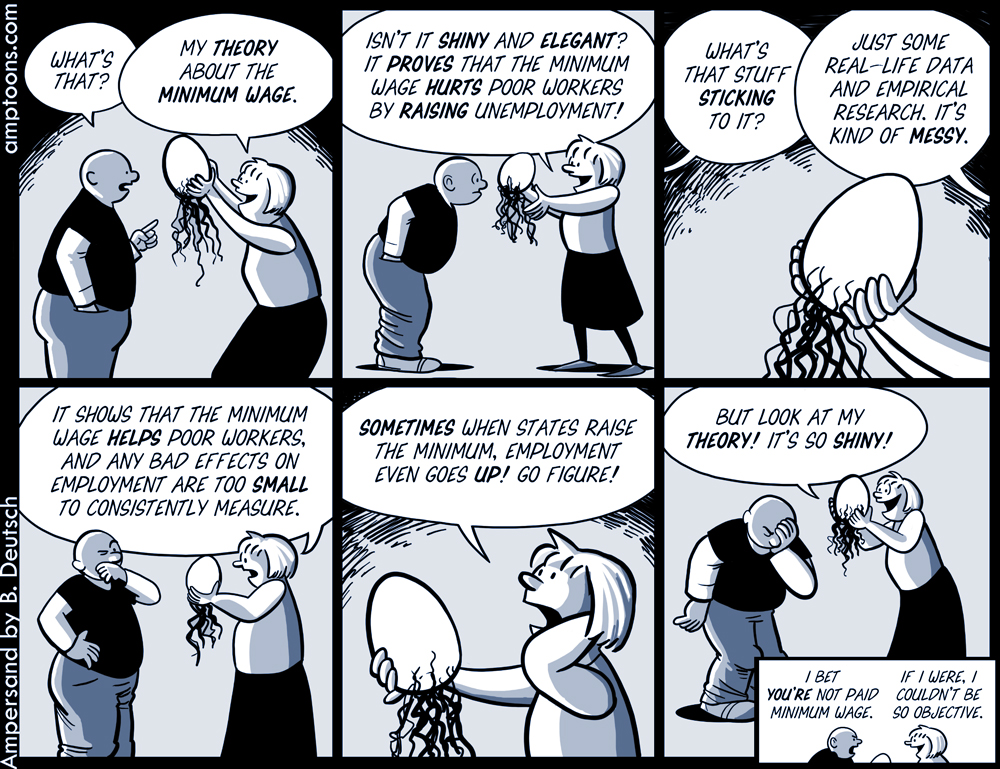
Two Reasons The American Action Forum’s New Minimum Wage Study Shouldn’t Convince Anyone

minimum_wage_theory

Fox News reports:

A new report from the conservative-leaning American Action Forum, shared exclusively with FOXBusiness.com, shows hiking the minimum wage hurts hiring.

The study looks at the 19 states that have minimum wages above the national rate of $7.25 an hour, as well as the 31 states in which the minimum wage is equal to the national average. The report finds that in 2013, a $1 increase in the minimum wage was associated with a 1.48 percentage point increase in the unemployment rate.

What’s more, this $1 hike also led to a 0.18 percentage point decrease in the net job growth rate, a 4.67 percentage point increase in the teen unemployment rate and a 4.01 percentage point decrease in the teenage net job growth rate. Overall, the AAF reports that high state minimum wages increased unemployment by 747,700 workers and reduced job growth by 83,300 jobs.

The study, “How Minimum Wage Increased Unemployment and Reduced Job Creation in 2013,” is published on AAF’s website.

I’ve read it, and I don’t think it’s persuasive, for two reasons: First, it’s an outlier, and second, its methodology compares apples and oranges, because it compares entire states rather than economically similar regions.

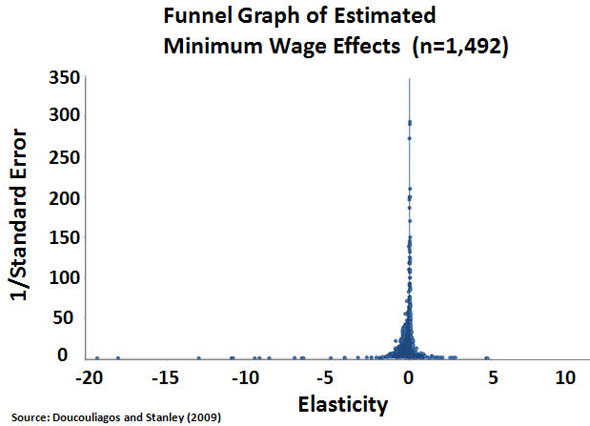
1) In 2009, Hristos Doucouliagos and T. D. Stanley – both PhD economists who are published experts in meta-analysis (they literally wrote the book on the subject, har har har) – “conducted a meta-study of 64 minimum-wage studies published between 1972 and 2007 measuring the impact of minimum wages on teenage employment in the United States. When they graphed every employment estimate contained in these studies (over 1,000 in total), weighting each estimate by its statistical precision, they found that the most precise estimates were heavily clustered at or near zero employment effects.” ((I’m quoting John Schmitt’s excellent overview of the debate; pdf link.))

Doucouliagos and Stanley concluded, “Two scenarios are consistent with this empirical research record. First, minimum wages may simply have no effect on employment… Second, minimum-wage effects might exist, but they may be too difficult to detect and/or are very small.” Here’s their graph:

minimum-wage-effects-on-tee

So this AAF study is, at best, an outlier. The evidence from 64 minimum-wage studies shows that the minimum wage either has no effect on teen unemployment, or that whatever effect it does have is extremely small. ((Another recent meta-analysis, by Dale Belman and Paul Wolfson (pdf link), had similar results, concluding “that there is a negative and generally statistically significant employment effect which is between small and vanishingly small.”)) ((To be fair, economists themselves seem to be split on the question of what effect the minimum wage has. However, a majority agreed that the minimum wage’s positive effects outweighed any negative effects.))

2) In 2010, in a study published in The Review of Economics and Statistics (pdf link), Arindrajit Dube, T. William Lester, and Michael Reich showed that minimum wage studies “that do not account for local economic conditions tend to produce spurious negative effects due to” regional effects in employment “that are unrelated to minimum wage policies.” ((In 2011, Dube and Reich replicated their finding using a different dataset, this time focusing on teen unemployment. Allegretto, Sylvia A., Arindrajit Dube, and Michael Reich. 2011. “Do Minimum Wages Really Reduce Teen Employment? Accounting for Heterogeneity and Selectivity in State Panel Data.” Industrial Relations, vol. 50, no. 2, pp. 205-240. ))

In other words, if you don’t control for regional differences in employment, it will look as if the minimum wage is correlated with higher unemployment; but the moment you account for regional differences, that finding disappears.

This is why the best studies of the minimum wage compare contiguous counties in neighboring states. The counties used to test minimum wage effects are, as much as possible, within a single economic region, except that one is in a state that has just raised its minimum wage. In other words, good studies compare apples with apples. The AAF’s hamhanded study, in contrast, compares entire states, as if the only economic difference between (say) Oregon and Georgia is minimum wage levels. They’re comparing apples and oranges.

(To be fair, the AAF study also controls for high school graduation rates. But that is literally the only confounding factor they consider. Nothing else – not region, not college graduation rates, not industry – is controlled for.)

How did they make such an amateur mistake? Possibly because this study was conducted by an amateur. Ben Gitis, who conducted the AAF study, graduated from college (undergraduate) less than a year ago, according to his AAF bio. Gitis majored in econ, but he’s not an economist, and he doesn’t know how to objectively measure effects of the minimum wage.

Posted in Economics and the like, Minimum Wage | 11 Comments

Boycott Firefox! says both sides of the Marriage Equality debate, and to hell with free speech

brendan-eich-robert-george

Well, certain members of both sides, at least.

OKCupid is taking a surprisingly strong stance against Mozilla. Right now, those who visit the hipster/nerdy dating site using Firefox see this message (full text here):

Hello there, Mozilla Firefox user. Pardon this interruption of your OkCupid experience.

Mozilla’s new CEO, Brendan Eich, is an opponent of equal rights for gay couples. We would therefore prefer that our users not use Mozilla software to access OkCupid. […]

OkCupid is for creating love. Those who seek to deny love and instead enforce misery, shame, and frustration are our enemies, and we wish them nothing but failure.

If you want to keep using Firefox, the link at the bottom will take you through to the site.

However, we urge you to consider different software for accessing OkCupid.

The reason this comes up now is that some Mozilla employees have been objecting to Eich’s recent promotion to CEO, because Eich donated $1000 to support Prop 8. (There is no sign that Eich has changed his views since then.) (Eich, incidentally, is credited with inventing Javascript.)

I think it’s fair for Mozilla employees to object to Eich’s promotion – it’s their company, they’re directly impacted by who runs it, and they have a stake in the company’s internal culture.

But OKCupid is in the wrong. Note that they are not asking that Mozilla change any specific corporate policies; rather, they are saying that no one who disagrees with them in private life about SSM should be CEO. This isn’t working to create real, positive change; it’s an attempt to economically punish Eich for disagreeing with them. “We wish them nothing but failure” is not a generous sentiment.

Now here’s where it gets funnier. Robert George, co-founder of NOM and the leading intellectual of the anti-marriage equality movement, read this article, in which Eich non-apologized “I express my sorrow at having caused pain.” Eich continued:

I am committed to ensuring that Mozilla is, and will remain, a place that includes and supports everyone, regardless of sexual orientation, gender identity, age, race, ethnicity, economic status, or religion.

Apparently even that weak corporate boilerplate statement ((You can read Eich’s full statement here.)) is more equality than Robert George can stomach. George, in a public post on his Facebook, called for boycotting Firefox:

I have just deleted Mozilla Firefox from my computer. If I’m not morally fit to be their employee, I’m not morally fit to use their products. If you are a faithful Catholic, Evangelical, Eastern Orthodox Christian, Mormon, Orthodox Jew, Muslim, or member of any other tradition that believes that marriage is fundamentally the institution that unites a man and woman as husband and wife to be father and mother to any children born of their union, providing those children with the inestimable blessing of being brought up in the committed bond of the man and woman whose union brought them into being, or even if you believe in marriage thus understood quite apart from membership in any community of faith, I would ask you to do the same. Why contribute to the prosperity of those who would exclude you? Cancel Firefox or any other Mozilla product. Sure, its competitors are probably “just as bad,” but we have an opportunity here to send a message to all of them.

Problems with both their approaches:

1) It goes against what I think of as a “free speech culture” to encourage an companies to fire employees (even CEOs) based not on how well the employees can do the job, but on their stands on current political controversies. Although there’s no government censorship going on here, that’s not enough. Truly open and free speech – substantive free speech – won’t exist if people are afraid of being fired for taking a side on a controversial issue.

2) It doesn’t actually advance anyone’s cause in any meaningful way. (Admittedly a plus as far as Mr. George’s bigoted cause is concerned).

3) It encourages people to think of politics as a matter of maintaining personal purity through choosing the correct products, rather than making meaningful change.

This sort of approach makes both sides look like bumblers and busybodies, searching around for a high horse to nit-pick from, and makes both sides look as though they aren’t committed to a civil debate or the ideal of substantively free speech. I don’t know if Robert George’s side can do better, but I’m certain the pro-SSM side can.

Posted in Free speech, censorship, copyright law, etc., Same-Sex Marriage | 44 Comments

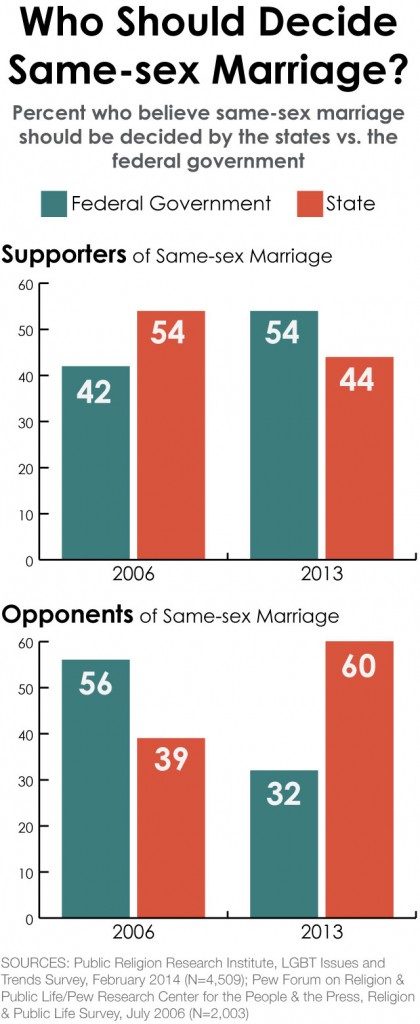
Federalism is Usually Opportunistic

ssm-and-federalism

Another example: House Republicans Want To Sue The President For Not Arresting People For Marijuana

Posted in Same-Sex Marriage | 15 Comments

Government And Social Suppression of Free Speech

Shout

Set off by the genuinely appalling theft of a huge anti-abortion sign (one of those signs with gross photos of allegedly abortion-age fetuses) by a feminist Professor at UC Santa Barbara, Freddie deBoer has a pair of posts arguing that the “social justice left” is abandoning free speech.

Although I don’t question Freddie’s report that “it is not at all unusual, for me, to encounter liberals and leftists who […] do not believe that controversial speech (what they call hate speech) should be legally expressible,” I do wonder if the people Freddie hangs out with are a representative sample of lefties. As Corey Robin points out, if anything today’s left seems less likely to question the legal doctrine of free speech than (say) during the Reagan years, when the MacKinnon/Dworkin anti-porn legislation was a major issue. Where is today’s equivalent of Catherine MacKinnon?

Anyway, I’m not posting to argue with Freddie. Rather, I wanted to get down some thoughts about different types of threats to free speech.

First, we have Government Suppression of Free Speech. This includes (but isn’t limited to):

1) When governments directly outlaw certain speech content – for example, the German government outlawing Holocaust Denialism, or the US outlawing cigarette advertising on TV.
2) The government determining that some public areas are not open to protest, such as “free speech zones.”
3) Copyright laws and trademark laws.
4) The government using the law, or the bureaucracy, to punish people for their speech. Or even just threatening to do so, as Boston Mayor Thomas Menino did when he said “If [Chick-Fil-A] needs licenses in the city, it will be very difficult,” in response to Chick-Fil-A’s owner’s opposition to same-sex marriage. (Menino backed down from his position, thankfully.)
5) Laws against libel and slander.
6) Directly shutting down newspapers and other media outlets.
7) Arresting protestors.

It doesn’t take much imagination to imagine contexts for most of those forms of government suppression of free speech that almost anyone who isn’t an anarchist would say is legitimate. We can’t say that it’s always wrong to arrest a protestor; to be able to make that call, we’d want to know the fuller context (what was the protestor actually doing that got her arrested?).

Second, we have Social Suppression of Free Speech. This includes (but isn’t limited to):

1) Social sanctions for stating the “wrong” opinions – or so much fear of social sanctions that speech is “chilled.” When right-wingers complain that for a left-winger to use the term “bigot” or “racist” “shuts down speech,” I think this is what they mean.
2) Economic sanctions for stating the “wrong” opinions. Or, again, so much fear of economic sanctions (such as losing a job) that speech is “chilled.”
3) Protests that have the effect of shutting down opposing speech – for instance, if protestors in an audience yell so loud that it’s not possible to hear the speaker. ((Ken White at Popehat had a great comment about this: “The doctrine of the Preferred First Speaker holds that when Person A speaks, listeners B, C, and D should refrain from their full range of constitutionally protected expression to preserve the ability of Person A to speak without fear of non-governmental consequences that Person A doesn’t like. The doctrine of the Preferred First Speaker applies different levels of scrutiny and judgment to the first person who speaks and the second person who reacts to them; it asks “why was it necessary for you to say that” or “what was your motive in saying that” or “did you consider how that would impact someone” to the second person and not the first. It’s ultimately incoherent as a theory of freedom of expression.”))
4) Capitalistic suppression, in which the owners of capital – such as newspapers, blogs, auditoriums, tv networks, etc – decide not to publish certain views. Or, for that matter, when the owners of an auditorium have security remove the people protesting the speaker.

I think that, for most Americans, social and economic sanctions are probably the things that are actually most likely to be shutting us up on a day-to-day basis. And when people say they want a “culture of free speech,” I think what they mean is they want a culture in which social and economic sanctions for speech are rare, or at least proportionate.

I can’t imagine any possible policy approach to decreasing “social sanctions” in which the cure wouldn’t be worse than the disease. But I would favor legal protections for employees so that they don’t have to fear being fired for their off-work-hours political speech, unless that speech is somehow directly relevant to job performance.

Posted in Free speech, censorship, copyright law, etc. | 29 Comments

Open Thread: The Pants Have Faces Edition

2014-03-26

Feel free to post whatever you want. Self-linking makes the world go “squeee!”

Posted in Link farms | 106 Comments