-
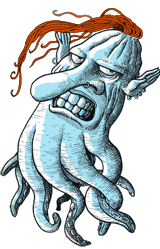
Am I the only one who read "Beware the narcoterrorists" and thought "beware the jabberwock"?
@beth: Thank you
@Watcher If you scroll through Barry's old cartoons on leftycartoons.com, some of the old ones are about Clinton, while some…
@Watcher: Much as I would like to have Obama or Clinton or even Dubya* back rather than the current wannabe…
-
In Answer to the Person Who Recently Asked Me What My Poems Are About
I feared back then a world I couldn’t name,
Posted in Writing
2 Comments
Questions linger over US Border Patrol’s killing of 16-year-old
From the article:
The bullet hit Elena in the back of the head. He slumped mortally wounded to a sidewalk on the Mexican side, a few paces from the border fence. At least two agents, perched on the U.S. side about 20 feet above the street and shielded by the fence’s closely spaced iron bars, continued to fire, witnesses said. In all, 10 bullets struck Elena, spattering a wall behind him with blood.
Yet Jose Antonio Elena may not have tossed any rocks at all. He may have been just walking on a sidewalk on Mexican soil, an innocent passerby.
The Border Patrol has a video of the events that night, Oct. 10, 2012. The video likely shows whether U.S. agents killed an innocent Mexican or shot a member of a marijuana smuggling ring. But the U.S.’s largest law enforcement agency refuses to make the video public. The agents remain on the job, neither publicly identified nor receiving any disciplinary action.[…]
One witness on the Mexican side of the border calls Elena’s death murder. Those tossing rocks ran down a side street, escaping before the shooting started, he said. Elena was walking on the sidewalk when the rock throwers darted past him.
“To me, it was cold-blooded murder,” said Isidro Alvarado Ortiz, a 37-year-old security guard who said he was walking about 30 paces behind Elena when the agents opened fire.
Alvarado has given testimony to the FBI but like several Mexicans involved in the case, he has grown frustrated at the lack of U.S. action on the investigation.
“Imagine if it had occurred the other way around – if a Mexican had killed one of them. They would’ve come the next day to get the person,” Alvarado said. […]
Overhead – at the top of the knoll on the U.S. side of the border – is a metal pole topped with remotely operated video cameras that monitor the border. There is little doubt that one of the cameras captured the scene, including whether any rock thrower wore clothing matching what was found on Elena.
What appears on that video “is huge. It’s very important. It will verify whether the civilian witnesses are being truthful about what occurred that evening,” said Luis F. Parra, an American attorney for Elena’s family who has filed a notice of claim against the U.S. government for wrongful death.
“If it showed him throwing rocks, they would have exhibited it already,” added the family’s Mexican attorney, Manuel Iniguez Lopez.
Reticence by the Border Patrol to release the video is understandable. Errors in judgment would be embarrassing to agents and potentially costly to taxpayers.
That last paragraph seems bizarre to me. Yes, the desire of alleged criminals to cover up evidence of their alleged crime is “understandable,” but that doesn’t mean it’s not reprehensible.
Posted in Immigration, Migrant Rights, etc
2 Comments
Political cartoon: Marriage Fixes Everything!
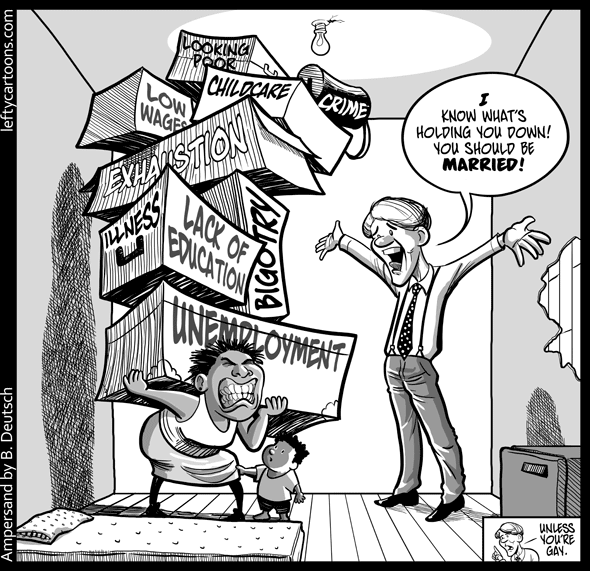
Description of cartoon:
The cartoon depicts a young mother and her toddler, in a small and crappy-looking room. The woman is bent double under a load of boxes, trunks and bags, each of which is labeled: Unemployment, Lack of Education, Illness, Bigotry, Exhaustion, Low Wages, Childcare, Looking Poor, and Crime.
Also in the room is a young white guy, wearing a necktie and suspenders, who is grinning happily and telling the woman “I know what’s holding you down! You should be married!”
In a little “epilog” panel at the bottom of the cartoon, the guy continues “…Unless you’re gay.”
What’s Sexist About The Faces In Disney’s Frozen
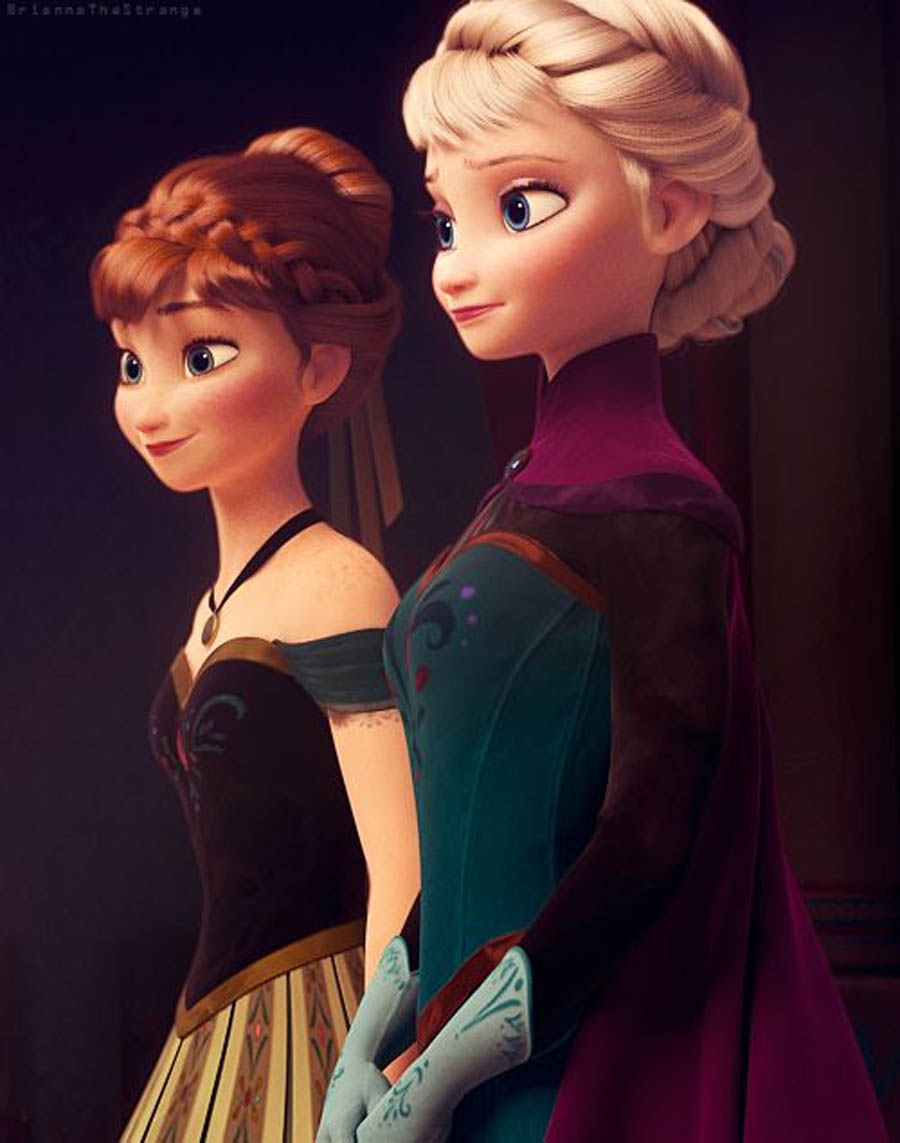
Animation student Gianna has blogged an excellent essay critiquing the identical faces of the protagonist sisters in Disney’s Frozen.
Disney has already proven that that they can easily design female characters who don’t have the Exact Same Face. Then they started doing that on Frozen, but someone — probably one of the higher-ups or executives, I seriously doubt it was the character designers — said, “No, make them look like this.” And they knew full well that they looked identical and also extremely similar to Rapunzel, because anybody with eyes can see that.
Don’t even tell me it’s because they’re sisters, because I have two sisters, and I don’t look identical to either of them. I have never met a pair of non-twin siblings who had the Exact Same Face. It doesn’t even make sense for the story, because Elsa’s face in particular hardly fit her character or voice actress. […]
So now that we’ve ruled out laziness, lack of ability, or some story-based cause as reason for their Sameface Syndrome, and taking into account the trend of “good people = pretty; bad people = ugly” that’s always been so prevalent in Disney, the truth becomes clear.
Rapunzel, Anna, and Elsa all look the same because they’re supposed to be beautiful.
And Disney has decided, either consciously or subconsciously, that there’s only one way to look beautiful. For women, that is.
I agree with this analysis, but I wonder if it doesn’t additionally have to do with making the characters look more like what Disney’s marketing people believe will be the most sell-able toy versions of the characters.
Elsewhere in her essay, Gianna refers to Disney’s big (and, imo, positive) move away from realistic faces for female leads with The Little Mermaid. I’ve always thought the reason Disney did that is that the title character is mute for huge portions of The Little Mermaid, forcing them to make Ariel’s face extra expressive, rather than porcelain-doll pretty.
But with Frozen, Disney has taken a giant step backwards to pre-Mermaid days. The princess characters are made to look like porcelain dolls, and really have the least expressive faces of any Disney princess since Eilowny in 1985’s Black Cauldron. Gianna writes:
Anna and Elsa’s facial expressions, particularly Elsa’s, were significantly dialed back at the animation stage to prevent their faces from stretching out of shape and making them look ‘too ugly,’ producing the side effect of making them look oddly stiff. Stretching and exaggerating faces to get good overall movement is one of the basic principles of animation, and I’m concerned that Disney decided to throw it out in favor of making their women look slightly more attractive, especially since I haven’t noticed this in any other Disney Princess films.
So no, I don’t think Frozen is the most feminist Disney film ever – that title remains with either Mulan or Brave. And part of the reason why is Frozen‘s distinctly un-feminist character design.
More anti-Frozen ranting: The problem with false feminism. Although really, I liked Frozen a lot. But it had flaws.
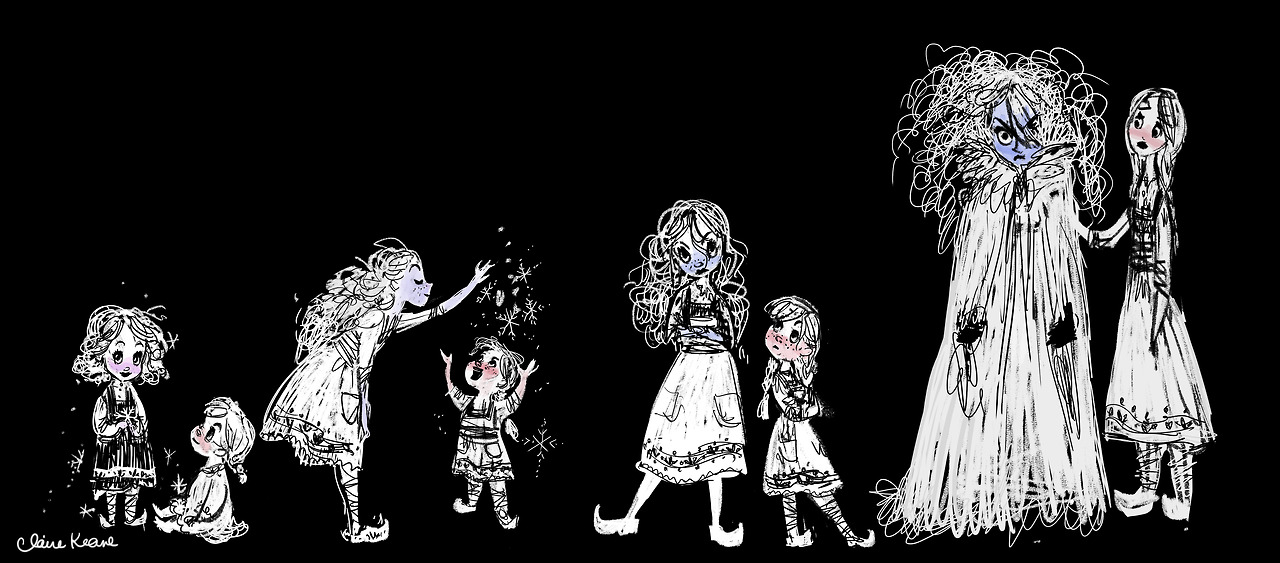
Update: Early conceptual art of the sisters from Frozen.
Ellen Klages, Toastmaster of the 2014 Nebula Awards
I am so excited that Ellen Klages is going to be the Toastmaster for this year’s Nebula Award weekend!
The announcement went up on SFWA’s website a bit ago, but I just wanted to repeat it for people who missed it. And also because it’s so awesome.
I’m a big fan of Ellen Klages’s writing. One of my favorites young adult fantasy story “The House of the Seven Librarians” which first appeared in Firebirds Rising and which I got to narrate for PodCastle, and which you can get a kindle single version of, too. But by no means is this the only wonderful thing Ellen has written: you’ve got to check out her collection, Portable Childhoods. I mean that. Check it out. It’s got a number of really smart stories, including her first ever published story, “Time Gypsy,” which I love for its description of a particular moment in lesbian history (and its invocation of early women scientists). I also really like the titular story, “Portable Childhoods,” which isn’t genre at all, but instead an interesting set of vignettes which together create an emotionally affecting arc about mother and daughter.
There are also fantastic stories by Ellen that don’t appear in her collection. Probably my favorite of those is “The Education of a Witch” which first appeared in Under My Hat, edited by Jonathan Strahan. It’s about a young girl who identifies with the evil queen character in Snow White instead of the princess.
I say “probably my favorite” because it’s hard to decide between that and “Wakulla Springs”, which you can find on Tor.com. She cowrote this novella with Andy Duncan who is also brilliant, and it’s on this year’s Nebula ballot.
Ellen is a keen observer of setting and dialogue, but particularly skilled at creating realistic, non-sentimental writing about children and the experience of childhood. More than almost any other writer, she captures the details and disjunctions of childhood in a way that is both strongly tied to time and place (she often writes about the fifties) but also emotionally recognizable to me as a child of the eighties. She doesn’t get bogged down in adult ideas of what “childhood is like,” but looks at it with a sharp, clear eye.
Ellen is also very funny. She’s been working the Tiptree auction at Wiscon for many years where she stirs the audience with improvisation. She’s an animated delight in conversation. Annually at FogCon, she appears on the Liar’s Panel, which as you might imagine involves lying wildly. She told me that last year, she accidentally told a bunch of true stories, and no one noticed because they were so funny and strange. Just talking to her is like that: she has a well of funny, true anecdotes and observations. I’m excited to see that energy and storytelling ability translate to the Nebula podium.
There aren’t very many women toastmasters on the convention circuit. Connie Willis does her amusing duty from time to time, which is awesome, but I’d love to see more ladies taking the stage. In addition to Ellen Klages, I hope conventions will consider Charlie Jane Anders, Mary Robinette Kowal, and other talented women performers for future ceremonies.
This is going to be a great Nebulas. With Ellen Klages there as toastmaster, and Samuel Delany coming in as our new Grandmaster (squee!)… I’m really excited to get to be there and to hear such talented people speak.
This year’s Nebula Awards Weekend is May 15th to 18th, 2014, at the Marriott in San Jose. There are more details on the SFWA website.
Posted in Uncategorized
Comments Off on Ellen Klages, Toastmaster of the 2014 Nebula Awards
Rachel Swirsky’s Recommendations for the 2014 Campbell Awards
There are two weeks left until the end of the Hugo nomination period, and I wanted to blog about some of the awesome writers I’ve found this year or last year who are eligible for the Campbell Award.
For those who don’t know, the Campbell Award is given to notable new writers of science fiction and fantasy. Whether or not you’re nominating for the Campbell, you should check these writers out because they’re repositories of new, exciting energy and ideas.
At the end of the post, I’ll also include a few brief lines about some of the other Campbell candidates I’m considering nominating, who are also worth checking out.
As always, I’m sure there are many, many very fine authors that I’m missing out on. I focus on short stories instead of novels (and I feel justified in doing that because so many people do the opposite) so I am automatically biased that way. But more than that, I just don’t get to all the stories I should! And there are also the problems of memory.
The metric I’m using for pulling people out is that they either have to have had one work that I found overwhelmingly wonderful, or else a body of work that includes quite strong stories. If people have only come out with one thing that I consider quite strong (but not “OMG so great I can’t even handle it!”) then I’m leaving them off this particular list.
I note that I’m also trying to correct for bias toward people I know well, such as Emily Jiang and Chris Reynaga. They both published things I respected last year, but I can’t report the experience of coming to the work cold, and neither has a substantial enough published body of work for me to feel like I can double check myself.
For a partial list of people who are eligible for the Campbell, you can check here. Not everyone who is eligible knows to put in their name, but it’s a place to start.
I’ll also note here that I have reservations about the Campbell Award. Not the concept of it (yay new writers!), so much as the fact that it’s very, very hard for an award with such tight restrictions to be comprehensively judged by popular vote. By the nature of the thing, many new writers, no matter how exciting, don’t have the time to build a significant public profile while they’re eligible, even if they are producing exciting work. That’s not to say that the nominees and winners aren’t often awesome, but it’s hard for the award to be really comprehensive. So, you can take this as my attempt to get a few more names out there for the award, or just as an attempt to get some awesome new writers read independently of the Campbell. Either way.
In alphabetical order:
Brooke Bolander is in her second year of eligibility.
Work you should read immediately: Tornado’ s Siren” on Strange Horizons
Brooke Bolander has published a number of short stories, the bulk of them in Lightspeed. The first story of hers that I read was “Her Words Like Hunting Vixens Spring.” Also notable is “Sun Dogs,” a story about Laika, the first dog sent into space.
Brooke has an unusual voice that takes advantage of disjunctive leaps of imagery to create a series of dense and surreal impressions. Sometimes they are whimsical; sometimes dark. I find her writing very grounded in the body—hot, cold, lonely—she evokes physical sensations in me.
I like the charming whimsy of “Tornado’s Siren,” but in many ways it’s a less ambitious story than the more complex and unresolved concepts of “Her Words Like Hunting Vixens Spring” and “Sun Dogs;” I consider those stories to not have totally realized their potential, but in a wonderful, interesting way, full of unusual and striking material.
I find it hard to think of a writer to compare her work to. There may be a touch of Aimee Bender in the texture of the unusual imagery that she uses to evoke emotion.
Carmen Maria Machado is in her first year of eligibility.
Work you should read immediately: “Inventory” on Strange Horizons
Carmen and I both went to the Iowa Writers Workshop but for some reason we failed to intersect through that channel. I missed her story “Inventory” when it came out in Strange Horizons due to my rushed reading this year, but luckily, Carmen submitted it as a potential reprint to Women Destroy Science Fiction. It didn’t work out for that purpose, but it’s a strong story that put Carmen on my radar, and which may nudge its way onto my Hugo ballot.
Carmen has also published a number of other short stories appearing in a wide scatter of venues, some of which are familiar to speculative fiction readers (like Lightspeed and Shimmer) and some of which aren’t. In particular, I’m looking forward to reading her story from issue #2 of Unstuck (it’s out of print, but you can still get electronic editions), a journal which publishes work that lies on the boundary of speculative and literary fiction. It’s a neat journal and more people should check it out.
About “Inventory,” I wrote in a recent blog post, “Exquisite telling detail transforms this list story (a format that I have a weakness for) into something emotional and poignant. Machado has experience writing in the lit world and brings those chops to the development of this sad, post-apocalyptic tale, told on a very personal level. By detailing moments of togetherness, Machado creates in the reader the sensation of loneliness that her character feels, isolation that persists despite touch and intimacy. Read for character, language, and emotion.
Sofia Samatar is in her second year of eligibility.
Work you should read immediately: A STRANGER IN OLONDRIA (Small Beer Press)
Sofia Samatar’s novel is on the Nebula ballot this year, as is her Strange Horizons short story, “Selkie Stories are for Losers.”
I particularly loved her short story in Glitter and Mayhem, “Bess, the Landlord’s Daughter, Goes to Drinks with the Green Girl.” It’s an amazing story. I wrote about it in my short story recommendations for 2013: “This surreal story is about two ghost girls who are known by their ghost stories, and how they navigate their unlives in the wake of that endless, unavoidable trauma. I thought it discussed living with violence really intelligently as well as being beautifully written.”
Sofia’s prose and imagery are really beautiful, and her observation of character and detail sharp. Her body of work thus far is impressive, and it’s clear she’s a major talent.
Benjanun Sriduangkaew
Benjanun Sriduangkaew is in her first year of eligibility.
Work you should read immediately: “Silent Bridge, Pale Cascade” (Clarkesworld)
I first read Benjanun Sriduangkaew’s work last year in Giganotosaurus. In the novella,”
She also writes short stories based in a space operatic world. Two from this year include “Silent Bridge, Pale Cascade” (linked above) and “Annex,” both in Clarkesworld. Her space opera world is an intricate weave of interesting technology and eye-kicks, dealing explicitly with the territories of colonialism, gender, and identity. In this year’s short story recommendations, I wrote about her space opera world: “Like much far future work, [the world] loops away from the comfortable details of the present into very strange imagery, wrapping around toward the oddness of surrealism or high fantasy.”
Benjanun’s work is really interesting with a distinct, strong point of view. Her space opera overlaps thematically with Ann Leckie’s novel, Ancillary Justice, but style-wise, she’s on her own. Her ability to write epic storylines over the course of short stories is particularly impressive and unusual. I look forward to seeing what she does with a novel if she’s writing one; her stories suggest she’d be a natural at it, but they are also wonderful in themselves and shouldn’t be underestimated on account of their form.
Some other folks I’d like to chat about:
Henry Lien is in his first year of eligibility.
His first ever published piece, the novelette “Pearl Rehabilitative Colony for Ungrateful Daughters,” which appeared in Asimovs Magazine, is on this year’s Nebula ballot. Although many people clearly loved this novelette, I’m lukewarm about it. The basic concepts are neat (it’s about young girls practicing a martial art based on something similar to ice skating), but I found the voice of the teenage main character unconvincing—to me, it seemed like a stereotype drawn from adult ideas of what teenage girls are like, rather than drawing from actual teenage girls.
If I were looking at this story alone, I’d think he was an interesting writer with some space to grow. Which, as a new writer, he is. However, I’m also in a writing group with him, and I’ve had the privilege of reading some of his unpublished work, especially the beginning of his young adult novel. From that, I know that he’s a powerhouse.
I probably won’t nominate him for the Campbell because I don’t feel comfortable doing so on the basis of what I’ve read privately, but I know that I’m really excited to see what he keeps producing, and I do recommend him as a name to look out for.
Also, check out his website to see the beautiful, surreal work by the artists he works with. He has amazing taste in art.
Joy Kennedy O’Neill
Joy Kennedy O’Neill is in her second year of eligibility.
“Aftermath” from Strange Horizons (link goes to the first of two parts) was one of my favorite novelettes from last year.
I wrote about it, “This is one of the few zombie stories that I’ve really liked. It’s about the process of reconciliation that occurs after the zombies recover and how they reintegrate into society. The novelette intelligently references and builds on real-world situations like the post-apartheid recovery in South Africa. Mending the sociological rifts left by genocide and other atrocities requires a sort of willful social blindness, a denial of what’s happened. In the novelette’s case, the zombies did not have control over their actions, so the story necessarily removes the question of responsibility for the atrocities, which does make the reconciliation process less intense than it is in real life. Nevertheless, I think O’Neill intelligently explores the ways in which people act to protect themselves psychologically: denying what has happened, denying what they did, the ways in which the socially mandated silence creaks and cracks.”
This really smart and well-developed story makes me excited to see what else Joy Kennedy O’Neill will do in the future.
Posted in Writing
2 Comments
Hereville Wins An Oregon Book Award And I Am Surprised
I attended the Oregon Book Awards tonight with my friend Becky Hawkins; Hereville: How Mirka Met a Meteorite was nominated for the “Graphic Literature” category, but had no chance of winning, since the competition included Joe Sacco and Craig Thompson, both of whom are 600-pound gorillas of cartooning awards (and deservedly so). And also nominated was my pal Shannon Wheeler, who is a friggin’ New Yorker cartoonist, and an award-winning gorilla himself, albeit perhaps more of a 450-pound gorilla.
So I had NO chance.
And then I WON!!!!!!!

I can’t possibly describe how surprised I was. (And thrilled. And honored.)
BTW, Joe Sacco wasn’t there tonight, but Craig Thompson greeted me afterwards with a big hug and congratulated me. (I had only met him once before, but he seems very nice). And Shannon was also very nice, but of course I know him well enough to expect him to be gracious.
Posted in Hereville
16 Comments
School Won’t Let Bullied Boy Bring ‘My Little Pony’ Bag to Class
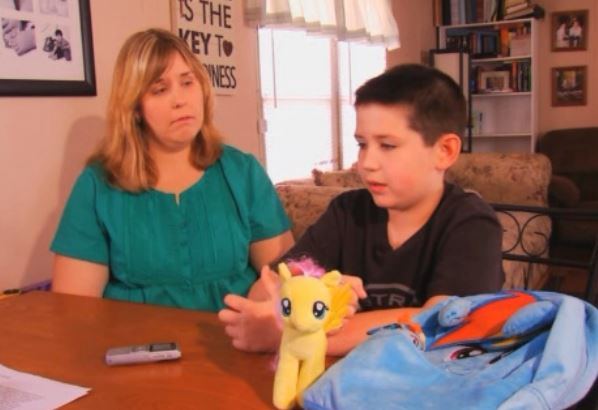
School Won’t Let Bullied Boy Bring ‘My Little Pony’ Bag to Class.
Thank goodness they weren’t bullying him over having red hair, or the school would presumably have told him to shave his head. Because giving the bullies what they want is always the best solution, and furthermore whatever it is the bullies have currently fixated on is sure to be the root cause of the bullying. Right?
The article notes that Grayson Bruce, the subject of the article, isn’t the only North Carolina boy to deal with Pony-related bullying:
Grayson Bruce isn’t the only North Carolina “Brony”—a popular term used to describe male “My Little Pony” fans—to make headlines for being bullied about his interest in the show. In January, 11-year-old Michael Morones, of Wake County, tried to commit suicide because he was tormented at school for his love of “My Little Pony.”
I don’t think that Grayson will suddenly stop being bullied if he leaves his My Little Pony bag at home. In fact, I suspect that being an open MLP fan is Grayson’s way of resisting the bullying that takes place anyway. Grayson is unwilling or unable to go along with what’s expected of him as a boy, and boys who don’t fit in with gender norms are always punished. I’m sure he loves My Little Pony as a show, but at some level, I believe he’s using his MLP bag as a way of openly defying the bullies, both among his peers and (it seems) in the school administration, who are trying to force him to conform to the norms of boyhood. And in my eyes, at least, Grayson’s defiance is nothing less than heroic.
Posted in Feminism, sexism, etc, In the news, Sexism hurts men
33 Comments


I heavily criticized Obama for his drone strikes, but I do think there are legal (maybe not moral[?]) differences even…