Panti Bliss Lectures About Being Lectured About What Is Not Homophobia

Drag queen performer and “accidental and occasional gay rights activist” Rory O’Neill, aka Panti Bliss, gave a wonderful speech. It’s worth listening to the whole thing (about ten minutes), or at least reading through the transcript.

)

Here’s my favorite bit, but the full transcript follows.

And for the last three weeks I have been lectured by heterosexual people about what homophobia is and who should be allowed to identify it. Straight people – ministers, senators, lawyers, journalists – have lined up to tell me what homophobia is and what I am allowed to feel oppressed by. People who have never experienced homophobia in their lives, people who have never checked themselves at a pedestrian crossing, have told me that unless I am being thrown in prison or herded onto a cattle train, then it is not homophobia.

And that feels oppressive.

So now Irish gay people find ourselves in a ludicrous situation where not only are we not allowed to say publicly what we feel oppressed by, we are not even allowed to think it because our definition has been disallowed by our betters.

And for the last three weeks I have been denounced from the floor of parliament to newspaper columns to the seething morass of internet commentary for “hate speech” because I dared to use the word “homophobia”. And a jumped-up queer like me should know that the word “homophobia” is no longer available to gay people. Which is a spectacular and neat Orwellian trick because now it turns out that gay people are not the victims of homophobia – homophobes are.

I read that quote on Tumblr, and I reblogged it on my own Tumblr, adding:

Reblog, reblog, a thousand times reblog. The biggest lie the devil ever told was that homophobia is “only a slur word,” that bigotry is “only a pejorative,” that there is no such thing as sexism, as racism, as cissexism, that these are all words that have been made up by mean liberals, with no meaning apart from meaning to make innocent straight white cis men feel saaaad.

Well, screw that. Bigotry exists, and the reason so many people are so devoted to claiming that bigotry ain’t nothing but a slur word is because they don’t want bigotry named, because something that is named is something that can be discussed and fought, and they sure don’t want that to happen.

Full transcript (taken from AmericaBlog, which also has some background if you want it):

Hello. My name is Panti and for the benefit of the visually impaired or the incredibly naïve, I am a drag queen, a performer, and an accidental and occasional gay rights activist.

And as you may have already gathered, I am also painfully middle-class. My father was a country vet, I went to a nice school, and afterwards to that most middle-class of institutions – art college. And although this may surprise some of you, I have always managed to find gainful employment in my chosen field – gender discombobulation.

So the grinding, abject poverty so powerfully displayed in tonight’s performance is something I can thankfully say I have no experience of.

But oppression is something I can relate to. Oh, I’m not comparing my experience to Dublin workers of 1913, but I do know what it feels like to be put in your place.

Have you ever been standing at a pedestrian crossing when a car drives by and in it are a bunch of lads, and they lean out the window and they shout “Fag!” and throw a milk carton at you?

Now it doesn’t really hurt. It’s just a wet carton and anyway they’re right – I am a fag. But it feels oppressive.

When it really does hurt, is afterwards. Afterwards I wonder and worry and obsess over what was it about me, what was it they saw in me? What was it that gave me away? And I hate myself for wondering that. It feels oppressive and the next time I’m at a pedestrian crossing I check myself to see what is it about me that “gives the gay away” and I check myself to make sure I’m not doing it this time.

Have any of you ever come home in the evening and turned on the television and there is a panel of people – nice people, respectable people, smart people, the kind of people who make good neighbourly neighbours and write for newspapers. And they are having a reasoned debate about you. About what kind of a person you are, about whether you are capable of being a good parent, about whether you want to destroy marriage, about whether you are safe around children, about whether God herself thinks you are an abomination, about whether in fact you are “intrinsically disordered”. And even the nice TV presenter lady who you feel like you know thinks it’s perfectly ok that they are all having this reasonable debate about who you are and what rights you “deserve”.

And that feels oppressive.

Have you ever been on a crowded train with your gay friend and a small part of you is cringing because he is being SO gay and you find yourself trying to compensate by butching up or nudging the conversation onto “straighter” territory? This is you who have spent 35 years trying to be the best gay possible and yet still a small part of you is embarrassed by his gayness.

And I hate myself for that. And that feels oppressive. And when I’m standing at the pedestrian lights I am checking myself.

Have you ever gone into your favourite neighbourhood café with the paper that you buy every day, and you open it up and inside is a 500-word opinion written by a nice middle-class woman, the kind of woman who probably gives to charity, the kind of woman that you would be happy to leave your children with. And she is arguing so reasonably about whether you should be treated less than everybody else, arguing that you should be given fewer rights than everybody else. And when the woman at the next table gets up and excuses herself to squeeze by you with a smile you wonder, “Does she think that about me too?”

And that feels oppressive. And you go outside and you stand at the pedestrian crossing and you check yourself and I hate myself for that.

Have you ever turned on the computer and seen videos of people just like you in far away countries, and countries not far away at all, being beaten and imprisoned and tortured and murdered because they are just like you?

And that feels oppressive.

Three weeks ago I was on the television and I said that I believed that people who actively campaign for gay people to be treated less or differently are, in my gay opinion, homophobic. Some people, people who actively campaign for gay people to be treated less under the law took great exception at this characterisation and threatened legal action against me and RTÉ. RTÉ, in its wisdom, decided incredibly quickly to hand over a huge sum of money to make it go away. I haven’t been so lucky.

And for the last three weeks I have been lectured by heterosexual people about what homophobia is and who should be allowed to identify it. Straight people – ministers, senators, lawyers, journalists – have lined up to tell me what homophobia is and what I am allowed to feel oppressed by. People who have never experienced homophobia in their lives, people who have never checked themselves at a pedestrian crossing, have told me that unless I am being thrown in prison or herded onto a cattle train, then it is not homophobia.

And that feels oppressive.

So now Irish gay people find ourselves in a ludicrous situation where not only are we not allowed to say publicly what we feel oppressed by, we are not even allowed to think it because our definition has been disallowed by our betters.

And for the last three weeks I have been denounced from the floor of parliament to newspaper columns to the seething morass of internet commentary for “hate speech” because I dared to use the word “homophobia”. And a jumped-up queer like me should know that the word “homophobia” is no longer available to gay people. Which is a spectacular and neat Orwellian trick because now it turns out that gay people are not the victims of homophobia – homophobes are.

But I want to say that it is not true. I don’t hate you.

I do, it is true, believe that almost all of you are probably homophobes. But I’m a homophobe. It would be incredible if we weren’t. To grow up in a society that is overwhelmingly homophobic and to escape unscathed would be miraculous. So I don’t hate you because you are homophobic. I actually admire you. I admire you because most of you are only a bit homophobic. Which all things considered is pretty good going.

But I do sometimes hate myself. I hate myself because I f*cking check myself while standing at pedestrian crossings. And sometimes I hate you for doing that to me.

But not right now. Right now, I like you all very much for giving me a few moments of your time. And I thank you for it.
Posted in Homophobic zaniness/more LGBTQ issues, Lesbian, Gay, Bi, Trans and Queer issues | 2 Comments

If Only More Oppressed People Were White Cis Ex-Models In Their Twenties

Watching the trailer for “Divergent,” I just can’t help but imagine a bunch of Hollywood types sitting around a conference table and complaining that “Civil rights struggle stories are cool. If only they were about gorgeous thin straight white people, then they’d be great!

)

Of course, I said the same about the X-Men movies. And then there’s the Hunger Games movies. And don’t get me started on Airbender.

There’s a somewhat related controversy going on about cis actor Jared Leto’s Oscar-winnning turn as a trans character in Dallas Buyer’s Club:

Jared Leto was onstage at the Virtuosos Awards during the Santa Barbara International Film Festival Monday, speaking with Fandango’s Dave Karger, when he heard a shout from the audience: “Trans misogyny does not deserve an award.” Leto chose to handle the incident beautifully.

“Well, what do you mean by that?” Leto asked the hecklers, a pair of women near the front of the Arlington Theater.

“You don’t deserve to play a trans woman,” the heckler answered, referring to Leto’s character, Rayon, in Dallas Buyer’s Club.

“… Because I’m a man, I don’t deserve to play that part?” Leto said. “So you want to hold a role against someone who happened to be gay or lesbian – they can’t play a straight part?”

“Historically,” the heckler continued, “Straight-gender people always play transgender people, and all of them received awards and credit for it.”

“Then you make sure that people that are gay, people that aren’t straight, people like the Rayons of the world would never have the opportunity to turn the tables and explore parts of that art,” Leto answered, and the auditorium applauded.

The vision Leto paints – of a world where the best actor is cast for every role, regardless of if the actor (or character) is trans or cis – is lovely, and I’d like to see it. But the heckler had it right – that’s not the world we live in. Instead, in the status quo, openly trans actors generally aren’t cast as trans characters – and openly trans actors aren’t basically never cast as cis characters. (At least, not in mainstream productions). So if we don’t advocate for trans actors to play trans characters, it’s pretty much the same as saying that openly trans actors will be entirely blackballed from mainstream movies and TV.

I don’t have any objection to straight actors being cast as gay, because we’ve reached a point where openly gay actors can be cast as straight characters even in mainstream productions (Neil Patrick Harris, for instance, or Jodie Foster.) But trans actors just aren’t in the same situation – without the political pressure to use trans actors for trans characters, trans characters will simply not have any fair chance to compete at all.

That said, in a perfect world, I don’t see any reason why a cis actor couldn’t be wonderful in a trans part, as long as casting agents are just as willing to cast wonderful trans actors in cis roles. The ability to convincingly depict people we are not is not just the basis of acting, but the basis of all narrative art. But we won’t get there by declaring it a victory that cis people can play both cis and trans parts, or by denying the existence of barriers to trans actors, as Leto seems to do.

Then, finally, there’s this:

)

It seems to me like a perfectly good re-framing of the Annie story – and, honestly, shifting the race of the main character (and the period of the story) strikes me as a far less radical shift than the way the original musical changed “Annie” cartoonist Harold Gray’s right-wing politics into a FDR-worshipping liberal ode to New Deal politics. Although not everyone agrees (trigger warning for predictable but vile racism).

A bigger problem is – can either Jamie Foxx or Cameron Diaz sing? This is where I draw the line – I want singing parts to be played only by capable singers, dammit.

Posted in Popular (and unpopular) culture | 17 Comments

Short-Term Unemployment Is At Normal Levels, But Long-Term Unemployment Is Killing Us

This graph from today’s 2014 Economic Report of the President is worth considering.

unemployment-by-duration

The current elevation of the unemployment rate is entirely due to long-term unemployment. In December 2013, the unemployment rate for workers unemployed 26 weeks or less fell to lower than its average in the 2001-07 period, while the unemployment rate for workers unemployed 27 weeks or more remained higher than at any time prior to the Great Recession. But the long-term unemployment rate has declined by 1.1 percentage points in the last two years, a steeper decline than the 0.5 percentage point drop in the short-term unemployment rate over that period (Figure 2-24).

The effects of long-term unemployment on our economy are dire – and made worse by each continuing year of government inaction. From the Economix blog:

People who lose jobs, even if they eventually find new ones, suffer lasting damage to their earnings potential, their health and the prospects of their children. And the longer it takes to find a new job, the deeper the damage appears to be. […] A 2010 Pew survey on the experience of long-term unemployment was aptly entitled, “Lost Income, Lost Friends – and Loss of Self-Respect.”

Appallingly, the GOP has chosen to make “cut unemployment! Cut food stamps!” its major policy response to the unemployment crisis, and Democrats seem unable to overcome Republican intransigence.

Hat tip: Wonkblog.

More reading:
Long-term unemployment: Doom.
Even as U.S. economy revives, long-term unemployed face uphill battle – CBS News
10 Reasons That Long-Term Unemployment Is a National Catastrophe | Mother Jones
The American Way of Hiring Is Making Long-Term Unemployment Worse – Gretchen Gavett – Harvard Business Review
Caught in a Revolving Door of Unemployment – NYTimes.com
Study: Longterm Unemployment Has Disastrous Effects On Health And Longevity

Posted in Economics and the like | 3 Comments

The Elephant in the Room — Trans Women, Cis Women, and Penises

Dear cis women who are uncomfortable with trans women in bathrooms,

Hi, it’s us. Trans women who use bathrooms. ((So, trans women.))

We know that you’re not comfortable sharing a bathroom with us, even though all the nakedness happens behind a stall door.

And this might surprise you, but… yeah. We sympathize. We get it. There’s possibly a penis in the room, and that’s just wrong! Good God, the baggage! If you have to think about that, you’re probably going to end up picturing it (it’s like trying not to picture a pink elephant), and then you’ve got images on the view screen of your mind which you didn’t want when you’re alone in a room with your butt bared over cold water – men, deep voices, (danger), men taking up space, assuming your attention is theirs by right, (rape risk), men laughing at fart jokes and arguing about which woman was “the dog” in that national beauty pageant, (embarrassment — they’ll hear us peeing and all that), men smiling comfortably as they throw out a pickup line or a comment on our body, (where are the exits…), even the men we love in our lives just not getting it (don’t be silly, Joe’s a good guy…), and if we have the special privilege of inclusion in that large fraction of women who have been sexually assaulted, ((hello, sister)) we may have the images, sounds, smells, whole-body revolted shudders from that whole massacre of our sense of self and safety.

We get it. There’s that penis in the room, and the whole entourage that can come along with those goddamn things.

We get it. Because when we go to the bathroom, there’s a penis in the room, too. Every time.

It’s right there in the stall with us.

And if we want to be hygienic, and quiet, we have to handle it. We have to aim it, and wipe the tip dry, and then strap it down tight so that when we step out, there’s no sign of it. ((And it’s not like that’s a comfortable process — damn but that thing has a lot of nerve endings, and more of them than you might suppose detect pain.))

So. We have some common ground.

We also have some differences. Here’s one: For you, when we walk out of the bathroom, so does the penis. All those unwanted, socialized, traumatized associations… they walk away, too — or at the very least, they step away and keep a greater distance.

For us, there is no distance. Not when we walk out of the bathroom, not ever. (Except through dissociation, for those of us who do that.)

There it is. Not just along for the ride. Attached. As always.

Now, certainly, as I use present tense, above, I’m referring only to trans women who still have penises — those of us who can’t get the money together, those of us who are contraindicated for surgery because of a heart condition, those of us who are trying desperately to hold together the marriage and wife and family and children we would die for but found that we can’t live as a man for, because we we tried and we aren’t good enough, strong enough, tough enough to man up and make it work — and whose wife has told us that genital surgery is a deal-breaker. ((For the sake of this discussion I am leaving aside those women who do not feel this revulsion toward our penises. We women of that sort exist, but we are a minority, and that complexity is beyond the scope of any possible short discussion.))

But even for those of us who no longer have penises — we used to. And those fucking things were right there in the room. Right there in the bed. Palpable when we were aroused.

And those of us who still have them, believe me, we’d love to fix that, and if we can, we’re working toward fixing that. ((Except for that small fraction who aren’t; see above about complex discussions.)) Some of us are lucky enough to be able to work overtime. Some of us work five part-time jobs. Some of us sell our bodies because no one will hire us for anything but that.

Most of us, even the ones working overtime, burn with contained rage when our co-workers talk about how their health plan covered their appendectomy, or their ingrown nail. Most of us who even have health plans find that they specifically exclude all healthcare related to anything transsexual, including gender confirmation surgery. ((Don’t call it a “sex change operation.” Just don’t.))

But of course we still have human bodies, and we still have physical health needs. Those of us with enough money and privilege still need to use locker rooms sometimes. In a locker room, the last thing we want you or anyone else to see, the last thing we want to see, is our penis. We will avoid locker rooms, when we can. When we can’t, we will change bottoms in the toilet stall. We will wear baggy shorts into the sauna along with a sports bra and a towel over our shoulders to make it all seem like routine, ordinary body modesty, instead of hypervigilant, terrified self-policing. We will sit out camel pose in yoga class, or avoid yoga class entirely, because the last thing we want anyone to see is something which hints at what’s there. ((This is for those of us with the income and other privileges to be able to do yoga, of course…))

That communal shower in the locker room? The one they tell you to rinse off in before you use the sauna or the hot tub or the dipping pool? Nope, not going in there. ((Once, before I transitioned publicly but after I developed breasts, I had to use such a communal shower in the MEN’S locker room. Fortunately, it wasn’t crowded and no one knew me, so no one talked to me, and one of the showers was situated such that I could face the corner and keep my elbows in tight, pretending that I needed to massage my neck. This sort of careful, planned negotiation of spaces became routine for me.))

So, yeah. There’s a lot not to like about this situation. Enclosed space. Penis. We probably like it a whole lot less than you do. We’re just a whole lot more resigned to it. Habituated to it. Kinda like Stockholm syndrome, except for the part where we grow to love our hostage-taker.

You know what we’re not used to, at least at first? You’ve got a leg up on us, on this one. We’re not used to thinking about getting assaulted in bathrooms. We’re used to going into bathrooms, doing what one does, ((Which, since I’m writing explicitly here, I mean to refer specifically and only to excretion and the necessary manipulations directly related to it.)) washing our hands, ((One hopes.)) and walking out. Problem solved! On to the next problem.

…not so fast. Now we have to worry about getting assaulted in bathrooms by lurking rapists (because that is a thing most women worry about at least some of the time) AND we have to worry that a Concerned Citizen, man or woman, will call the authorities and accuse us of a sex crime, or simply decide that the time is right to stomp us into a mud hole.

Like you, we actually can walk away from that fear, for a little while … but not for long. We have feces and urine inside our bodies sometimes, just like you. And just like you, because we are decent, clean people we want to dispose of that feces and urine in such a way that no one else has to see it, smell it, or feel it. And when we have to hold it for a long time, it gets painful, and awkward, and sometimes (more often if we’re post-genital-reconstruction) we get UTIs. Just like you.

So we’d like to go to the bathroom, just like you. Ideally, we’d like to do it alone, but if we must have company, in that vulnerable moment, sitting over cold water with our pants down or skirt up, holding our clothes so that they don’t touch the floor (because, gah, ew)… we would like that experience to be gentle and brief, rather than nasty, brutish, and possibly followed by a stint in the hospital or the morgue.

Just like you.

Grace


Note: If you are a man who is concerned about your women having to share facilities with us — and you do appear to be numerous, or vocal — this post is not addressed to you. Go find some other place to clutch your pearls.

Caveat: Some small portion of this was hyperbole. The basic thesis, not so much.

Caveat 2: Not all trans women feel this way. Many do. ((I may or may not be one of them, because I’m not inclined to discuss the conformation and surgical history of my genitals with every random member of the public who may read this.)) We’re not a hive mind. We are vast. We contain multitudes.


Posted in Uncategorized | 21 Comments

Two Stunning 2013 Short Stories You Should Read

I knew I was missing some great short stories in my rush to read as much as I could (and failing to get to anywhere near what I wanted). I have since found two more gorgeous pieces that I wish I’d seen sooner and that you should absolutely read.

The first is “Happy Hour at the Tooth and Claw” by Shira Lipkin.

The Vampire
Agony Jones is less than five feet tall. She compensates with screaming red hair cut short and choppy, tall boots, and an aggressive stomp. She cases the joint as she walks in; she notes all of the exits. She’s freshly fed and looks nearly human, if a bit out of date. She claims a table in the corner and watches the crowd; she winces when the beginning of karaoke night is announced.

The Werewolf
Mary Magdalene Kendall, all worn denim and soft black tee and long black hair, goes by Maggie or Mags. Too many Marys in her family. She walks in with a few women from her pack, laughing; she nods at Jack when she passes him, and he nods back. Mags and her pack aren’t trouble. Or, well, they are, but they keep the trouble outside. Here they are model citizens whose only crime is that they hog the pool table sometimes.

A witch who can bend reality flits through different dimensions–magical, science fictional–tweaking the lives of the people she meets and sometimes loves.

This story is written in an experimental format which some will see as gimmicky, but I suggest you give it a moment to adjust. It starts to read smoothly, and the structure has a significant purpose that makes it inherent to the story rather than just being an add-on. Shira Lipkin is a poet and you can see that in the way that the writing, though usually simple, provides little, intriguing hooks that work with the story and also outside it. I liked the way that the splashiness of the setting and conceits contrasted with development of emotion.

I could have wished for slightly better development of one of the plot lines, and the title is terrible for the piece as it sets altogether a different (and lesser) mood and expectation, but overall this was unusual and interesting, and the strange texture of the writing and format created that mood.

The second is “Inventory” by Carmen Maria Machado.

One girl. We lay down next to each other on the musty rug in her basement. Her parents were upstairs; we told them we were watching Jurassic Park. “I’m the dad, and you’re the mom,” she said. I pulled up my shirt, she pulled up hers, and we just stared at each other. My heart fluttered below my belly button, but I worried about daddy longlegs and her parents finding us. I still have never seen Jurassic Park. I suppose I never will.

Exquisite telling detail transforms this list story (a format that I have a weakness for) into something emotional and poignant. Machado has experience writing in the lit world and brings those chops to the development of this sad, post-apocalyptic tale, told on a very personal level. By detailing moments of togetherness, Machado creates in the reader the sensation of loneliness that her character feels, isolation that persists despite touch and intimacy. Read for character, language, and emotion.

Posted in Uncategorized | Comments Off on Two Stunning 2013 Short Stories You Should Read

The surprising parity of the 2012 ground game

Shannon Westfield, 20, left, and Jane Kernan, 16, make calls for the Romney campaign while wearing quick response code stickers, known as QR codes, in Fairfax, Va., on Tuesday, June 19, 2012.   The presidential ground game has gone high tech, marrying old-school organizing work with innovative digital tools.   The T-shirts that Romney campaign volunteers wear in Virginia feature a digital code that voters can zap with their smart phones to learn more about the Republican presidential hopeful, which gives Romney field organizers valuable information on how to reach them in the future.  (AP Photo/Jacquelyn Martin)

Shannon Westfield, 20, left, and Jane Kernan, 16, make calls for the Romney campaign while wearing quick response code stickers, known as QR codes, in Fairfax, Va., on Tuesday, June 19, 2012. The presidential ground game has gone high tech, marrying old-school organizing work with innovative digital tools. The T-shirts that Romney campaign volunteers wear in Virginia feature a digital code that voters can zap with their smart phones to learn more about the Republican presidential hopeful, which gives Romney field organizers valuable information on how to reach them in the future. (AP Photo/Jacquelyn Martin)

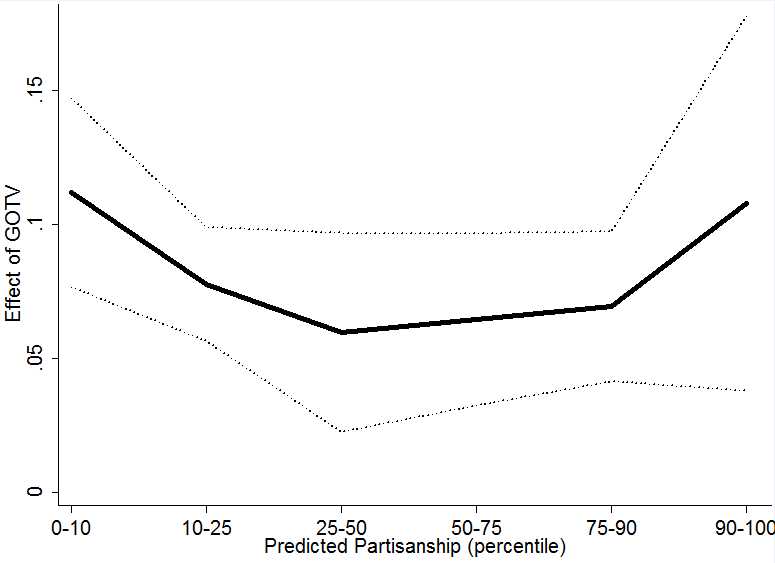
At the Monkey Cage, a couple of Harvard professors report on their new study, which found that Romney’s ground game was apparently as good as Obama’s:

…despite the media accounts of the superiority and sophistication of the Obama campaign, we estimate similar effects for the most Republican and Democratic subsets of individuals, as seen on the left and right sides of the figure, respectively. In other words, both campaigns appear to have been very effective in mobilizing their supporters, and there is no evidence that Obama’s campaign was more effective than Romney’s.

EnosFowlerFigure21

Clearly, these results differ from media accounts which praise the Obama campaign for its technological sophistication. They also differ from a recent post by Aaron Strauss who, using similar data and methods, estimates much smaller effects of GOTV and a notable difference between Obama and Romney. What explains these different results?

I can’t attempt to adjudicate the competing studies here; I just find it interesting that we don’t actually know if Obama’s famously high-tech data game was actually any more effective than Romney’s.

I hope that it’s true that Obama’s tech wizardry – as much fun as it was to read about – didn’t actually give Obama an advantage. Technical wizardly is fundamentally non-partisan; any technical approach gives one side an advantage, the other side will be sure to pick up on eventually. I’d rather believe that Obama’s win was fueled by ideological and demographic advantages, neither of which the GOP can easily copy. But of course, that I’d like something to be true won’t make it true (dammit!).

The Harvard researchers found that both Obama and Romney got about a 7% increase in votes from their GOTV ((Get Out The Vote)) campaigns in heavily contested swing states. Just the possibility that this is true means that neither side will dare invest any less into their GOTV campaigns in the future, even if they know that it won’t lead to anything but parity. And that’s sort of nice: GOTV campaigns are in many ways the Norman Rockwell Idealized Iconic version of politics, in which scores of citizen volunteers walk from door to door, knocking and asking for just a couple of minutes to try and persuade people to vote for their candidate.

Posted in Elections and politics | Comments Off on The surprising parity of the 2012 ground game

Favorite Anti-Feminist Theory Debunked By Purdue Researchers

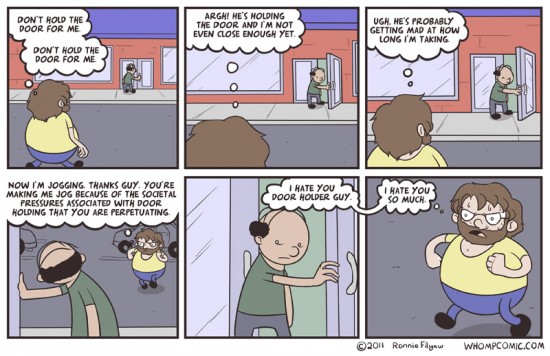
Whomp-Comics-Holding-Pattern

Amanda Marcotte at Pandagon reports on a study of holding doors open.

It turns out that women seemingly don’t chew men out for holding doors open, contrary to the anti-feminist cliche (or if there was a lot of angry women chewing people out, it went mysteriously unmentioned, even though this was a study of people’s reactions to having doors held open).

However, to my surprise, for some men holding a door open for them depresses their self-esteem. I know that trying to maintain conventional masculinity can lead to anxiety, but sometimes I forget how little it can take.

To be fair, there is no indication that anyone of any gender freaked out at the door-opening man. But the only people in the study who had the emotional reaction to the door-opening that could lead to a freakout were men.

So I offer this as a counter-theory to all the men online who claim women are cruising for a confrontation if you dare open a door for them: Perhaps you are projecting your own insecurities and easy-to-offend nature onto women.

Posted in Feminism, sexism, etc | 74 Comments

Interview with Eileen Gunn

Short story writer Eileen Gunn (author of the collection Stable Strategies and Others which you should read) was recently kind enough to do an interview with me for the SFWA Bulletin.

We didn’t end up using anywhere near enough of her intelligent commentary in my article which had a specific focus as a compare/contrast between the SFWA experiences of brand-new SFWA member Adam Rakunas and established member Eileen Gunn.

Luckily for readers everywhere, Eileen consented to having the interview published in Q&A form on the SFWA website.

Eileen is a Nebula Award winner and a fantastic writer. She has supported the science fiction and fantasy community in numerous, important ways, including her hard work with the Clarion West Writers Workshop. I’ve been lucky enough to know her since I started out and benefit from her knowledge and general awesomeness.

Here’s an excerpt from the interview that I found particularly useful/interesting/exciting:

I’ve never been a huge fan of the “mentoring” concept, as it describes itself – it seems patronizing and self-aggrandizing. We’re all adults here: let’s treat one another as equals. However, I’ve benefitted enormously over my writing life, including in my advertising/marketing career, from people who have shared their knowledge with me when I needed it. In offering advice, there’s a fine line between being descriptive and being prescriptive, and a not-so-fine line between advising from one’s experience, and simply nattering on. I try to return the favors I’ve received without crossing those lines.

My father was a successful graphic designer in Boston, and he always made time to see students and new graduates of design schools. He’d meet with them, review their work, tell them who was hiring, and generally encourage them. I worked for my father for eight years, during high school and college, and scheduled those appointments for him, usually during his lunch hour. He set me a very good example, as did Kate and Damon, Joe and Gay Haldeman, and editors such as David Hartwell, Gardner Dozois, and Sheila Williams.

There are certain kinds of writers I’m particularly concerned about: writers who write slowly, or who deal with difficult subjects or subjects outside the mainstream – writers who deliberately choose, for whatever reasons, to write outside the marketplace trends. These writers are the potential heirs to Octavia E. Butler, Ted Chiang, Howard Waldrop, and, strange as it may seem, William Gibson and George R. R. Martin. I think SFWA and the Clarion and Clarion West workshops, indeed speculative literature in general, have historically supported those kinds of writers by providing community, feedback, and role models. SFWA has honored those writers with Nebula awards and nominations. I hope that, as it widens its reach and relevance, SFWA will continue to attract and support the wildly original writers, the writers with limited patience for advance marketing, and the brilliant but stubbornly self-effacing writers. They give energy to the entire field, and we need to save them some seats at the awards banquet.

Posted in Uncategorized | 2 Comments

A post to show contractors the repair work I need to have done.

This is exactly what it sounds like – a post so I can easily show contractors photos of some repair work I need done. So my usual readers should feel free to completely ignore this post. Or, you know, use it for offering advice and/or snarky comments about how if it was your room you’d it all yourself instead of throwing money away by paying someone to do it. :-p

Continue reading

Posted in About the Bloggers | Comments Off on A post to show contractors the repair work I need to have done.

“If You Were a Dinosaur, My Love” Nominated for the Nebula Award

I am thrilled to announce that my short story, “If You Were a Dinosaur, My Love,” has been nominated for the Nebula Award for short story.

I am particularly pleased because I love my category. I’ll be thrilled to see anyone win.

Here’s the SFWA press release which includes a list of other recognized works.

2013 Nebula Awards Nominees Announced

Science Fiction and Fantasy Writers of America are pleased to announce the 2013 Nebula Awards nominees (presented 2014), the nominees for the Ray Bradbury Award for Outstanding Dramatic Presentation, and the nominees for the Andre Norton Award for Young Adult Science Fiction and Fantasy.

Best Novel
We Are All Completely Beside Ourselves, Karen Joy Fowler (Marian Wood)
The Ocean at the End of the Lane, Neil Gaiman (Morrow; Headline Review)
Fire with Fire, Charles E. Gannon (Baen)
Hild, Nicola Griffith (Farrar, Straus and Giroux)
Ancillary Justice, Ann Leckie (Orbit US; Orbit UK)
The Red: First Light, Linda Nagata (Mythic Island)
A Stranger in Olondria, Sofia Samatar (Small Beer)
The Golem and the Jinni, Helene Wecker (Harper)

Best Novella
‘‘Wakulla Springs,’’ Andy Duncan & Ellen Klages (Tor.com 10/2/13)
‘‘The Weight of the Sunrise,’’ Vylar Kaftan (Asimov’s 2/13)
‘‘Annabel Lee,” Nancy Kress (New Under the Sun)
‘‘Burning Girls,’’ Veronica Schanoes (Tor.com 6/19/13)
‘‘Trial of the Century,’’ Lawrence M. Schoen (lawrencemschoen.com, 8/13; World Jumping)
Six-Gun Snow White, Catherynne M. Valente (Subterranean)

Best Novelette
‘‘Paranormal Romance,’’ Christopher Barzak (Lightspeed 6/13)
‘‘The Waiting Stars,’’ Aliette de Bodard (The Other Half of the Sky)
‘‘They Shall Salt the Earth with Seeds of Glass,’’ Alaya Dawn Johnson (Asimov’s 1/13)
‘‘Pearl Rehabilitative Colony for Ungrateful Daughters,’’ Henry Lien (Asimov’s 12/13)
‘‘The Litigation Master and the Monkey King,’’ Ken Liu (Lightspeed 8/13)
‘‘In Joy, Knowing the Abyss Behind,’’ Sarah Pinsker (Strange Horizons 7/1 – 7/8/13)

Best Short Story
‘‘The Sounds of Old Earth,’’ Matthew Kressel (Lightspeed 1/13)
‘‘Selkie Stories Are for Losers,’’ Sofia Samatar (Strange Horizons 1/7/13)
‘‘Selected Program Notes from the Retrospective Exhibition of Theresa Rosenberg Latimer,’’ Kenneth Schneyer (Clockwork Phoenix 4)
‘‘If You Were a Dinosaur, My Love,’’ Rachel Swirsky (Apex 3/13)
‘‘Alive, Alive Oh,’’ Sylvia Spruck Wrigley (Lightspeed 6/13)

Ray Bradbury Award for Outstanding Dramatic Presentation
Doctor Who: ‘‘The Day of the Doctor’’ (Nick Hurran, director; Steven Moffat, writer) (BBC Wales)
Europa Report (Sebastián Cordero, director; Philip Gelatt, writer) (Start Motion Pictures)
Gravity (Alfonso Cuarón, director; Alfonso Cuarón & Jonás Cuarón, writers) (Warner Bros.)
Her (Spike Jonze, director; Spike Jonze, writer) (Warner Bros.)
The Hunger Games: Catching Fire (Francis Lawrence, director; Simon Beaufoy & Michael deBruyn, writers) (Lionsgate)
Pacific Rim (Guillermo del Toro, director; Travis Beacham & Guillermo del Toro, writers) (Warner Bros.)

Andre Norton Award for Young Adult Science Fiction and Fantasy
The Coldest Girl in Coldtown, Holly Black (Little, Brown; Indigo)
When We Wake, Karen Healey (Allen & Unwin; Little, Brown)
Sister Mine, Nalo Hopkinson (Grand Central)
The Summer Prince, Alaya Dawn Johnson (Levine)
Hero, Alethea Kontis (Harcourt)
September Girls, Bennett Madison (Harper Teen)
A Corner of White, Jaclyn Moriarty (Levine)

Damon Knight Grand Master Award: Samuel R. Delany
Special Guest: Frank M. Robinson

About the Nebula Awards
The Nebula Awards are voted on, and presented by, active members of SFWA. Voting will open to SFWA Active members on March 1, and close on March 30. More information is available from http://www.sfwa.org/nebula-awards/how-to-vote/.

About the Nebula Awards Weekend
The 49th Annual Nebula Awards Weekend will be held May 15-18th, 2014, in San Jose at the San Jose Marriott. The Awards Ceremony will be hosted by Toastmaster Ellen Klages. Borderland Books will host the mass autograph session from 5:30 p.m. until 7:30 p.m. on Friday, May 16th at the San Jose Marriott. This autograph session is open to the public and books by the authors in attendance will be available for purchase. Attending memberships, and more information about the Nebula Awards Weekend, are available at http://www.sfwa.org/nebula-awards/nebula-weekend/. Membership rates increase on March 1. The Weekend is open to non-SFWA members.

About SFWA
Founded in 1965 by the late Damon Knight, Science Fiction and Fantasy Writers of America brings together the most successful and daring writers of speculative fiction throughout the world.

Since its inception, SFWA® has grown in numbers and influence until it is now widely recognized as one of the most effective non-profit writers’ organizations in existence, boasting a membership of approximately 2,000 science fiction and fantasy writers as well as artists, editors and allied professionals. Each year the organization presents the prestigious Nebula Awards® for the year’s best literary and dramatic works of speculative fiction.

Media: For information on obtaining press passes, interviews with nominees, or questions about the event itself, please contact SFWA’s Communications Manager, Jaym Gates, at communications@sfwa.org.

Additional Information
Website: http://www.sfwa.org/

Posted in Uncategorized | 2 Comments