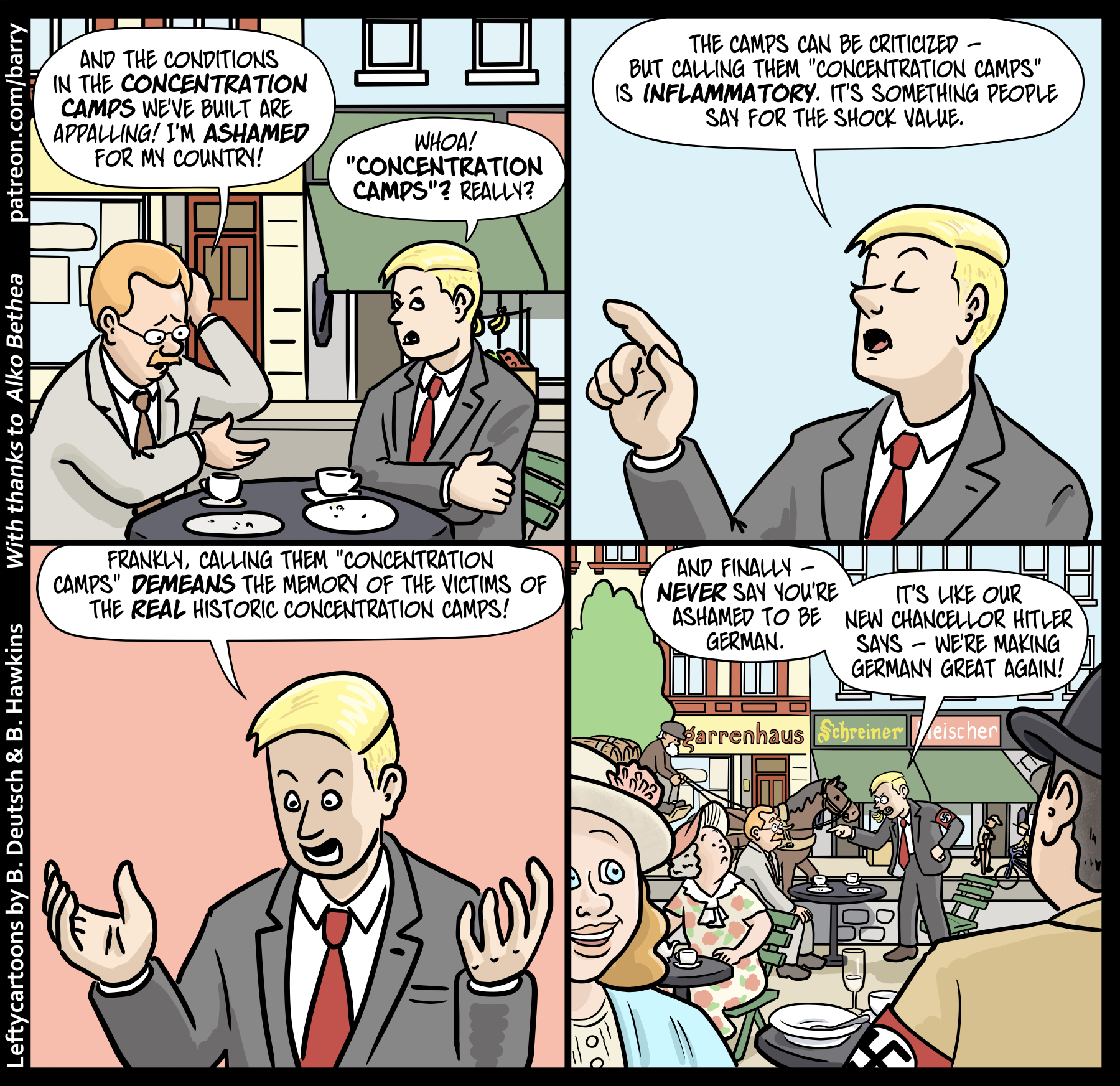
This comic is by me and Becky Hawkins.
Becky writes:
What’s a better challenge than drawing a period piece? Drawing a period piece where the reader is supposed to think it’s present-day until panel 4! Luckily for me, men’s fashion doesn’t change as wildly as women’s fashion, and that one haircut (long on top, short on the sides) is still around. The guy on the left–suit, glasses, and hair–was modeled after someone I saw while I was out and about. Granted, sartorial choices in Portland don’t seem to be bound by time or geography… I hope it works!
Surprising no-one, I spent most of my time laying out panel 4. Barry’s script says: The camera pulls back a little. We now see that the speaker is wearing a swastika armband just above his left elbow. Maybe we can see one or two characters in the background wearing them too. Women are wearing circa 1930s hats; there’s a horse and carriage in the background, maybe; in general, we can now see we’re looking at Berlin in the 1930s.
I did a few sketches from different angles. When I pictured this cartoon in my head, the “camera” was pointing toward the cafe, with the characters sitting by the wall. That way, all you could see in panels 1-3 were two guys, a big window, and a bit of wall. It would be easier to hide the 1930s-ness that way. But when I sketched it out, I couldn’t make it work.
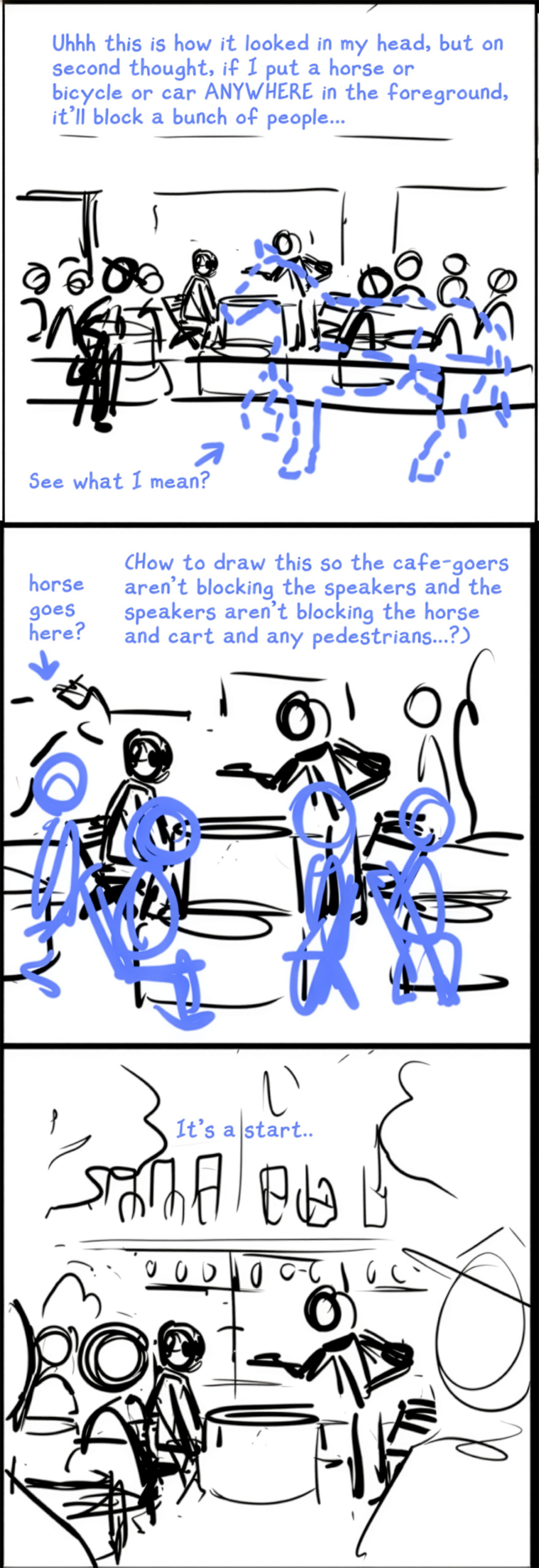
Barry kindly collected several photos of 1930s Berlin cafes before sending me the script. But I still spent way too much time looking at old photos to find some buildings that would plausibly be on a modern American street. Berlin’s public plazas, broad streets with tree-lined medians, and ornate building facades would scream Ye Olde World, in my opinion.
I searched for “1930s Berlin street photography” and found some commercial-residential buildings that wouldn’t look out of place in an old-for-the-US downtown area. I then committed the newbie cartoonist mistake of putting a lot of detail into an area that was destined to sit behind a word balloon. At least I copy-pasted the windows.
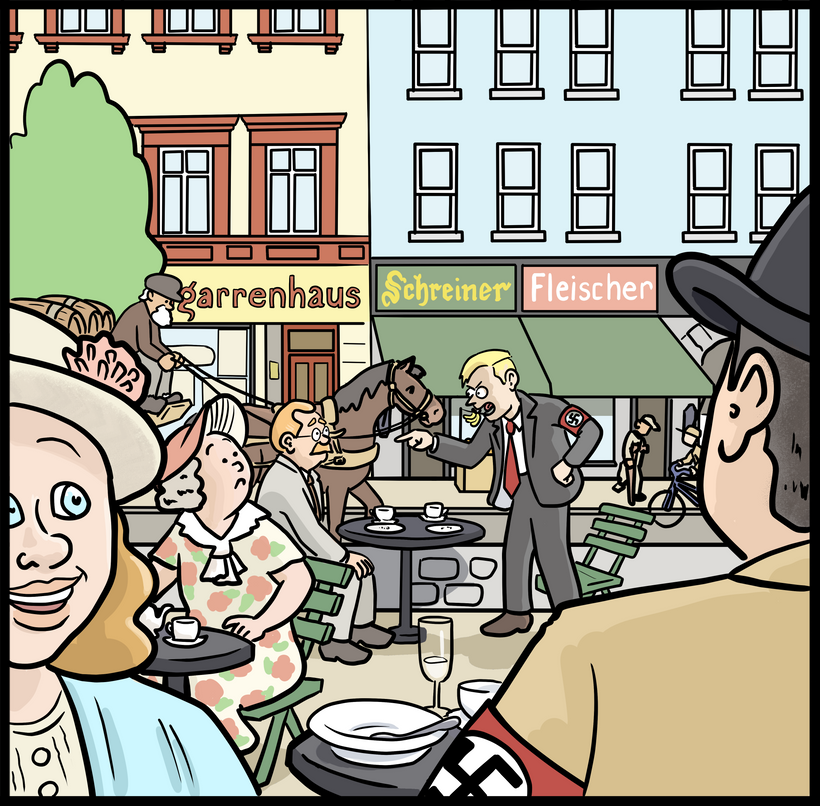
I hope you enjoyed this cartoon!
Barry writes:
Rep. Alexandria Ocasio-Cortez, D-N.Y., ignited the latest semantic scuffle when she recently charged that the Trump administration “has established concentration camps on the southern border of the United States for immigrants, where they are being brutalized with dehumanizing conditions and dying.” Her use of this term to describe the mass detention facilities in which thousands of asylum-seeking migrants, many of them children forcibly separated from parents and family members, are being held in deplorable conditions, provoked an immediate and fierce backlash. … Sami Steigmann, a Holocaust survivor voiced his indignation: “What you are doing is insulting every victim of the Holocaust. Shame on you!” Rabbi Abraham Cooper, associate dean of the Simon Wiesenthal Center, charged that Ocasio-Cortez “is insulting victims of genocide” with her comments.
But concentration camps – both actual camps, and the term – existed before World War Two. As far back as 1899, during the Boer War, some British people argued against calling the British concentration camps in Africa what they were.
The American Heritage Dictionary defines the term concentration camp as: “A camp where persons are confined, usually without hearings and typically under harsh conditions, often as a result of their membership in a group which the government has identified as dangerous or undesirable.”
People tend to conflate “concentration camps” with “death camps,” but the two terms aren’t interchangeable, and it’s important to be able to discuss concentration camps without euphemisms. Refusing to call them what they are just helps them get worse.
If you were swept off the streets in vans by secret police wearing masks; if your initiation into detention involved transit camps meant to hide your departure and effectively disappear you from legal help, temporarily or forever; if you are held with others who are denied due process; and if you are detained with people who have predominantly been rounded up more on the basis of ethnicity, race, religion or political affiliation than for any criminal charge you have in common, you are in a concentration camp. It is only a question of what stage concentration camp you are in, and whether you will be stuck there until the camp is allowed to transform into its next nightmare form.
TRANSCRIPT OF CARTOON
This cartoon has four panels. All of them show two men in suit and tie, talking at an outdoor cafe. One man is a redhead with a mustache; the other is a clean-shaven blonde.
PANEL 1
REDHEAD: And the conditions in the concentration camps we’ve built are appalling! I’m ashamed for my country!
BLONDE: Whoa! “Concentration camps”? Really?
PANEL 2
A shot of the blonde man, lecturing.
BLONDE: The camps can be criticized but calling them “concentration camps” is inflammatory. It’s something people say for the shock value.
PANEL 3
The blonde man looks angry.
BLONDE: Frankly, calling them “concentration camps” demeans the memory of the victims of the real historic concentration camps!
PANEL 4
The “camera” pulls back, and we see that this is a scene from 1930s Germany. (Storefront signs are in German, there’s a horse and carriage going past, women in 1930s fashions and hats.) The blonde man has angrily stood up, and we can see he wears a swastika on his sleeve (as does another man in the foreground).
BLONDE: And finally – never say you’re ashamed to be German. It’s like our new chancellor Hitler says – we’re making Germany great again!
(No chicken fat in this one!)



I was completely surprised when I got to panel 4. Good job both of you.
Not exactly chicken-fat, but…
The three storefronts in the background are
1. Zigarrenhaus/Cigarrenhaus – Tobacconist. Z_ was standard orthography at the time, but the C_ form was still in wide use.
2. Schreiner – Carpenter. /Schreiner is commonly used in the South of Germany, Tischler in Berlin and the north. But perhaps the store owner was a southerner.
3. Fleischer – Butcher.
Thanks for the translations! I’m pretty sure Becky copied the signs from a period photograph.
Beth! Yay! Thanks.