
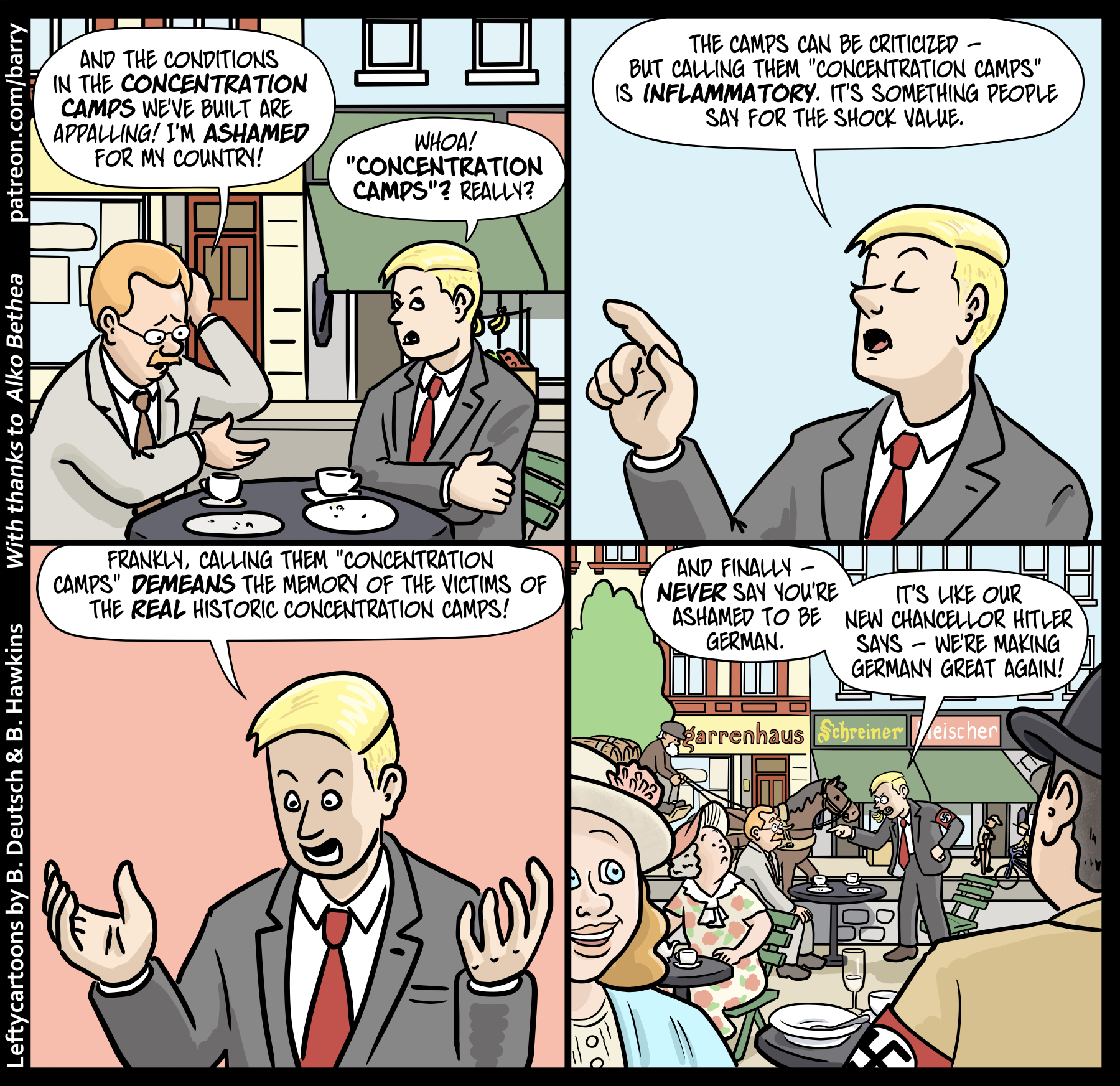
This comic is by me and Becky Hawkins.
Becky writes:
What’s a better challenge than drawing a period piece? Drawing a period piece where the reader is supposed to think it’s present-day until panel 4! Luckily for me, men’s fashion doesn’t change as wildly as women’s fashion, and that one haircut (long on top, short on the sides) is still around. The guy on the left–suit, glasses, and hair–was modeled after someone I saw while I was out and about. Granted, sartorial choices in Portland don’t seem to be bound by time or geography… I hope it works!
Surprising no-one, I spent most of my time laying out panel 4. Barry’s script says: The camera pulls back a little. We now see that the speaker is wearing a swastika armband just above his left elbow. Maybe we can see one or two characters in the background wearing them too. Women are wearing circa 1930s hats; there’s a horse and carriage in the background, maybe; in general, we can now see we’re looking at Berlin in the 1930s.
I did a few sketches from different angles. When I pictured this cartoon in my head, the “camera” was pointing toward the cafe, with the characters sitting by the wall. That way, all you could see in panels 1-3 were two guys, a big window, and a bit of wall. It would be easier to hide the 1930s-ness that way. But when I sketched it out, I couldn’t make it work.
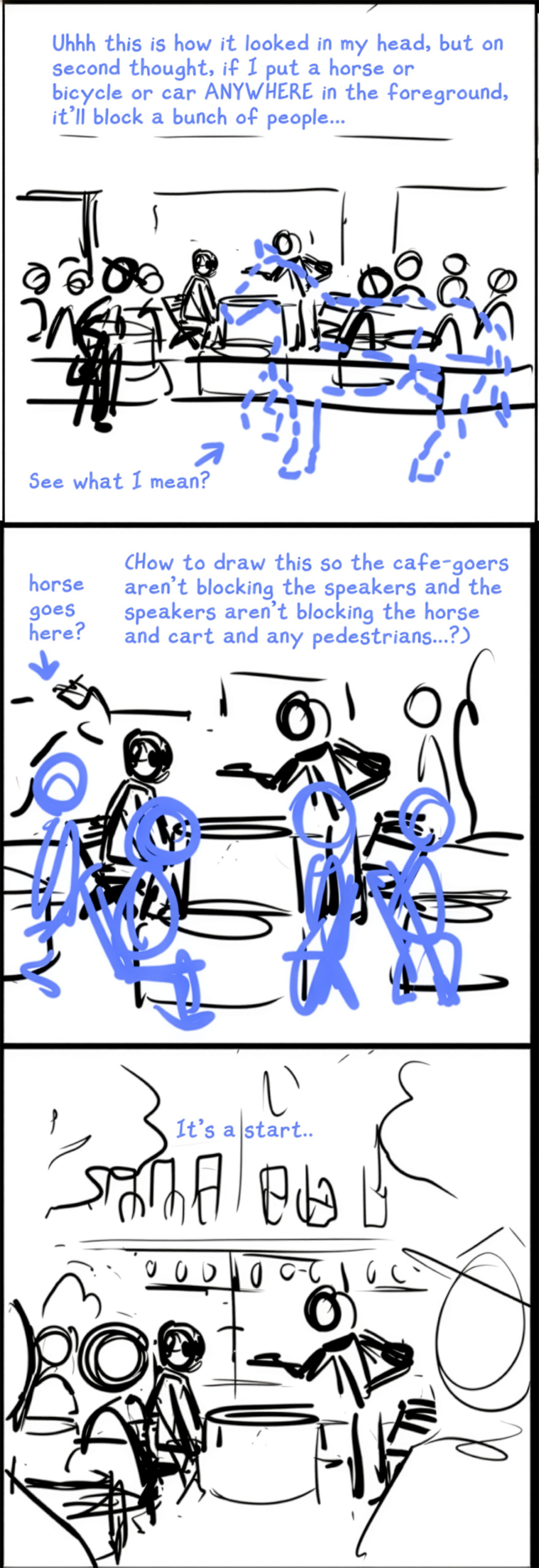
Barry kindly collected several photos of 1930s Berlin cafes before sending me the script. But I still spent way too much time looking at old photos to find some buildings that would plausibly be on a modern American street. Berlin’s public plazas, broad streets with tree-lined medians, and ornate building facades would scream Ye Olde World, in my opinion.
I searched for “1930s Berlin street photography” and found some commercial-residential buildings that wouldn’t look out of place in an old-for-the-US downtown area. I then committed the newbie cartoonist mistake of putting a lot of detail into an area that was destined to sit behind a word balloon. At least I copy-pasted the windows.

I hope you enjoyed this cartoon!
Barry writes:
Rep. Alexandria Ocasio-Cortez, D-N.Y., ignited the latest semantic scuffle when she recently charged that the Trump administration “has established concentration camps on the southern border of the United States for immigrants, where they are being brutalized with dehumanizing conditions and dying.” Her use of this term to describe the mass detention facilities in which thousands of asylum-seeking migrants, many of them children forcibly separated from parents and family members, are being held in deplorable conditions, provoked an immediate and fierce backlash. … Sami Steigmann, a Holocaust survivor voiced his indignation: “What you are doing is insulting every victim of the Holocaust. Shame on you!” Rabbi Abraham Cooper, associate dean of the Simon Wiesenthal Center, charged that Ocasio-Cortez “is insulting victims of genocide” with her comments.
But concentration camps – both actual camps, and the term – existed before World War Two. As far back as 1899, during the Boer War, some British people argued against calling the British concentration camps in Africa what they were.
The American Heritage Dictionary defines the term concentration camp as: “A camp where persons are confined, usually without hearings and typically under harsh conditions, often as a result of their membership in a group which the government has identified as dangerous or undesirable.”
People tend to conflate “concentration camps” with “death camps,” but the two terms aren’t interchangeable, and it’s important to be able to discuss concentration camps without euphemisms. Refusing to call them what they are just helps them get worse.
If you were swept off the streets in vans by secret police wearing masks; if your initiation into detention involved transit camps meant to hide your departure and effectively disappear you from legal help, temporarily or forever; if you are held with others who are denied due process; and if you are detained with people who have predominantly been rounded up more on the basis of ethnicity, race, religion or political affiliation than for any criminal charge you have in common, you are in a concentration camp. It is only a question of what stage concentration camp you are in, and whether you will be stuck there until the camp is allowed to transform into its next nightmare form.
TRANSCRIPT OF CARTOON
This cartoon has four panels. All of them show two men in suit and tie, talking at an outdoor cafe. One man is a redhead with a mustache; the other is a clean-shaven blonde.
PANEL 1
REDHEAD: And the conditions in the concentration camps we’ve built are appalling! I’m ashamed for my country!
BLONDE: Whoa! “Concentration camps”? Really?
PANEL 2
A shot of the blonde man, lecturing.
BLONDE: The camps can be criticized but calling them “concentration camps” is inflammatory. It’s something people say for the shock value.
PANEL 3
The blonde man looks angry.
BLONDE: Frankly, calling them “concentration camps” demeans the memory of the victims of the real historic concentration camps!
PANEL 4
The “camera” pulls back, and we see that this is a scene from 1930s Germany. (Storefront signs are in German, there’s a horse and carriage going past, women in 1930s fashions and hats.) The blonde man has angrily stood up, and we can see he wears a swastika on his sleeve (as does another man in the foreground).
BLONDE: And finally – never say you’re ashamed to be German. It’s like our new chancellor Hitler says – we’re making Germany great again!
(No chicken fat in this one!)




I was completely surprised when I got to panel 4. Good job both of you.
Not exactly chicken-fat, but…
The three storefronts in the background are
1. Zigarrenhaus/Cigarrenhaus – Tobacconist. Z_ was standard orthography at the time, but the C_ form was still in wide use.
2. Schreiner – Carpenter. /Schreiner is commonly used in the South of Germany, Tischler in Berlin and the north. But perhaps the store owner was a southerner.
3. Fleischer – Butcher.
Thanks for the translations! I’m pretty sure Becky copied the signs from a period photograph.
Beth! Yay! Thanks.
Fun fact: The German government actively promoted describing its camps as ‘concentration camps’ because that’s better than what they actually are – death camps.
It’s only because of the Germans that the term ‘concentration camp’ has come to mean ‘a place where you send people to kill them’.
Thanks, Bla!
But I don’t think that would have been happening yet in 1933-1934, when this comic takes place?
Were there concentration camps already in 1934? I thought they only came into use or at lest major use after the Wannsee Conference in 1942.
The first Nazi concentration camp, Dachau, was opened in 1933.
And of course, there were concentration camps before then.
@Amp: Oh, sorry, I should have checked the date. Quite right, apologies.
I don’t know guys….
I think we need to be a little more discerning about language. I think it’s been part of politics writ large for a very long time to try to paint opponents as being morally bankrupt by comparing anything they do to the most rhetorically baggage-loaded things they think they can get away with, and I think we’re either at or approaching the stage where people are going to become numb to the terms.
Because let’s be real: Sure, you can find a couple of ways that the ICE facilities are similar to concentration camps, but if all it takes are a couple of similarities and a concentration of a class of people, then so are prisons, schools and cubicle farms. But these things are obviously not all the same. The differences matter. And I think that rational, thinking, honest people can probably (and very easily) understand the differences between a Nazi facility in the 30’s and 40’s, and an ICE facility in the 10’s and 20’s, regardless of what you want to call them.
@Corso: How are the ICE concentration camps different from, say Dachau in 1935? What criteria have to be met before you are willing to use the term “concentration camp” to refer to facilities where people are held without legal recourse and deprived of basic necessities based on arbitrary and unfair criteria?
Corso, Amp cited the definition of concentration camp above, and “prisons, schools and cubual farms” clearly do not fit that definition. ICE detention facilities do.
This misses my point so hard it hurts. Barry used the American Heritage Dictionary, and gave an honest representation of the first definition, but failed to give the second, which is “2. A place or situation in which extremely harsh conditions are imposed by those in authority.” and on dictionary.com, the second definition is literally “a Nazi prison camp or death camp prior to and during World War II.”
My point is that people like AOC purposefully use language with baggage to try to drag current things down a cognitive dissonance scale. This is a motte and bailey argument, the ICE facilities obviously aren’t Nazi death camps, and you can’t defend that comparison, so people like Dianne say “Well, what about Dachau?” But I don’t care whether technically, the camp at Dachau in 1935 kind of lines up with what ICE is doing if you squint at it, very few people know that there was a camp in Dachau in 1935, never mind know what the conditions in it were like. Whether intended or not (and I think it very obviously was) people are going to be misled by the comparison.
I think before I answer that, I’d like to ask the obvious: Why do you want the term to be used?
The idea that the correct thing to do in 2026 is to describe something by comparing it to a word that has a whole lot of meanings, some of them very dark and non-applicable, with a very specific instance of the usage in mind that most people aren’t aware of hits me as fundamentally dishonest.
Even if I were to concede that the comparison to Dachau in 1935 is valid (and I don’t, but if I did…), do you actually believe that what’s being communicated by people like AOC is merely the “Dachau 1935” version of the term?
As to the question:
The definition Barry gave (which as I pointed out above isn’t the only definition) was “A camp where persons are confined, (1)usually without hearings and typically under (2)harsh conditions, (3)often as a result of their membership in a group which the government has identified as dangerous or undesirable.” That’s probably actually better for your argument than the Dachau camp comparison specifically, because Dachau was still worse than some of that.
(1) There are hearings. All the time. So many that it’s taking an unfortunately long time to process them, which is not great, and the government should probably allocate resources to speeding up those hearings, but for the record: Dachau never had hearings.
(2) The conditions are harsh, but again… The comparison to Dachau fails: 25,000 people were deliberated murdered in Dachau, and despite your assertion that in 1935 it was better, the Bavarian police were called in immediately after the camp opened in 1933 to investigate the first murders. It might have originally been intended as a forced labor camp (which the ICE facilities also aren’t), but it opened with a crematorium because the people running it expected the deaths.
(3) What is the group? What is being concentrated? We’re not talking about racial or ethnic minorities, political or religious opponents, homosexuals or unionists. We’re talking about people who have broken the law, in this case, a very specific law. In any other context we would merely call this a prison.
For the most part, playing the “it’s not exactly like I’m claiming Dachau was like (without citations)” game isn’t something I’m interested in. Yes, it’s true, no two historic events are ever alike in every detail, and people will always use that to make excuses for atrocities and Orwellian terms that hide the truth of what’s going on.
That’s one reason it’s important to use terms like “concentration camps.” Because part of the process enabling concentration camps to keep escalating and getting worse is the denial that they’re concentration camps at all. (A similar dynamic applies to the word “genocide”).
It’s true that people in the DHS system aren’t denied all hearings. But they are denied substantive due process, in many cases, even if they did technically receive a hearing. A obvious example, when we deported people to CECOT in El Salvador, they are in all probability being sentenced to life in a brutal prison without any trial (Abrego Garcia’s case was very much an exception) other than a deportation hearing that may have been done in their absence.
There’s the entire “expedited removal” process, the whole point of which is to be able to deport someone in hours or days without a hearing. That existed before Trump, and applied to people arrested less than 100 miles from a border who had been in the US less than two weeks. The Trump administration expanded that to apply to anywhere in the US, and up to two years, and has applied it to people who are clearly trying to follow the rules (for instance, by arresting people when they show up at a courthouse for a scheduled immigration hearing). It’s currently wrapped up in lawsuits.
A third example: Until the Supreme Court’s 2018 Pereira v Sessions ruling, DHS routinely issued “Notice to Appear”s that didn’t say when and where the hearing would take place, and also they didn’t process change of address (so even if an immigrant informed the court they’d moved, the notices would be sent to outdated addresses and never seen). When tons of people didn’t show for their hearings, removal orders were issued without them being present. By the DHS’s lights, this means the person has had a hearing, but substantively they did not.
That’s just one of many examples of how DHS strives to be able to say people have had hearings, while also substantively avoiding giving them due process.
(“Due process” in the commonplace sense. There’s a legal sense in which “due process” can only be applied to questions of constitutional law – or I’ve seen a lawyer claim that, anyway – but that’s not what I mean here.)
As someone who grew up with constant Holocaust education, year after year, between the ages of 7 and 15, I started calling them concentration camps as far back as 2018 because it was so obvious that that’s what they were.
But that’s not really what’s happening here, is it? I think you nail it in your next paragraph, when you point out what we’re talking about with “concentration camp” is almost functionally identical to the conversation around “genocide”.
No one is confused. We aren’t talking about concentration camps. Israel isn’t committing a genocide. We aren’t hiding the concentration camps and genocides behind flowery language, they aren’t happening. What is happening isn’t good, and we should talk about it, but they aren’t the worst things we can articulate.
And this is where I just plain think you’re wrong.
This idea that if we don’t lie, that if we don’t put on this kayfabe and call things that we oppose the worst things we can imagine, those things are more likely to happen is both deeply weird and self defeating.
I know you’re going to balk at “lie”, but I think what you just said was that you don’t actually think these words apply now, but it’s necessary to use them to keep them from happening. Please, if I’m wrong, say it clearly: Do you actually believe that when “concentration camp” and “genocide” is being used in these contexts, they’re describing things that are actually concentration camps and genocides?
And just for the record: The Germans actually did call them concentration camps. They owned it. They weren’t meek about the hatred they felt for the people they ended up killing. The word was “Konzentrationslager” or KZ.
I mean… Sure. I’m not going to defend the practices writ large, America’s justice system treats it’s citizens poorly, I’m more than willing to believe that it treats non-citizens worse. But I’m also not as hawkish as you are on this… “substantive due process” is an allusion here, I think, used by Liberals to give the impression that people aren’t receiving justice. But these cases are relatively simple – The court has to determine whether the person before them is in the United States legally, or not. There might be some added process for an asylum claim, but there generally aren’t a whole lot of questions of fact. There’s not much of a process that’s due, and that doesn’t take a whole lot of time.
I think the problem is that there are people who think that these people shouldn’t be deported, and to facilitate that, they’re trying to manifest process. Time consuming, arduous processes. Things that might take until after the next election cycle, as an example. In my mind the people who would complain both about the conditions in the facilities and the speed in which people are processed out of them are similar to the people who complained about the sleeping conditions in the facilities, and then boycotted Wayfair when the administration bought beds from them.
I have never been less impressed by the American education system.
Yes, I actually do. The ICE camps are concentration camps, and what’s going on in Gaza is genocide.
Gaza was determined to be a genocide by the UN in September of 2025.
Conditions in the ICE camps are hard to determine, because the Trump administration is blocking lawful oversight. From the Guardian:
I have never been less impressed by the American education system.
Then I have good news for you! I got my Holocaust education in Hebrew School at my parents’ synagogue. Score one for supplemental private Jewish education.
Ampersand:
I agree, on both points. I also consider the October 7 attack by Hamas to have been an act of genocide against the Israeli people. Of course, two genocides do not make a right.
Three members of congress visited an ICE “holding facility,” and found that the facility wasn’t holding more people than it was rated to.
That was at a scheduled visit. When they went back for a surprise inspection, things were very different:
“The Germans actually did call them concentration camps. They owned it. They weren’t meek about the hatred they felt for the people they ended up killing. The word was “Konzentrationslager” or KZ.”
Because before WW2, ‘concentration camp’ was taken to mean ‘a place where people are involuntarily confined for political reasons without legal due process’. The Germans were trying to hide what they were doing and naming the camps as places for ‘concentration’ was part of that tactic. They gave tours of the camps to the International Red Cross stage managed not only to make the camp conditions seem less harsh but to hide the deaths.
The irony is that the name ‘concentration camp’, which was intended to hide what these camps were, became so associated with what we all know happened in them, that it now means ‘camp where you murder people’. But in 1934 that wasn’t the case, quite the opposite.
I’ve never been less impressed by the Canadian education system.
Thanks Amp, it is good to know that some oversight is starting to happen. Frustrating that ICE abuses, and Iran, and Gaza and on and on, get less attention from Democratic leaders than Abdul El-Sayed campaiging for the Democratic Senate nominiation in Michigan with Twitch streamer Hasan Piker (my opinion on that is basically the same as Leeja Miller’s). Centrist corporate Democrats still clearly find the left of their party more dangerous than Trump.
Not to distract too much, but why is that attack an act of genocide per se? Was the intent to destroy Israel and/or all Israelis? I thought it was more an act of terrorism: an attack designed to terrorize a non-military population, rather than an act of genocide (an attempt to destroy a culture or people). I’m just wondering whether I missed part of the motivation or context of the attack.
We very definitely are talking about racial and ethnic minorities! Profiling based on race and ethnicity is the explicit policy of ICE.
It’s ludicrous to pretend that justice is being applied fairly here. Proper rule of law does not live when law enforcement prioritizes people with the wrong ethnicity, or when laws are changed ad hoc to pull the rug out from under law-abiding people, or when people are arrested and convicted on false charges and without an opportunity to mount a proper defense.
Diane:
The UN definition of genocide is “…any of [specific enumerated] acts committed with intent to destroy, in whole or in part, a national, ethnical, racial or religious group…” https://www.un.org/en/genocide-prevention/definition This doesn’t require that the attack be intended to kill all the members of the group – the definition specifically includes destruction of a part. Not included in the definition is the destruction of a state. A state can be destroyed without intent to destroy its people, as arguably happened to Germany in 1945.
In my opinion, the attackers intended to kill or abduct as many Israeli Jews as they could, and the number of victims – nearly 1,450 people killed or abducted plus a further 3,400 injured – constitutes the destruction of a part of the group.
I would not consider the murder of two Jews – or ten – to be genocide, however heinous the intent. I don’t know where I would draw the line, but certainly lower than the number of victims of the 7 October attack.
I agree it was an act of terrorism. It was also an act of war. These things do not preclude each other.
@Daran: Not to muddy the issue, but if one says that the line between genocidal killings and non-genocidal killings (which is still horrendous) is some number, then genocide has a competence component. Like, if my intention is to eradicate a nation, but I am just really ineffective in doing so, or my target is very good at self-defense, I may not kill sufficient numbers of people (or indeed any at all) and therefore there was no genocide even though I am as intent on genocide as any canonical genocidal killer, I’m just less effective.
Like I agree the number is fuzzy, but does that mean that in some alternative universe where the Israelis were better prepared, and Hamas’ attack killed far fewer people, it wouldn’t have been a genocide? Despite their goals being identical?
The language of the UN definition seems to be open to examples of genocide where nobody is killed – by explicitly including scenarios involving coercive but nonlethal instruments, e.g. the forcible transfer of children. Of course I realise you may not agree with the whole of the UN definition, but nonetheless I feel this is worth mentioning.
Unfortunately I think the whole issue of what is a genocide and what is non-genocidal mass killing is just hopelessly fuzzy, not least because many people engage with it from a partisan point of view – they want attacks on them to be seen as genocides because it delegitimises their enemies. Even if we believe that the Ukrainians, for example, have been victims of genocide, we cannot deny that the Ukrainian government has been extremely active in lobbying for acknowledgements of their genocide in almost every possible venue from the academic to the popular – this can’t help us reach the correct conclusion, even if we believe the Ukrainians are correct in substance, it’s clear that to them the question of whether there’s a genocide against Ukrainians isn’t an abstract issue, but another “front” in their war. Ukraine is far from unique in this, it’s just a particularly telling example.
@Amp – I honestly hadn’t expected that to be your position, I apologize for calling you a liar. I’m going to chew for a while on what the implications of that are.
@Amp and Kate – I will say, just as unambiguously, that I don’t think that the Israeli actions in Gaza, regardless of what you call them, amount to a Genocide. Again… Not saying that what Israel is doing is good. And I’ll go further on that and say that the longer this goes on, the more their original justification and whatever moral standing they may have once had deteriorates. But I think there are special, high bars for that classification, and I don’t think Israel has reached them yet. Frankly, I don’t think the people at the UN do either, because despite what a commission put in a report (and we’ve spoken about the UN before), and despite what the ICJ has ruled (which was not actually what people seem to think it was), no one has actually called for the Tribunal that could actually determine the facts definitively.
@David – Of course they aren’t. First off… The blatantly obvious: No one is in a facility merely for being a minority, and many people of the same minority status as people in the facilities aren’t in any danger of ever being in one. Second – I don’t think ICE processes like you think they do. ICE tends to have targets that they know are in America illegally, usually as a matter of law (there was process), and then when they pick those people up, they check the people in proximity. There isn’t a whole lot of latitude in that.
@Daran and Watcher – Daran’s point was right, but incomplete… It’s not a numbers or competence problem, you could probably technically commit a genocide with only a single death, but reality asserts and a single person is de minimus. The usual determinant in a genocide determination is the intent: “Dolus Specialus”. Without the intent requirement, a whole lot of wars throughout history could probably have been considered a genocide on the base requirements, if for no reason other than the fact that up until relatively recently, most state lines were also ethnic borders.
Hamas yelled full-throatedly their dolus specialus on October 7th, literally out loud, and have for years. It was in their founding constitution. Part of the reason I don’t think that Israel will ever even be formally charged with genocide is that they had a very obvious non-genocidal justification for their commencement of their war.
I don’t think this was the stunning refutation you thought it was.
@Watcher: Number’s matter, but I don’t think it can be boiled down to “some number”. Rather, it is whether the atrocity of was such degree and nature that it rises to the level of destruction, at least in part, of the group. My feeling – and it is just a feeling; I have no objective criteria to justify it – is that the Hamas attack did. And yes, effectiveness, (or lack of it), is important, whether due to the attackers competence, the defender’s incompetence, or plain good luck for the attacker (or the reverse of these things).
As you anticipate, but perhaps not in the way you anticipate, I have issues with the UN definition. Specifically I don’t agree with its exclusive focus upon intent without regard to effect. A better definition would have two prongs. The first prong would be genocidal effect – the action should cause the destruction of the group in whole or in part. And some clarity as to exactly what that means would be helpful. The second prong would be either genocidal intent or egregious or unconscionable action. One way to operationalise the latter would be if the action amounted to a serious war crime or is otherwise a crime against humanity.
In other words, if the attacker perpetrates substantive war crimes or crimes against humanity, and the effect was the complete or partial destruction of the group, it would not be a defense to the charge of genocide for the attacker to say “That’s not what we intended”.
This seems incoherent. If it is correct that Ukrainians have been victims of genocide, then whatever helps us to reach that conclusion, however illegitimate, has helped us to reach a correct conclusion.
There will almost certainly never be a tribunal for Israel like the International Criminal Tribunal for Yugoslavia [“ICTY”]. This is because the ICTY was created by a resolution passed by the UN Joint Security Council, which gave it a lot of investigatory power (including the ability to hold suspects in custody while the trial proceeded). I doubt that the UK would support creating such a tribunal, and the US definitely will not, and both countries have veto power in the Security Council.
Of course, other organizations, like the International Criminal Court, are investigating and intend to hold a trial, and the ICJ is able to use evidence gathered by the ICC in the same way it used evidence gathered from the ICTY. There is no legal requirement for a UN-Security-Council created tribunal to gather evidence for the ICJ to make a decision.
Regardless, my guess is that if and when there is a trial, the ICJ will find insufficient evidence that Israel had the specific intent to commit genocide in Gaza. Nonetheless, I believe Israel is committing genocide in Gaza.
The ICJ’s requirements for intent are so stringent that it’s unlikely that any state will ever again be found guilty of genocide. That does not mean that no genocide will ever again occur.
I also believe that OJ Simpson committed murder – and I think most people agree with me on that, even though OJ was acquitted in a criminal court. This is because we all understand that there’s a difference between “X did a crime” and “X was found guilty by a criminal court.”
In 1939, Hitler made his first public declaration that referred to genocide of the Jews.
“Today I will be once more a prophet,” he said, addressing the Reichstag, “if the international Jewish financiers in and outside Europe should succeed in plunging the nations once more into a world war, then the result will not be the Bolshevizing of the earth, and thus the victory of Jewry, but the annihilation of the Jewish race in Europe!”
It’s interesting to consider that, by the standards of Israel’s apologists, that statement isn’t evidence of genocidal intent.
I’m still struggling with this… How do you get there? Are you working with a novel definition?
Because you’re right, obviously, there’s a difference between “X did a crime” and “X was found guilty by a criminal court.”, but I’m not sure that people are even properly articulating a fact pattern that fits the definition of genocide. We’re getting to the point where even if you want to ignore the intent portion of the charge and say that the actions prove the motive, the actions are telling a different story: The longer the conflict has waged, the more the deaths have tapered off.
This is almost certainly an actual occupation at this time, I’d agree that ethnic cleansing from some areas is occurring, I think that in the wake of this, when the investigations are done, it will be a travesty if there aren’t some people brought up on war crime charges. Again: I’m not saying their actions are good, and they’re hemorrhaging credibility and goodwill the longer this continues. But I don’t think it’s a genocide.
And sorry for completely derailing the topic. I think I have my dander up on this more than a whole lot of other topics just because if what’s happening in Gaza isn’t a Genocide, then what we’re looking at is probably one of the most egregious cases of victim blaming in the history of the planet: The nation borne of genocide is being falsely accused of the genocide of the people actively trying to commit a genocide of them. I mean take a step back, and rhetorically assume a situation where I’m right. Isn’t that ugly?
@Daran: I agree on re-reading I didn’t express it well. Maybe Ukraine isn’t a good example. I just feel like a lot of claims of genocide are based on a desire to criminalise/demonise one’s political/military opponents, and their goal is simply to gain a propaganda advantage. This isn’t, overall, a good thing when it comes to having a solid definition of genocide.
No, this is certainly not a case of victim-blaming Israel. Even if what Israel is doing isn’t technically genocide, they are guilty of horendous war crimes against the Palestinian people on top of decades of Apartheid-style oppresson. The response to the attack of October 7th has been completely disproportionate. This war ceased to be a war of self defense (if it ever really was) months into the action. It is now a war of vengence. It is an immoral war.
If it were impossible for a group that has suffered an atrocity to commit the same (or other) atrocities, then history would be a lot simpler. As far as the accusation being false, it’s hard for me to see any other explanation for Israel’s attempts to colonize Gaza and the law that has a death penalty specifically for Palestinians and no one else as anything other than genocidal.
“Even if what Israel is doing isn’t technically genocide, they are guilty of horendous war crimes”
This is something that I think sometimes gets lost in these discussions. Just because genocide isn’t happening, it doesn’t mean everything is fine.
But more generally – this wouldn’t even be the first case of a group that was subject to genocide then committing genocide themselves. It might not even be the worst one (not yet, anyway).
I pretty much am working with this definition:
If I were designing a definition from scratch, I’d define it a bit differently. But I think that’s a reasonable definition to base this discussion on, and one that applies to the situation in Gaza.
You seem to be “working with a novel definition” of genocide. It’s true that war deaths have tapered off (and hopefully will remain that way). But your implication that therefore, any genocide must be over is wrong, because genocide is not solely defined by deaths. “Deliberately inflicting on the group conditions of life calculated to bring about its physical destruction in whole or in part,” in particular, has not even remotely ended.
What Kate said. If Israel has not technically committed genocide, it’s still committed gross war crimes and crimes against humanity, and to call criticism of such crimes “blaming the victim” is obscene.
I’ll quibble a little with this. The death penalty law was originally written to exempt Jews. That language was taken out before the law was passed, so the law itself isn’t “specifically” reserved for Palestinians. (Or at least, that’s my understanding.)
But the law is written in such a way that either 100% or very close to 100% of people it applies to will be Palestinian, even though the law doesn’t say so explicitly. So I think you’re entirely correct in substance, even if I’d quibble with the word “specifically.”
Hopefully, Israel’s Supreme Court will block the law. Fingers crossed.
Corso:
Kate:
Indeed not. The State of Israel did not exist at the time of the Shoah, and was not a victim of it. The victims were Jews as a people. The victims of the current genocide in Gaza are Palestinians as a people. The entity “actively trying to commit a genocide” against Jews/Israelis is Hamas. The IHRA* Working Definition of Antisemitism includes as one of its examples “Holding Jews collectively responsible for actions of the state of Israel”**. Corso here is holding Palestinians in Gaza collectively responsible for the actions of Hamas. Isn’t that ugly?
*The Working Definition originated as an EU document in the early noughties, which as far as I can see the IHRA doesn’t acknowledge anywhere, so this looks like plagiarism to me.
**I have some objections to the working definition, but not this part.
But to return to the topic of the cartoon, is this the behavior of a government that wants to keep people in custody alive? There aren’t gas chambers (yet), but death through medical neglect is certainly in progress already.
Amp:
What you’ve provided is an incomplete version of the legal standard established in the 1948 Convention on the Prevention and Punishment of the Crime of Genocide. The other part of that is the special intent requirement. And the reason that you have a problem with your definition is that if that were all it took, then every international war in the history of humanity, defensive or offensive, is definitionally a genocide.
No, well, actually: Yes, but indirectly. What I had said was: “We’re getting to the point where even if you want to ignore the intent portion of the charge and say that the actions prove the motive, the actions are telling a different story”. I’ll rephrase: From the point of view of someone already using a novel definition, one that focuses on outcomes, it will be hard to engage with the reality that outcomes are improving. Again… Absent the intent, what separates every war in history from a genocide? And then regardless of what you identify as the material difference, what else would you catch in your net in your endeavor to make Israel fit?
I don’t think a reasonable person could read me saying: “This is almost certainly an actual occupation at this time, I’d agree that ethnic cleansing from some areas is occurring, I think that in the wake of this, when the investigations are done, it will be a travesty if there aren’t some people brought up on war crime charges. Again: I’m not saying their actions are good, and they’re hemorrhaging credibility and goodwill the longer this continues. But I don’t think it’s a genocide.” and come away with the idea that I think criticizing the actual things they’ve done is blaming the victim. Obviously that’s not what I’m saying, or I would also be guilty of doing it.
What I’m saying is that everything Israel is doing is a reflex. From conception to current state, the Israeli position has been to wait for an excuse, and then respond with overwhelming, absolutely disproportionate, deadly force. The Gazans want them dead, you don’t have to squint and contort the definition to find their genocidal intent, they shout it proudly from their rooftops. What Israel was responding to was objectively a genocide, both from the definition you supplied, and by the complete 1948 standard. Calling what Israel is doing a genocide when it’s not, regardless of how bad what they’re actually doing is, when what they’re doing is responding to a genocide attempt, I think counts as victim blaming. It’s definitely something. And pointing that out isn’t obscene.
I almost feel like, I’m sorry, I don’t think this is intentional, I think that perhaps you might not have thought this through, but I don’t think the people here actually have a principled opposition to genocide, so much as they have a principled opposition to human death and suffering, and genocide is the tool, the term, used to articulate that position. I actually think that you might be willing to purposefully ignore some amount of genocide, so long as the genocide has a low body count.
What the actions of Israel and Russia have in common, beside both obviously not being genocides, is a massive body count and a whole lot of human suffering. What China and Gaza have in common, beside both obviously being genocides, are a lower, or at least slower body count, and a less obvious tie to direct suffering… In China’s case, because they’re letting the Uighurs die out by attrition, and in Gaza, because their capability to follow through is low.
Daran:
What I said: “The nation borne of genocide”
What you said: “The State of Israel did not exist at the time of the Shoah”
Right… It’s almost like the formation of Israel was a direct result of the holocaust.
I suppose, partly, yes. I wouldn’t necessarily hold any individual Gazan responsible for Hamas, but the Gazans overwhelmingly elected Hamas. And while information gathering in the zone isn’t great, the popularity polls have always, consistently shown a very high approval rate for Hamas. It’s part of the reason why Israel would have a hard time de-escalating even if they wanted to: There’s no one reasonable to negotiate with.
This is the exact same way I would use “American” when Trump does something egregious, I know you all didn’t support him or vote for him, but he is your leader, he did win not only the electoral college, but the popular vote, and it wasn’t close. Americans, collectively, bear some level of responsibility for him.
” then every international war in the history of humanity, defensive or offensive, is definitionally a genocide.”
You might be surprised how many wars, particularly before the invention of “total war” in the 20th century, didn’t aspire to destroy national groups – let alone ethnic, religious or racial groups. Which nations/ethnicities/religions/races did Napoleon want to destroy, for example? None. Wars were fought over territory, to subjugate another state, to alter another state’s policies, or for nebulous concepts like “prestige” or “honour”. Even the great religious wars of Europe or the Middle East rarely sought to completely eradicate a religion, usually instead to subjugate it. But to seek to destroy a nation was rare (especially if we accept Benedict Anderson’s differentiation between a nation and a state), and to seek to destroy a religious, racial or ethnic group was even rarer.
Corso:
The last election was over 20 years ago. The median age in Gaza is 18, which means that less than half of the current population of the Strip was alive at the time, and only about half at the time would have been of voting age. According to Wikipedia, turnout in Gaza was about 75%, and Hamas won less than 45% of the vote for the Palestinian Authority as a whole. I can’t find figures specific to Gaza, but let’s assume that their share of the vote was higher in the Strip.
So I recon that less than half of about half of about 75% of possibly more than 45% of those living in Gaza in 2026 were alive, of voting age, and actually did vote for Hamas in 2006. In no way, shape, or form did the current population of Gaza “overwhelmingly elect Hamas”
I’m Scottish. He’s not our leader. Not yet, anyway.
I know you’ve told me this before, but I never remember to read your words with a Scottish accent in the voice inside my mind.
(Although the main example in my mind of a Scottish accent is Fern Brady from Taskmaster, and probably you don’t sound exactly like Fern.)
I was born in England to English parents and moved here when I was 25. Many Scots wouldn’t accept me as Scottish, but I’ve lived in Scotland longer than many of them, so there.
My voice sounds neutral to me, but doesn’t everybody’s? Scots would say I have an English accent. Some English might think I have acquired a Scottish one. Fern Brady’s is Edinburgh or thereabouts I’m also East Coast, but further north. Not far north, but the sticky-out bit we call the North East. I live within pissing distance of one of Trump’s golf courses, and I have in fact pissed on it.
If you’d like to hear the local dialect, or see some of the city, here’s a short video. I find it interesting how he pronounces the name of the city two different ways in the first few seconds.
https://www.youtube.com/watch?v=U8txQMIxKIk
I’m confused by this. What I provided was a near-direct quotation of how “genocide” is defined in the 1948 Convention on the Prevention and Punishment of the Crime of Genocide, including the word “intent.”
The “special intent requirement” isn’t part of the 1948 convention. The 1948 convention just says “intent”; “the type of intent required (e.g., dolus specialis, dolus eventualis, general, or knowledge-based) is not stated.”
“Special intent” isn’t part of the standard definition of genocide. It’s a legal standard, like “beyond a reasonable doubt.” And you already conceded that legal standards of proof are not the same thing as the act itself – that is to say, even if OJ can’t be found guilty in a court of law, OJ’s still a murderer. So I’m a little confused that you’re seemingly backtracking on that.
(Incidentally, not only was dolus specialis not part of the 1948 convention – it wasn’t even used as a legal standard in a genocide conviction until Akayesu’s trial in 1996, almost a half century later).
Most of your arguments against me seemed based on two premises. 1) I didn’t include “intent” in my definition. And 2) “Special intent,” aka dolus specialis, is an essential part of the definition of “genocide.” Both of those premises are false.
Raphael Lemkin – who created the word “genocide” – wrote about the distinction between genocide and war:
I think Lemkin would certainly think what’s happened in Gaza over the last two years is genocide. As do most genocide experts.
You keep on saying that what Israel’s done in Gaza is “obviously not” a genocide. Why not? Let’s go back to the definition.
I think it’s undeniable that Israel has committed at least one of A, B, or C. (I’d argue all three.)
Rather, your argument seems to rest on the word “intent” – Israel is doing all those terrible things, but not intentionally.
The problem is, it’s obvious Israel is doing all those things intentionally. They understand perfectly well that what they’re doing amounts to collective punishment (with bombs, with sanctions, with attacks on water supplies, etc etc) on Gaza, and they understand that doing this will kill large masses of Gazans. They have used methods of warfare that are vastly disproportionate and indiscriminate, which will obviously kill many more civilians than soldiers, and which do not meet standards of proportionality as required in international law.
Not to mention many statements from Israeli leaders which flow freely back and forth between saying they want to wipe out Hamas and saying they will flatten Gaza. Then, later on, they say “I didn’t mean Gazans, I only meant Hamas militants” – even though they were obviously calling for punishment and destruction of Gaza in general.
“Prime Minister Netanyahu vowed to inflict “mighty vengeance” on “all of the places which Hamas is deployed, hiding and operating in, that wicked city, we will turn them into rubble. I say to residents of Gaza: leave now because we will operate forcefully everywhere.””
There will “be no Hamas. We will eliminate everything. If it doesn’t take one day, it will take a week. It will take weeks or even months, we will reach all places.”
“I have ordered a complete siege on the Gaza Strip. There will be no electricity, no food, no fuel, everything is closed. We are fighting human animals and we act accordingly.”
“It’s an entire nation out there that is responsible. It is not true, this rhetoric about civilians who were not aware and not involved. It is absolutely not true.” (Herzog later walked this back.)
““What has been will be no more! We shall go out to it [the enemy] in war, we shall pulverize every accursed plot of land from which it came, we shall destroy it and the memory of it … and we shall not return until it is annihilated.”
“It will take so many years to revive from this blow… this place will be a fallow land. They will not be able to live here.”
To get around the obvious fact that Israel has full intent and understanding of what it does, Israel’s apologists rely on “dolus specialis,” which they claim must be applied in such a stringent way that virtually none of the above statements (some of which are from the PM, the President, or generals) are evidence of intent, and nor is anything Israel does. It’s as if they believe that nothing short of an explicit confession of deliberate genocide, signed by every leader of the government, would be evidence of intent. But that’s absolutely not what Lemkin intended, and it’s not what the drafters of the 1948 convention intended.
In general – and by “in general” I mean “this is not about Corso, since I have no idea what Corso does in forums where he could encounter Israeli apologists” – I’ve grown very skeptical of “of course I believe some of what Israel is doing is bad, but it’s not genocide” arguments.
Because the people who say them, when they’re people I get to observe a lot discussing these issues in public, seem to have infinite energy for arguing things like “it’s not genocide” or “all Israel’s wars have been in self-defense,” they don’t seem to have put any time into arguing against Israel’s policies. It makes it seem as if they’re just stating that they disagree with Israel’s policies, not because they actually care at all about that, but because they want to establish “not an Israel simp” credentials in order to better defend Israel.
Sorry, but no. This is a misunderstanding of how legal text works… We’re going to have to back into this, because what’s obvious to a laywer isn’t always obvious to anyone else.
We agree that dolus specialis is the current standard of intent, right?
If that wasn’t the original standard of intent, when did that change?
Go one step further:
That was the first time the latin words were used, but what was the standard before then?
The answer is that there was no other standard, and it hasn’t changed, because the standard was always dolus specialis, they just didn’t have those words yet.
I’m sorry, but also no.
First, there is no separate standard definition for genocide. Genocide, like murder, is a legal term. I think it’s telling that you don’t have different text for your “separate standard definition” and your definition of genocide is literally just the text of the legal standard for genocide. You’ve decided to interpret the exact same text to mean something different by reading the word “intent” in a novel way.
Second, and more importantly: I’ve said this before, and you didn’t even get close to touching it – If there is no special intent requirement in the definition of genocide, if the “intent” in “with intent to destroy” doesn’t mean anything more than just the plain reading of intent, then what differentiates any international war in the history of ever from a genocide?
Obviously, not every war is a genocide, so also obviously there’s some way to make that differentiation. And it’s not surprising to me that people have thought of this, and layed out the differentiation for anyone willing to learn it.
What is your alternate theory? Is every war a genocide, or not? And if not, why not?
Are you a lawyer, Corso?
You’re a lawyer? I didn’t know that, or I knew and forgot. What specific area of law do you practice?
In any case, you’re wrong.
First of all, you explicitly claimed that “the special intent requirement” is in the 1948 convention. This is what you wrote:
You were factually wrong, as anyone can see by reading the 1948 Convention. There is nothing about special intent there.
Now, without admitting that what you wrote was flat-out wrong, you’ve shifted your goalposts. Now you’re claiming that even though special intent isn’t mentioned in the 1948 convention, it’s obvious that’s what it meant, as any one with special lawyer-reading powers could tell.
But that’s false as well, because experts (lawyers included) have been arguing over what “intent” in the 1948 Convention means for decades. As my quote mentioned (and you ignored), intent might be “dolus specialis, dolus eventualis, general, or knowledge-based.” People with a far deeper understanding of this law than either of us have been having good-faith disagreements on this since before either of us were even born (assuming you’re not much older than I realize), and such arguments continue to this day.
The late Otto Triffterer – one of the world’s leading experts on this subject – wrote (emphasis added):
So no, it’s not true that everyone has always agreed that dolus specialis is what was meant in either the 1948 Conference or the Rome Statute. That’s always been controversial, and for good reason – the insistence on dolus specialis, especially in the strong form that Israel and Russia apologists use, has the effect of making excuses for genocide. It’s not meaningful to be against genocide if you define it so narrowly that it practically never happens.
I addressed this, and you ignored it.
It’s simply not true that every war ever done meets the definition of genocide unless we have “special intent” as an inferred part of the definition. I know you’ve claimed otherwise over and over – never while making a single supporting argument – but just because you say so doesn’t make it so, Corso. Not every war is a war against a civilian population the way the Gaza war has been. Not every war features a cut-off of supplies to the extent of creating serious fears of starvation. Not every war is concentrated on the populace in general rather than on an opposing army. Not every warring nation goes out of its way to destroy the cultural heritage sites of the enemy (which wasn’t part of the 1948 definition, but has been used as evidence of genocide in recent decades). Not every warring nation systematically attacks universities, or water salination plants, or power plants used by civilians. Etc etc.
But of course, some wars do meet the definition of genocide. Although not all genocides happen during war, most of them do – war and genocide are often fellow travelers.
(I also instinctively suspect that if a war is large enough, with multiple theaters, then it’s possible to see some particular events and campaigns within a war as genocidal, while others within the same war are not. But probably there’s no reason to go that deep into the weeds.)
Finally, I explained why I think Israel has and is committing genocide in Gaza, and you ignored it. So, once again: Why don’t you think it’s genocide? Don’t just say “it’s obvious!” or “because I think lawyers agree on this” (not all do); actually make an argument, please.
It’s not shifting the goalposts. I suppose that as opposed to “incomplete” I could have said “uncontextualized” or something. I still don’t know what the better word would be. Because, sure, the operative text is right there: “Intent to Destroy”. But that means something more than just the words, and regardless of what Triffterer thought, or whatever conversations are being had, no other standard than dolus specialis has ever been used in the determination of a genocide, even before they had they assigned those words to that standard.
Which means that if someone were to read that standard, absent that context, there’s a good chance that they would walk away misinformed. Figure out what word you want me to use to describe that, and I’ll use it.
Right…. And none of that is required by your definition:
That’s it. No civilian targets, starvation, heritage sites, or infrastructure required. If a nation invades another nation with intent to destroy a part of a national group by killing some of them, by your definition that’s a genocide.
Don’t tell me that I’m wrong, tell me how my reading is incorrect.
And if my reading isn’t correct, and there’s something else required, what is that thing, and where in your definition does it stem from?
Because I believe that there is a standard for genocide, a high standard, that involves the specific intent to commit genocide, and I don’t think that bar has been met.
Epistemology time: I’m trying to look at what I think would have to happen for me to change my mind on this. I think that if Israel was doing what they’re doing now absent the instigation of 10-7, I’d probably be there with you. But that’s revisionist. I think if the civilian death numbers start increasing again without any militancy from Hamas, that would be incredibly suspect. Maybe if there was a marked uptick of objectively non-combative civilian infrastructure targeted… It’s hard, because Hamas’ historic use of human shields and hiding in hospitals and schools makes civilian casualties that much more likely, and that’s not Israel’s fault.
Regardless, like I said: Israel’s attack wasn’t unprompted. Israel has a very storied history of waiting to be given an excuse, being given an excuse, and then responding with overwhelming and disproportionate violence. It doesn’t matter who attacks them, they kill some of the people they deem responsible. In this case, the government of Gaza sent hundreds of soldiers into Israel and killed something like 1000 people, some material number of them civilians. I think that is terminal to the intent to destroy standard, because their obvious intent is to keep the people who attacked them from being able to do that again. That said… That doesn’t give them carte blanche to do war crimes, but historically, people have been given a whole lot of leeway in retaliation of atrocity. Think America post 9-11, or the bombs the UK dropped on Dresden in WWII, or some of the Ukrainian treatment of Russian POWs.
I’m not sorry, I’m not going to treat the single Jewish-majority nation on earth worse than a whole lot of other bad actors. I don’t think they deserve it. It offends my sense of fairness.
Do I misunderstand you or are you saying that these acts were justified because of prior atrocities?
You do.
What I said was: “That doesn’t give them carte blanche to do war crimes, but historically, people have been given a whole lot of leeway in retaliation of atrocity.” I’m not excusing anything, I’m pointing out that these things happened, and what the response to them was.
The shelling of Dresden in particular was very ugly – the bombing was done at night, no one even pretended to aim, the allies dropped thousands of pounds of explosives, killing 25,000 people, mostly civilians, in their homes, over three days.
Because up until that point Dresden had largely been untouched by the war, the city of about 600,000 people had a refugee population of about 200,000 people. Meaning those 25,000 people represented about 3% of the people present.
They weren’t peppered with instructions to leave, there were no warning shots.
But was that a genocide? No, there’s probably a couple of different war crimes in there, but the intent was to cripple the lunatic administration running rampant across Europe. I’m not saying the bombing was good… I’m saying that not every bad thing is the worst thing I can articulate.