So, it’s a beautiful day here in Minnesota.

The really great part comes once the snow stops; at that point, we get temperatures around -15° F, with wind chills around -30° F.
Gotta love this state. I guess.
So, it’s a beautiful day here in Minnesota.
The really great part comes once the snow stops; at that point, we get temperatures around -15° F, with wind chills around -30° F.
Gotta love this state. I guess.
This is an open thread. Post what you like, how you like, and while wearing whatever clothing you like. Self-linking is so welcome, it can even sit in my special chair.
I had my left big toenail removed Monday, a casualty of moving my mom’s desk in bare feet (stupid, stupid, stupid). This is only six months after my right big toenail had to be removed, after accidentally kicking a metal chair. (It’s mostly grown back now.) This has been a terrible year for my toenails. Anyhow, some links:

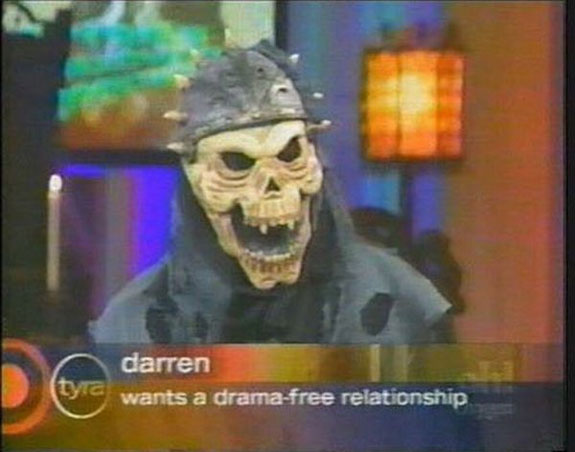
(TV screencaps via Damn Cool Pics.)
Two years later, I find it interesting to read what I wrote about Obama on the eve of the 2008 Virginia primary:
Tomorrow is the Virginia primary, and for the first time ever I am considering intentionally not voting… The trouble is, neither Obama nor Hillary have shown solid progressive leadership. Both of them pander to the right to the point of grotesquery. I could almost forgive Obama his weak health care plan even though that issue is extremely important to me, but that “Harry and Louise” ad was so wildly irresponsible, it really made me question his judgment. Wouldn’t it be nice if Obama used his rhetorical talents to promote a real health care plan? He has also repeated right-wing lies about there being a Social Security “crisis”; his praise of Ronald Reagan was steeped in gauzy right-wing frames about the ’60s, ’70s, and ’80s; and his campaign actually created an oppo page about Paul Krugman, a true-blue progressive hero whose intellectual integrity I greatly admire… Obama has been so reckless in his approach to these bedrock issues that I simply don’t trust him. Sorry to rain on the hope parade, people, but there it is.
I actually admire Obama for what he managed to accomplish on health insurance — but aside from that, I’d say my misgivings were justified. Not that you’ll ever see me as a vaunted TV pundit.
There’s a lot I’d criticize Obama for: His Bush-like despotic abuse of civil liberties and presidential powers when it comes to US prisoners, for example, is nothing less than loathsome. His ridiculous habit of making concessions to Republicans in return for nothing. His government’s attack on Wikileaks. His refusal to make the filibuster an issue (although here the majority of blame rightly belongs to Harry Reid). His lack of leadership on climate change, the most important issue of this century. (Although here, again, the Senate deserves most of the blame).
So I’m hoping this post won’t lead to accusations that I’m a mindless Obama-worshipers, etc..
But this week’s tax deal isn’t something I’ll hate on Obama for.
Because it’s a good deal.
The GOP got around $95 billion in tax cuts for wealthy Americans and $30 billion in estate tax cuts. Democrats got $120 billion in payroll-tax cuts, $40 billion in refundable tax credits (Earned Income Tax Credit, Child Tax Credit and education tax credits), $56 billion in unemployment insurance, and, depending on how you count it, about $180 billion (two-year cost) or $30 billion (10-year cost) in new tax incentives for businesses to invest.
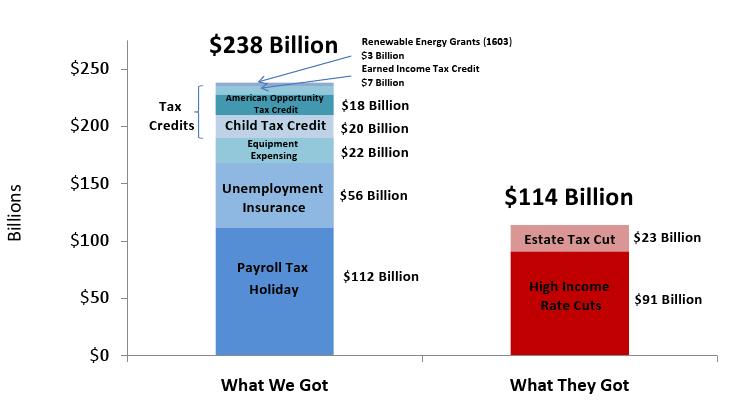
That’s $125 billion in the tax cuts Republicans wanted, and $246-$396 billion of the tax cuts Democrats wanted. Frankly, that’s about $200-$300 billion dollars better than I expected. (It’s likely that Congress will wind up changing these numbers somewhat before the final bill is signed, but the baseline has been changed in a very positive direction). Overall, imperfect though it is, it’s more stimulus than anyone expected — and stimulus for the economy should be a higher priority than either deficit-cutting, or tax fairness, until unemployment drops to reasonable levels.
I think we might have gotten a better deal if the Democrats in the Senate had been standing firm on taxes over the last month, rather than a whole bunch of them being obviously and publicly weak on blocking the extra tax cuts for the rich. That wasn’t Obama’s fault, but it put him in a bad bargaining position.
And nonetheless, Obama walked away with a much better than expected bargain.
I know that the press thinks otherwise, and Republicans think otherwise. That’s because both the press and the Republicans are fools. They don’t do the math; they just pay attention to who won the news cycle. Well, Republicans won this week’s news cycle. But they lost on the numbers.
President Obama did, after all, extract more concessions than most of us expected. […] All of this is very much second-best policy: consumers would probably spend only part of the payroll tax break, and it’s unclear whether the business break would do much to spur investment given the excess capacity in the economy. Still, it would be a noticeable net positive for the economy next year. […]
This political reality makes the tax deal a bad bargain for Democrats. Think of it this way: The deal essentially sets up 2011-2012 to be a repeat of 2009-2010. Once again, there would be initial benefits from the stimulus, and decent growth a year before the election. But as the stimulus faded, growth would tend to stall — and this stall would, once again, come in the months leading up to the election, with seriously negative consequences for Mr. Obama and his party.
Krugman’s argument is that even if though the compromise is more than he thought Obama would be able to get, and “would be a noticeable net positive for the economy next year,” it could also lead to electoral trouble in two year’s time.
First of all, that amounts to criticizing Obama for taking a deal that’s good for the country even if it’s not ideal for the Democrats politically. Since when is putting the country’s needs first the wrong thing to do?
Secondly, the politics of this aren’t as clear-cut as Krugman claims (Krugman is an authority on economics, not on politics). The problem in 2010 wasn’t that the “recovery” had stalled; it was that the recovery only existed on paper and in corporate balance sheets, but not in the areas that ordinary Americans care about. The unemployment rate didn’t drop, and in general people don’t have any more money to spend or feel less economically vulnerable.
If we see some real economic improvement — dropping unemployment, more security, more spending money — then the Democrats will be in a stronger position for the 2012 election, even if things level off before November 2012.
And if that doesn’t happen, my bet is that things like the payroll tax cut get extended another year. Extending tax cuts for the majority of working Americans during a time of economic crisis is not the most difficult political lift in the world. But if Republicans want to fight for raising every working American’s taxes with just 10 months to go until the 2012 elections, would that really hurt the Democrats in 2012?
Here’s my interview on KBOO. Thanks to interviewer, host, and man-about-town SW Conser — I’ve done interviews before, but this was my first live interview, and he made it easy.
SFF Chat put together a series of essays by Jewish writers for this Hanukkah series. I’m honored to have been included, with an essay about the process of editing People of the Book: A Decade of Jewish Science Fiction and Fantasy (available on Amazon).
Some sample quotes:
When I was eleven, I remember a boy my age asking, “So which is it? Are you an atheist or a Jew?”
His tone was one of skeptical indignation. He was clearly intimating that he’d caught me in a lie because I’d described myself as both. The weird thing was that my perspective immediately flipped to his. Even as I explained that the situation was more complicated than either/or, that I was both Jewish and an atheist, I saw him as right. I saw myself as a liar.
I suppose that was a tiny fragment of what W. E. B. DuBois describes as double consciousness—a “sense of always looking at one’s self through the eyes of others.”…
I mention all of this to work my way toward the context of how I understand the question with which Michael Weingrad, writing in the Jewish Review of Books, perturbed the internet (or at least my corner of it) several months ago—”Why Is There No Jewish Narnia?”
Weingrad wonders why “amidst all the initiatives to solve the crisis in Jewish continuity, no one has yet proposed commissioning a Jewish fantasy series that might plumb the theological depths like Lewis or at least thrill Jewish preteens with tales of Potterish derring-do.”…
Others have challenged Weingrad’s assertions in detail, but at this late point in the discussion, I have to admit that my central response to Weingrad is to wonder whether the entire problem is definitional. Weingrad appears to be defining the fantasy genre in such a way that it excludes most Jewish fantasy. Most secondary world fantasy by Jewish authors doesn’t count because it’s not theologically based in the way Lewis’s Narnia is based in Christianity. And apparently for Weingrad, Jewish primary world fantasy doesn’t evoke the same sense of wonder as Rowling’s Harry Potter.
It seems to me that Weingrad defines fantasy by the terms of Christian writers, and then wonders why Jewish doesn’t look exactly like Christian fantasy does.
Well, why should it?
Why is primacy and centrality given to Narnia but not Kafka?
Why is Christian fantasy taken on its own terms, but Jewish fantasy compared to a Christian default?
Read the rest at SFF Chat.
There’s also a book giveaway going on over there. Leave your name and email in comments and SFF Chat will enter you to win a free copy of People of the Book.
The press release from Words & Pictures, a Portland radio show devoted to comics:
Tomorrow morning (Thursday December 9th) from 11:30am to noon (PDT), Words & Pictures celebrates its seventh anniversary on the air by returning to its local roots. This month’s guest is up-and-coming Portland author Barry Deutsch, who’s just published his first graphic novel Hereville: How Mirka Got Her Sword, the adventures of a troll-fighting eleven-year-old Orthodox Jewish girl.
Words & Pictures airs on KBOO community radio, 90.7fm, Not near a radio? You can listen to the real-time webstream at http://kboo.fm/listen via iTunes or Abacast. And look for the webcast version on KBOO’s home page shortly after the show airs.
More info and links to recent webcasts can be found at http://www.tooningin.com
Jake Richmond, Hereville’s colorist, will be there as well. Should be fun!
 Only in a nation that is truly ill-informed could Republicans block unemployment aid for millions unless the most fortunate among us get tax cuts, while simultaneously talking out the other side of their mouths about deficits burdening our children. All this while we live in a new Gilded Age of mind-blowing income inequality. It’s almost too absurd to contemplate. But you knew that already. As for my thoughts on the Great Compromise: I think Obama could have used his rhetorical abilities to put the GOP on the defensive. But caution is his middle name (it has officially replaced “Hussein,” in fact), and it’s going to come back and bite him on the butt.
One almost gets the impression from the GOP that something is wrong with you if you’re still doing actual, useful work (or would like to, except for the fact that there are five available workers for every job opening), as opposed to occupying the loftier realms of high finance. So I decided to play around with the idea of everyone becoming a banker. Related cartoon from 2004 (a personal fave): “The Labor Chain“



There is nothing new under the sun. From Charles Dickens's Hard Times, 1854: Surely there never was such fragile china-ware…

From the title, I was expecting a comic about how bankruptcy laws favor the rich, getting them into a special…

I think a lot of Trump voters - not all, but a bunch - are convinced that Democrats want to…
The odd thing, given that Trump voters often appear to be pure ego, is that I can't imagine what they…
...raise taxes on all red states to pay for free healthcare for undocumented immigrants. I don't know, that last one…