
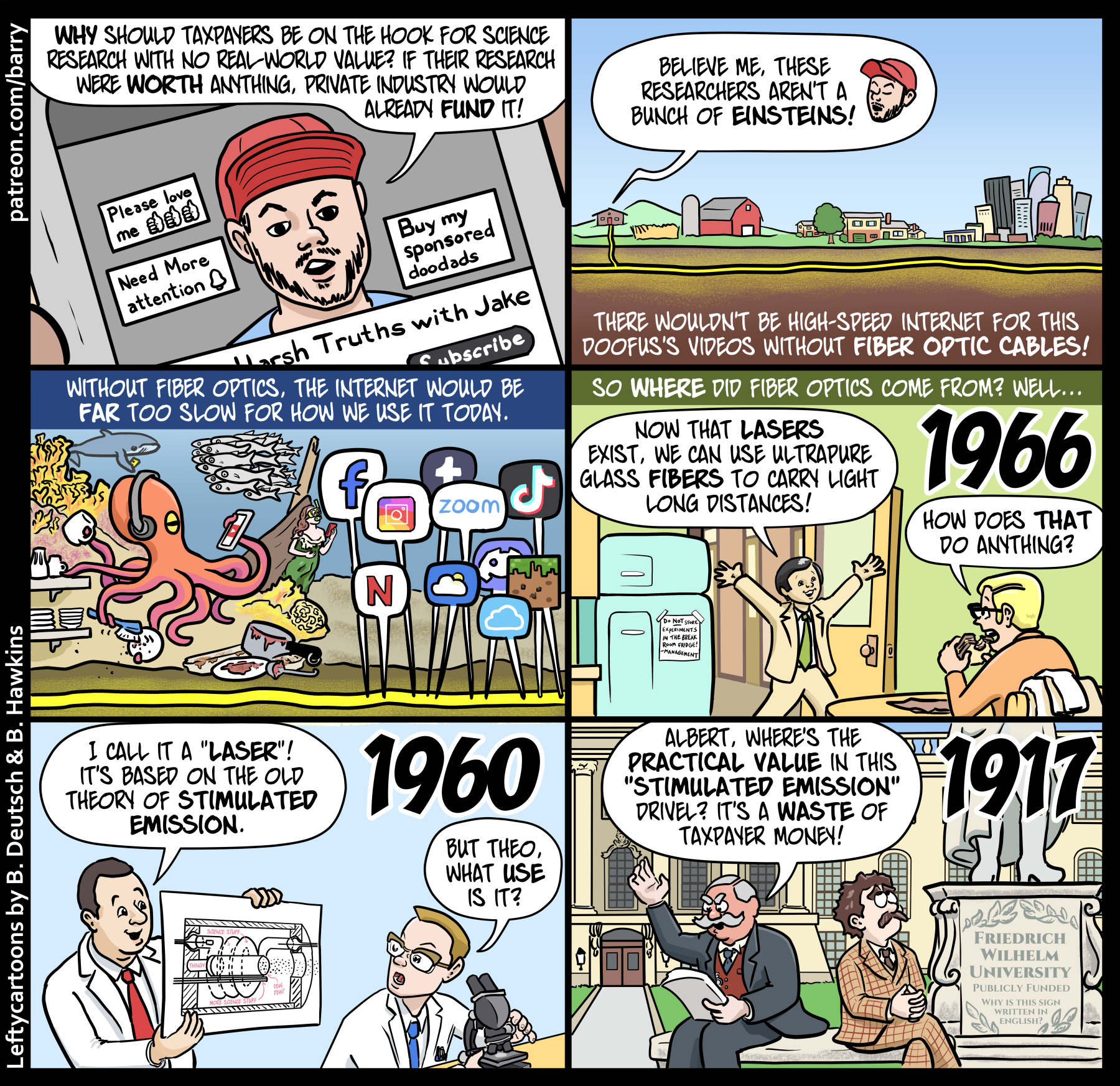
Another collaboration with Becky Hawkins!
Becky writes:
This cartoon was a fun mix of historical (Charles Kao! Theodore Maiman! Young Einstein at Friedrich Wilhelm University!) and fanciful (annnd the octopus is… watching YouTube! while doing dishes!).
Barry’s script for panel 2 says “A cross section of a buried cable – buried under city or farm or woods, whatever you like – and the dude’s word balloon is coming from the cable.” I sketched a cross-section of fiber optic cable with some dirt around it. I sketched another version from farther away, with a city and farm and suburbs, which Barry preferred. I like that this version shows how the internet connects different regions.
It was fun to draw the transition from mountains to farmland to suburb to city. It’s the sort of progression you see driving back to Portland from the coast, or taking any intercity rail. Yes, I think about these things hard enough to draw brick warehouses and a tiny self-storage unit on the outskirts of the city. I’ve been known to get unnecessarily bogged down in a quest for accuracy (such as last June’s Pittsburgh skyline) so it was a fun departure to draw a deliberately cartoony Downtown, USA. I did look at LA and Houston for skyscraper inspiration.
After the drawing was done, I realized the word balloon in panel two could be coming from the cabin on the left instead of the cable itself. I like how that tells us something about Jake of the imaginary YouTube series, Harsh Truths with Jake.
Barry writes:
I’m still a bit in shock over the huge cuts to basic research. Supporting basic research shouldn’t be a matter of ideology; plain old greed should be enough. Funding basic research will, in the long run, make the US (and other countries) wealthier.
All our grandchildren — including the grandchildren of the Republicans themselves! — are being made poorer by defunding basic science.
I considered a lot of examples of publicly funded science producing economic value: quantum mechanics and semiconductors; DARPA leading to the internet; the global positioning system; CRISPR gene editing; messenger RNA (mRNA), which led to COVID vaccines; the Human Genome Project.
Our world would look unimaginably different without the decades of public science funding underlying modern life.
After considering a bunch of options, I ended up writing a cartoon about lasers. There were a few reasons, but a major one was that I could hook Einstein into it, giving me a chance to do the “they’re no Einsteins” gag.
Lasers are used for a lot more than just fiber optics (although just that would be pretty fantastic). Barcode scanners, eye surgery, DVD players, industrial precision cutting, and of course hypnotizing cats are just a few of the ways we use lasers. (Wow, does this paragraph sound like an extremely boring film I might have been forced to watch in the second grade.)
When lasers were first invented, Charles Townes called them “a solution in search of a problem,” and it’s such a great quote that it’s a shame there’s no evidence that Townes ever said it. People really did say that about lasers in the 1960s, but we just don’t know who said it first.
TRANSCRIPT OF CARTOON
This cartoon has six panels.
PANEL 1
A bearded man in a red cap is recording a video of himself.
JAKE: Why should taxpayers be on the hook for science research with no real-world value? If their research were worth anything, private industry would already fund it!
PANEL 2
Jake’s rant continues over a cross-section of the landscape, from farmland and suburbs to a city; his voice is coming from a little cabin. A fiber-optic cable runs underground all the way across the panel.
JAKE: Believe me, these researchers aren’t a bunch of Einsteins!
CAPTION: There wouldn’t be high-speed internet for this doofus’s videos without fiber optic cables!
PANEL 3
Under the ocean, a fiber-optic cable runs along the ocean floor. Word balloons coming from the fiber optic cable contain the icons of many internet-based services — Facebook, Zoom, Discord, Netflix, Minecraft, and more.
CAPTION: Without fiber optics, the internet would be far too slow for how we use it today.
PANEL 4
CAPTION: So where did fiber optics come from? Well…
CAPTION: 1966
In a laboratory break room, an excited scientist throws his arms wide while another scientist eats at a table.
SCIENTIST: Now that lasers exist, we can use ultrapure glass fibers to carry light long distances!
OTHER SCIENTIST: How does that do anything?
PANEL 5
CAPTION: 1960
A scientist proudly holds up a diagram of a newly invented device. Another scientist sits at a microscope.
SCIENTIST: I call it a “laser”! It’s based on the old theory of stimulated emission.
OTHER SCIENTIST: But Theo, what use is it?
PANEL 6
CAPTION: 1917
Outside a university, a pompous-looking man gestures indignantly as he reads a scientific paper. He’s speaking to a young Albert Einstein, who rolls his eyes.
MAN: Albert, where’s the practical value in this “stimulated emission” drivel? It’s a waste of taxpayer money!
CHICKEN FAT WATCH
In panel 1, Jake’s video is titled “Harsh Truths with Jake.” Signs behind him read “Please love me” with three thumbs-up symbols, “Need More attention” with a notification-bell symbol, and “Buy my sponsored doodads.”
In panel 3, the octopus is simultaneously listening to headphones, drinking coffee, using a phone, and washing dishes. A whale with swims overhead, looking at her phone. A shipwreck has a figurehead wearing a snorkel and looking at a phone.
In panel 4, a note taped to the refrigerator reads: “Do NOT store experiments in the break room fridge! —Management.”
In panel 5, the technical diagram has parts labeled “SCIENCE STUFF,” “THINGY,” “MORE SCIENCE STUFF,” and “PEW! PEW!”
In panel 6, the statue pedestal reads: “Friedrich Wilhelm University. Publicly Funded. Why Is This Sign Written in English?”



I have mixed feelings on this.
It’s true, obviously, that a lot of advances are the unintended consequences of research. It’s also true that a lot of tax dollars have been spent frivolously and have had nothing come from them.
Take for example, this case, which Republicans made hay over in 2013. The story at the time was that despite sequestration (which forced government cuts across the board) the federal government still found it in their hearts to fund $400,000 to study duck penises. Is that true? Kind of. It turned out that the study was funded by 2009 stimulus dollars that had not been spent yet and the intricacies of grant financing is complicated, and that grant wasn’t effected by sequestration because it shouldn’t have been.
But the government sure did spend $400,000 studying the anatomy of a duck penis.
And I don’t think we got faster internet out of that.
Research is complicated, but I think that it’s easy to envision a couple of vectors: Curiosity and Practicality. I think the private sector is willing enough to invest in practicality, and that leaves governments and philanthropists to fill the gap on curiosity. I’ve never seen this mapped, but I would be prepared to bet good money that relatively few advancements have come out of the high-curiosity, low-practicality quadrant. I think discussions about limiting public expense on research, particularly in hard times, is probably legitimate. You mentioned Einstein’s precursor work that eventually resulted in lasers – His work at the Kaiser Wilhelm Society was funded by a mix of public and private dollars, and the entire institute was aimed at practical wartime innovations. That’s not exactly the best case for investment of public dollars in curiosity research.
Duck penises: Not so much a study of duck dicks as it is a study of how evolution works when something that benefits one group (male ducks) does not benefit another group (female ducks).
More here: https://pmc.ncbi.nlm.nih.gov/articles/PMC2871948/
Why would we need to know this? It’s one more useful piece of information about how evolution works. It’s easy to make fun of scientific studies by choosing a strange-sounding detail, but that’s kind of a cheap ploy.
Does studying mechanisms of evolution in sexual conflicts among ducks benefit your average tax-payer? Knowledge always pays off in the end, so I’m betting yes.