Another collaboration with gorgeous visuals from R.E. Ryan.
University of Amsterdam professor Petter Törnberg wrote an article that could have been written to go with this cartoon: It’s Not Polarization; It’s the Radicalization of the Political Right.
Polarization offers an ostensibly neutral frame, distributing blame evenly across the political spectrum. Much like journalism’s “both-sides” logic, its scholarly embrace allows analysts to diagnose dysfunction without appearing partisan. […]
Yet this neutrality is not borne out by the empirical evidence. Across advanced democracies, crisis is resulting not from mutual divergence but from the one-sided transformation of the political right: the mainstreaming of authoritarian rhetoric, the normalization of conspiracy and hate as political strategies, and the systematic dismantling of institutional guardrails. […]
Refusing to name asymmetry is itself a political act. To continue describing democratic crisis as polarization is to lend legitimacy to those undermining democracy by treating them as one half of a symmetric dynamic. Neutrality under these conditions is not objectivity: it is complicity.
Törnberg’s article is about scholars, whereas my cartoon is about journalists and pundits, but the same analysis applies. A certain kind of personality likes finding a way to blame both sides no matter what the conflict is. It lets them — or “us,” I should say, since my personality definitely includes this flaw — feel like our analysis is smarter, our viewpoint fairer, and our insights deeper.
And yet, so many of the stupidest ideas I’ve heard have come from people who proudly declare themselves above taking sides.
To quote Thomas Zimmer (as I’ll do a lot in this post):
The “polarization” concept is useful if you want to sound serious by lamenting the state of American politics but don’t understand or deliberately want to obscure the fact that the major threat to democracy is a radicalizing Right.
It’s certainly good to be able to criticize both parties. But viewing everything through a polarization lens can be as distorting as viewing everything through a partisan lens.
Commenting on Ezra Klein’s Why We’re Polarized, Thomas Zimmer points out that Klein, in the final section of his book, admits that it’s the Republicans who have changed — but still attempts to cling to “polarization.”
To account for these rather crucial differences between Left and Right, Klein employs the concept of “asymmetrical polarization.” But that doesn’t really solve the problem. Even when it comes with the qualifier “asymmetric,” the term “polarization” still implies both sides moving towards the extremes at least to a somewhat significant degree – and that is certainly how the term is used in the broader public discourse and understood in widely accepted parlance today. But based on the evidence Ezra Klein himself presents, there is no liberal version of Fox News and the rightwing media bubble, the Democrats don’t have a Trump, and there is no equivalent on the Left to the influence of reactionary and white nationalist forces inside the GOP. If, by the authors’ own standards, de-emphasizing the concept of “asymmetric polarization” and instead foregrounding the idea of a radicalization of the conservative movement and the GOP would capture the central development in recent U.S. history and politics more adequately and precisely, why doesn’t he?
From what I’ve seen, Klein is the best of the “polarization is the problem” pundits, but that’s perhaps not the highest bar to clear.
And as Zimmer said on Bluesky, it’s no surprise that the “polarization” analysis has been seized upon by conservatives, who recognize the value to their cause of prioritizing the “value” of depolarization over values like democracy and anti-bigotry.
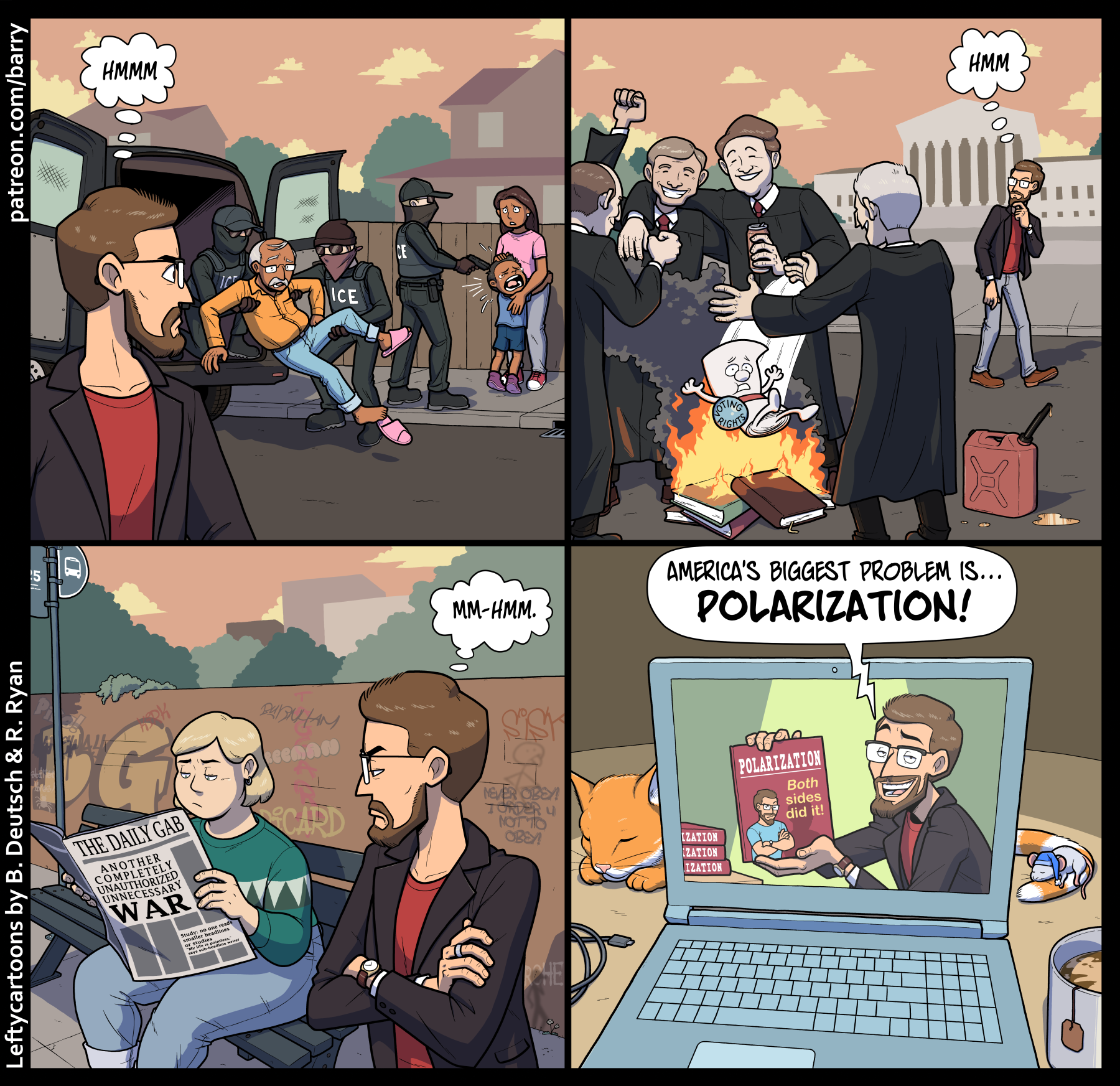
TRANSCRIPT OF CARTOON
This cartoon has four panels. The same bespectacled, bearded man appears in all four.
PANEL 1
The man walks past several masked ICE agents. Two agents are dragging an older man toward the open back of an SUV. Nearby, a distressed woman stands with a small child who is crying. An ICE agent is pointing a gun at the child.
MAN (thought): Hmmm.
PANEL 2
Outside the Supreme Court, several Supreme Court justices in black robes are drinking and celebrating around a bonfire in which the Voting Rights Act is burning. The man walks past in the background, watching them.
MAN (thought): Hmm.
PANEL 3
At a bus stop, a woman is reading a newspaper. The man stands beside her, leaning slightly to read the front page. The newspaper’s main headline says: ANOTHER COMPLETELY UNAUTHORIZED UNNECESSARY WAR
MAN (thought): Mm-hmm.
PANEL 4
We see an open laptop. On its screen, the man is appearing on a TV interview show, grinning as he holds up a copy of his book, Polarization: Both Sides Did It!
MAN: America’s biggest problem is… POLARIZATION!
CHICKEN FAT WATCH
In panel 2, the burning Voting Rights Act is depicted as the “I’m Just a Bill” character from Schoolhouse Rock!
In panel 3, the newspaper is called The Daily Gab. Under the enormous war headline is a much smaller headline: “Study: No one reads smaller headlines or studies.” A sub-headline says “‘My life is pointless,’ says sub-headline writer.”
On the wall in panel 3, graffiti includes tags from all eight captains from Star Trek shows (Pike, Kirk, Janeway, Burnham, Freeman, Picard, Sisko, and Archer) plus Taggart from Galaxy Quest. Other graffiti includes “Skitter Lives!” with a spider; a huge “BG,” for “background”; and “Never obey! I order U not to obey!” It only occurs to me now, writing this transcript, that I should have made it “not 2 obey.” Oh well.
In panel 4, behind the laptop, a large orange cat is sleeping. Curled up asleep on the cat’s tail is a tiny mouse wearing a sleeping cap.



I lived in Harlem for a little bit too! Maybe we ran into each other there.