The Slap. The first episode of the American TV show made me recall something Gore Vidal once wrote: “Bad books on writing tell you to “WRITE WHAT YOU KNOW”, a solemn and totally false adage that is the reason there exist so many mediocre novels about English professors contemplating adultery.”
But actually, Gore Vidal didn’t say that, Joe Haldeman did. So much for the accuracy of my memory.
Anyhow, the first episode of The Slap is about Hector, a well-off liberal white guy with a great wife and kids and a 40th birthday party which he spends contemplating having an affair with his kid’s 16-year-old babysitter. But I knew that the premise of The Slap is that a guy slap’s someone else’s child in the first episode. So the only thing that made Hector interesting, to me, was that by the end of the episode he would do something completely uncharacteristic for someone of his personality and class position, and slap another person’s child.
But then it turned out that the slap wasn’t delivered by him; it was delivered by his boorish right-wing stereotype cousin Harry. (I warned you there’d be spoilers.) So, in fact, there is absolutely nothing interesting about this dude in whose tedious P.O.V. I’ve just spent forty minutes trapped.
Anyhow, boorish right-wing stereotype Harry slaps the bratty, undisciplined child of self-righteous left-wing stereotypes Gary and Rosie.
I’d bet money the writers of the American The Slap are middle-of-the-road liberal Democrats, much like Hector. And it’s just… boring and annoying that their slapper is such a cartoon of right-wingers, and Gary and Rosie are such cartoons of social-justice types. This is the sort of Aaron Sorkinesque crap that makes me sympathize with Conservatives who call liberals smug condescending assholes.
But I kept on watching, because a friend told me that the series features shifting points of view and seeing how different characters view the same events, and I love that kind of stuff. So I watched the second and third episodes, and they were better, largely because they weren’t in Hector’s perspective.
But then I found out that the Austrialian The Slap, on which the American The Slap is based, is available on Netflix. And I starting watching it, and you know what? It’s MUCH better. In the Aussie version, Hector from the start is narcissistic and a bit of dick towards his family, which makes his interest in screwing the babysitter less out of the blue. Harry, while still arrogant, is apolitical rather than right-wing. Every female character is more three-dimensional and distinct than on the US version, and the relationship between lifelong friends Anouk, Aisha (Hector’s wife), and Rosie is shown as being as central to this group of characters as that between cousins Hector and Harry.
One notable difference is that everyone seems less friggin’ rich in the Aussie version. It’s as if American TV producers just can’t imagine a story being interesting if it’s not about rich people.
Conclusion: If you like extended multi-protagonist narratives about how one bad decision can lead to a bunch of bad repercussions for a group of fairly lousy people, check out the Australian version of The Slap.
* * *
Charles and I watched Dear White People, a crowdfunded indie movie, tonight. I enjoyed it; for a political movie about anti-black racism, it was surprisingly UN-idealogical, as all the main characters ended up having to shift away from pat ideologies at one point or another. In fact, if there’s an underlying ideology in this film, it’s the director’s beliefs that Black people’s stories are interesting and worth telling. The actors were fine (lead actress Tessa Thompson, from Veronica Mars, was especially good). The story wasn’t the greatest; the script was sometimes self-indulgent (the movie theater bit was out of character and felt like sketch comedy), and the supporting characters felt more like plot drivers than characters. But the central four characters were all fun to watch, and the film’s refusal to accept simple answers to anything was refreshing.
Passes the Bechdel test by a hair – there are two lead female characters, and they talk at least once about something other than a man. But although two of the four lead characters are female, there’s a default-male trap that the director falls into; every significant supporting character in this movie is male.
* * *
I love low-budget sci-fi that has to rely more on a clever script than on special effects. I also love time travel movies. So no surprise I watched Time Lapse, a low-budget suspense movie about three roommates who discover that a camera pointed at their living room window takes pictures of what will be going on in their apartment 24 hours in the future.
The writers are clearly Hitchcock fans; the characters try to use the camera to take control of their lives (by getting wealthy by betting on sports, for example), but very quickly it seems as if the camera might be controlling them instead, and things spiral out of control. The plot gets enjoyably convoluted, seemingly irrelevant details from early in the film turn out to be crucial, and disaster looms. I enjoyed it.
The comparison to Hitchcock doesn’t do Time Lapse any favors. No one can expect first-time filmmakers on a tiny budget to be able to approach Hitchcock’s stunning cinematography, but watching this made me appreciate how expert Hitchcock was at making characters distinct and full of blood and nuance, even when they’re just there to drive the plot along. That doesn’t happen here. And sure, these actors aren’t Jimmy Stewart and Grace Kelly, but neither the script or direction gives the actors a chance to play full characters.
Also, from a feminist perspective, this movie isn’t offensive, but it sure ain’t great – the one major female character’s participation in the plot is mostly kissing one boy or the other, and her love life seems to be her only interest.
So: A fun time-travel thriller, but one that is probably too flat to be memorable. I liked it, but I bet their next movie will be better.
I’m pretty sure this fails the Bechdel test. There are only two female characters (one very minor), and they’re never on screen together.
* * *
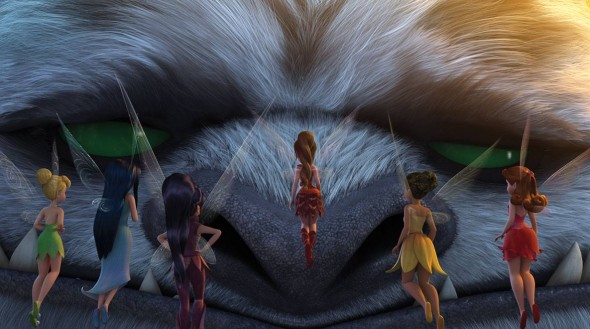
I watched Tinker Bell and the Legend of the NeverBeast with the girls (Maddox and Sydney, now aged 9 and 11).
First of all, gotta say this for the Tinker Bell series of movies – a Disney powerhouse that mostly stays below the radar but is hugely profitable – every Tinker Bell movie passes the Bechdel test with flying colors. But this newest installment in the franchise is definitely tenser, darker and more gut-wrenching than the previous Tinker Bell movies (not a very high bar to clear, admittedly).
It was really good! The animation was good enough to be expressive and enjoyable, and to bring in some good visuals (but very basic! Don’t expect any million-dollar “Brave” hair animation here), and grown-ups will find the story familiar. But sometimes it’s fun to watch a well-done version of a familiar tale! And the character design of the NeverBeast – borrowing from both Where The While Things Are and Studio Ghibli, I think – is gorgeous (the spiral patterns on its fur work really well when animated).
I’d recommend that anyone with a 7-12 year old friend sit down and watch this with them. Especially animal lovers. But if your friend (or you) is susceptible to tear-jerkers, you’d best have tissues handy for the ending.
Trivia: Tink’s voice actor, Mae Whitman, was also the voice of Katara in “Avatar: The Last Airbender,” and played Ann Veal on “Arrested Development”, so if her choice of roles say anything about her she must be a neat person.
* * *
Speaking of time travel narratives, I’ve been rewatching the two seasons of Terminator: The Sarah Conner Chronicles. A very underrated show that started out well and got smarter and deeper as it went along; I wish it had lasted longer, although at least the second season ends at a decent story-ending point.
Another easy Bechdel-test passer, although I wish there had been more than two significant non-white characters.
* * *
I saw the most recent Hobbit movie. Helped, perhaps, by my ultra-low expectations, I had fun. It was pretty, the landscapes were very pretty, the special effects were nice, a great group of actors, some of the fight scenes were well done in American blockbuster style. It didn’t feel as bloated and annoying as the second Hobbit movie.
It was all very… competent. If you enjoy seeing expert setbuilding and makeup and costuming, there’s a lot to enjoy here. But what a steep decline from how good the Lord of the Rings movies were (and those were far from perfect).
It did pass the Bechdel test, perhaps, but only barely – the Elf lady may have spoken to the little human girls about fleeing the burning city while they were, well, fleeing the burning city. Lots of “oh, the cowardly male character is wearing a dress, how hilarious” humor that stopped being funny sometime in the 1990s, I think.
* * *
So what have you watched lately?






Am I the only one who read "Beware the narcoterrorists" and thought "beware the jabberwock"?