Interesting Bloggy Debate About Inclusivity

exclusion zone

in·clu·siv·i·ty
ˌinklo͞oˈsivitē/
noun

1. An intention or policy of including people who might otherwise be excluded or marginalized.

I thought this inter-blog debate was interesting.

It started with Apophemi, whose views I mostly agree with (at least in this post). Here’s a few excepts:

There are things that lie too close to home for me to be comfortable debating them, which I’m sure at least a plurality of people in the ongoing Charming And Friendly Rationalist Dinner Party group would wholeheartedly disapprove of, seeing as I thus require adherence to these ideas or at least a lack of explicit challenges to them on the part of anyone speaking to me before I can entertain their arguments in good faith. […]

An example: I cannot in good faith entertain the argument that high-scarcity societies are right in having restrictive, assigned-sex-based gender roles, even if these social structures result in measurable maximized utility (i.e. many much kids). I have a moral imperative against this that overrides my general impulse towards maximized utility, or rather (if you asked me about it personally) tilt-shifts my view of what sectors ‘deserve’ to see their utility maximized at the expense of a given other sector.[…]

Because of the conditions of discourse that not having limitations on what type of ideas can be acceptably entertained, these environments are also self-selecting. In other words, even when the people speaking loudest or most eloquently don’t intentionally discourage participation from people who are not like them / who may be uncomfortable with the terms of the discussion, entertaining ‘politically incorrect’ or potentially harmful ideas out loud, in public (so to speak) signals people who would be impacted by said ideas that they are not welcome.

I agree with Apophemi about many things. Part of my philosophy for “Alas” is that, at least on this blog, certain debates are closed. For example, I’m not interested in arguing about if Science shows that White people are genetically smarter than Black people; I’m convinced that science shows no such thing with any certainty, and more importantly, that the debate itself is harmful in just the ways Apophemi describes. Similarly, there are a number of anti-trans arguments I’m rather not see here. There are lots of places where those arguments are welcome, but I’d rather Alas be a place where trans people are welcome.

On the other hand, some debates are not closed in our society, ((I’m an American, so that’s what I think of as “our society,” although I realize that not all “Alas” readers are Americans.)) even if they are distressing to have. There is more-or-less a consensus in our society that overt racism is wrong, but there’s no such consensus about reproductive rights, or about marriage equality, or about fat activism. Since there is no consensus, I think it’s important to be able to have these debates openly. And since I can’t function well in environments in which insults are hurled and people are overtly dehumanized, I try and create an environment for myself in which these topics can be debated with enough civility to reach my personal minimum threshold of bearability.

Of course, by creating such an environment, I inevitably exclude other people – people who find the demand to maintain that threshold of civility makes “Alas” into a place they find oppressive or hurtful.

So it won’t be surprising that although I largely agreed with Apophemi, I also had a lot of sympathy for this response to Apophemi by Scott Alexander of Slate Star Codex, a blog I quite like although I often disagree with Scott’s ideas. Scott wrote:

This reminds me of the idea of safe spaces.

Safe spaces are places where members of disadvantaged groups can go, usually protected against people in other groups who tend to trigger them, and discuss things relevant to that group free from ridicule or attack. I know there are many for women, some for gays, and I recently heard of a college opening one up for atheists. They seem like good ideas.

I interpret Apophemi’s proposal to say that the rationalist community should endeavor to be a safe space for women, minorities, and other disadvantaged groups. ((I’m not sure I agree with Scott about this. I interpreted Apophemi’s essay as explaining why ze doesn’t feel comfortable posting on spaces like “Less Wrong,” without necessarily proposing any changes.))

One important feature of safe spaces is that they can’t always be safe for two groups at the same time. Jews are a discriminated-against minority who need a safe space. Muslims are a discriminated-against minority who need a safe space. But the safe space for Jews should be very far way from the safe space for Muslims, or else neither space is safe for anybody.

The rationalist community is a safe space for people who obsessively focus on reason and argument even when it is socially unacceptable to do so.

I don’t think it’s unfair to say that these people need a safe space. I can’t even count the number of times I’ve been called “a nerd” or “a dork” or “autistic” for saying something rational is too high to count. Just recently commenters on Marginal Revolution – not exactly known for being a haunt for intellect-hating jocks – found an old post of mine and called me among many other things “aspie”, “a pansy”, “retarded”, and an “omega” (a PUA term for a man who’s so socially inept he will never date anyone).

I think this leans towards my own preference, which is to have lots and lots of different spaces. No conversation will be comfortable for everybody, so the optimum is to have as many different spaces making good discussions accessible to as many different sorts of people as possible.

Scott also included a very kind link to “Alas,” so thanks for that, Scott.

Scott loses me later in his essay, though, by going overboard in what (even if this wasn’t Scott’s intent) comes off as an attempt to deny that there is any problem at all. For instance, he argues that Yoga classes are taken more by women than by men, but it wouldn’t be reasonable to assume that yoga classes are driving men away with anti-male attitudes; rather, “men and women are socialized differently in a bunch of subtle ways and the interests and values they end up with are more pro-yoga in women and more anti-yoga in men.” Okay, that seems reasonable to me.

He then says the rationalist community is the same way, and therefore there is no problem of women and some minorities feeling excluded by the dialog there. But unlike yoga class, we have direct evidence – such as the post Scott was responding to – that there are women and minorities who do feel excluded from rationalist communities, and say so clearly.

Nor do I think it takes a very great leap of empathy to realize why, for example, some Black readers would find serious discussion of how Black people are allegedly genetically less intelligent than whites or Asians, to be unwelcoming. (Scott points out that Less Wrong has no shortage of Asians. But, again, it’s not hard to see why claims that Blacks are intellectually inferior to Whites and Asians may be, on average, easier for Asian readers to stomach than Black readers.)

The third post I want to point to is On inclusivity in Less Wrong: a response to Scott Alexander by Ben Kuhn. He has a similar reaction to mine to the Yoga metaphor: “People find Less Wrong exclusionary. I’ve asked them and they said so, and as far as being discouraged from contributing goes, that’s the end of the story.” Overall, Kuhn argues for a middle ground:

Basically, the rebuttal of Apophemi is fine. I agree, discourse without limitations is an important part of Less Wrong and shouldn’t go away, fine. But that’s no excuse for overreaching and ignoring the middle ground. Less Wrong does have problems with discourse that marginalizes people. We need to at least notice that we’re making a trade-off here, and look for ways to improve along both axes when we can.

I don’t really have any solutions to offer, beyond my belief that all forums exclude in one way or another, and therefore we need a lot of different forums. But the trade-off between “discourse without limitations” and “we want to be welcoming” is always going to be an issue, whenever any forum is created. It’s something useful for blogrunners (and readers) to keep in mind.

Posted in Civility & norms of discourse, Uncategorized | 95 Comments

Alas Bugs Have Been Driven Out Into The Cold Where They Suffer, Shivering, Uncared For And Soon To Be Forgotten

Hey, so “Alas” is back up, and many bugs that have plagued “Alas” (most notably, the inability to edit comments) have been defeated. (For now).

Suggestions? Comments? Are people okay with the new setup of the comments sidebar (quoting the first few words of new comments), or do you prefer the old style?

Posted in Site and Admin Stuff | 64 Comments

Which States Enact Voter ID Laws? The Most Racist Ones

voter-id-bills

PolicyMic nicely sums up recent research on what factors made it likely that a state enacted Voter ID laws in 2011:

According to new research by University of Massachusetts Boston sociologist Keith Bentele and political scientist Erin O’Brien, the states that have enacted tougher voter ID laws in the past few years are also the same states where both minority and lower-income voter turnout had increased in recent years.

Focusing further analysis on just 2011, when the vast majority of voter ID regulations were passed, the researchers found that states which passed the legislation were highly likely to have:

– Republicans in control of both houses of the state legislature and the governorship

– Strong probabilities of being swing states in the 2012 elections

– Minority turnout which was higher in the 2008 election and with high proportions of African-American voters

– Larger numbers of allegations of fraud in 2004, though these had a “much smaller substantive impact relative to partisan and racial factors”

The authors note that the study’s results carry ominous implications and demonstrate voter ID laws have “an uncomfortable relationship to the political activism of blacks and the poor.” Their paper further situates voter ID within a realm of policies that “collectively reduce electoral access among the socially marginalized.”

Related: Republicans Admit Voter ID Laws Are Aimed at Democratic Voters – The Daily Beast

Posted in Elections and politics, Race, racism and related issues | 37 Comments

More on Felony Disenfranchisement, America’s Most Racist Policy

prison-gerrymandering

Columbia Law Professor Vivian Berger, quoted at TalkLeft, writes:

These laws have a disproportionate impact on minorities — 1.4 million black men cannot vote. That is a rate of 13 percent — seven times the national average. A majority of the disenfranchised live in the South: Alabama, Mississippi, Florida, Kentucky, Tennessee and Virginia all bar former prisoners from voting. Some of these states adopted disenfranchisement provisions during Reconstruction in order to evade the 15th Amendment’s ban on withholding suffrage from freedmen. (Disenfranchising crimes were carefully selected to disqualify large numbers of blacks.) In Florida and Alabama, the racial effect is greatest; blacks comprise almost 50 percent of the disenfranchised.

Given the disparate targeting and treatment of blacks by the criminal justice system, felony disenfranchisement adds a second level of insult and injury to minority ex-offenders. It harms individuals and also limits group political power.

Although these laws originated with racist Democrats over a century ago, they are maintained and sometimes expanded by the current GOP. For instance, “As one of his first actions after taking office in 2011, [Florida Governor] Scott, as chairman of the Florida Board of Executive Clemency, undid automatic restoration of voting rights for nonviolent ex-offenders that previous Gov. Charlie Crist helped adopt in 2007. Since then, the number of former felons who have had their voting rights restored has slowed to a trickle, even compared with the year before Crist and the clemency board helped make the process easier.”

No one should be disenfranchised after having served their time.

In fact, US citizens should have the right to vote while in prison. Having a huge population of citizens who are especially subject to the government’s dictates, but have no right to vote, invites abuses and is no way to run a democracy.They are people, and citizens; they should have the right to vote.

Furthermore, white racists have rushed to do the same thing with felons that their predecessors did with slaves – use them for head-counting purposes to increase the voting power of white people.

The federal government, in the form of the Census Bureau, is permitting states and counties all over the country to undermine the “one person, one vote” concept. The Census Bureau is doing this by counting prison inmates as residents of the prisons where they are serving their sentences instead of counting them as residents of the places they lived before they were incarcerated. Then, to make matters worse, when the inmates go back to their residences, their prison “districts” continue to reap the benefits of the Census count. In a nation where millions are incarcerated, this is no small accounting glitch.

The result is that rural counties (where prisons typically are located) gain the benefit of higher Census populations (and thus more legislative representation). The problem would be one of semantics, of course, if prisoners were allowed to vote. But in the vast majority of cases, felon disenfranchisement laws ensure that they do not.

Fred Grimm, in the Miami Herald, describes how this works in Florida:

North Florida pols have packed their state House districts with a particularly low-maintenance category of citizens. The kind who don’t show up at townhall meetings clamoring about too much traffic or lousy parks or crumbling bridges or under-funded schools or the need for more cops on the beat. They never, ever complain about too few cops.

Best of all they don’t go around town grumbling that folks should vote for that other candidate. They can’t. They can’t vote. They’re state prisoners.

They’re the great gift urban counties ship up to state representatives in Florida’s rural prison belt, whose districts encompass Sumpter or Bradford or Baker or Hardee or Calhoun and other counties where incarceration is a major local industry and inmates represent a sizeable chunk of the local population.

Come time to redistrict, every 10 years, those inmates — most of them big city homies — are counted along with the local population, making prisoners a valuable political commodity and consigning elected officials, particularly state reps, political power out of whack with their actual voting constituency.

As you can see from the map at top, some localities have banned prison gerrymandering – but most haven’t. The Census Bureau is talking about changing how the Census counts prisoners, and that’s good; however, I worry that any reform done by the Obama administration is subject to being undone by future Republican administrations.

Posted in Elections and politics, Prisons and Justice and Police, Race, racism and related issues | 37 Comments

Four Reasons Racist Voter ID Laws Matter

Restrictive_Voting_2013

In the last year, I’ve seen several people posting suggesting that voter ID laws shouldn’t worry Democrats much (the most prominent were these two posts by Nate Cohn).

But despite a disproportionate impact on Democratic-leaning groups, the electoral consequences of voter ID seem relatively marginal. […] Obama’s share of the vote in North Carolina might have dropped from 48.3 to 48 percent, expanding Romney’s margin of victory from 92,000 to about 120,000 votes. 25,000 to 30,000 votes could flip a very close election, but nothing more. In 2012, no state was so close.

I’d argue that, despite the statistically small difference voter ID laws have made so far, they’re still a matter of legitimate concern.

1) Just as a matter of Democratic principle, it’s wrong to allow Republicans to rob 25,000 to 30,000 North Carolina voters of their vote. (Ditto for other states, of course.)

2) Those 25,000 to 30,000 lost votes came in the context of a high level of concern about voter ID laws. The correct belief that Republicans are attempting to reduce Democratic voter turnout with laws that disproportionately harm Latin@, Black, elderly and poor voters caused backlash, and caused many targeted voters to be more determined to vote than they would otherwise have been. If Democrats been less concerned about the impact of voter ID laws, voter ID laws might have had a larger impact.

3) Voter ID laws are not stand-alone laws; they are part of a larger system of anti-voting laws intended to keep Blacks, Latin@s, the elderly, poor people and young people from voting. As well as voter ID laws, there’s a large variety of laws intended to make it harder to vote early, to register, or to vote at all (for instance, by reducing voting hours). The oldest anti-voting laws still on the books, felony disenfranchisement laws, may be the most damaging – and the most racist.

According to Jean Chung, author of a Sentencing Project report on felony disenfranchisement, one in every 13 African Americans of voting age is disenfranchised, a rate more than four times greater than the rest of the adult population. And in certain states the statistics are alarmingly high: in Florida, 23 percent of Black voters are disenfranchised; in Kentucky, 22 percent; and in Virginia, 20 percent – that’s more than one in five Black adults who cannot vote.

4) Republicans have only begun attacking voting rights. After the Supreme Court eviscerated the Voting Rights Act in June’s Shelby v. Holder decision, Republican-controlled legislatures rushed to enact whatever voter ID laws they already had written.

In time, new and more extreme laws will inevitably be written to take advantage of the freedom Shelby has given states to reduce voting rights. And the conservatives on the Supreme Court may further reduce voting rights in future decisions. The worse damages of current voter ID laws are not the worst we’ll see.

How bad things will get depends, to some extent, on how hard Democrats fight back against these laws. Deciding not to be concerned will lead to more restrictive anti-voting laws than we’ll see otherwise.

Posted in Elections and politics, Race, racism and related issues | 6 Comments

Maintenance mode

Hey, folks. We’re doing some maintenance stuff that involves switching the servers. Any comments you post during the next day or two are “provisional”; you might have to repost them once maintenance is done. I’m really sorry for the inconvenience. Please keep copies of your comments, and I’ll try to do the same.

Best wishes, Amp

Posted in Site and Admin Stuff | Comments Off on Maintenance mode

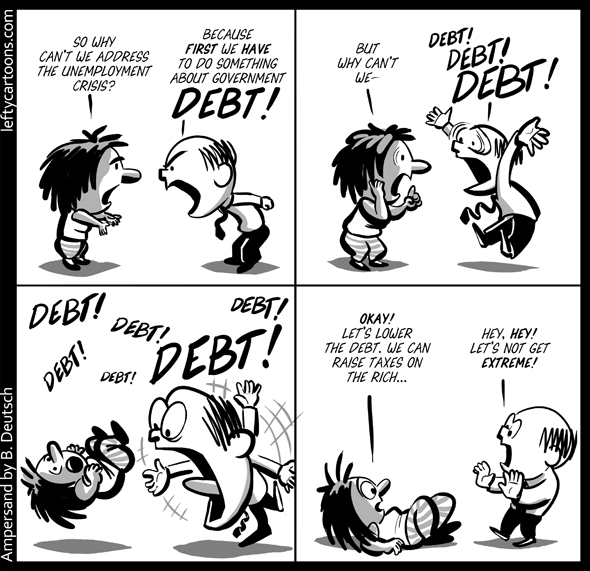
Cartoon: DEBT!

[expand title=”Transcript of cartoon”]This cartoon has four panels. Each of the panels depicts two characters, a woman in casual clothing (striped pants, sleeveless shirt) and a balding man wearing a collared shirt and necktie.

Panel 1
WOMAN: So why can’t we address the unemployment crisis?
MAN: Because FIRST we HAVE to do something about government DEBT!

Panel 2
WOMAN: But why cant we–
MAN (Jumping up and down): DEBT! DEBT! DEBT!

Panel 3
The man’s head has grown to three times ordinary size, as he yells, waving his arms in the air, his tongue sticking out of his mouth. The woman is bowled over by his intensity.
MAN: DEBT! DEBT! DEBT! DEBT! DEBT! DEBT!

Panel 4
WOMAN: OKAY! Let’s lower the debt. We can raise taxes on the rich…
MAN: Hey, HEY! Let’s not get EXTREME![/expand]


Posted in Cartooning & comics | 10 Comments

New grotesque drawing from my sketchbook

I love drawing these!

Posted in Cartooning & comics | 2 Comments

Rachel Swirsky’s Short Story Publications, 2013

When I sat down to write this, I thought I'd only published four short stories this year, but then I remembered that there are two originals in my collection, and also that an older story of mine was published in the first issue of THE DARK.

In total, I published seven original stories this year. It's not so bad for a year in which I've been primarily noveling, although I wish I had finished a few more that are in the late stages of revision.

Many of the stories are available online, but if you'd like to access one of the ones that isn't for awards consideration, contact me and I'll send you a copy.

The story of mine that seems to be getting the best reaction this year is:

"If You Were a Dinosaur, My Love," at Apex Magazine. It's a short-short with a poetic rhythm.

The one that's probably my favorite is:

"All That Fairy Tale Crap" which first appeared in GLITTER & MAYHEM, but was reprinted in Apex Magazine this December. (It's still original to this year.) It's a meta-fictional take on Cinderella with some rated R content.

I also published three other original stories in magazines and anthologies:

"Beyond the Naked Eye" appeared in John Joseph Adams and Doug Cohen's OZ REIMAGINED. It's not available for free online, but it is available as a Kindle single for 1.99. The prompt for this anthology was to reimagine Oz as a different genre; I wrote about Oz as a reality show, but the character of the narrator–a jeweler–took over the story as I was writing.

"Abomination Rises on Filthy Wings" appeared in Apex Magazine. It's got a trigger warning on it for sexual (and other) violence. I wrote it on a dare because there's a particular kind of story that appears a lot in horror slush, where writers seem to be working out autobiographical fantasies of killing their wives or ex-wives. I wanted to see if I could follow all of the "rules" of the genre while creating a narrative that carried an opposite message.

"What Lies at the Edge of a Petal Is Love" is a heavily imagistic story that appeared in the first issue of The Dark.

Two original stories appeared in my collection, HOW THE WORLD BECAME QUIET, which came out this year from Subterranean Press.

"Speech Strata" is another heavily imagistic story about a far-far future that's largely indistinguishable from fantasy.

"With Singleness of Heart" is the other story on this list that has a trigger warning for sexual (and other) violence. It's very short, and deals with the topics of rape as a weapon of war, and the abuse of soldiers.

Posted in Mandolin's fiction & poems | Comments Off on Rachel Swirsky’s Short Story Publications, 2013

Guest Post At “A Moment Of Cerebus”

I’ve written a guest post at A Moment of Cerebus, a blog dedicated to the enormously influential but also very anti-feminist comic book “Cerebus.” My post is about the artistic ends of things, not the anti-feminism.

Included in the post is a page from my sketchbook in which I drew Cerebus in my character Mirka’s clothes.

Posted in Cartooning & comics, Comics I Like | Comments Off on Guest Post At “A Moment Of Cerebus”