“Of Course There Are Times When a Man Has to Discipline His Wife!”

One of the reasons I haven’t been blogging lately is that I’ve been hard at work on an essay that I thought was going to be a very simple one to write. Instead, it has turned out to be one of the most challenging pieces I’ve tried to produce in a long time. Nominally about violence against women, the essay—which does not yet have a title—has turned into a meditation on my own commitment to feminist values, not so much where it comes from, which I’ve written about before, but rather how that commitment has taken shape in—and, in turn, has shaped—my life. Rob Okun, editor of Voice Male Magazine, commissioned the essay from me after he read a piece I wrote about one of my poems, called “Coitus Interruptus,” for my publisher’s blog. The poem, which is from The Silence of Men, and which is one of the most strictly autobiographical I’ve ever written, weaves together several of my own experiences with violence against women, while the blog post I wrote about it meditates on how of the many women I have known—family members, lovers, friends, students—have chosen to share with me the fact that they were survivors of some form of male, usually sexualized, violence.

Rob thought it might be interesting to hear about the experience of talking to those women from my perspective as a teacher—the blog post I wrote for my publisher begins with an anecdote about one of my students—and, at first, I agreed. Once I started writing, however, I began to realize that I didn’t have very much to say. The stories those women have told me are, sadly, not unique and retelling them, however briefly, just so I could talk about my own experience of women’s trust, seemed more self-serving than anything else. What did feel new to me, though, was trying to make sense of the connection, both implicit and explicit, between myself as a man and the men those women told me about, and once I had this focus, the three-part structure of the essay began to come together almost by itself. The first part of the essay delves more deeply into an incident I wrote about for Role/Reboot, when I confronted a man who certainly appeared like he might be getting violent with a woman outside my building; the third part—which is the one I am working on right now—goes back to something I first wrote more than fifteen years ago (but which I have since revised and posted to my blog) about a time when I saw a vision of myself beating my girlfriend to a pulp. The second section is the one I want to share with you a little bit. It begins like this:

“…consider the conversation I had not too long ago with a woman from Nigeria, a friend who will soon marry a man from her country. She was telling me about a friend of hers back home, a woman who’d been severely beaten by her husband. “Of course,” my friend concluded, “her husband might have gone a little too far, but there are times when a man has to discipline his wife. If she misbehaves, she deserves it.”

I had never before heard a woman defending a man’s right to violence like this, and when I responded that I couldn’t imagine myself “disciplining” my wife in any way, much less laying a hand on her, my friend was incredulous. “Sure,” she said, “but that’s because it’s illegal here.”

“No,” I told her, “It’s because I don’t think I have the right to hit her.”

“Of course you have that right.” Her tone was patient and didactic. “How else will your wife learn not to misbehave? If you don’t discipline her, she will disgrace you.”

If I had been talking to a man, I would have known immediately how to respond; but to hear a woman say these things and mean it—and my friend meant it—well, at first, it left me speechless. Finally, I told her that while I did not doubt she loved her fiancé, I could not imagine such love coexisting with the ever-present threat of violence that she described.

“I am sure I will never give my husband a reason to hit me,” she said, “but if I do, yes, it is his right and his obligation to do so.” Then she shook her head. “You and I could never marry. You are not strong enough to handle a woman like me.”

Leave aside, if you will—though I do not mean by this that it is unimportant—what this exchange reveals about my friend’s internalized oppression and self-hatred. That’s a subject for an essay I am not qualified to write. Instead, I want to talk about how those last two sentences made me feel. I liked this woman, and I knew that she liked me. Given her upcoming marriage, there was no possibility of a relationship between us, but there was chemistry. She was smart and funny, and that made her beauty, and she was very beautiful, compellingly sexy to me. I would be lying, therefore, if I told you it did not sting when she dismissed me for “not having the balls”—those were not her words, but it was what she meant—to hit a woman who “deserved” to be hit. Part of me, in other words, wanted to be man enough for her, and for a very brief moment I considered trying to persuade her that I was—not because I thought we could ever be together, but because I did not want to think she might no longer find me attractive.

I did not recognize this, though, until the first words of whatever I was going to say were ready to come out of my mouth, and then I stood there, awkward, silent, caught between the reflexive impulse to defend my manhood that I think many men would feel in this situation and the realization that once I started defending myself I would never not be on the defensive. Nothing I said would ever be definitive proof that I was “man enough,” because there would always be a next time when that proof could be called into question and demanded again; and even if I took it to the next step and tried to prove myself physically, by hitting her for example–which I cannot imagine myself being tempted to do–that “next time” would still always be there. I took a breath and relaxed. “You’re probably right,” I told my friend. “I’m probably not strong enough.” Her eyes went wide and her mouth closed into a kind of frown. This was not the answer she’d been expecting, and I took some pleasure in having rendered her momentarily speechless. That instance of verbal jiujitsu, however, does not change the fact that, for however brief a moment, part of me was willing to sacrifice my friend’s friend, a woman who’d been beaten by her husband, to prove that, like him, I was “man enough” to put a woman in her place.

It’s easy to dismiss the significance of moments like this because they take place almost entirely inside our heads. After all, in the end, I didn’t try to prove myself. The fact that I wanted to, however, raises the question of whether, under different circumstances—if, for example, my friend had not been engaged—I might have, and that is not a question I can dismiss so easily.

Author’s note: I have made some small changes in the essay excerpt to make clear that the “response” I am talking about in the last couple of paragraphs was a verbal and not a physical one.

Cross-posted on my blog.
Posted in Rape, intimate violence, & related issues | 3 Comments

Piers Morgan’s Interview Fail With Janet Mock

janet_mock_piers_morgan

Privilege can lead to double-perception; two people look at the same thing and see something entirely different. I used to think of a particular street as a fine place to walk, and was taken aback when a friend of mine told me she’d never walk there alone, because of all the street harassment she’s experienced there. What she sees on that street is invisible to me, because of my privilege.

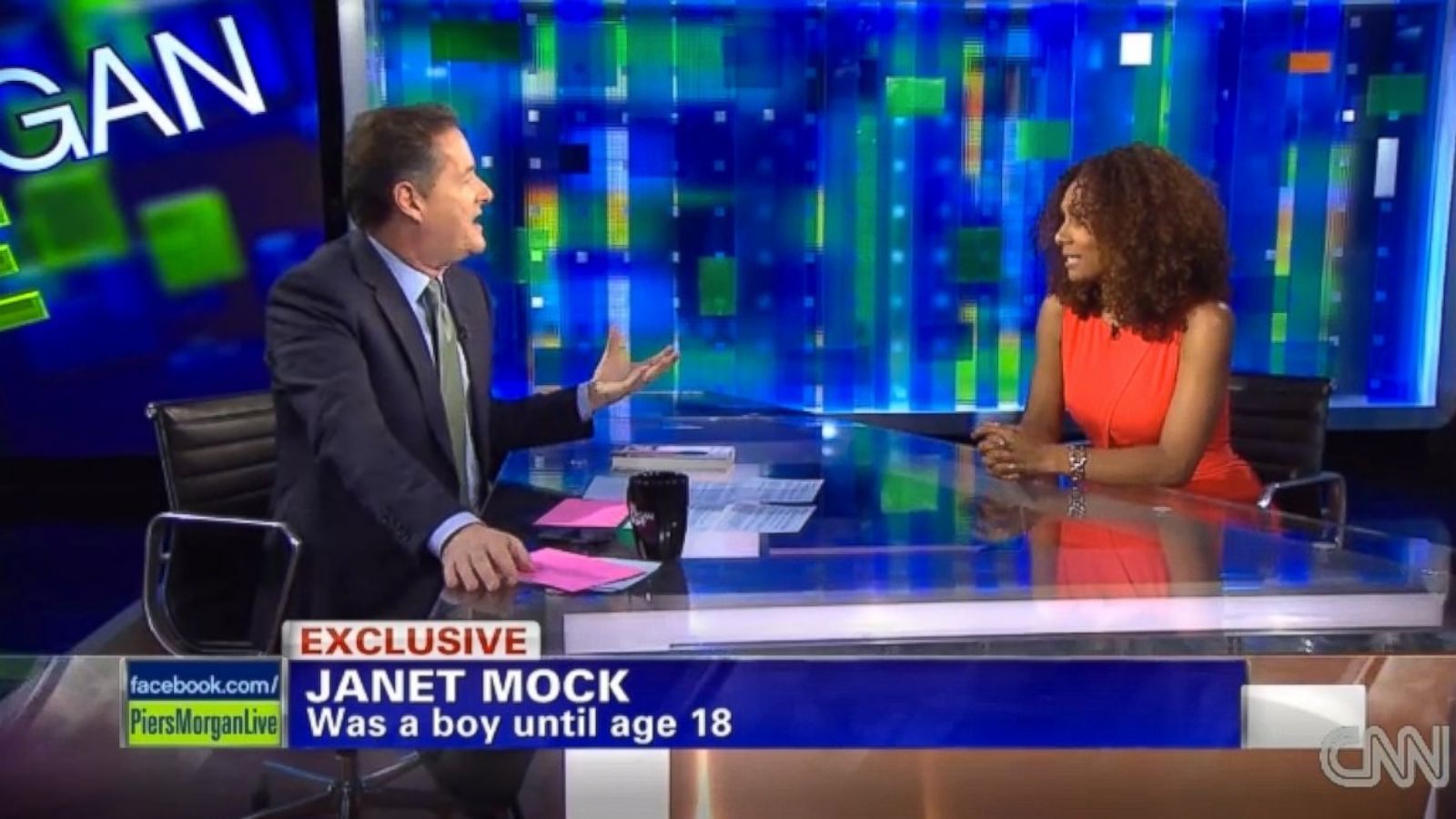
There was an impressive example of this double-perception on CNN this week. Piers Morgan, a CNN host, interviewed trans activist and author Janet Mock. ((It’s relevant to mention that Morgan is a white cis man, while Mock is a trans woman of color.)) Morgan, who has a record of pro-lesbian and gay advocacy, thought the interview went great. Mock did not; she thought Morgan’s focus on her surgery, his gendering her as male up until the surgery, and his repeated interest in how her boyfriend reacted when she came out to him, was sensationalistic and objectifying.

(Of course, those are all common mistakes made by cis people who don’t know very much about trans issues. But as Amanda Hess points out, it’s not unfair to expect that a professional journalist – particularly a highly-paid journalist with a staff – will have done some research to prepare for interviewing a trans activist, rather than just repeating common mistakes of cis people who haven’t done any research.)

The producers of Morgan’s show made things worse when the interview was broadcast; their caption identified Mock as “Janet Mock: Was a boy until age 18,” and they advertised the show with a tweet saying “How would you feel if you found out the woman you are dating was formerly a man?” ((Unfortunately, this sort of thing is par for the course for mainstream news coverage of transgender people. Here’s another example..))

Amanda Hess perceptively describes how Morgan got things wrong from literally his first words to Mock:

“This is the amazing thing about you,” said Morgan. “Had I not known your life story, I would have absolutely no clue that you ever would have been born a boy. A male. Which makes me absolutely believe you should always have been a woman. And that must have been what you felt, when you were young. Take me back to when you first thought, ‘This isn’t right. I’m not Charles’—which is the name you were first given when you were born in Hawaii. ‘I’m a woman. I’m a girl.’”

Notably, this is not a question. This is Piers Morgan assessing Mock’s legitimacy as a woman, based exclusively on her physical appearance, then assuming that Mock’s own experience of her gender identity conforms to his own, and finally, putting words into her mouth. The opening statement set the stage for a ten-minute interview fueled by Morgan’s own superficial understanding of what it’s like to be trans, as opposed to a legitimate attempt to understand Mock’s experience, which is his job.

But this isn’t something that would be immediately visible to most cis ((“Cis” is short for “cissexual.” From Wikipedia: Sociologists Kristen Schilt and Laurel Westbrook define cisgender as a label for “individuals who have a match between the gender they were assigned at birth, their bodies, and their personal identity.”)) people (myself included). What most cis people would see is that Piers Morgan clearly liked Mock, treated her respectfully, ((On the surface, at least)) called her beautiful and her life story inspiring. Our privilege may make it difficult to understand what the criticism of Morgan is about.

Piers Morgan’s twitter account received many critical responses (including some critical tweets from Mock herself – and some extremely rude tweets from folks other than Mock), and Morgan – clearly furious at the criticism, when he thinks of himself as such a great ally! – responded with tweet after tweet angrily declaring how unfair the criticism was and how pure his soul is (“For the record, I’m not anything-phobic.”)

Janet-MockMorgan invited Mock for a follow-up interview, during which Mock tried to explain why she thought Morgan’s questions were harmful (“Being offensive and being kind are not mutually exclusive things. I think that we can be completely have great intentions and be good people but also be ignorant and have a lack of understanding about these issues”), and Morgan – while remaining marginally polite ((On mainstream cable TV news, “marginally polite” practically makes you Miss Manners.)) – seemed mainly interested in expressing his own anger at what he clearly felt was unfair criticism.
What’s exhilarating to me is that, ten years ago, Morgan would have been able to monopolize the conversation. He would have done the interview; any criticism of the interview would be ignored by him and his producers, in the unlikely case that they ever heard any of it; and that would have been that. But now Morgan finds himself sharing the conversation. He can’t control or shut off the response to his show on Twitter. As Mock herself said:

That’s the special thing about social media now is that we can talk back. Piers doesn’t have the final say… Our media is just as valid.

I don’t think that the response on Twitter was perfect. If the goal was to make Piers Morgan understand his mistakes, then the whole exercise must be called a failure. But I don’t think that was the goal – Piers Morgan is only one man, after all, and the movement will continue even if Morgan remains befuddled. What’s more important is how this has shown that Janet Mock’s community – a community consisting to a great extent of trans women of color, surely one of the most marginalized groups there is – is able to talk back to power and insist on controlling their own narrative.

After his second interview with Mock, Morgan concluded with a three-guest panel – none of the panel members were trans, of course – mostly dedicated to attacking Mock (and defending Saint Piers). But one panel member, Marc Lamont Hill, really got it. (Thanks to Grace for pointing out Hill’s contribution.)

MARC LAMONT HILL: I totally get your frustration Piers, but I think this is one of the challenges of being an ally and I think you can be frustrated for communities when allies of that community when they’re questioned or challenged or critique say, “Hey, wait a minute don’t critique me. I’m your best friend. I’m an ally.” It’s like when why people pointed a number of black friends they have or men talk about the binders full of women that they’ve hired.

You know, it’s really important for us to take critique and think about it. Now, I agree with you. I actually wish Janet in the interview had questioned you and challenged you on your use of language around boy and manhood. I think you’re wrong to do it. I think she should have challenged you on it. But I do understand her point of being scared. This is a national interview on a major show, on a major network. I could see how she was intimidated and upon watching it later had a different response.

But for me Piers, the bigger issue isn’t the use of language. It’s the fact that so much of the interviews centered around the sensational aspects about genitalia that so much more about trans life, trans experience that I wanted you to cover… if you talk about surgery and when you talk about saying a boy until 18, it implies that she — her womanhood is… That was a very dangerous point. Trans identity does not change upon surgery. You can have a penis and still be a woman, a trans-woman. [Said to another panelist:] You’re confusing sex and gender. You should really read a book on this.

* * *

Some more links worth reading. Again, thanks to Grace for many of these links:

A video of The first Morgan-Mock interview. A transcript of the interview can be found here.

A video of the second Morgan-Mock interview. And a video of Marc Lamont Hill’s remarks during the discussion panel. Transcripts of both the interview and the post-interview panel can be found here.

Just to show it can be done much better, a video of Melissa Harris Perry interviewing Janet Mock.

The Deadly Logic Behind Piers Morgan’s Awful Interview With Janet Mock – COLORLINES

Did Piers Morgan ‘Sensationalize’ Transgender Activist Janet Mock’s Story? | Mediaite

How Piers Morgan Screwed Up His Interview With Transgender Advocate Janet Mock | ThinkProgress

Piers Morgan grills trans activist Janet Mock with invasive, sensationalist questions – Salon.com

Under fire from transgender advocates, Piers Morgan has an ‘incredibly annoying day’ | Twitchy

Piers Morgan’s Failed Interview With Transgender Advocate Janet Mock: 3 Lessons Learned — Fusion.

Piers Morgan and the psychology of the privileged

Piers Morgan’s Meltdown: Five Ways To Be A Bad LGBT Ally

Janet Mock Schools Piers Morgan On How To Tell Transgender Stories | ThinkProgress

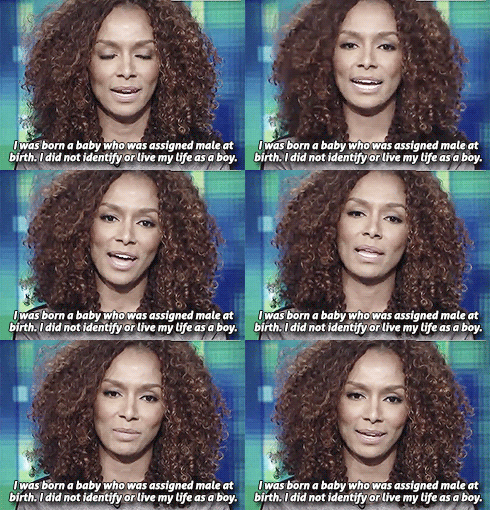
Nicely-done animated gif set of Janet Mock from the second interview.

Posted in Media criticism, Transsexual and Transgender related issues | 45 Comments

Open thread and link farm: Rainy Day Edition

  1. Echidne does a wonderful (and lengthy) job responding to Christina Hoff Sommers on the gender wage gap. I can’t wait till part 2.
  2. Feminism’s Toxic Twitter Wars | The Nation This is certainly the most talked-about article within online feminism this month.
  3. There were many, many responses to Michelle Goldberg’s “Toxic Twitter” articles, but my favorite was a three-post series on the blog Nuclear Unicorn (written by someone who was quoted in, but still critical of, Goldberg’s article): Words, Words, Words: On Toxicity and Abuse in Online Activism, followed by Beyond Niceness: Further Thoughts on Rage and then the longest and (for me, at least) most interesting one, The Chapel Perilous: On the Quiet Narratives in the Shadows./a>
  4. I also really liked this post by Verónica Bayetti Flores: On cynicism, calling out, and creating movements that don’t leave our people behind.
  5. She Was Harassed By A Games Reporter. Now She’s Speaking Out. Excellent article about harassment in tech/gaming industries – although frankly the lessons apply just as well to many other industries (comics comes to mind).
  6. Judge sentences woman for 300 days for talking back to him. Did the judge, watching Breakfast Club, think Paul Gleason’s character was supposed to be a role model?
  7. Confessions of a Former Lane Bryant Employee: What I Learned From Selling Clothes to Other Fat Women | xoJane
  8. Chart of the Day: Everyone Agrees That Iraq Was a Disaster | Mother Jones
  9. No, no, no: pick-up artists and rape manuals – Blog – The F-Word
  10. “…an opportunity to climb is no real answer for people at the bottom. A perfectly fair race is, in at least one important way, the same as a rigged race: Both have a first-place finisher and a last-place finisher. The question of what happens to the person at the bottom genuinely matters.”
  11. Fox News: Boogeyman Of The Liberals. A right-wing writer thinks FOX has stopped mattering. I thought his point about how his kids haven’t learned to be okay with commercial breaks on TV is perhaps even more true of laugh tracks, which are now becoming unwatchable. Except then I realized that one of the few places you’ll still find laugh tracks is on Disney Channel sitcoms.
  12. What The Biggest Loser is Really About | Dances With Fat
  13. Freaked Out By Rachel Fredrickson’s Biggest Loser Win? Read This. — Body Love Wellness
  14. FL: 11th Circuit Throws Out Death Sentence After Prosecutor Cites Biblical References in Sentencing Phase | The Open File
  15. In defense of the word “Creep,” with gifs
  16. Virginia prosecutors lie and cover up evidence to execute Justin Wolfe | a public defender
  17. The Grand Jury Voting on One Case Every 52 Seconds – The Daily Beast Oddly, the author seems to be calling for doing away with the Grand Jury system, rather than reforming it so it can serve its intended function. (Via.)
  18. “Victim’s Rights” are only respected by prosecutors when the victim and his loved ones are pro-death penalty.
  19. “Privilege” doesn’t mean having it easy
  20. DC judge denies defendants’ motion to dismiss Michael Mann’s defamation complaint | Climate Science Watch
  21. The cost of keeping prisoners hundreds of miles from home
  22. We are respectable negroes: Pedagogical Failures: Would You Show a “Satirical” Film as a Way of Encouraging High School Students to Discuss Racism and Slavery?
  23. Which Woody Allen movie is your favorite? Dylan Farrow’s story of being sexually abused by Woody Allen.
  24. Certain primates, though, have evolved to see a third: red. It turns out that these primates—humans, chimps, gorillas, and orangutans, to name some—all have one thing in common: bare-skinned faces.”
  25. How Dianne Feinstein Exaggerates Global Terrorism – Conor Friedersdorf – The Atlantic
  26. In the same week it was announced that one of the actual Boston bombers will face the death penalty if convicted, ESPN has released a mini-documentary about Richard Jewell, a man who actually saved lives on that fateful day, and then had his life utterly ruined.
  27. EconoMonitor : Ed Dolan’s Econ Blog » Could We Afford a Universal Basic Income? (Part 2 of a Series)
  28. The Myth Of The Absent Black Father | ThinkProgress
  29. A Trove of History As 1970s Housewives Lived It – Conor Friedersdorf – The Atlantic
  30. Taxing Or Criticizing The Rich Is Just Like The Holocaust
  31. Dirty Energy Job Numbers Don’t Add Up | DeSmogBlog
  32. Fleeing man shot to death for trespassing on someone’s lawn. Yay gun culture!
  33. Socialized Law
: A Radical Solution for Inequality | New Republic
  34. The worst/best lawyer ad ever:

Posted in Link farms | 160 Comments

Rachel Swirsky’s Young Adult and Middle Grade Novel (Norton) Recommendations, 2014

In order to create this list, I read sixteen young adult books. That's not very many, but I knew this wouldn't be a very comprehensive list. Four more books were on my list as things I wanted to read. There is some vague possibility I might get to them and, if I do, I may review them separately.

I primarily gathered the list of books I read by asking trusted readers — people whose opinions I hold in high esteem, such as some of this year's Norton jurists, and my friends who are young adult authors. Most other years I would have asked authors whose young adult novels I like to let me know if they had published anything I missed; this year, I didn't. I also looked at recommendations that passed through the SFWA list for YA/MG authors, both by people discussing books they enjoyed and people discussing books they had written; I didn't end up picking up all of these.

At my request, two authors sent me electronic copies of their books, but I have been unable to read either at this point due to my recent loss of internet access. My apologies to both of those authors and to their publishers; I will read them for the Hugo best novel, although I know young adult doesn't always get a fair shake there.

While I didn't read very widely this year, I did find a *really high* density of books that I liked a lot. I turned up two books that I marked as "average" (3 stars) and one that I didn't finish reading (it was the second or third in a series that I hadn't been especially fond of to begin with). Everything else I marked as "interesting" (3.5) or above. I'm pretty sure there was a higher number of books that I rated 4.5 and 5 than I ran into last year.

BOOKS DEFINITELY ON MY BALLOT:

THE SUMMER PRINCE by Alaya Dawn Johnson

Young adult: In future Brazil, a teenage street artist learns about the politics of her city as she falls in love with the summer prince who will be ritually killed at the end of the season.

I had a little bit of trouble with this at first because I was listening to it in audio and it took me a while to adjust to the narrator (who did a lovely job, but I still had to adjust to her). However, the story is beautiful, remarkably lush and sensory, evoking a strong sense of what it's like growing up. The science fiction elements are wonderful. The story moves in fluid and unexpected ways and balances wonder and confusion and growing awareness and all those other attributes of adolescence beautifully.

17 & GONE by Nova Ren Suma

Young adult: If this book is nominated for the Norton, the first debate will likely be whether or not it's actually genre. I resort to my general opinion in cases like this: who cares?

Seventeen-year-old Lauren discovers the MISSING poster for Abby Sinclair who went missing from the site of a summer camp near where Lauren lives. She begins to be haunted by Abby, and later the ghosts of other girls who went missing at age seventeen.

This is one of the most effective ghost stories I've ever read, slowly and beautifully building its mood through setting and deep immersion in the main character's point of view. It does a beautiful job of exploring the fragility of being seventeen, right on the boundary between adolescence and adulthood; in this story, that boundary marks radical and potentially fatal change. It explores the terrible mundanity of violence against girls without dropping into any easy or trivializing narratives.

BOOKS POSSIBLY ON MY BALLOT:

ZOMBIE BASEBALL BEATDOWN by Paolo Bacigalupi

Middle grade: Three best friends make their way through the zombie apocalypse.

A fun and action-oriented adventure, amusingly laced with Bacigalupi's politics. I gave this to my nephew and it was as well-received as I expected it to be.

THE COLDEST GIRL IN COLDTOWN by Holly Black

Young adult: A teenage girl wakes up at a party and discovers that everyone else has been murdered by vampires. Exploring, she finds her ex-boyfriend has survived but been exposed to vampiricism. A strange vampire helps save their lives, and in return they try to save his, while trying to figure out how to make it through the next few months without being killed by other vampires, turning into vampires, or being endangered by vampire-phobic human society.

CONJURED by Sarah Beth Durst

Young adult: A teenage girl in witness protection has both amnesia and magical powers. Relocated to a small town, she tries to figure out the meaning of both.

Immediately interesting. Vivid imagery. Although I tend to find amnesia plotlines annoying, this one really worked for me. I liked the development of the mystery, and how many strange possibilities seemed feasible as the text continued. Kept turning and twisting in ways I didn't expect, all of them interesting, although there were a few moments in the last third that didn't quite work for me.

SEPTEMBER GIRLS by Bennett Madison

Young adult: A teenage boy visits the beach where he discovers "The Girls," strangely beautiful blonde women whose surreal appearances and behavior suggest that they are otherworldly.

Very beautiful and detailed, with strange and poetic interstitial passages. I thought at first that the "unreachable, unattainable, mystical girls ARE ACTUALLY MAGIC" thing would annoy me, but the novel manages to overturn those tropes, endowing the characters with individuality and motivations. The surrealism works with the piece rather than against it and develops unusual and emotional content with a lot of metaphorical resonance for exploring adolescence and emotional boundaries. Lots of vivid, striking details. I got a bit sick of the casual misogynist chat between male characters, although that's not an indication that it shouldn't have been there or wasn't well done; I just had a personal pet peeve about it after a while. Beautiful, beautiful writing.

BOOKS I RECOMMEND:

GHOULISH SONG by Will Alexander

Middle grade: When a little girl becomes detached from her shadow, her family and community conclude that she is dead, and send her away.

There were moments when I felt that this novel wasn't tied together as well as it could have been, but it worked quite well for me when considered as a series of vivid and strange images. (There is totally a plot; it just seems sometimes as if the main character is being blown through it. I don't think it would bother me if I could turn off writer-brain which is not always helpful as a reading tool.) There are some really beautiful and odd moments about bones and music, and the vaguely disturbing magical imagery in this book (and Will's first book) reminds me a bit of Miyazaki.

DOLL BONES by Holly Black

Middle grade: Three young children discover that a doll who featured in their games contains the ashes of a dead little girl.

Another really interesting haunting story. Definitely the best "creepy doll" story I remember reading. The haunting and related details are well-developed (and I had no idea that bone porcelain had bones in it!), but the particularly interesting thing for me was the development of the main character. I thought it had an interesting perspective on masculinity, and on that moment growing up when "playing pretend" is no longer permitted or easy, which I have to confess drove me nuts as a kid.

MIRAGE by Jenn Reese

Middle grade: The second book in the series that began with ABOVE WORLD which was on last year's Norton ballot.

In this world, many parts of humanity have split off into groups genetically engineered to survive in different environments, such as mermaid-type people, harpy-type people, etc. As part of their epic adventure to oppose the man trying to take over the world, the young protagonists (two mermaids who don't yet have tails, a harpy, and a centaur born with a genetic abnormality that made him express as only human) journey to the desert where they try to recruit the society of genetically enhanced centaurs to their side. Two things stand in their way: 1) the centaurs have already been recruited by the other side, and 2) the centaur-boy who travels with them has been sentenced to death if he ever returns.

This is a lot of fun, with neat world-building details and particularly cool fight scenes.

THE WAKING DARK by Robin Wasserman

Young adult: The novel follows the stories of several teenagers who all live in the small town of Oleander. On a strange day in Oleander, five people went mad and murdered every living person they could find, killing themselves afterward. Four of the protagonists are the survivors. The fifth is one of the murderers who lived.

This is a very dark and unforgiving novel. I loved the way that its rotating points of view were created with such detailed precision, the lives of each teenager, and the town as a whole, feel exceedingly well-realized. I thought that, perhaps, it was longer than it needed to be.

Posted in Uncategorized | 2 Comments

Want Fewer Heroin Deaths And Users? Give Addicts Heroin For Free

Heroin graffiti

Well, for free under very controlled circumstances. From a blog post by “M.S.” on The Economist:

But we do have a good idea of how to stop more people from destroying themselves specifically with heroin injection, which has a higher fatality rate than most controlled substances. As with most drug problems, the solutions involve decriminalisation and universal access to treatment programmes, including alternative blocking drugs like methadone and buprenorphine. In the case of heroin, there is also another proven way to reduce harm: setting up safe injection rooms monitored by healthcare staff, and—for registered addicts who cannot or will not comply with treatment regimes—providing heroin itself for free.

Switzerland and the Netherlands pioneered this “Heroin Assisted Treatment” (HAT) approach in the 1990s, and both countries adopted it as national policy in the 2000s. Heroin use has steadily declined since; by the 2000s the Dutch incidence of new heroin users had fallen to essentially zero, and the aging population of addicts from the ’70s and ’80s continues to shrink. The average age of Dutch heroin users rose from 34 in 1997 to 45 in 2009.

Decriminalisation of marijuana use has also played a role in shrinking Dutch heroin use, since it separates the use of cannabis from the use of harder, more restricted drugs. HAT trials have since been run in Spain, Britain, Germany and Canada. The evidence consistently shows that HAT drastically reduces heroin-related crime, since addicts don’t need to steal to get money for their fix, and it slashes heroin-related deaths and HIV infection, since addicts are shooting up under medical supervision.

More interestingly, HAT is also correlated with lower overall heroin use. This is in part because free government heroin tends to drive out private-sector providers. Most addicts will end up shooting up in safe rooms monitored by public-health staff, where they will be encouraged to enroll in a treatment programme or, if they fail or refuse treatment, simply receive free heroin. This gradually erodes the market for dealing heroin for profit; as they say in the tech world, you can’t compete with free. The result is what you see in the Netherlands: the slow disappearance of heroin use.

As I understand it, the idea is not to make heroin legal in the sense that anyone can walk into their friendly neighborhood heroin shop and buy some, but a legal drug that addicts can acquire from designated places with a prescription.

In comments, M.S. added:

Heroin use rose across Europe while it fell in the Netherlands and Switzerland. There’s essentially no policy disagreement among drug experts that harm reduction saves many lives and vast amounts of money without increasing usage. The initial application of HAT is this: once you’ve provided universal free treatment and gotten all the addicts pulled into the system through safe injection sites, what do you do with those last recalcitrant users who can’t or won’t quit and are underwriting the private heroin market? You give them free heroin. It doesn’t increase usage because people have to go through the wringer before they start getting the free stuff, and it likely reduces it by putting dealers out of business.

Meanwhile, you clearly have your own pre-existing, unjustified prejudices if you demand that HAT reduces usage before you’ll consider it. Many people, *clearly including Philip Seymour Hoffman*, are able to live reasonably happy, productive lives while regularly using heroin. The harm they do by using is 1. epidemiological, 2. financing illegal drug trade, and 3. the risk they will unintentionally die, hurting themselves and their loved ones. Giving these people free heroin at controlled sites fixes their problems even if it doesn’t reduce usage at all; unless you can prove it *increases* usage, which runs against all the available data in every trial run so far, I can’t see what the argument against it is. The amount of money HAT saves society is generally estimated in the range of $5k-$10k per patient per year.

Posted in Health Care and Related Issues, Prisons and Justice and Police | 17 Comments

Guest Strip on “Modest Medusa” today

modest-medusa-guest-panel

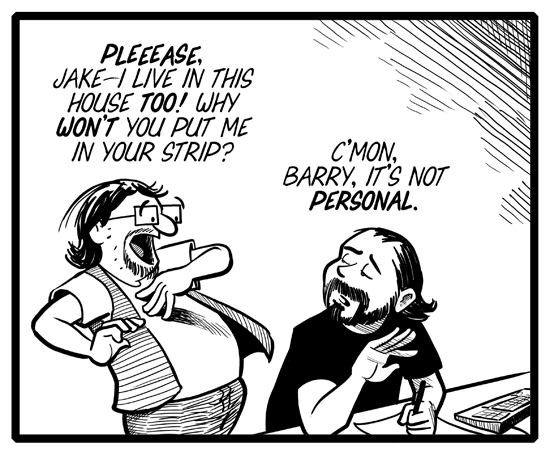
I’ve got a guest strip on Jake Richmond’s webcomic “Modest Medusa” today; Jake is my housemate, my studiomate, and the colorist of “Hereville.” Bizarrely, considering we share a home and a workplace, it feels like I don’t actually see Jake all that often.

Anyhow, click on the panel to read the whole guest strip. It was lotsa fun to draw.

* * *

Also, my friend Ben Hsu is having a kickstarter for the first book collection of Licensed Heroes, a webcomic Ben writes and Elaine Tipping draws. On the surface a swords-and-monsters adventure set in a generic D&D world, it quickly turns out to be a lighthearted not-very-disguised autobiographical strip about being young and with no money and no idea how to proceed. But, you know, with monsters.

And while I’m linking Kickstarters I’ve supported, fans of Jewish comics should definitely check out The Jewish Comix Anthology, which looks like it’ll be really excellent.

Posted in Cartooning & comics, Comics I Like | Comments Off on Guest Strip on “Modest Medusa” today

Millions To Be Spent On Battleground Secretary of State Races in 2014

Monopoly Money

Both liberals and conservatives will put more money than ever into key Secretary of State races in 2014. The officials who win these races will have a great deal of power over voting rules in the 2016 election.

From the Associated Press:

Gregg Phillips, who recently founded the conservative SOS for SOS, said his organization planned to spend $5 million to $10 million on secretary of state campaigns in Arkansas, Arizona, Colorado, Iowa, Kansas, Michigan, New Mexico and Ohio. The group backs candidates who support photo ID requirements, proof-of-citizenship requirements and policies to prevent voter fraud.

“We have no agenda other than ensuring one person, one vote,” Phillips said. He said the group intends to support “people with a backbone, someone who is able to stand up to the name-calling.”

Actually, “ensuring one person, one vote” in a substantial fashion would mean insuring that everyone has reasonable access to their one vote. What Phillips’s is actually fighting for is just the opposite: He wants to erect needless barriers to make it as hard as possible for Black, poor, Latin@, and student voters to vote.

The article goes on:

Both parties note that unlike costly Senate and gubernatorial campaigns, many campaigns for secretary of state can cost $500,000 or less to run. That means the influx of $200,000 or more of television and radio ads could play a major role in convincing voters and influencing the outcome.

Meanwhile, from Greg Sargent, Democrats are also planning major fundraising for Secretary of State races:

A group of leading Democratic strategists is launching a new political action committee that will raise money for a very specific purpose: Getting Democratic secretaries of state who favor expanded voting elected in four states — Ohio, Colorado, Iowa, and Nevada.

Jeremy Bird, a national field director for Obama’s presidential campaign, tells me the effort will aim to raise in the “significant seven figures” to spend on just those four races… That could have a real impact, Bird says, because the average secretary of state candidate in such races spends an average of $500,000 total. The group’s board of directors has ties into the world of Obama and Clinton donors.

“The idea is that we need to flip the switch on this entire voting rights conversation, and go from defense on voter suppression, to offense on expanding access to voting,” Bird says of the effort, called iVote. “This isn’t a short term effort. We’ve got to be systematic. We’ve got to be dogged. We’ve got to be sure we’re out-organizing them.”

Both articles mention that $500,000 figure. But I think the age of $500,000 Secretary of State races – at least in key battleground states – is already dead and gone.

So if both parties spend like crazy on the same races, does that leave the odds in those races the same as if neither party had increased spending?

Possibly.

But that doesn’t mean this doesn’t matter. The increased spending will make the voter rights vs voter suppression issue more prominent. And that’s good. The more it’s in people’s minds, the harder it will be for Republican voter suppression tactics to work. Because total legal disenfranchisement is not politically viable (except when it is), modern voter suppression works by making voting as inconvenient as possible for disfavored voters. But the more voters and organizers are aware of and pissed off by these efforts, the more determined voters will be to find ways past those barriers. So the increased visibility of these races could be good for getting out the vote, even if the extra spending is a wash.

On the downside, the increased salience of big money in elections is bad. But I think that ship has sailed.

Posted in Elections and politics | 1 Comment

Coke’s controversial “America The Beautiful” Commercial

Some comments about Coke’s Super Bowl Ad from Coke-Cola’s Facebook page:

You should be ashamed of that commercial. Ill never buy another coke product again.

Offensive and a diss to America the Beautiful!

Ashamed, disappointed. Bad choice, Coke! I’ve been a LONG time fan. Guess I’m looking for a new soda.

really really really disappointed at Coke may have to quit buying Coke

Have been pro coke all my life. I will never buy another coke product! NEVER

I’ve been buying Coke for 40 years and you just lost my business! That ad was insulting to American patriots.

And the ad itself:

Use this thread to discuss the subject, but also to discuss the Super Bowl, other Super Bowl ads, links to ads you liked (or thought were bad in an interesting way), etc..

(Hattip: Immigration Prof Blog.)

Posted in Immigration, Migrant Rights, etc, In the news | 63 Comments

“Obama often speaks as if he is an outside observer of his own administration” (UPDATED) (UPDATED AGAIN)

*SEE UPDATE AT BOTTOM*

no jornal / on the news

Jacob Sullum at the libertarian site Reason nails it (UPDATE: No, he didn’t nail it. See the update at the bottom of this post):

Obama at first denied that the executive branch has the power to reschedule drugs, saying “what is and isn’t a Schedule I narcotic is a job for Congress.” As Tapper pointed out, that’s not true. While Congress can amend the Controlled Substances Act (CSA) to increase or reduce restrictions on particular drugs, the statute also gives that power to the attorney general, who has delegated it to the Drug Enforcement Administration (a division of the Justice Department). In fact, the DEA has repeatedly rejected petitions to reschedule marijuana, most recently in 2011. I forget: Who was president then?

Apparently Obama forgot too. Obama often speaks as if he is an outside observer of his own administration—condemning excessively long prison sentences while hardly ever using his clemency power to shorten them, sounding the alarm about his own abuses of executive power in the name of fighting terrorism, worrying about the threat to privacy posed by surveillance programs he authorized. Now here he is, trying to distance himself from his own administration’s refusal to reclassify marijuana.

I think the only imaginable defense of Obama’s incoherent, hypocritical, immensely harmful marijuana position is that he’s gone further than any previous president towards admitting that throwing people in jail for pot use is an injustice.

But one, that’s damning with faint praise.

And two, Obama’s statements about pot come in the context of the most pro-pot-legalization American public since polling on the subject began. Obama deserves no points for timidly inching in the direction the American public is already running.

UPDATE:

Mark Kleiman – who I don’t always agree with, but he’s a genuine expert in this area, and I trust him to know the facts – convincingly argues that it’s Reason’s Sullum, not Obama, who doesn’t understand the law and the President’s powers regarding marijuana’s legal status.

So administrative rescheduling would not make “medical marijuana,” or any other kind, legal at the federal level. Its practical effect would be identically zero.

What’s actually needed in the way of administrative action is to get the DEA and the Public Health Service out of the way of medical research, by breaking the University of Mississippi monopoly on research cannabis and eliminating the requirement that researchers using cannabis (but no other controlled drug) have the material “granted” to them by a federal agency rather than just going out and buying it. The Obama Administration can and should be criticized for not having taken those steps.

But “rescheduling” is a red herring dragged across the trail of policy reform.

UPDATE 2: See the comments for a lot of folks pushing back against Kleiman.

Posted in Libertarianism, Prisons and Justice and Police | 8 Comments

Richard Sherman’s Play And The Vast Overreaction

darrren-bell-thug-cartoon
(Cartoon by Darrin Bell.)

I found the Richard Sherman bruhaha surprisingly interesting, so even though it’s a bit past the due date, I thought I’d post some links.

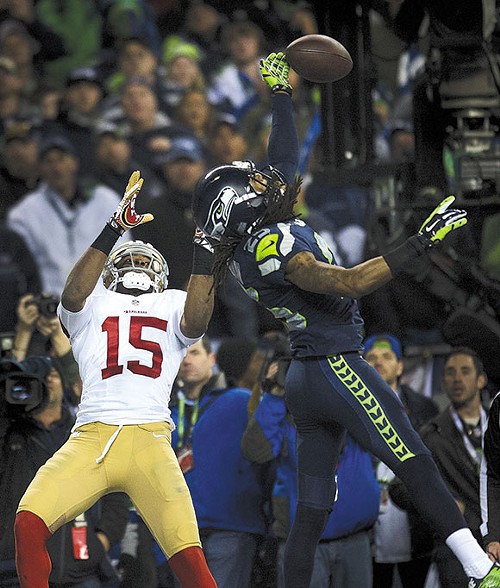
For those of you who don’t know, Richard Sherman is a football player for the Seattle Seahawks who made a spectacular play at the end of an important game, blocking a pass that would otherwise have been a touchdown for the other team. Partly because of this play, the Seahawks will be playing in the Superbowl this Sunday.

sherman-blocks

Okay, I don’t especially like football or sports, but that’s pretty darned beautiful. Here it is in animated form:

Sherman gave a brief post-game interview in which he yelled at the camera, and the internet’s head exploded, and much of the yucky brain matter splattering around was ridiculously racist.

After seeing the fuss that it caused, I was surprised when I finally saw the interview itself; Surprised, that is, at how inoffensive Sherman’s comments actually were. Via NPR, here’s a transcript:

Andrews: “The final play, take me through it.”

Sherman: “Well, I’m the best corner in the game! When you try me with a sorry receiver like Crabtree, that’s the result you gonna get! Don’t you ever talk about me!”

Andrews: “Who was talking about you?”

Sherman: “Crabtree! ((Can I just say that “Crabtree” would be a wonderful last name for a Simpsons character?)) Don’t you open your mouth about the best, or I’m gonna shut it for you real quick! LOB!” (That’s a reference to the Seattle defense’s nickname, “Legion of Boom.”)

The most interesting thing I saw because of this controversy had nothing to do with the controversy itself. It’s this video of Sherman talking about the strategy and tactics that go into being a great cornerback. He argues, convincingly, that what sets him apart from other cornerbacks is not his physical prowess but his understanding of the game and the opposing players.

I also enjoyed this interview with Sherman, in which Sherman shows a level of open contempt for the interviewer (“I’m intelligent enough and capable enough to understand that you are an ignorant, pompous, egotistical cretin…”) that’s really pretty rare to see.

Gregg Howard on Deadspin wrote:

When you’re a public figure, there are rules. Here’s one: A public personality can be black, talented, or arrogant, but he can’t be any more than two of these traits at a time. It’s why antics and soundbites from guys like Brett Favre, Johnny Football and Bryce Harper seem almost hyper-American, capable of capturing the country’s imagination, but black superstars like Sherman, Floyd Mayweather, and Cam Newton are seen as polarizing, as selfish, as glory boys, as distasteful and perhaps offensive.

Sarah Blackwood has interesting things to say about the genre-bending aspects of the Sherman interview:

What Sherman said to the reporter after the game would not have been out of place on the field. But it was out of place in the post-game interview, which has a very specific structure—a pandering, breathless, thankful, selflessness in the service of banal clichés. These clichés attempt to defuse the physical violence that has just taken place on the field. The genre of the post-game interviews reassure us that, no matter how brutal the spectacle, we spectators aren’t really encouraging brutality. Sports are civil, after all! (This is, perhaps, why so many post-game interviews are conducted by women—emblems of civilization and all that.)

Use this thread to discuss Richard Sherman, football in general, or even this Sunday’s Superbowl game (which I won’t be watching).

Posted in In the news, Race, racism and related issues | 32 Comments