Making Fear a Thing of Beauty

A reading and workshop built around strategies for turning what scares you into art.

When: December 12, 2015, 2:00 – 3:30 PM
Where: QED Astoria, 27–16 23rd Avenue, Astoria NY 11105
To buy $5 tickets click here.
Here’s the Facebook event page.

When I received from the Queens Council on the Arts the 2015 individual artists grant that made it possible for me to finish my second book of poems, Words for What Those Men Have Done, I intended, as I’d written in my proposal, to use the public presentation of work that I would do to fulfill the grant to start of a conversation in my community about male survivors of sexual violence. Once I started planning the event itself, however, I kept coming up against a question that I’d never really thought about. Why make art out of my experience of sexual violence in the first place? It wasn’t that I had doubts about the value of my work or the role it might play in raising people’s awareness, but raising awareness is not why I write the poems that I write, and so I began to wonder if a program that reduced my art to an awareness-raising tool was really what I wanted to create.

So I took a step back and read through the manuscript one more time, paying attention to how the poems that deal explicitly with sexual violence fit into the book as a whole, and I discovered a thread running through the work that I hadn’t noticed before: coming to terms with fear. I haven’t thought of myself, when I think of myself as a survivor, as afraid in a very, very long time. Yet the more closely I looked at the poems touching directly on who I am as a survivor, the more I realized that, whatever else they may be, I’d written them in confrontation with a fear I had never explicitly named–which meant I’d written them not to end that fear, but to turn it into something beautiful.

On the one hand, this seemed to answer my question about why I write such poems in the first place. On the other hand, however, it raised a second question with disturbing implications. What does it mean, then, to find beauty in sexual violence? I am not talking, of course, about the simple, straightforward beauty of surfaces, but rather about the beauty that puts us in touch with the full depth of what it means to be human, that does not force us to choose between loveliness and ugliness, but rather holds them in precisely the balance that exists in each of us. I have been writing poems rooted in my experience of sexual violation for at least twenty years; more than that, I have made who I am as a survivor central to who I am as a writer. I have never before asked myself, however, why I feel compelled to fashion something beautiful from an experience that would seem, on its face, to be beauty’s antithesis. Why, to put it another way, do I feel so compelled to love what I fear? That is a question worth exploring.

The statistics speak for themselves. Depending on the measure used, studies show that as many as 20–25% of men will experience some form of sexual violence at some point in their lives. Sadly, most of us in this group suffer in silence, victimized a second time by a culture that refuses to acknowledge the truth of what those who violated us did to us. I was nineteen when I first broke my own silence–at, of all places, the Vassar College Spring Semi-Formal (which is a story in itself, but that’s for another time). I was fortunate. My girlfriend’s response was respectful and compassionate, protective and nonjudgmental; she was angry for me and happy I trusted her enough to tell her; and all of that helped me find the courage to keep telling people, without which I don’t know what kind of person I’d be right now. For that, Pat Holtz, wherever she is, will have my gratitude for as long as I live.

To take that first, terrifying step of sharing with someone else something you thought was unspeakable, or that you were sure no one else in the world would understand or accept, is to step off a ledge without knowing where your foot will land. Will you end up standing on solid ground, affirmed, bolstered, saved, by the understanding you see in that other person’s eyes, or will you find yourself falling even more deeply into the isolating despair that whatever you’ve been carrying has forced upon you? For some people, that difference can mean–has already meant–the difference between life and death, which is another way of saying that this kind of telling is about the teller’s needs and no one else’s. It is an appropriately and necessarily selfish act, and, in that selfishness, it is the antithesis of art.

Whenever I think about this distinction between art and other forms of telling, I think about something the poet Khaled Mattawa wrote in his introduction to Without An Alphabet, Without a Face, his translation of the selected poems of the Iraqi poet Saadi Youssef: “Poetry can only be an exploration of an ideology, not a means of expressing belief in it.” Art can certainly inspire belief, of course, as it can even inspire action based on belief, but once art starts calling for belief, or for action, it becomes, no matter how artfully it has been made or how moving an audience finds it, propaganda. It is no longer art.

Recently, I attended a poetry reading where a local, spoken-word poet shared some of his work. His performance was quite dramatic, but it actually made me feel imposed upon by, rather than invited into, the world of his words. Initially, I wrote him off as being, simply, a bad poet who used the emotive capacity of performance to make up for the shallowness of his language, but then I realized the problem went deeper than that. His work seemed to me entirely focused on getting his audience to feel not with him, but for him. Every word he spoke, every verbal inflection he gave, every dramatic pause he inserted–especially at the end, right before the last few words of each piece–was carefully crafted both to impress us with his vulnerability and to convince of the profundity of his willingness to be vulnerable in our presence. He was, in other words, propagandizing for himself.

When I first started trying to make art from my experience of sexual violence–I was in my mid-twenties at the time–I made the same mistakes that poet did. The lines I wrote were concerned less with exploring my experience than with making sure the world knew, in near-clinical detail, that I had, beyond any shadow of a doubt, been sexually violated. I saw those poems as a way to lay claim to the measure of the world’s attention I believed I was owed as a survivor, and so I them to a literary magazine that I thought would be sympathetic to their content. I can’t remember the exact words of the editor’s response, though I can still see the slightly cramped, cursive script in which it was written. Its intensity remains palpable to me. The gist of it was this: Call me what you will. Think I am a heartless son-of-a-bitch, if you need to. I don’t care. But never, under any circumstances, submit another poem to this magazine.

This was the mid–1980s, when people were just beginning to talk openly about the sexual abuse of girls. Almost no one was talking about the sexual abuse of boys, which meant that many of what we now understand to be very harmful myths and misconceptions were accepted as fact. More than once I heard it explained, by both lay people and recognized experts, that sexual abuse just didn’t happen to boys, or that, if it did, it happened so rarely that the only ones who really needed to pay attention to it were law enforcement and the professionals who dealt with the victims. What many of these same people said about the victims themselves was even more disturbing. Sexual violation, they suggested, left a boy damaged beyond repair, with a crippled psyche and a deformed sexuality that rendered him if not entirely unfit for “normal” society, then certainly someone you were better off giving a wide berth to if you could.

The editor who rejected my work, I told myself back then, almost certainly thought this way, and so I comforted myself that he deserved the shock and disgust my poems had made him feel. When I think about his rejection now, however, I am struck that he took the time to respond to the anger he imagined I would feel at being rejected. What’s more, he invited this anger, solicited it as the price he was willing to pay never to see my name in his slushpile again. I may be projecting backwards here, but in my memory, his response feels very much like what I probably would have told the spoken word poet I discussed above had he approached me about being featured in the reading series I run. When I think about it now, in other words, that editor probably rejected me for the same reason that I would reject the spoken-word poet: we each resented having someone else rub our face in his life for no other reason than that he believed had the right to do so.

I don’t want to deny that there is a time and place for that kind of confrontation–especially when the world has refused to notice that you exist–but even if submitting the poems I wrote back then did indeed change the way some of the editors who read them saw male survivors, the poems themselves failed as art. Precisely to the degree that they merely indulged the anger by which they were motivated, they became nothing more than rants, shutting readers out from the complexity of the experience into which a succcessful work of art would have invited them. To put it in Khaled Mattawa’s terms, the poems I wrote back then expressed a belief in the righteousness of my anger; they did not explore what it meant to be that angry.

The problems art solves are essentially formal ones, how to give shape in whichever medium the artist works to the concerns the artist wants the work to address. Through the years, one such problem I have had to face over and over and over again is the impossibility of loving myself in the present without loving the boy in me who was violated. For how do I love that boy without seeing beauty in him, even in the fact of his violation; and how do I make sure that seeing this beauty does not in the least excuse or justify or rationalize or exonerate the men who violated him? I make art from my experience of childhood sexual violence because making art is the only way I know to respond to these questions, because trying to answer them with a reasoned, logical argument makes me feel like I have something to prove, and I have nothing to prove. If I am to love myself, I must love that boy, all of him, even the things about him that scare me, even though the idea of loving him scares me. Logical reasoning will not make the complexity of that love comprehensible; but the complexity itself can be made accessible through art.

It may sound paradoxical to say that you need to love your fear to turn it into art, but I believe it’s true, and I also believe it’s true that bringing craft to bear on what you fear is part of that love, because craft is how you walk into the darkness of what you fear and give it structure, and sometimes that structure might in fact let in the light that will chase what you’re afraid of away, but sometimes building that structure is how you learn to love sitting in the dark, which is the only way you’ll ever know its beauty.

Posted in Writing | 2 Comments

Open Thread and Link Farm, Interview With Myself Edition

  1. Fatal Fat Shaming? How Weight Discrimination May Lead To Premature Death | CommonHealth I really wish they hadn’t started this article with an anecdote, which I suspect is going to cause people to argue about the anecdote while ignoring the study that the article is reporting on.
  2. Volunteering At An Abortion Clinic Made Me Lose Patience With The Abortion Debate
  3. Farewell to the Bigoted Bust | Laura J. Mixon The World Fantasy Award will no longer be shaped like a bust of H.P. Lovecraft. Looong past due. As you’d expect, some are apoplectic.
  4. The campaign to exonerate Tim Hunt for his sexist remarks in Seoul is built on myths, misinformation, and spin. Thanks to Mookie for this link.
  5. The Bernie Bros vs. the Hillarybots — The Cut
  6. A lot of folks have been arguing that this book cover image, from an anti-Clinton book but painted by a huge fan of Clinton, is misogynistic. I don’t agree.
  7. Sady Doyle (Not About Gender). Sady Doyle outlines reasons that have nothing to do with Clinton’s sex, for preferring Clinton over Sanders.
  8. A Sanders supporter who probably has a better netname than 1kidsentertainment, but I don’t see it anywhere, responds to Doyle.
  9. Sady Doyle (Not About Gender: 2 Fast 2 Gender) And Sady Doyle responds to 1kidsentertainment.
  10. On Supporting Bernie (But Feeling Like You’re Going to Vote for Hillary).
  11. I’m posting the above Hillary-vs-Bernie links because I think they’re all well-written and interesting reads, but not because I fully agree with any of them.
  12. Ryerson men’s issues group says students’ union shutting out male voices – The Globe and Mail Not allowing the men’s rights group is both appalling and censorious. But by saying that, I am not at all altering my opinion that Warren Farrell, who suggests that college shootings are caused by decisions like this one, is anything less than ludicrous.
  13. What’s Really Going On at Yale — Medium It’s not just about one Halloween email.
  14. Racism and Academic Freedom at Yale | The Academe Blog Like the previous link, this one adds a lot of useful context that’s missing in most of the discussions I’ve seen of goings-on at Yale, including some useful points about the position of “Master.” Like this author, I think that the (some) students who have said the Christakis’ should lose their Master positions are going too far. “Fire them” should not be the first-step response to speech we disagree with; the idea that people can and should be fired for their political speech is already far too common in the US, and on the whole is extraordinarily bad both for “free speech culture” and for workers.
  15. Reproducibility Crisis: The Plot Thickens – Neuroskeptic I think Ben posted this link in the previous open thread. Really worth at least clicking through for a quick skim and a look at the very impressive graph.
  16. John Oliver doing stand-up about Daily Show Slash Fic.
  17. Missouri Lawmaker Seeks To Block Students From Studying Restrictive Abortion Law. Instructive how little attention the mainstream media gives to right-wingers attempting to censor students, even though as censorship goes, we have far more to fear from the legislature than we do from student protesters.
  18. All Saints Day | Easily Distracted I agree with some but not all of this extremely well-written blog post, which is critical of the Yale protesters and of the way the concept of appropriation is (mis)used. There’s also some stuff worth reading in comments.
  19. When the campus PC police are conservative: why media ignored the free speech meltdown at William & Mary – Vox
  20. Support for a “No-Fly Zone” in Syria Should Be Disqualifying | The American Conservative Unfortunately, I think Rand Paul and (maybe?) Bernie Sanders are the only folks still in the race who oppose a no-fly zone, so oh well.
  21. University of Illinois Pays $875,000 to Settle Salaita Case | The Academe Blog I guess this is a censorship on campus story that has a happy ending? Although Salaita still doesn’t get his job back. $600,000 of that goes to Salaita, the rest to his attorneys.
  22. Hilarious anecdote about “The First Wives Club 2,” adolescence, and pay-per-view pornography.
  23. The Evolution of the Female Broadway Singing Voice (Part 1) | Musical Theatre Resources. I found this essay really interesting. Good to follow it up by listening to this video of examples of the same songs sung in original recordings and in recent revivals.
  24. Tell a science fiction story in six words. My entry: “Look, over there!” said my glasses.
  25. Flight of the Ruler by Gabrielle Bellot – Guernica / A Magazine of Art & Politics An excellent longform essay by a trans woman who has immigrated to the U.S. from the Commonwealth of Dominica.
  26. First Amendment v. Privacy? | The Academe Blog Unless I missed something, I agree with everything in this blog post about the professor’s conflict with a student journalist at the University of Missouri. 1) Professor Click was in the wrong (she has apologized), and 2) It’s dubious to claim a right of privacy for your very public tent city set up in the middle of a public square, which was obviously set up at least in part to make a public political point.
  27. University of Missouri police arrest suspect in social media death threats – The Washington Post To be kept in mind anytime someone suggests that students on campus don’t actually face racism.
  28. On Welders and Philosophers | The Academe Blog
  29. In Missouri, the Downfall of a Business-Minded President – The Chronicle of Higher Education Probably best not to read the comments, (he writes, thereby guaranteeing that some of the folks here will read the comments.)
  30. Nobody can figure out what this 1000 pound machine is – Business Insider
  31. Netflix’s New Series ‘Master of None’ Is Aziz Ansari’s Best Work Yet – The Atlantic I really, really enjoyed “Master of None” (despite Ansari’s character being my least favorite part of “Parks and Recreation); if you have Netflix, I recommend watching this.
  32. What Bernie Sanders misses about a $15 minimum wage – Vox
  33. Michigan’s Proposed Second-Trimester Abortion Ban Advances
  34. This Is So Gay: Only I Get to Decide Which Criticisms of Me Are Valid
  35. Full Text Of TPP Released: And It’s Really, Really Bad | Techdirt
  36. Beepy Boopy Veronica — Gentlemen! Let’s play a little game. I call it “Creep or Normal Guy?”
  37. Class Action Lawsuit Charges Missouri Town With Turning Residents Into Revenue Stream
  38. First Grader Plays A Power Ranger With Imaginary Bow and Arrow . . . Ohio School Suspends Him For Three Days | JONATHAN TURLEY
  39. Eighth Grader in Florida Disciplined For Giving Hug To Friend At School | JONATHAN TURLEY
  40. It turns out that those spiffy Old Spice commercials were made (primarily, not entirely) with practical effects:

Posted in Link farms | 93 Comments

Interviewing Sylvia Spruck Wrigley

A few weeks ago, I discovered that it was a lot of fun to hand people some casual interview questions and see what they had to say. Sylvia Spruck Wrigley kindly responded to the query I circulated to some writers asking if they wanted to play along. She’s a writer currently spending a lot of her time in Wales, and was nominated for the short story Nebula award (along with me) in 2013.

By happy and unplanned coincidence, her new novella, Domnall and the Borrowed Child just came out through Tor’s new novella line. It’s her longest piece of published work to date.

Thanks again, Sylvia, for the interview!

1. The first thing that appears on your website is a quote from The Catcher in the Rye, ending with “I don’t feel like going into it, if you want to know the truth.” Why that quote?

Self-promotion is hard. There’s this whole thing about even having a home page, that I have to tell the world about myself and hope that they care. I struggled with what to say, because I have this super confusing background and if I start, then it’s going to go on a bit. I can’t even say “I’m from [country]” or something simple like that. To be honest, I wrote a lot of long intros and then I just couldn’t face it. I remembered the start of The Catcher in the Rye; I’ve always loved Holden Caulfield’s voice. And he just really encapsulated how I felt about how to tackle this problem. I figure JD Salinger probably had the same problem, how to start this novel. So I decided to steal that introduction for my own page.


In the meantime, I’ve ended up putting a three-sentence bio on the website after all which does manage to give a brief version of where I am from…so I guess it’s rather silly now. A legacy quote.

2. Even today when being online makes exchange a lot easier, a lot of excellent British writers are unknown in America. Have you found it difficult to pass that cultural border?

Well, for writers starting out, I think a real issue is that writers who are not in the US miss out on a lot of events. The amount of education and business that happens at cons, or through introductions that happened at a con, is really a bit frightening. I don’t think you have to show up to break through but my own experience is that it does make things a lot easier, especially when it comes to making connections and finding out about invite-only anthologies. And you get this great support network of other writers — I always feel super motivated after attending a con. I know a few people who attend a couple of cons a year and then work off that energy.


This is why I feel really strongly that Worldcon should be held outside of the US every three years. Honestly, I think for something with “World” in the name, it’s not unreasonable to ask that the US limit itself to hosting 66% of the cons. I know not everyone can attend if it is held abroad. But when you compare that to the number of interesting authors who have *never* attended because it quite frankly is never local to them, it doesn’t seem that much to ask that the hosting locations are spread out a bit more.


As of right now, 7 of the 74 WorldCons have been held outside North America. So I’m really excited about Helsinki and hopeful for Dublin the year after that.

3. Your recent Nebula Award-nominated story “Alive, Alive Oh” is about home and displacement, a theme I also saw in Matthew Kressel’s nominated story from the same year, “The Sounds of Old Earth.” What about those themes appeals to you? Do you think they have particular traction at this moment in western culture?

I believe there’s a lot more movement between countries (and cultures) than there was even 50 years ago. And really, it comes down to a lot more travel and emigration in the West than there was. It’s not so rare any more to know someone who ended up moving to South America or Thailand or India. When I was a kid, it was this huge big thing that I went to school in two countries. Immigration involved people moving to the US, middle-class white Americans didn’t leave, or at least not more than a summer. As a result, home, displacement and belonging have become important themes that people are exploring. My son holds German and American passports but has never lived in either country, has never had that sense of belonging to a place (or even of a place belonging to him). I think when I was a kid in a similar situation, everyone in both countries was kind of amazed by it. Now, it’s not such a big deal.

4. What is the most irritating mistake about Wales and/or the Welsh that you see in American media?

Confusing Wales with England. I know that sounds silly but I get it all the time. Seriously, like I’ll say “I live in Wales,” and people will ask me what it’s like living in England, and whether I like it there. There’s this total disconnect.


I do like England, as it happens, but Wales is very different. Not just the accent, in attitude and economics and a million small things. There’s a lot that I love, like Welsh women are much more likely to say “You are being an idiot” to a man who is being an idiot than anywhere else I’ve ever lived. There doesn’t seem to be this deep-rooted belief that women have to be nicer than men when it comes to idiots.

5. What work of yours should readers be looking for, and what do you have coming up?

My most recent publication is a reprint, Space Travel Loses Its Allure When You’ve Lost Your Moon Cup in the current issue of Flash Fiction Online. I love this story because menstruation in space is just really not a well-covered subject in science fiction. But this publication of it is super special because includes a rap song, which I commissioned off of Fiverr late one night after too much wine. Rsonic had an ad on Fiverr, saying he’d write a rap song about any subject. The guy was this black, good-looking American Marine combat veteran and I thought he was going to tell me to go to hell when I showed him the story. He totally rose to the challenge and wrote a rap song without flinching. Best five dollars I’ve ever spent.


I’m also super excited about what’s coming up. Domnall and the Borrowed Child is a traditional fairy tale based in Scotland coming out on the 10th of November as a part of Tor.com’s new novella imprint. This is my first longer publication and it’s part of a story I’ve been working on for ten years. The audio version is amazing – Tor have chosen a narrator with a great mid-atlantic accent. He grew up in Ireland and England but spent his adult life in the US, so I spent my first listen wondering where’s he from? before finally realising that he probably sounds a lot like me. He calls it hybrid, which sounds a lot nicer than “all over the place”.

Source: Rachel Swirsky’s blog

Posted in Interviews, Mandolin | Tagged | 2 Comments

New Cartoon: The 32 Types of Anti-Feminist

types_of_antifeminist

Both the full cartoon, and a transcript of the cartoon, can be viewed at Everyday Feminism.

Posted in Anti-feminists and their pals, Cartooning & comics | 40 Comments

Hereville Book 3 Premiere In Portland, November the 13th

spritely-bean-event-graphic

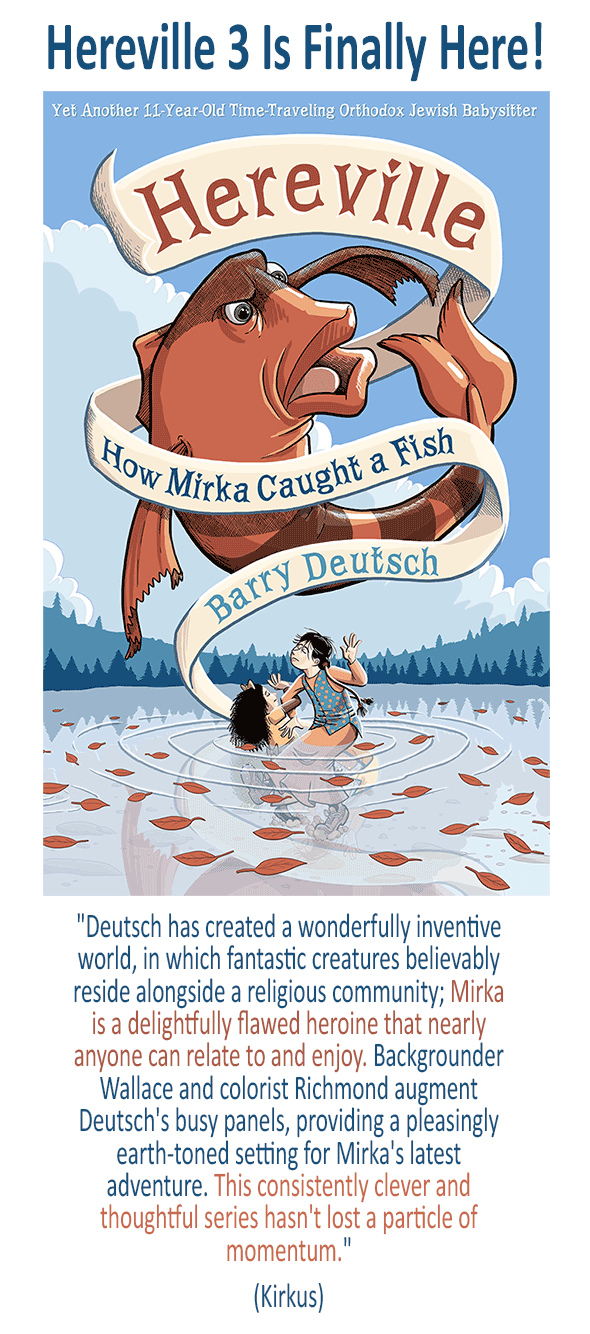
Hereville: How Mirka Caught A Fish is the long-awaited third book in Barry Deutsch’s Hereville series, about “Yet Another 11-Year-Old Time-Traveling Orthodox Jewish Babysitter.” And it’s finally here!

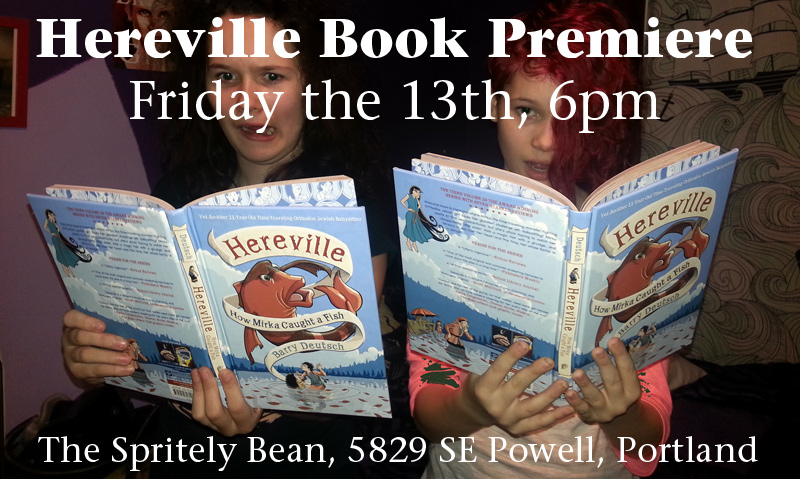
Hereville creator Barry Deutsch will be on hand at 6pm on November 13th at The Spritely Bean, Portland’s comics and coffee cafe, to sign and sketch in books, alongside his collaborators, longtime Hereville colorist Jake Richmond, and new background artist Adrian Wallace. There will also be a presentation at 7pm, featuring live drawing demonstrations, an animated film of the Hereville drawing process, and other fun stuff. The festivities will continue pretty much until people stop showing up.

“Deutsch has created a wonderfully inventive world, in which fantastic creatures believably reside alongside a religious community; Mirka is a delightfully flawed heroine that nearly anyone can relate to and enjoy. Backgrounder Wallace and colorist Richmond augment Deutsch’s busy panels, providing a pleasingly earth-toned setting for Mirka’s latest adventure. This consistently clever and thoughtful series hasn’t lost a particle of momentum.” –Kirkus Reviews

Past Hereville books have been nominated for Eisner, Ignatz, Harvey, and Andre Norton Awards, and have won the Sydney Taylor Book Prize, the Oregon Book Award, and a Sybel Award.

The Hereville Book Premiere event will take place at The Spritely Bean, located at 5829 SE Powell, Portland, Oregon, beginning at 6pm. We’ll have copies of all three Hereville books for sale.

If you’re in or near Portland, I hope I’ll see you there!

Posted in Hereville | 2 Comments

On The Wonderful Potential People Who Are Aborted

watchmen-thermodynamic-miracle

Faith writes:

What saddens me about abortion is that those who get pregnant and abort the child destroy every chance of happiness, love, excitement, growth, knowledge, friendship, etc. that child could ever have simply because it’s inconvenience. It’s more than a life, it’s a lifetime of experiences and future husbands and wives and mothers and fathers and friends that you’re aborting. ((The rest of Faith’s post, which I’m not quoting, sneered at people who have abortions for caring about their own “convenience.” Faith’s lack of empathy is appallingly common among pro-lifers.))

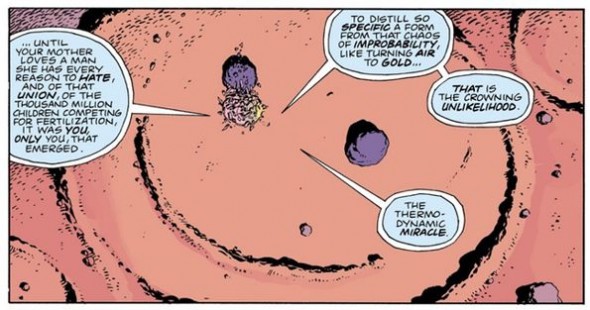
I know so many wonderful children who would never have been born if not for abortion.

Take a lovely young girl I know – let’s call her Patty. Patty is bright and likes math and loves Steven Universe (but who doesn’t?). Patty’s mom had an abortion as a teenager, years before Patty was born. Because she had that abortion, her life went in certain directions – going to college, bouncing around like a young person, having free time for hobbies – that would have been different in uncountable ways if she had instead been a teenage parent.

But she did have an abortion. Her life went the way it went, and in her early 30s she met a great guy (through their shared hobby – a hobby that alternate-universe-teen-mom Patty would have had much less time for), married, and later on Patty was born. Patty would never have existed if Patty’s mom hadn’t gotten an abortion.

It’s true that when someone has an abortion, the potential for that particular egg-and-sperm combo to become a wonderful person with an amazing life ends. But it’s equally true that other potentially wonderful future people won’t happen if someone chooses NOT to have an abortion. That’s what making choices IS; some potential outcomes become canon – er, reality – while other potential outcomes never happen.

There’s no logical reason to believe that the child Patty’s mother aborted would have been more valuable, more important, or more wonderful than Patty herself is. This wouldn’t be a better world if Patty’s mother hadn’t had the freedom to control her own reproductive timing – a freedom that led, eventually, to Patty being born.

Posted in Abortion & reproductive rights | 36 Comments

from “Multiculturalism and the Politics of Interest,” by Michael Walzer

51u+2xHneTL._SX329_BO1,204,203,200_Reading Walzer’s essay, I kept having to remind myself that this book was published nearly twenty years ago. There’s a lot about what he says that makes sense to me, but I found myself wondering if things have changed. Religious community is of course very different than ethnic, racial, or even national community. Religious communities share a culture, in the sense of a set of values, in ways that people of the same ethnicity, race, or nation–despite their many similarities–might not. And it would seem to me that the communal self-interests generated by this commonality, which (in theory anyway) transcends, or at least potentially transcends many other differences,  makes certain kinds of communal organizing much easier. Anyway, here’s an excerpt:

In multicultural politics it is an advantage to be injured. Every injury, every act of discrimination or disrespect, every heedless, invidious, or malicious word is a kind of political entitlement, if not to reparation then at least to recognition. So one has to cultivate, as it were, a thin skin; it is important to be sensitive, irritable, touchy. But perhaps there is some deeper utility here. Thin skins are useful precisely because the cultural identities over which they are stretched don’t have any very definite or substantive character. People are right to be worried about cultural loss. And because identity is so precarious in modern or postmodern America, because we are so often so uncertain about who we are, we may well fail to register expressions of hostility, prejudice, or disfavor. Thin skin is the best protection: it provides the earliest possible signal of insults delivered and threats on the way. Like other early warning systems, of course, it also transmits false signals–and then a lot of time has to be spent in explanation and reassurance. But this too is part of the process of negotiating a difficult coexistence in a world where difference is nervously possessed and therefore often aggressively displayed.

Despite all the misunderstandings generated by the mix of nervous groups and thin-skinned individuals, there is something right about all this. Social peace should not be purchased at the price of fear, deference, passivity, and self-dislike–the feelings that standardly accompanied minority status in the past. The old left wanted to substitute anger at economic injustice for all these, but it is at least understandable that the actual substitute is the resentment of social insult. We want to be able and we ought to be able to live openly in the world, as we are, with dignity and confidence, without being demeaned or degraded in our everyday encounters. It may even be that dignity and confidence are the preconditions for the fight against injustice.

So it is worth taking offense–I am not sure it is always worth feeling hurt–when demeaning and malicious things are said or done. But a permanent state of suspicion that demanding and malicious things are about to be said or done is self-defeating. And it is probably also self-defeating to imagine that the long-term goal of recognition and respect is best reached directly, by aiming at and insisting on respect itself. (Indeed, the insistence is comic; Rodney Dangerfield has made a career out of it.)….People do not win respect by insisting they are not respected enough. (89-90)

The experience of American Jews may be of some help here, though their extraordinary economic success requires me to be very cautious about setting them up as a useful example. Certainly, they have been sensitive to insult, as the early founding of the Anti-Defamation League (1913) suggests, and they are still quick to feel insulted and injured in cases like that of the Farrakhan invitation. But they are not today the main protagonists of identity politics and their history suggests an alternative (indirect) political strategy….

What is it that gave the Jews place and standing in American society? First, a strong internal organizational life, communal solidarity reflected in institutions: synagogues, schools, welfare and mutual aid associations, defense leagues, fraternal and sororal societies, a great variety of cultural and political organizations, Yiddishism, Zionist, laborite, and so on. But an intensively organized Jewry can along, historically has gone along, with isolation and fear vis-a-vis the larger non-Jewish community. It has coexisted with the politics of deference, passivity, and accommodation which is suggested by the image of the “court Jew,” an ambassador from the weak to the powerful, who often found himself begging for favors. Something more is needed if Jews are to live with confidence among the “others.”

So, second, Jews sought and won legal protections in the form anti discrimination laws (the end of restrictive covenants and quota systems) and political protection in the form of friendly politicians and “balanced tickets” and equal access to public funds–which allows, in turn, for the strengthening of Jewish organizational life. Winning these protections required a politics of interest rather than a politics of identity, even though the interests at stake were those of men and women who were similar identified (rather than similar situated, say, vis-a-vis the means of production). The leaders of this politics of interest spoke from positions of strength–from a mobilized electoral base and a mobilized socioeconomic base–and their “demands” were highly specific and detailed. Dignity and confidence were achieved not by pursuing them directly but by acting in the world in pursuit of individual rights and collective advance.

The result provides a model of what I will call “meat and potatoes multiculturalism.” This Jewish achievement is paralleled by that of other religious groups, Catholics, Lutherans, Methodists, and Baptists among others (who mostly didn’t need to win the same kind of political battles). Thus far, only religious groups have been able to deliver the meat and potatoes, although these groups often have ethnic subsets: Irish Catholics, German Lutherans, black Baptists. These are the chief protagonists of a concrete multiculturalism. Purely ethnic and racial groups, by contrast, though some of their representatives are leading defenders of the multicultural idea, have had greater difficulty putting it into practice–or at least into the specific kind of practice that I now want to describe. They don’t have organizational histories comparable to those of the mainstream religions. (91-92)

One more thing: When I finished reading Walzer’s essay, I started thinking about my son, whom we sent on the weekends to a Persian language school until he was in fifth or sixth grade. I know he is glad to speak Persian as well as he does, if only because it allows him to speak to relatives and acquaintances who either don’t speak English or whose English is not so great; and I know that he proud of the Persian part of his heritage. I am sure, in other words, that, in the long run, he does not regret having given up his Saturday mornings to learn Persian. Nonetheless, I doubt very much, should he have children, that he will send his children to learn the language; and I doubt as well that any of his cousins, who have two parents from Iran, will be sending their kids to that school either. Then I contrast that with my experience in the Jewish community, where people have been sending their kids for however minimal a Jewish education for generations. My son’s Jewish education, for example, is partial and fragmentary. Nonetheless, I can see him sending his children to the same Jewish sleep away camp we have sent him to, in part so that they would get the kind of identity-building experience that he had there.

I could, of course, be wrong, and I’m not really trying to make an argument here. It just seems to me, though I’m not entirely sure how, that this example speaks to the politics of interest Welzer is talking about, and the way religious groups seem to have developed this kind of politics far more effectively than most racial, ethnic, or national-origin groups.

Posted in Jews and Judaism | 4 Comments

Short Story and Novelette Recommendations, 2014

Over at Apex Magazine, I did a quick round-up of some short stories and novelettes I really enjoyed in 2014. Yes, it’s a while ago now, but I never managed to make my 2014 recommendation posts for short stories and novelettes, so it’s nice to be able to get to recommend some excellent material now.

You can read my post with links to stories by Octavia Butler, Aliette deBodard, Chris East, Maria Dahvana Headley, N. K. Jemisin, Yoon Ha Lee, Ken Liu, Derek Kunsken, Will McIntosh Sarah Pinsker, Cat Rambo, Veronica Schanoes, Emily Skaftun, Genevieve Valentine, and Isabel Yap. Of the sixteen stories, ten are available online.

My usual proviso–I didn’t read nearly as many stories as I’d have liked to, can’t recommend everything I enjoy, and even the stories I’ve recommended here get short shrift from these brief reviews. Still, again, I hope you enjoy them!

t-rex meme

Source: Rachel Swirsky’s blog

Posted in Recommended Reading, Reviews and Criticism | Tagged | Comments Off on Short Story and Novelette Recommendations, 2014

The New Hereville Graphic Novel Was Published Today!

hereville-3-is-here

I’m so excited that this is out! I really think it’s the best of the three Hereville books.

Kirkus’s review:

“Deutsch has created a wonderfully inventive world, in which fantastic creatures believably reside alongside a religious community; Mirka is a delightfully flawed heroine that nearly anyone can relate to and enjoy. Backgrounder Wallace and colorist Richmond augment Deutsch’s busy panels, providing a pleasingly earth-toned setting for Mirka’s latest adventure. This consistently clever and thoughtful series hasn’t lost a particle of momentum.”

Hereville 3 at Powell’s Books

Hereville 3 at IndieBound

Hereville 3 at Barnes & Noble

Hereville 3 at Amazon

And it’s also available as a digital download on Comixology!

Posted in Cartooning & comics, Hereville | 11 Comments

from “Pluralism and Its Discontents: The Case of Blacks and Jews,” by Cheryl Greenberg

51u+2xHneTL._SX329_BO1,204,203,200_Twenty years or so ago, not too long after I first started teaching at the college where I am still a professor, one of my colleagues–the woman who started the institution’s Jewish Studies Project–tried to start a Black-Jewish dialogue on campus. It was not successful. One reason, I think, was structural. In my memory the idea for the dialogue did not emerge from a shared sense of need, but rather with the desire of the white Jews’ on campus to “do something” about Black-Jewish relations. I don’t mean that Black people on campus didn’t also feel the need for dialogue, but, as far as I know, no one actually asked them how they understood the need and so nothing about what they thought, felt, and understood was incorporated into the initial discussion about how the dialogue should be structured or what its goals ought to be.

I remember sitting in a room with about eight or nine of my white Jewish colleagues and maybe three or four Black colleagues from across campus and watching the dialogue fall apart before it ever really go started. One of my Black colleagues, used a term to describe those non-Jews who were critical of Louis Farrakhan’s antisemitic rhetoric, especially if they were Black, that was the structural equivalent of “nigger lover.” I do not remember it exactly, but it was something like Judaiophile, and my colleague meant by it people who were not Jewish who defended Jews–which was how he seemed to understand what it meant to criticize Farrakhan’s antisemitic rhetoric–because they had a “love” for Jews that went against their own self-interests. Jews, he suggested, were lucky to be able to count on people like that. Responses to that comment consumed the rest of the meeting, which was the last one we had.

Greenberg’s essay, which is long, fascinating, and well worth reading carefully, begins with these two sentences:

Blacks and Jews, once partners in the struggle for civil rights and racial justice, have more recently become estranged. Paralleling the rise and fall of that coalition is the rise and fall of pluralism as an ideal for structuring American social life. (55)

This is an excerpt from the first couple of pages:

Continue reading

Posted in Jews and Judaism, Race, racism and related issues | 3 Comments