Amp and Mandolin are at Comikaze in LA this weekend

comikaze-map

I’ll be tabling at “Stan Lee’s Comikaze” comic-con in Los Angeles this weekend! And at my table, at least part of the time, will be Mandolin! So if you’re in LA, please come and say hi. The con is open today, Saturday, and Sunday.

This is the first event where I’ll have copies of Hereville 3 on sale, so I hope someone buys it! We’ll be at table #SSA08, which is near the Bob’s Burgers Pavilion and also near the R2D2 maker’s booth.

Posted in Uncategorized | 2 Comments

from “In Defense of Shaatnez: A Politics for Jews in a Multicultural America,” by Mitchell Cohen

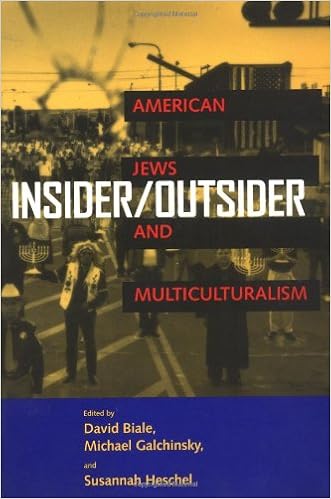
51u+2xHneTL._SX329_BO1,204,203,200_Shaatnez refers to the prohibition in Jewish law against mixing wool and linen in the same garment. Such mixing is considered, as Cohen puts it, “an inappropriate bringing together of opposites” (35). His article is an exploration of the value that multiculturalism could have for American Jews, despite the fact that proponents of multiculturalism often seem to exclude Jews, Judaism, and Jewishness from the multicultural umbrella. Here is an excerpt:

[T]oday’s multiculturalism is often expressed in a spirit quite distant from [previous versions that] almost invariably included Jews. [Nowadays,] multiculturalism is often identified…with a segment of the left that has, to put it bluntly, a Jewish problem. Sometimes this problem is manifested in an obtuse anti-Zionism, other times in insensitivity to Jewish interests and fears, and sometimes in an inability to rebuke anti-Semites without qualification. The Jew, in short, is the problematic Other. The reproduction of this attitude among some advocates of multiculturalism, especially those with third world orientations, threatens to taint multiculturalism in the same way that Communism unfairly tainted the left as a whole.

The problem doesn’t necessarily express itself in outright anti-Semitism…or in the tendency of some people to speak of Israel with a hiss reminiscent of neoconservative pronouncements about the left. Sometimes this tendency is manifested simply as intellectual numbness when it comes to Jews, a numbness multiculturalists quickly protest when it comes to other groups. Moses Maimonides is rarely on the list of authors these multiculturalists aim to incorporate into the canon. Consider, for instance, Multiculturalism: A Critical Reader, a recent, weighty collection of some twenty essays. The only reference to Jews and Judaism to be found in it are in passing, and Jewish studies, which has flourished across the United States in the past quarter century, does not exist in it at all, even in the essay entitled “Ethnic Studies: Its Evolution in American Colleges and Universities.” Marx wrote somewhere that in his vision of the future, the conditions for the liberation of one would be the conditions father liberation of all. If some American Jewish liberals are wary of some advocates of multiculturalism, the reason is plain: it is not always evident that the multicultural “all” includes Jewish culture. (45)

Posted in Anti-Semitism, Jews and Judaism | 9 Comments

Open Thread And Link Farm, Meta-Hitler On A Turtle’s Back Edition

  1. Robot Hugs – Technigal This autobio political cartoon, co-created by a trans woman, is about how her expertise as a videographer was treated before and after she began publicly presenting as a woman. And see also Veronica and a couple of other folks talking about similar experiences they or their spouse have had.
  2. Microaggression, macro harm – LA Times “The new culture of victimhood is not new, and it is not about victimhood. It is a culture of solidarity, and it has always been with us, an underground moral culture of the disempowered.”
  3. The brutal Spring Valley High School video shows what happens when you put cops in schools – Vox
  4. Guatemala just elected a comedian with zero political experience to be president – Vox
  5. Remembering the African-American Suffragists Who Fought a Dual Oppression – Vogue
  6. Minor League Baseball Team Spokane Indians Change Jerseys to Salish Language – ICTMN.com Very neat! Thanks for the link, Ben.
  7. No Trenchcoat for the Giant Squid « The Hooded Utilitarian How in the end, Watchmen undermines “realistic” grim crime drama with superhero silliness.
  8. The philosophical problem of killing baby Hitler, explained – Vox
  9. Why there’s no point telling me to lose weight | The BMJ
  10. Let’s Talk About Intentional Weight Loss and Evidence-Based Medicine | Worse for the Fishes
  11. Why “gender gap” analysis of American politics is mostly wrong
  12. The Rise and Fall of the First Galactic Empire | Ordinary Times
  13. Prison vs. Harvard in an Unlikely Debate – WSJ A debate team from an in-prison college program beats a debate team from Harvard. There’s a followup story here.
  14. Study: Men Get Bigger Start-Up Packages | The Scientist Magazine Er, pun not intended.
  15. Why Snoopy Is Such a Controversial Figure to ‘Peanuts’ Fans – The Atlantic
  16. The US Economy Has Definitely Done Better When A Democrat Is President. But why? And can Democrats reasonably take credit? Well, maybe kind of sort of mumble. Turns out that not needlessly getting into Gulf wars is good for the economy, and some unidentified policy differences may encourage greater productivity.
  17. The House science committee is worse than the Benghazi committee – Vox
  18. I want to live in a baugruppe | Grist
  19. How our housing choices make adult friendships more difficult – Vox
  20. And a counterpoint: Stop Blaming Suburbia for Killing Off Friendships
  21. Reasons I Would Make An Excellent Housekeeper In A Forbidding Eighteenth-Century Estate And You Should Consider Me For The Position – The Toast
  22. Benghazi Timeline. Specifically, a timeline focused on when Clinton and other members of the Obama administration said that the attacks were or weren’t preplanned, were or weren’t “acts of terror” or “terrorist attacks,” and were or weren’t motivated by a Youtube video. Useful if you’re trying to follow (or double-check) what folks attacking Clinton over Benghazi are saying.
  23. Ben Carson Assures Conservatives That His Campus Speech Monitoring Would Only Target Liberals | Right Wing Watch Right Wing Watch’s title is an exaggeration – Carson only implied that, but didn’t explicitly state it. Nonetheless, Carson’s position is anti-free-speech.
  24. Religious Right Activists Argue For Recriminalization Of Birth Control In ‘The Birth Control Movie’ | Right Wing Watch
  25. A chess-set you wear in a ring / Boing Boing “Near impossible to set up.” Heh.
  26. THE LION KING Australia: Cast Sings Circle of Life on Flight Home from Brisbane – YouTube
  27. A woman as president? The gender-neutral Constitution. – Volokh Conspiracy Interesting! Despite the use of “he” as a generic pronoun, the US Constitution was for the most part intentionally written using gender-neutral language.


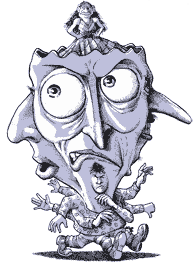
Grimace-Pumpkin-by-Ray-Villafane

Posted in Link farms | 90 Comments

from “The Melting Pot and Beyond,” by David Biale

51u+2xHneTL._SX329_BO1,204,203,200_Continuing my excerpting from Insider/Outsider: American Jews and Multiculturalism, this is from the first essay in the book, “The Melting Pot and Beyond,” by David Biale, a fascinating look at the Jewish role in forging the notion of the United States as a melting pot. This is from the section of the essay called “Jews Become White.”

When Jews came to America, they assumed both that America was different [from Europe] and that their “privileged” status as the emblematic minority [which Biale argues persuasively the Jews represented in Europe] would continue. The erection of educational quotas and the rise of a virulent American strain of anti-Semitism in the 1920s and 1930s confirmed the sense of continuities with Europe. The fact that such groups as the Ku Klux Klan targeted Jews together with African Americans reinforced the feeling of a commonality of persecution. But as anti-Semitism and formal discrimination waned in the post-World War II years and as Jews became economically successful, they found themselves for the first time in modern history doubly marginal: marginal to the majority culture, but also marginal among minorities. They were no longer a minority that defined the central political discourse of the majority culture [as they had been in Europe]. In the American histories of victims, Jews were no longer sociologically “the chosen people.”

Instead, with the rise of the civil rights movement, a very different narrative focusing on African Americans became dominant. As Cheryl Greenberg shows elsewhere in this book [in an essay called “Pluralism and Its Discontents: The Case of Blacks and Jews,” which is well worth reading], although it seemed for a period as if Jews might be able to wed their narrative to that of blacks in the rhetoric of the early civil rights movement, it quickly became apparent that the experiences of the two groups were fundamentally different: despite the mythic memory of enslavement in Egypt, the more recent history of Jews in Europe was not commensurate with the African American experience of slavery. In fact, despite the persecutions and disabilities suffered in Europe, the Jews had still enjoyed a degree of internal autonomy utterly different from that of African American slaves. Their culture in Europe may well have prepared them better than most immigrant groups for success in America. Thus, not only economic success and social integration but also an intrinsically different history divided the Jews from American blacks. Whether they liked it or not (and usually they did), the Jews in postwar America had become white. (27-8)

The indeterminacy of contemporary Jewish identity is often the cause of much communal hand-wringing. But instead of bemoaning these multiple identities, Jews need to begin to analyze what it means to negotiate them and, by doing so, perhaps even learn to embrace them. Reconciling of Jewish identity along postethnic lines would undoubtedly require a sea change in Jewish self-consciousness, since Jews often continue to define themselves according to the old fixed categories. In particular, the issue of intermarriage…requires radical reevaluation. Far from siphoning off the Jewish gene pool, perhaps intermarriage needs to be seen instead as creating new forms of identity, including multiple identities, that will reshape what it means to be Jewish in ways we can only begin to imagine. For the first time in Jewish history, there are children of mixed marriages who violate the “law of the excluded middle” by asserting that they are simultaneously Jewish and Christian or Jewish and Italian. Whether these new forms of identity spell the end of the Jewish people or its continuation in some new guise cannot be easily predicted since there is no true historical precedent for this development: it might be compared to the great sea change that took place with the destruction of the Temple by the Romans in the first century of the Common Era. Such moments of revolutionary transformation are always fraught with peril, but whatever one’s view of it, the task for those concerned with the place of Jews in America is not to condemn or condone but rather to respond creatively to what is now an inevitable social process.

Beyond intermarriage, all Jews in the modern period have learned to live with multiple identities: Jew and German, Jew and American, Jew and Israeli. At one time it was fashionable to describe these identities as hyphenated or hybrid…. But it is becoming increasingly apparent that multiplicity in the precise sense of the word is more apt a description than hybridity. As opposed to the melting pot in which a new identity emerges or the cultural pluralism model in which only one ethnic identity remains primary, this is the sort of identity in which one might retain at least two different cultural legacies at once. The Jewish Enlightenment slogan “Be a human being on the street and a Jew at home” now comes to fruition in a new guise: one can hold several identities both in the street and at home. (31-32)

Posted in Anti-Semitism, Jews and Judaism | Comments Off on from “The Melting Pot and Beyond,” by David Biale

More from Insider/Outsider: American Jews and Multiculturalism

51u+2xHneTL._SX329_BO1,204,203,200_This is from the introduction by David Biale:

Standing somewhere between the dominant position of the white majority and the marginal position of peoples of color, Jews respond with ambivalence to the attack of multiculturalism on the Enlightenment. For two centuries Jews have staked their position in Western society on the promise of the Enlightenment. When given the chance, they used emancipation to enormous benefit and they came to repay the Enlightenment with almost excessive gratitude, rushing to adopt political liberalism and cultural rationalism to a much greater degree than any other group. At the same time, the Jewish embrace of the Enlightenment reflected the limitations within the Enlightenment itself: it was Jewish men, much more than Jewish women, who realized the benefits of the Enlightenment, so the very enthusiasm for the Enlightenment needs to be qualified to some degree along gender lines. And Jews also recognize that the very failure of the Enlightenment led to Auschwitz. The dialectic of Jewish Enlightenment therefore oscillates between these two poles of enthusiastic celebration of modern Western culture and awareness of its most horrific results.

Having finally reaped the fruits of the promise of the Enlightenment, American Jews sometimes ask why liberalism can’t do for other marginalized American groups what it has done for them. This is the source of the conflict among Jews about affirmative action, a policy often associated with multiculturalism. If Jews historically associate quotas with barriers to opportunity, it is then particularly difficult for some to accept such quotas (or similar vehicles) as just means for American society to redress inequities. As beneficiaries, for whatever historical and cultural reasons, of the Enlightenment’s equality of opportunity, some Jews find it hard to understand why such slogans might be inadequate in dealing with the long-term consequences of slavery. At the same time, however, since probably the greatest beneficiaries of affirmative action have been Jewish women, Jews have just as many self-interested reasons to see the virtues of preferences.

(Biale does not offer a citation for his claim in that last sentence.)

Posted in Jews and Judaism | 1 Comment

What I’m Reading: Insider/Outsider: American Jews and Multiculturalism

Insider/Outsider: American Jews and Multiculturalism, edited by David Biale, Michael Galchinsky, and Susannah Heschel, has been on my shelf since I bought it in the late 1990s—the book was published in 1998—but I only started reading it last month. I wish I’d read it sooner. It is filled with really interesting and provocative takes on contemporary questions of Jewish identity as they relate to multiculturalism, intersectionality, canonicity, diaspora studies and more. This is a paragraph from Amy Newman’s (no relation) “The Idea of Judaism in Feminism and Afrocentrism:”

The specific content of…negative images of Judaism…is remarkably malleable. During the eighteenth century, when European scholars were infatuated with pure reason, Judaism was criticized as an irrational faith. Now that rationalist ideology has come to be viewed with suspicion, hwoever, Judaism is more often conceived as the source of sterile rationality. When the hallmark of rational religion was its universalism, Judaism was criticized for its particularism; now that universalism has given way to an emphasis on difference, some assert that Judaism is the original source of universalistic thinking. In nineteenth-century German revolutionary thought, scientific method was viewed as a good thing and the Jewish tradition was accordingly conceived as hostile to a modern scientific worldview. In contemporary social criticism, scientific method has come under suspicion, and now we learn that the desire to dominate the world often equated with the scientific worldview originated in the Hebrew tradition. In modern German theories of race, Jews were often categorized as “black” because their ancestors had intermingled with Africans; in some recent Afrocentric scholarship, Jews are portrayed as the original “white” racists. (174)

Newman’s article is a long and complex critique of the way some feminist and Afrocentric scholars locate Jews and Judaism as the source of their partricular oppressions (patriarchy and/or racism), and is not something I can do justice to here. This paragraph made me think, however, about how even a cursory glance at the intellectual history of antisemitism demonstrates what a profoundly flexible a hatred it has been and continues to be, being easily molded to fit the purposes—ideological and otherwise—of whichever party needed it, on the left, on the right, or anywhere in between.

Posted in Anti-Semitism, Jews and Judaism | 2 Comments

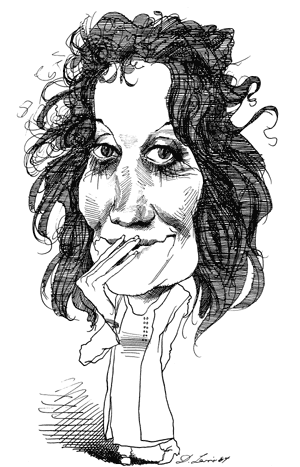
Three Points Regarding The No-Platforming Of Germaine Greer

Germaine Greer, by David Levine

Germaine Greer, by David Levine


Quick summery: Germaine Greer, a second-wave feminist famous for her 1970 book The Female Eunuch, was invited to give a speech at Cardiff University. Ms. Greer’s transphobia is well-known, gross, and undeniable. Rachael Melhuish, the Women’s Officer at Cardiff Unversity Students’ Union, started a petition asking for Cardiff to dis-invite Greer (aka “no-platforming” Greer), due to Greer’s bigoted beliefs, which 1346-and-counting have signed. The University said they wouldn’t rescind the invitation, but Greer now says she’s not going to go. And, of course, the usual suspects are calling this “censorship.”

1. Disinviting Greer wouldn’t be censorship.
It’s not censorship for activists to create a petition saying Cardiff University should cancel Germaine Greer’s scheduled speech. On the contrary, debates about who is or isn’t invited to speak are part of free speech. As Angus Johnston tweeted, “Censorship is suppression of speech. Criticism of speech isn’t censorship. Criticism of a decision to host speech isn’t censorship.” ((I don’t agree with everything Johnston said, but I agree with that tweet.))

Greer has a right to free speech. She has no right, however, to be an invited speaker at Cardiff. Nor, once she is invited, does she have a right to not have that invitation questioned or criticized.

2. But it’s not great behavior, either, if we favor a “culture of free speech.”
Just because it’s not censorship doesn’t mean it’s a tactic I agree with. Universities, in general, should create a “culture of free speech” where contested issues – and unfortunately, transphobia is still within the bounds of acceptable beliefs in our society – can be spoken and debated. Pressuring Cardiff to disinvite Greer goes against that ideal. IMO, it would have been better to respond to the Greer lecture in other ways.

3. Attempting to disinvite Greer has been a publicity bonanza for Greer.
In the petition, Rachael Melhuish wrote:

Trans-exclusionary views should have no place in feminism or society. Such attitudes contribute to the high levels of stigma, hatred and violence towards trans people – particularly trans women – both in the UK and across the world.

While debate in a University should be encouraged, hosting a speaker with such problematic and hateful views towards marginalised and vulnerable groups is dangerous. Allowing Greer a platform endorses her views, and by extension, the transmisogyny which she continues to perpetuate.

I agree that trans-exclusionary views should have no place ((In the sense of, I’d prefer such views to be very marginalized and socially treated with disdain)) in feminism or society. I agree that the existence of bigoted views such as Greer’s make the world more dangerous for trans people.

But getting Cardiff to cancel Greer’s speech (or, as things have turned out, persuading Greer to cancel) does not make the world any safer, or views such as Greer’s any less prominent. In fact, just the opposite. Due to the Streisand effect, dozens or hundreds of media outlets that would have ignored Greer are quoting her views. The petition to revoke Greer’s invitation has given Greer an infinitely bigger megaphone than just speaking at Cardiff could have.

And in a context of a university (or any other forum which makes a practice of hosting a variety of views), allowing someone a platform isn’t the same as endorsement of their views.

Posted in Free speech, censorship, copyright law, etc., Transsexual and Transgender related issues | 127 Comments

What Is “The Male Gaze”?

"Un Regard Oblique," by Robert Doisneau, 1948.

“Un Regard Oblique,” by Robert Doisneau, 1948.

The first use of the term “male” gaze, in 1975, was in an essay by Laura Mulvey:

In a world ordered by sexual imbalance, pleasure in looking has been split between active/male and passive/female. The determining male gaze projects its phantasy on to the female form which is styled accordingly. In their traditional exhibitionist role women are simultaneously looked at and displayed, with their appearance coded for strong visual and erotic impact so that they can be said to connote to-be-looked-at-ness. Woman displayed as sexual object is the leit-motif of erotic spectacle: from pin-ups to striptease, from Ziegfeld to Busby Berkeley, she holds the look, plays to and signifies male desire. Mainstream film neatly combined spectacie and narrative. (Note, however, how the musical song-and-dance numbers break the flow of the diegesis.) The presence of woman is an indispensable element of spectacle in normal narrative film, yet her visual presence tends to work against the development of a story line, to freeze the flow of action in moments of erotic contemplation. This alien presence then has to be integrated into cohesion with the narrative. As Budd Boetticher has put it:

“What counts is what the heroine provokes, or rather what she represents. She is the one, or rather the love or fear she inspires in the hero, or else the concern he feels for her, who makes him act the way he does. In herself the woman has not the slightest importance.”

…Traditionally, the woman displayed has functioned on two levels: as erotic object for the characters within the screen story, and as erotic object for the spectator within the auditorium, with a shifting tension between the looks on either side of the screen. For instance, the device of the showgirl allows the two looks to be unified technically without any apparent break in the diegesis. A woman performs within the narrative, the gaze of the spectator and that of the male characters in the film are neatly combined without breaking narrative verisimilitude. For a moment the sexual impact of the performing woman takes the film into a no-man’s-land outside its own time and space. Thus Marilyn Monroe’s first appearance in The River of No Return and Lauren Bacall’s songs in To Have or Have Not. Similarly, conventional close-ups of legs (Dietrich, for instance) or a face (Garbo) integrate into the narrative a different mode of eroticism.

The male gaze is a term of art a feminist critic gave to aesthetic conventions she observed in many films, not a statement of biological determinism, or a statement about men in general. There’s no reason to think that “the male gaze” can only be produced by men, and it’s not hard to think of counter-examples of female filmmakers utilizing the male gaze (i.e., the Pheobe Cates bikini scene in “Fast Times At Ridgemont High,” directed by Amy Heckerling).

I’m not sure it’s coherent to speak of “the male gaze” outside the context of discussing a piece of media. A person doesn’t have “the male gaze”; only a piece of art does. (As I understand it.)

Posted in Media criticism | 11 Comments

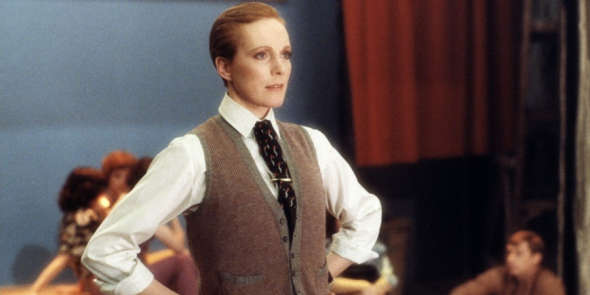
Deb Chachra on “The Gray Man” and Gender-Marked Fashion

victor-victoria

Source.

In this fantastic interview for Rawr Denim, William Gibson talks about clothing and fashion: “There’s an idea called “gray man”, in the security business, that I find interesting. They teach people to dress unobtrusively. Chinos instead of combat pants, and if you really need the extra pockets, a better design conceals them. …[T]here’s something appealingly “low-drag” about gray man theory: reduced friction with one’s environment.” That made me wonder: “What does a ‘grey woman’ look like?”, which made me think about how Deborah Tannen used the linguistics terms marked and unmarked to describe gender and clothing. Just as many English words are default male (unmarked), with a changed ending to connote female (marked; think ‘actor’ vs ‘actress’), she argued that men’s dress can be unmarked but women’s dress is always marked. That is, there are decisions that men make about what they wear that are defaults, that aren’t even seen as a decision. In contrast, every decision that a woman makes about what she wears—heels vs, flats, pants vs, skirts, the length of a skirt and the height of a neckline, haircuts, jewelry—is freighted with cultural baggage. Take makeup. Especially in professional settings, for a woman, not wearing makeup is a noticeable, and notable, decision: marked. But for a man, not wearing makeup is not a decision—nobody notices when men aren’t wearing makeup: unmarked. (Of course, a man wearing makeup is very marked indeed.) […]

The roots of the ‘Grey Man’ lie in the Great Male Renunciation: the period around the end of the 17th century, in the middle of the Enlightenment, when society collectively decided that men’s clothing, previously as colourful and ornamented as women’s, was to be dark, sober and serious. What’s kind of astonishing is how we’ve never really gone back—a quick scroll through red-carpet photos makes that clear—and how we mostly just accept this sexual dimorphism as the norm. Just why men’s clothing has never returned to pre-GMR levels of finery is something I’ll leave to historians and sociologists, but it’s almost certainly related to the harsh enforcement of gender norms—while women can wear colours and clothing styles indistinguishable from men’s (as I write this, I’m wearing black jeans, a black t-shirt, and Camper high-tops), the slightest hint of femininity in men’s self-presentation elicits verbal abuse at best, and the worst is far worse.

Read the whole thing.

Posted in Feminism, sexism, etc, Men and masculinity, Sexism hurts men | 6 Comments

Link Roundup & Geek’s Guide to the Galaxy

Interviewed on Geek’s Guide to the Galaxy

I was privileged to be in this week’s Geek’s Guide to the Galaxy in which host David Barr Kirtley interviewd me, Matt Kressel, and Jack Dann about Jewish science fiction and fantasy. Listen to the podcast here.

(Among many other things), Matt talks about Jewish mythology, and how Jewish symbols have become cultural staples–such as Leonard Nimoy’s Vulcan salute. Jack Dann talks about how the attitudes toward Jewishness in science fiction have changed in the past century. I talked about my experience editing The People of the Book: The Decade’s Best Jewish Science Fiction and Fantasy.

Relatedly, I’m looking forward to Matt Kressel’s new book, KING OF SHARDS.  king of shardsQuoting its description, “Across the ineffable expanse of the Great Deep float billions of shattered universes: the Shards. Populated with vengeful demons and tormented humans, the Shards need Earth to survive just as plants need water. Earth itself is kept alive by 36 righteous people, 36 hidden saints known as the Lamed Vav. Kill but a few of the Lamed Vav and the Earth will shatter, and all the Shards that rely upon it will die in a horrible cataclysm.” I love Matthew’s facility with bizarre world-building, and I’m excited to see what he does with it in novel form.


Link Round-Up

On my social media, I’m posting links to things I’ve written, things other people have written, and artists to support. On Mondays, I’m gathering the links from the previous week into a blog post. (Within the next couple weeks, I’m hoping to replace my Wednesday poems with writing advice, and add Patreon links on Thursdays.)

Some horror for October.

A Story of Mine

“When Shadow Meets Light,” Fantasy Magazine

This isn’t really a horror story, but it is about a ghost. When I was little, Princess Diana was a figure who loomed large. I had paper doll books of her fashions, knew what her wedding dress looked like. Reading her biographies was interesting; most seem to take a particular slant on her. I ended up siding with the more sympathetic, she seems to have been very young and naive when she got entangled in the royal mess.

A Poem of Mine

Thirteen,” Apex Magazine

Straight-up horror.

This is also the last poem of mine that I’ll be linking to here, unless I start reprinting stuff online or publishing something new. I’m planning to replace these entries with writing advice columns.

A Cool Patreon

If you don’t know what Patreon is, it’s a website that helps fans connect with artists they want to support. Some (like my friend Barry’s) work on a per creation basis (he gets paid per cartoon); others are monthly.

Carmen Maria Machado is one of my favorite new writers, and probably one of my favorite writers period. I hadn’t planned this deliberately, but she’s actually a very talented horror writer, so yay for continuing the October theme. Whether or not you end up supporting her Patreon, check out her stories; it’s worth it.

(ETA: Whoops! Actually posting my links to this next week. But her patreon is still awesome.)

An Awesome Story

Flat Diane” (audio) by Daniel Abraham, originally published in F&SF, reprinted in Pseudopod
There is a version in text as well

This is one of the scariest stories I’ve read. When I gave it to my students a few years ago, they agreed. It’s chilling, with excellent character work, and Daniel Abraham’s consummate craft. Trigger warning for violence against children.

Posted in Uncategorized | Comments Off on Link Roundup & Geek’s Guide to the Galaxy