The Gift that Keeps On Giving


Michele Bachmann is keepin’ it real, yo:

As Steele concluded his remarks, Minnesota Rep. Michelle Bachmann—the event’s moderator—told Steele he was “da man.”

“Michael Steele! You be da man! You be da man,” she said.

She’s the duly elected representative from Minnesota’s 6th District, ladies and gentlemen.

(Via Jesse)

Posted in Conservative zaniness, right-wingers, etc., Race, racism and related issues | 5 Comments

Unimpressed.

I was curious about this book until I saw this little gem by the author on Jewcy:

Whatever we say about women and men being equal now and tomorrow – I have three daughters who I want to see beat the world – throughout the whole human past, including the Jewish past, men and women have had different rules, different roles, different thoughts, and different lives.

Biology and common sense both tell us sex is something women have and men want. We can try as hard as we want to talk our way around this, but we can’t make it any less true–for the Jews or any other people.

But I’m sure your book is very smart. Jewish men? You guys have got a long way to go. (That goes for all you Gentile fellas, too.)

PS – So, when I feel aroused, is that really just the need to unload myself of all that pesky sex? Or maybe Judith Butler has just brainwashed me into imagining that I enjoy it.

Dang, think of the poor lesbians – so much sex and nowhere to put it.

UPDATE: The author has responded to a comment I left on the Jewcy post, defending what he wrote as “an exaggeration, but a useful one.”

(Cross-posted at Modern Mitzvot.)

Posted in Feminism, sexism, etc, Gender and the Body, Jews and Judaism | 29 Comments

With Judges Like These

Cross-posted from The Mustard Seed.

First read this on the e-mail list serve I’m on for the website Community Labor News. In an article by Mumia Abu-Jamal, he writes:

In Pennsylvania’s Luzerne County, there are 9 judges of the Court of Common Pleas. Two of them just pleaded guilty to a conspiracy to convict and sentence juveniles to a private prison, so that they could get kickbacks from the prison’s builders and owners.

At least 22% of their judges have admitted being corrupt, in the sordid business of selling the freedom and well-being of poor children for profit.

And the worst part is that the Pennsylvania Supreme Court originally rejected the petition to hear the case.

The media reports on this outrage and the Pennsylvania Supreme Court expresses a little interest. This is the nature of judging these days; when even kids are expendable fodder for the Prison Industrial Complex.

Posted in Class, poverty, labor, & related issues, Prisons and Justice and Police | 1 Comment

Conveying a Message to the Jews of South Africa

A few weeks after South African minister Fatima Hajaig set off a firestorm by saying much of the world is under the heel of “Jewish money”, it is becoming more and more apparent that this is not a one-off. COSATU, a major South African union deeply tied to the ruling ANC, recently lead a march to protest Israeli government policies. Not necessarily bad in of itself. Where did they march? On the Israeli embassy? Nope. They decided the best place for their march was a Jewish community center. Bongani Masuku, International Relations Secretary for COSATU, phrased the goal this way:

We want to convey a message to the Jews in SA that our 1.9-million workers who are affiliated to COSATU are fully behind the people of Palestine… Any business owned by Israel supporters will be a target of workers in South Africa.

Well, if you want to “convey a message to the Jews” then targeting a Jewish community center is the way to do it. Of course, it does make it more difficult to take seriously the statement of the Palestine Solidarity Committee’s Salim Vallie (which helped coordinate the march), “We are not going to support the canard that says if you are opposed to the policies of Israel you are anti-Semitic, this does not intimidate us.” As Howard Jacobson put it in another context “No, you don’t have to be an anti-Semite to criticise Israel. It just so happens that you are.”

Mr. Masuku then got into an email correspondence with the head of South Africa’s It’s Almost Supernatural blog, which is dedicated to identifying and exposing anti-Semitism in South Africa, after leaving this comment:

Hi guys,

Bongani says hi to you all as we struggle to liberate Palestine from the racists, fascists and zionists who belong to the era of their Friend Hitler!

We must not apologise, every Zionist must be made to drink the bitter medicine they are feeding our broathers (sic) and sisters in Palestine. We must target them, expose them and doo allthat (sic) is needed to subject them to pereptual suffering until they withdraw from the land of others and stop their savage attacks on human dignity. Every Palestinian who suffers is a direct attck (sic) on all of us!

In the email exchange, he expressed his view “that Jews are arrogant, not from being told by any Palestinian, but from what I saw myself,” and proclaimed that “If the offices of the Zionist Federation and that loud-mouthed Rabbi and his SABJD [South African Board of Jewish Deputies] were in town we would have marched there.” More distressingly, he made and reiterated a call for all Jews who did not actively disavow Israel to leave the country — to wit, “all the people who deny that occupation is wrong must be encouraged to leave South Africa before they infect our society with much more racism” and “none of those who tolerate Israeli apartheid and racism should ever imagine it [South Africa] to be their home.” Mr. Masuku made it very clear that full-throated condemnation was what was required — not “silently consenting or grumbling under tables.” Ultimately, the only permissible Jews are those who “have proven to be reasonable and humane.”

Continue reading

Posted in Anti-Semitism | 13 Comments

The real difference between Al Gore and George Will

Matt, noting a “both sides suck” article in the Times, writes:

Instead, out comes Andrew Revkin with a false equivalence article <a target=”_blank” href=”http://wonkroom.thinkprogress.org/2009/02/25/revkin-dead-wrong/”>painting Will with the same brush</a> as Al Gore. Will’s sin is to say that the world is not getting warmer when, in fact, it is. Gore’s sin was to say that warming is happening (it is) and to illustrate the problems with this trend by referring to a chart that Revkin deems unduly alarmist but that Gore found in <em>The New York Times</em>.

Matt’s correct, of course. But Matt didn’t note another way in which Gore has acted better than Will — a way that reflects, I think, Gore’s superior approach to science. What did they do once the errors were pointed out? Gore acted responsibly; Will and the Washington Post did not.

The critique of Gore’s chart (a new addition to his presentation) came out earlier this month. Gore, presumably because he or his staff felt the critique had merit, removed the chart from his presentation.

Tigerhawk says that’s embarrassing, and I agree, it is a bit embarrassing — but only a bit. Occasional mistakes are inevitable when a book or presentation draws evidence from hundreds of sources. What would be seriously humiliating is if the error were fatal to Gore’s larger thesis, or if Gore refused to correct the error once it was credibly pointed out. But that one chart isn’t the foundation of Gore’s argument about global climate change. And by promptly correcting the error, ((The exact timeline is unclear, but it appears less than a month, and maybe less than a week, passed between the critique of the chart, and Gore correcting the error.)) Gore has demonstrated how responsible writers act.

In contrast, George Will and the Washington Post have, so far, refused to admit, let alone correct, Will’s errors. Instead, the Post has compounded Will’s errors. And as for a prompt correction — it turns out Will has been repeating more or less the same error-filled column since 1992.

Posted in Environmental issues | 3 Comments

Job losses in this recession versus the previous five

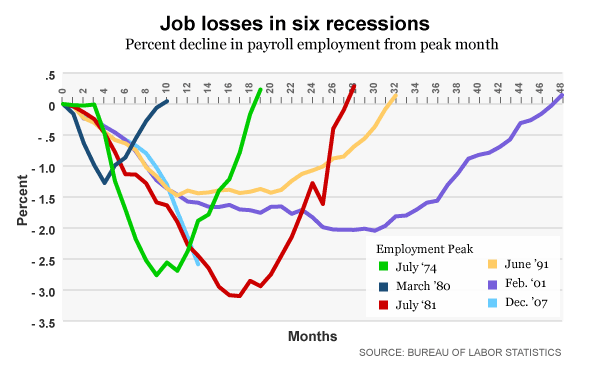
In another thread, Ron said “this recession is actually less severe than either of the last two in terms of the percentage of people out of work.” I think Ron’s understating the severity of the current situation.

I found this graph on Time’s econ blog. As you can see, we’ve already had greater job loss this recession than we did in either the 2007 or the 2001 recessions; you have to go back to 1981 for a recession that was worse than this one. And this recession hasn’t even reached its nadir yet.

(There’s an even scarier looking graph floating around, but the graph you see above is more accurate because it’s measuring by percentage, rather than absolute numbers that haven’t been adjusted for the growing population.)

Posted in Economics and the like | 18 Comments

Dollhouse Episode Two: Ridiculously Long Review

I am so excited about having a new Joss Whedon TV show (even though I haven’t been able to write anything else, because I’ve been planning this epic review. I may need to make the reviews a little less epic, if I’m going to ever blog about anything but Joss). Even though dollhouse is not great, by any stretch of the imagination, I’ve missed having a show to watch every week, and there’s huge potential.

I thought this episode was a huge step up over the second pilot (and not as good as the script from the pilot that they scrapped, but that’s the great minds of Fox executives for you). In particular the main plotline wasn’t deathly boring, and there was some connection between that plotline and what we learned about the dollhouse. It seemed to show exactly how much they could fit in an episode, and how much richer the episodes are when they’re full.

Plus it seemed more like a Joss show in general, it was more twisty, and the dialogue was snappier (“Four brother, none of them democrats” being the standout line). I thought the crash cut between the shooting of the deer and the sex, was obvious, but in keeping with the themes of the episode.

Clearly the heart of the episode was about Echo’s relationship with Boyd, and how he came to see her as human. I thought they tied the threads in together thematically really well, with the violence of Alpha reflecting (and possibly not just metaphorically) the psychopath’s mission. We learnt more about how the dollhouse operated quite organically.

Most importantly I really liked that they showed that Echo and Boyd’s relationship had started off with him contemptuous of her. To get explicitly political: The dollhouse was trying to divide its employees – the actives and the minders – by encouraging the minders pre-existing inclination to see the actives as lesser. To see Boyd and Echo overcome that was pretty awesome.

The big question for me is the politics of the engagement. One of the big questions that other people have asked is: ‘what makes depicitions of sexual predation exploitative?’ and ‘does the fact that the woman wins in the end matter?’. And I can’t really comment that much, because I don’t watch the crime shows and horror movies where this sort of stuff happens, so I don’t really have a feel for the parameters. As a single episode this didn’t bother me from that perspective, although I would have a big problem if it happened all the time. But that might change if I knew just how bad things are in the land of TV and movies I don’t watch.

The question I was more interested in was about the psychopath. I saw his psychopathic behaviour as a natural extension of buying the perfect woman. If you see people as commodities to be brought to order then of course you want to test them, of course you see them as yours. But another reading could be to see the fact that he’s a psychopath as endorsing what went before. “Well it’s a problem now he’s trying to kill her, but building her to spec is totally shiny.”

Having rewatched the ep, I think the show did actively undermine the second reading and support the idea that wanting to buy someone was part of him being a psychopath. In particular, he comes across as creepy from the first moment and his entitled misogyny is apparent from the way he talks about women with Adele. Although any understanding of this episode is challenged by the revelations about the psychopath’s connection with Alpha, and my reading could be uncompatible with what will be revealed in future episodes (which was the one thing I didn’t like about the way the stories came together, I liked the psychopath as a psychopath and wouldn’t like anything to undermine that).

The point of the story turned out to be that Echo overcame her programming in her relationship with Boyd. I think that that, combined with the fact that the psychopath is portrayed as an extension of men who feel entitled to women’s bodies, makes me more generous towards the general creepiness of men writing stories about men who want to kill women. But I would be worried if it was going to be like this lots.

Although this episode was much stronger than the pilot, I think the show still has a long way to go. I’m still unconvinced about Eliza Dushku’s acting range. Although I don’t think the scripts really helped her. The two male fantasy characters she’s played in the first two eps are Faith like (you can imagine either one of them saying “I’ve got mad skills” like Faith to Robin in the final of Chosen). I think she’s doing an excellent job as Echo, unimprinted, but I’m not sure about the idea that she can be anyone.

The FBI plotline just goes from bad to worse. You can tell that the writers on Dollhouse have spent their entire writing life constructing plotlines where they get to set the rules “Don’t touch the Flabotinum in jar C ” ((A term the Buffy writers coined to refer to the magic plots which they could just make each week since they controlled the whole universe.)) and don’t know how to make plots from real life. It’s not just that everything they know about cop-shows they’ve learned from other cop shows. It’s not even that they’re telling a story about a cop and have no interest in cops and nothing to say about cops (and I’ve watched the Wire, they’ve watched The Wire, there’s no excuse). It’s that they don’t seem to care that they’re regurgitating scenes we’ve all seen hundreds of times before.

I actually enjoyed Lasagna Girl AKA Mellie. But I was more than a little distracted that this was the woman who was originally cast as November. The casting description called for:

20’s, any ethnicity, beautiful and heavy.

And like a chump I got all excited, just like I did when Kaylee was described as zaftig in the Firefly pilot (and I’m not saying a word about Jewel Staite who was unbelievably awesome as Kaylee). I knew that they’d cast Miracle Laurie, so I wasn’t surprised when I saw her, but I still spent most of that scene going “What?”. I think it was underlined by the fact that the costuming people appear to have taken the same tack the Buffy people did with Tara “This is a real person, she will wear real people clothes that emphasise her real-ness”. ((Although the costumes are in general miles better than Buffy, where all the women had ridiculously large wardrobes and wore even more ridiculous and unsuitable clothes (remember when Willow skinned a muppet and wore it for a vest). On Dollhouse the clothes are stylie and all but they also seem to serve the story, rather than just be things the actresses want to wear. Also I’ve wanted almost every top Adele DeWitt has worn.))

I forget what the point of this rant was? I’ll be interested to see where Mellie goes, but her character will have to develop quite a way before I stop ranting in my head everytime she’s on screen.

It was really noticeable to me that this episode did not pass the Bechdel test (none of the female characters talked to each other). More than that the women in Dollhouse don’t seem to have relationships with each other, in the way Topher ((Confession: I find Topher really engaging. Clearly he’s an absolute asshole, but particularly in his relationship with Boyd, I find him really watchable. I think it’s at least partly because he’s an archetype Jossian character surrounded mainly by normal people. I’ve got kind of addicted to people who talk funny and it’s nice having one on my TV.)) and Boyd do (or Boyd and Echo) do. While I’m hopeful that Sierra and Echo will develop some sort of relationship, that’ll be long and slow. All the other female characters seem very isolated from each other. But, unlike on say Battlestar Galactica, where you got the feeling there must have been heaps of relationships between women that existed and the show just really wasn’t interested in them, I can believe that the women who work in the dollhouse are atomised, it seems like the place that would do that to people. I think that could be interesting, as long as they show the relationships developing over time (and at this point Adele DeWitt and Dr Saunders could have a huge history, but we wouldn’t know abuot it).

I’m worried about different things than I was after the first episode. I think this episode showed that they could write an interesting stand-alone story, that we weren’t just going to be bored with a procedural of the week.

But, in my head Echo’s coming to conciousness would be about forming relationships with other people. ((I think this is influenced by the unaired pilot, where the first sign we’re given that Echo is coming to awareness is that she’s grouping with two of the other dolls.)) And in this episode it seems to be about violence. The first sign we had that she remembers everything was the horrific-ness of “shoulder to the wheel/do you deserve to live.” It seems to undermine the idea that she’s overcoming her programming if all she takes with her is something from one of her programmers.

This episode was, for me, still more rocket launchers than emotional resonance. ((For those less obsessed than me in the commentary to Innocence Joss said that the two most important things in the work that he does were emotional resonance and rocket-launchers. Innocence certainly has an abundance of both.)) The Echo/Boyd plotline was cool, but it didn’t hit me in the gut. It was a story about trust and a growing relationship, but it seems strange and unusual, not resonant. I think the premise is very rich in emotional resonance, but mining it might be a challenge, because the leap to identify with an Active, or someone’s relationship with one, is a big one.

It’s frustrating, because the more I watch and think about the dollhouse, the more excited I am about the premise. Because at it’s heart it is a criticism of commodification, and (presumably) a statement that people cannot be commodified. It could be an amazing statement about resistance. And I know Joss’s work well enough to be reasonably confident that that will be part of the story he’s trying to tell (but probably not all of it). I’m just worried that Fox was more into the sex and violence, and not at all into the collective resistance, and they’re going to cancel it before we get to see the bits that I’m most interested in.

Posted in Buffy, Whedon, etc. | 6 Comments

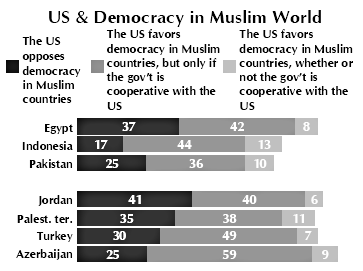
Hearts and Minds FAIL

Via Kevin Drum.

Posted in International issues | 19 Comments

Piyush

I’m going to have a post up later about Bobby Jindal’s Republican Response of last night — it’s taken me that long to get over my anger at him for using Hurricane Katrina as an example of why we need less government — but before I do, I wanted to take note of a name I’m seeing a lot on liberal blogs of late.

The name is Piyush.

Piyush is Bobby Jindal’s official name, the one given to him by his parents at birth. Like many second-generation immigrants before him, Jindal has chosen not to use that name in his professional life. Instead, he uses “Bobby.” Why does he do this? For the same reason that millions of second-generation immigrants have chosen to go by John instead of Juan, or Margaret instead of Mulan, or Barry instead of Barack, or Hank instead of Hans — because using a more traditional American name allows one to avoid some of the anti-immigrant, nativist hatred that has been a part of American society since the first Americans came to this country illegally and stole land away from its rightful owners.

Calling Bobby Jindal “Piyush” comes from the same dark part of the American soul that motivates some conservatives to always include Barack Obama’s middle name when speaking of him. It’s a way to “other” him, to make him sound less like an American, and more like a foreigner. It’s a way to attack Jindal’s ethnicity, and to argue subtly that he should be taken less seriously because he is an Indian-American, and therefore not a “real” American.

And that is, quite simply, abhorrent. There are many, many reasons to dislike Bobby Jindal politically, from his retrograde positions on women’s rights to his Norquistian, drown-it-in-the-bathtub view of economics. But these have nothing to do with his ethnicity, or where his parents were born.

Bobby Jindal has chosen to call himself Bobby. Polite and decent people call a person by the name they ask you to call them by. So feel free to call Bobby Jindal a sexist, a Christianist, and a disaster for the economy — but call him Bobby Jindal. Because that’s his name.

Posted in Race, racism and related issues | 48 Comments

Snowball fight in Hell! (I agree with David Blankenhorn.)

David Blankenhorn and Jonathan Rauch have written the week’s most talked-about op-ed, “A Reconciliation on Gay Marriage.” It’s an eye-catching byline, because Blankenhorn – a marriage equality opponent I’ve criticized once or twice in the past — and Rauch, one of the country’s leading marriage equality proponents — seem unlikely bedfellows.

We take very different positions on gay marriage. We have had heated debates on the subject. Nonetheless, we agree that the time is ripe for a deal that could give each side what it most needs in the short run, while moving the debate onto a healthier, calmer track in the years ahead.

It would work like this: Congress would bestow the status of federal civil unions on same-sex marriages and civil unions granted at the state level, thereby conferring upon them most or all of the federal benefits and rights of marriage. But there would be a condition: Washington would recognize only those unions licensed in states with robust religious-conscience exceptions, which provide that religious organizations need not recognize same-sex unions against their will. The federal government would also enact religious-conscience protections of its own. All of these changes would be enacted in the same bill.

Pam, who I usually agree with, has misunderstood what the proposal is:

I have a problem with this already, though I see where they are trying to accomplish — getting same-sex couples access to the rights and benefits of civil marriage and cede the word marriage to those who cannot decouple it from religious marriage in their heads.

But the compromise doesn’t cede the word “marriage.” Blankenhorn and Rauch aren’t trying to end debate over the word “marriage.” What the B/R compromise (as I shall now call it) attempts to do is put aside two sub-debates associated with marriage, while leaving the primary debate — over formal marriage equality — untouched and ongoing.

I think marraige equality proponents should take this deal, if it becomes a real legislative possibility.

First of all, Federal recognition of same-sex marriages and unions is worth a lot, even though the fight for full marriage equality would still go on. The benefits for couples currently torn apart by unjust and bigoted immigration laws, for example, would be incredibly important, and that’s just one example — there’s also tax law, social security, etc..

Second of all, the anti-marriage-equality movement relies on saying “booga-booga! Teh gays are coming to take away your religious liberties!” in order to drum up donations and votes. This bill could be an enourmous boon to us, because it would let equality proponents say “not only is that not true, it’s against a Federal law that was passed just last year — and the law was originally proposed by the guy who wrote the book on opposing equal marraige!”

Would that, alone, be a game-changer? Would it stop some marriage equality proponents from lying about what marraige equality would do? Of course not. But it would help. Not a guaranteed win, but also not nothing. As David Link writes,

The compromise tests the veracity of the claim that religious believers worry civil recognition of same-sex relationships will invade their belief system through the enforcement of civil rights laws which require gays to be treated equally.  The right has been able to scare up a few anecdotes about this misuse of civil rights laws: a wedding photographer forced to photograph a lesbian wedding; a same-sex couple who wanted to take advantage of a church-owned gazebo, which the church offered for use to the public; and churned them into a froth of paranoia about governmental intrusion into religion.

I’m with Jon in offering this proposal up publicly.  I am happy to let the right know that we are dedicated to stopping this cascade of anecdotes.  If they want additional assurance that the first amendment’s separation of church and state means what it says, I will be on the front lines to add a statutory “and we really mean it” clause.

In fact, the B/R compromise doesn’t go far enough. Can we also add another “and we really mean it” clause, saying that parents have the right to withdraw their children from any class in which the teacher is teaching about same-sex marriage?

Because if those two clauses had been federal law a year ago, I very much doubt Proposition 8 could have passed.

* * *

There is a danger here, as Nan Hunter points out:

…satan is truly in the details of their proposal for a “robust” exception for religious belief. It was  striking to me that the op-ed completely omitted any discussion of the impact when non-church (etc) entities – like charities or hospitals with a religious affiliation –  accept public funds. When all of our tax dollars are supporting these organizations, then all of us have a legitimate concern about the services they provide.

I wondered about this too, and emailed Rauch asking about it. Rauch told me that he’s imagining broad federal guidelines, with freedom for states to make their own religious exemption rules within those guidelines.

That’s conforting, in a way. If the “robust” exception for religious belief would mean that Massachusetts can set its own standards, then Massachusetts wouldn’t have to accept Catholic hospitals refusing to acknowlege same-sex marriages.  Of course, homophobes in states like Florida would use the exemption to screw over same-sex couples — but that’s already happening, so it’s not clear how the B/R compromise would make things worse.

Assuming it doesn’t become a trojan horse for eviserating anti-discrimination laws (as Kate Harding thinks is Blankenhorn’s intention), I’d like to see this compromise become law. It could provide substantial benefits for same-sex couples nationwide, and also blunt one of the anti-equality side’s favorite attacks. And I think that the more experience the country has with legally recognized same-sex unions, the better the odds of reaching full marriage equality. (Maggie Gallagher agrees with me, although in her case it’s something she fears.)

Curtsy: Eve at the Marriage Debate blog.

Posted in Same-Sex Marriage | 9 Comments