
Are loans a better idea than Obama's housing plan?

Cathy Young writes (emphasis hers):

Lately, there has been a lot of discussion of the moral aspect of anti-crisis measures that, in effect, allow people to get away with bad or at least irresponsible behavior — specifically, bailing out homeowners who took out mortage loans they couldn’t realistically afford. […]

There is, however, an alternative to letting the foolish and reckless go under — taking a few of the wise and responsible down with them — or forcing other, more responsible people to pay for their folly.

Provide the assistance — but in the form of loans. Let the people, companies, and states on the receiving end of taxpayer-funded rescue repay the money later, when they’re back on their feet.  At low interest.  Or even zero interest.   But there should be no such thing as a free bailout.

Looking specifically at the example of “homeowners who took out mortage loans they couldn’t realistically afford,” I think Cathy’s plan is far worse than Obama’s — because Cathy’s plan, not Obama’s, is the free bailout.

Obama’s plan (pdf link)…

is intended to reach millions of responsible homeowners who are struggling to afford their mortgage payments because of the current recession, yet cannot sell their homes because prices have fallen so significantly. Millions of hard-working families have seen their mortgage payments rise to 40 or even 50 percent of their monthly income – particularly those who received subprime and exotic loans with exploding terms and hidden fees. The Homeowner Stability Initiative helps those who commit to make reasonable monthly mortgage payments to stay in their homes – providing families with security and neighborhoods with stability.

So it lets people refinance their loans — but they don’t get a free lunch (or a free house). They’re required to continue making payments.

Meanwhile, the lenders are taking a loss compared to what they would get if mortgages were paid at the original terms — but that loss is mitigated by incentive payments from the Federal government. And it’s less of a loss for the banks than if the homeowners default on the mortgages.

Compare that to Cathy’s solution, in which, rather than helping the homeowners out with refinanced loans, the government lends homeowners money to cover the shortfall between what they can afford to pay, and what their mortgage terms call for. This would leave homeowners far worse off, but it would be a bonanza for lenders.

But that would be unfair. Let’s ignore, for a moment, the fact that many homeowners having trouble with their mortgages didn’t act irresponsibly. What about the case of someone who used a subprime loan to buy a house they couldn’t afford, once the adjustable interest rates went up? Sure, they acted irresponsibly — but so did the lender. In fact, I’d say the lender — who should have much more expertise than the borrower — was more irresponsible.

Cathy’s plan would be free money for irresponsible lenders. Obama’s plan — which rescues both lenders and borrowers from the worse consequences of irresponsible loans, but expects lenders to swallow some loss and borrowers to keep making monthly payments — is fairer.

* * *

The above is written under the assumption that under Obama’s program, lenders really do end up making less money than they were owed under the terms of the original mortgage agreements. (I think I read that somewhere, but I can’t find it now.) If I’m wrong about that — if the Federal government ends up paying lenders as much money as they “lose” by refinancing the loans — then Obama’s plan really is a free bailout for lenders.
Posted in Economics and the like | 9 Comments

The Superseded Jew

This was originally to be Part IV of my anti-Semitism series. I’ve mostly been side-tracked from it — I don’t think the rest of it flows organically from discussions we’ve been having. This post, though, I think remains important on its own merits.

When Christianity first came about, it did not see itself as a rival to Judaism. Rather, it viewed itself as its completion. The coming of Jesus was the next step in the natural progression of Jewish history. Early Christians were thus surprised when Judaism refused to die off in the face of its claims. This presented a problem: if Christianity is merely the new and improved form of Jews (as they like to see themselves, hence names like “The New Testament”), what does it mean if there continues to exist a live and vibrant Jewish community that rejects the divinity of Christ?

Christian theologians solved this problem by holding that post-Christ Judaism was vestigial, a dead tree that would bear no more fruit. This doctrine, of course, runs into trouble insofar as Jews still were running around making theological claims and arguments, and Christian rulers worked extraordinarily hard as a result to suppress Jewish religious practice and particularly the creation of Jewish religious scholarship. The goal was make the declaration of Jewish irrelevancy a reality, by force if necessary. Christianity could only be said to be complete insofar as it was totalizing; it could only be totalizing if it entirely incorporated (dominated, colonized) Judaism.

As the Enlightenment swept through Europe (and came to America), a similar problem emerged. Like Christianity, Enlightenment Liberalism was a totalizing ideology. Its assertions of universal human rationality were colored by the experiential backdrop of the persons making the claim. What was said to be “universal” was, in reality, primarily a reflection of the values of the dominant castes: European (later White), male, middle-class, and secular/Christian. Some Enlightenment thinkers were Christian, and others were not, but regardless of their religious affiliation they had to make allowances for the overwhelmingly Christian majorities they represented. Explicitly sectarian rules were abandoned, but they principles which replaced them did little to undermine Christian hegemony.

Once again, though, Jews presented a problem. Jewish difference was incompatible with the universalism that characterized Enlightenment thought. “Neutral” laws written with the Christian majority in mind did not fall equally upon the Jewish community – for example, Sunday closing laws, which are easily defended as neutral in purpose (to give people a day off) and selection (Sunday is the day most people would want off). Even the vaunted separation of Church and State, an enlightenment triumph and a hallmark of efforts to protect minority faiths, has been operationalized to perpetuated the social subordination of Jews. In such situations, once again the Jew was called upon to erase her or himself. Jewish requests for accommodation were shot down as special pleading or violations of equal treatment. But conditioning equality upon sameness, as Catherine MacKinnon argues, “simply means that…equality is conceptually designed never to be achieved. Those who most need equal treatment will be the least similar…to those whose situation sets the standard against which one’s entitlement to be equally treated is measured.” As Albert Memmi, a Tunisian Jew and one of the key figures in contemporary post-colonial philosophy, memorably put it in The Liberation of the Jew, Jewish inclusion into majority Christian “secular” institutions was done under the conditions of “the poor man who enters a middle-class family: they demand that he at least have the good taste to make himself invisible.” The idea that Jews could only become equal by abandoning their Jewishness was sometimes expressed in distressingly violent terms. In 1793, the German philosopher Johann Gottlieb Fichte wrote that “As for giving them [the Jews] civil rights, I see no remedy but that their heads should be cut off in one night and replaced with others not containing a single Jewish idea.”

Continue reading

Posted in Anti-Semitism, Jews and Judaism | 25 Comments

I Think You're Insulting Me Wrong

With the ADL charting a disturbing persistence in anti-Semitic attitudes in Europe, and a flurry of anti-Semitic activities racing through the continent over the past month, the head of the European Jewish Congress, Moshe Kantor, says that he believes that the actions have nothing to do with the conflict in Gaza, but instead represent economic scapegoating of Jews due to the current financial crisis.

Kantor is obviously more familiar with the facts on the ground than I am. And to some extent, I think he is clearly right: for the most part, I think hatred shines through when people are scared, angry, hurt, aggrieved, or vulnerable. Even people who might harbor anti-Semitic or otherwise hateful attitudes are less likely to act on them when they are feeling happy, content, fulfilled, and secure. So in that sense, it strikes me as extremely likely that the economic crisis was a primary spark in setting off this anti-Semitic wave.

Still, some things leave me nervous (not that I’d be any less nervous knowing that I’m liable to be stabbed because I’m associated with the Jewish banking cabal than because I’m associated with the Zionist war machine), and unsure that the rhetoric surrounding Israel in the international system isn’t also playing its part.
Continue reading

Posted in Anti-Semitism | 1 Comment

Open thread & link farm

Post what you like, with you like, for as long as you like. Self-link-love has been approved by Jocelyn Elders.

  1. We’re Making A Better World“: how large governing organizations corrupt and crush individuals in Joss Whedon’s work. I wonder how this will play out in Buffy season 8?
  2. Speaking of Whedon, check out the original script to the first episode of Dollhouse. It’s not perfect, but I think it’s much better than what was actually broadcast.
  3. A sweet story illustrating one way equal marriage rights are important to families.
  4. For [NAACP president] Jealous, mass incarceration is the civil-rights challenge of this generation”
  5. Interesting post about trans people who are vets. Two takeaway points: First, trans women are apparently more likely than cis people or trans men to have been in the armed forces. Second: The VA discriminates against trans people and often provides inadequate medical care.
  6. Musician Amanda Palmer’s record label wanted to digitally alter this music video because Palmer’s belly isn’t  flat enough for them. Palmer refused, and Palmer’s fans are very cool.
  7. How the GOP could try to appeal to Black voters
  8. To One Judge, At Least, Migrants Have Rights
  9. Iran and Women’s Rights
  10. If you don’t belong to the marginalized group in question lay the hell off the demeaning language.”
  11. The 39 Stairs, performed by Sesame Street. Awesome.
  12. Obama’s housing plan, nutshelled into a blog post. And it really isn’t all about giving money to irresponsible homeowners, contrary to the right-wing spin.
  13. Chevron trys to sic its legal bills on poor Nigerians who sued Chevron. The word “assholes” is so inadequate. But more importantly, “If the risk of trying to vindicate legal rights is bankruptcy, legal rights are worthless.”
  14. White people insisting on all-white proms.
  15. Interesting discussion of whiteness and Jewishness in America (or “Amerikkka,” as the author puts it). Curtsy: The Primary Contradiction.
  16. Laissez-Faire Capitalism Has Failed,” by Nouriel Roubini. For “Alas” readers who aren’t familiar with him, Roubini is the person who can most rightly claim to have seen our current economic collapse coming. As Eric Martin says, “isn’t it about time we started heeding the advice of the people that have been right about the major economic devlopments of the past decade or so?”
  17. Well-placed rage can be fun — watch this video of Lansing, Michigan’s mayor Virg Bernero being interviewed by some right-wing tool on Foxnews.
  18. “I am a Bisexual. Yes. No.” It’s a question you have to answer when applying to be an adoptive parent in Florida.
  19. Judge rebukes prosecutor for withholding exculpatory evidence, and orders man released from prison after 17 years. (Unsurprisingly, the victim of the prosecutor’s railroading is Latino.) The prosecutor plays up his conviction record and toughness to voters, of course.
  20. On imperialism and being a marginalized American teaching English in Brazil
  21. Prosecution’s bite mark expert in MIssissipi caught on video creating fake bike marks on corpse.
  22. Lowering expectations of what the US can do in Afghanistan.
  23. Lifetime appointments aren’t needed to preserve judicial independence.
  24. Why making the rich poorer can make the poor (effectively) richer.
Posted in Link farms | 31 Comments

Just because it made my cry

I haven’t seen Milk, or any of the other films that were nominated for Oscars. But everyone should watch the speech that Dustin Lance Black gave when he won the best original screenplay for Milk:

Via Yes Means Yes

Posted in Lesbian, Gay, Bi, Trans and Queer issues, Popular (and unpopular) culture, Same-Sex Marriage | 7 Comments

In this case, what Renee said, not what Hilzoy said

Hilzoy is one of the best writers in the liberal blogosphere, but I have some issues with this post, which my esteemed co-blogger Jeff linked to.

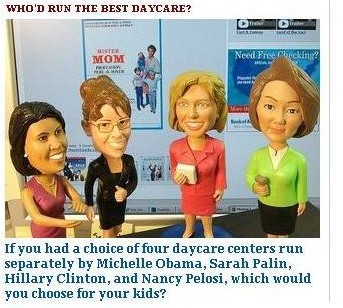
Hilzoy was responding to the image you see here, which is currently on the front page of US News and World Report’s “Washington Whispers.” She wrote:

But let’s take this a bit further. Here are some other polls I do not expect to see on the Washington Whispers page:

If you needed some yard work done, would you hire Mel Martinez, Henry Cisneros, Xavier Becerra, or Bill Richardson?

If you needed a rap DJ for a party, would you hire Barack Obama, Charlie Rangel, John Lewis, or Michael Steele?

If you needed an interior decorator, would you choose Jim McGreevey, Barney Frank, Larry Craig, or the disinterred corpse of Harvey Milk?

It’s not just that the people who make up polls for the Washington Whispers page would not expect John McCain to run a daycare center. It’s that they would probably recognize any of these other appeals to stereotypes as offensive. And yet, oddly enough, asking which one of four prominent women we’d like to have running our children’s day care center is A-OK.

Oddly enough, I had exactly the same idea for a response to this “poll,” and described it to a couple of friends. I think making this sort of comparison (what I think of as the “replace _____ with the word black school of criticism”) is the first thought of a lot of white people. I don’t know if making that sort of comparison occurred to Renee (who is a woman of color), but if it did, she didn’t make it the subject of her critique. I don’t think that’s a coincidence. (Renee’s critique, which is focused on analyzing the sexism in the “poll,” is excellent.)

It’s true, as Hilzoy said, that the US News editors would not likely allow her alternative poll ideas to be posted. And if they did, there might be a sizable outcry, like the outcry over Sean Delonas’ infamous dead monkey cartoon.

But the problem with Hilzoy’s post is that many of her readers (who are, I’d bet, mostly white and straight) might come away thinking that this “poll” demonstrates that racism and homophobia aren’t acceptable in the media anymore, but sexism is.

I assume (hope) that isn’t what Hilzoy intended to say. But even if that wasn’t her intent, as writers, we have to be aware not just of what we mean to say, but of how our posts are likely to be received by our audience. And the reading I described is frequent among white feminists; we saw a lot of this during the past election.

I don’t think many black, latin@, and/or queer activists would agree that bigotry against them isn’t as bad in the mainstream media. It’s bad in different ways, and rating them better or worse would be a terrible waste of time. It’s true, as Hilzoy says, that US News probably wouldn’t ask “If you needed some yard work done, would you hire Mel Martinez, Henry Cisneros, Xavier Becerra, or Bill Richardson?”; but an anti-immigrant bashfest by Lou Dobbs in their “serious” op-ed section would be completely unremarkable.

That may be all Hilzoy was attempting to say — but it’s not what she wrote. And I suspect it’s not the message that her readers (who are — like my readers — probably mostly white and straight) took away. This is an area where it’s better not to make the comparison at all — but if bloggers do make it, then we should at least forclose some of the more regressive interpretations such comparisons encourage.

(Tomorrow, I’ll post more about the general practice of “replace _____ with the word black” critiques, and why I think they’re a bad idea.)

Posted in Feminism, sexism, etc, Lesbian, Gay, Bi, Trans and Queer issues, Race, racism and related issues | 9 Comments

My workplace is hiring for a part-time position.

The historic site I work for is hiring for a part-time position. We’re looking for someone who is comfortable with computers (the job includes working with html, Photoshop, Word, Access, and Quickbooks), can do office work without supervision, and is also able to deal with the public (including directing wedding rehearsals). Being very calm and friendly with the public — even when the public isn’t terribly calm and friendly with you — is necessary.

The job is about 10-15 hours a week, and is located in Portland, Oregon. More details can be found here.

Posted in Whatever | 7 Comments

What Hilzoy Said

This has been another edition of What Hilzoy Said.

(What ____ Said concept shamelessly stolen from Duncan Black.)

Posted in Feminism, sexism, etc | 3 Comments

Misogyny Illustrated

I’m not even sure what to say about this:

Yes, that’s right:U.S. News and World Report is wondering whether you’d choose the First Lady of the United States, the Governor of Alaska, the Secretary of State, or the Speaker of the House of Representatives to run your kids’ day care, because, you know, they’re chicks, and they’re just good for taking care of kids, cleaning, cooking, and sex.

Looks like I picked the wrong day to quit sniffing glue.

Posted in Feminism, sexism, etc | 6 Comments

The London Declaration on Combating Antisemitism

The London Conference on Combatting Antisemitism has released the following declaration (via HP):

Continue reading

Posted in Anti-Semitism | 1 Comment