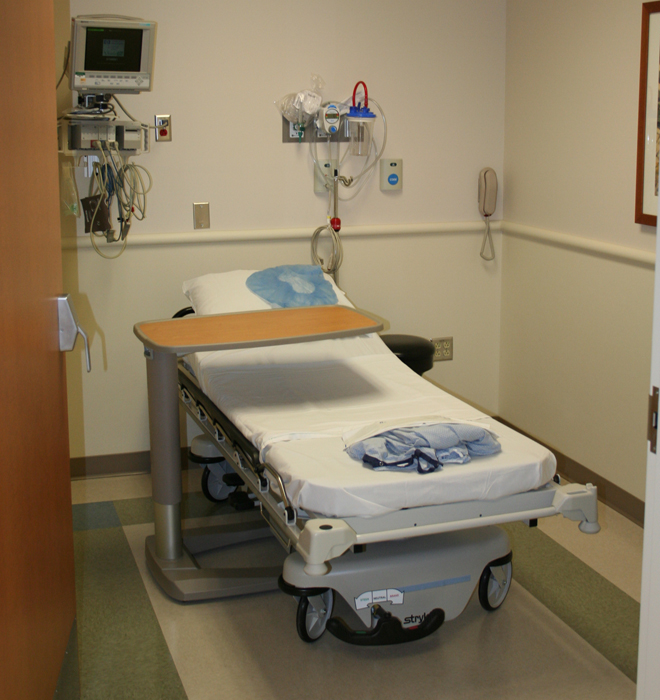
Not too long ago, I went through a series of surgeries involving intercontinental travel to an unfamiliar country, general anaesthesia, significant trauma, and extended recovery time, including the usual post-anaesthesia depression. I was out of work for over a month. At work, I let it be known that the purpose of my absence was surgeries, but I did not specify what they were, or give any other details. A small number of my coworkers have not acted well toward me since the start of my transition, passing misinformation amongst themselves, a process which later bit me in the rear. I did not want to fuel that dynamic.
I am blessed with a tight and supportive family, and with many superbly good friends whom I have accumulated over the years. Most of them reached out with supportive messages. Some rendered assistance with travel and out-of-the-blue expenses.
None of my co-workers contacted me. ((Contact methods available to all of my co-workers included work email, personal email, texting, cell phone, home phone, Google Voice mail which gets transcribed to my e-mail address, and of course, a letter to my home address. This was not a problem of access. In the end, technically, one did contact me, though not one I am close with. He sent me a single text, which I did not receive until I landed again in the US, and 99% of the expense, travel, recovery and general terror were done.))
During my time out of the country, while I was in early convalescence, I corresponded with friends, one of whom was another trans woman, older and wiser than I, who transitioned a couple of decades ago. I mentioned at one point that I felt down that none of my co-workers had contacted me. Her response, paraphrased: “You expected them to? Kids these days. We’re an embarrassment, hon. That’s why we stick together and help each other out. No one else is going to do it. Support from your co-workers? As if.” She told me a story about another woman she met when she, herself, was recovering from similar surgeries, a trans woman who had scrimped and saved and travelled alone to a city she didn’t know to go under the knife of a doctor she had met maybe once before, a woman who planned to recover alone, doling out her pain medications alone, mashing up her food alone so that she could slip it past her healing gums and nourish her healing body, getting up to do her clot-preventing walks down the hall of her rented single-room apartment alone, working through the post-anaesthesia depression and despair and “what have I done?” alone.
Except that it turned out that she wasn’t alone, because my friend was there, then, and afterward, for months, when the daily e-mails my friend sent were the only communications this woman received from another human being.
It was a familiar story. Almost every trans woman I know who has had significant surgery has a friend she met in the hospital, a friend whom she still touches base with regularly.
What are the ODDS?
Pretty good, actually, that you’re going to form bonds like that when you find that there there is one other person who understands, who knows, and you find that there are no other bonds, when you discover that no one in your life can find it in themselves to send you an e-mail to say that they hope you’re okay.
I’m more fortunate than most. I have my entire family, and all of my close friends. So I didn’t need a hospital friend like that, which turned out to be a good thing, since I ended up not sharing a recovery room with anyone.
Sometimes I wonder: what about the people like me who didn’t meet anyone in the hospital, but who, unlike me, had no one else? We don’t hear about them. Partly, obviously, because they don’t have a friend to tell the story about how they met in the surgery suite. But I suspect that a lot of them die in the post-anaesthesia depression, which can rear up and bite you weeks after the actual surgery, long after you’ve flown home and the surgeon is busy with other patients and chalks you up as a success. Some probably kill themselves deliberately, having made it that far but having hit their limit. Some probably just… fade. It would be easy. Just get home, collapse behind your front door, and … don’t follow the post-surgical instructions well.
My friend is right. We are an embarrassment. People don’t know what to do with us, even sometimes people who would seem to be close to us, and so rather than risk the wrong thing, they do nothing. At the same time, she’s wrong. Times are changing. People still screw up a lot toward trans people, but there has never been a better time in modern Western society to be trans; the general population is learning. And, theoretically, police organizations are supposed to be tight and self-supportive, a result which flows from the simple fact that we get critiqued, constantly, from all sides, and so we look to each other for understanding. In theory, this is particularly true of tactical teams, which tend to be very tight.
And, despite my professional calling, I’m an optimist. I want to be able to say, “Yes, people did the right thing. On their own.”
But, of course, in order to be able to say that truthfully, you have to make room for it to be true, which means that you also have to give people the opportunity to demonstrate that it’s false.
For my tiny corner of the world, my optimism turned out to be misplaced. My friend was right. Even though my transition in police work was wildly successful when measured against most previous such transitions… it turns out that I’m an embarrassment. ((With that one belated exception.))
I have another friend, a teenager (call her Teena). We met her when her mother read about my transition in social media and reached out, saying, “Can I talk to you? My kid is trans, and I need information and advice.” Teena is already socially transitioned and needs to access medical care, but her family is overextended handling other, unrelated, emergencies. I offered to help Teena get access to the puberty-blockers she so badly needs, and the therapy which is probably useful in itself and definitely required to access cross-hormone therapy eventually. Her mother accepted. I met with Teena to find out exactly what she wanted to do. She told me. I digested, and then suggested a plan of action. She agreed to it. At the end, she hugged me and said, “Thank you.”
“You bet, hon,” I said. “We have to watch out for each other. No one else is going to. We’re an embarrassment.”
She smiled, safe in a moment of support. Sixteen years old with her body going wrong on her and inexpensive treatment extant which she had not been able to access. There was not a trace of surprise on her face. “Yeah,” she said. “We are.”
Grace
[edited to correct a generalization]




Am I the only one who read "Beware the narcoterrorists" and thought "beware the jabberwock"?