Sa’di’s Most Famous Lines Hang on the Wall of the United Nations

I am a few days late with this post because we had some renovation issues to deal with in my house last week and they left me no time at all to write. The extra time, however, did help me understand better what I want to say about this week’s Sa’di Says, which contains Sa’di’s most famous lines. Here is my translation:

All men and women are to each other
the limbs of a single body, each of us drawn
from life’s shimmering essence, God’s perfect pearl;
and when this life we share wounds one of us,
all share the hurt as if it were our own.
You, who will not feel another’s pain,
you forfeit the right to be called human.

These lines are woven into a Persian carpet created by Mohammed Seirafian, which the government of Iran gave to the United Nations as a gift. There’s a picture of it at the top if this post. Unfortunately, I have not been able to find a larger image that I could use to show you where on the carpet the verses are. The carpet originally hung in the main hall in the UN building, but, according to the UN Visitor’s Center Facebook page, renovations have made it necessary to hang the carpet in the entrance of the temporary building on the North Lawn. In 2009, President Obama quoted an older translation of these lines in the first off his Noruz messages to the people of Iran:

You can read some other, more contemporary translations of these lines here–mine is among them–and listen to a lovely musical setting of the original Persian here.

While it would be an exaggeration to say that Sa’di’s reputation rests on the strength of these lines alone, it would not be inaccurate to say that the sentiment they contain, which is found throughout his work, is why people all over the world have been celebrating his work for centuries. Indeed, who would disagree that we are all–or at least that we ought to see each other as all–part of the same body, possessing the same innate humanity, and therefore worthy of the same compassion. Given the ways in which the US and Iran have been dehumanizing each other since the Islamic Revolution of 1979-80, you can understand why President Obama chose to use these lines in the first conciliatory message a sitting United States president had sent to the people and government of Iran in thirty years. Had President Obama placed these lines in their original context, however, while his message might still have been appropriate, it would have appeared far less conciliatory. In his Golestan, Sa’di places these in the context of the following narrative:

An Arab king notorious for his cruelty came on pilgrimage to the cathedral mosque of Damascus, where I was immersed in prayer at John the Baptist’s tomb. The king prayed nearby, clearly seeking God’s assistance in a matter of some urgency:

The dervish, poor, owning nothing, the man
whose money buys him anything he wants,
here, on this floor, enslaved, we are equals.
Nonetheless, the man who has the most
comes before You bearing the greater need.

When his prayer was finished, the monarch turned to me, “I know that God favors you dervishes because you are passionate in your worship and honest in the way you live your lives. I fear a powerful enemy, but if you add your prayers to mine, I am sure that God will protect me for your sake.”

“Have mercy on the weak among your own people,” I replied, “and no one will be able to defeat you.”

Sa’di, in other words, did not write the lines President Obama quoted as a gentle admonition to all people to remember the humanity that connects us all. Rather, he put them in the mouth of a fictionalized version of himself speaking truth to a tyrant trying to use religion to escape the consequences of his own tyranny. The next two stanzas make that truth more explicit:

To break each finger on a poor man’s hands
just because you have the strength offends God.
Show compassion to those who fall before you
and others will extend their hands when you fall down.

The man who plants bad seed hallucinates
if he expects sweet fruit at harvest time.
Take the cotton from your ears! Give
your people justice, or justice will find you.

It’s almost too easy to make a list of people in power here in the US and around the world to whom these lines could apply. What is not so easy is to be responsible and accountable for what those lines mean, not just because it can be dangerous to speak truth to power, but–and this is why the real power of Sa’di’s most famous lines only becomes evident when they are read in context–because it means a commitment to human equality based not on some abstract, intellectual argument, but on the fact that we each have a body that is more or less the same body and that any politics not rooted in this shared physical reality represents, by definition, both a failure of imagination and a failed humanity:

All men and women are to each other
the limbs of a single body, each of us drawn
from life’s shimmering essence, God’s perfect pearl;
and when this life we share wounds one of us,
all share the hurt as if it were our own.
You, who will not feel another’s pain,
you forfeit the right to be called human.
Posted in Iran, Writing | 9 Comments

Robin Williams, 1951-2014

robin-williams

Oscar-winning actor and comic Robin Williams died Monday at 63 of an apparent suicide, the Marin County Sheriff’s Office confirmed.

Posted in In the news | 10 Comments

There’s More To Being A Feminist Than Favoring Equality

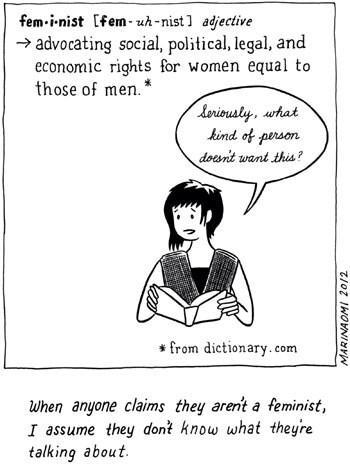
Cartoonist MariNaomi, who I’ve been anthologized with, makes an argument that’s popular among feminists.

MariNaomi-feminist-cartoon

I think we should stop making this argument, because it’s kind of a cheap shot, and it’s not really true. Scott Alexander, in his pre-Star-Slate-Codex blog, makes a persuasive argument:

Here, let me draw a handy table.

Obviously Reasonable Feminist Beliefs
– Women are not doormats.
– Women should not be forced to stand around in the kitchen barefoot and pregnant.
– Women deserve equal civil rights including the right to vote.
– Rape is bad, the victims must be helped, and the perpetrators must be punished.
– Domestic violence is bad, the victims must be helped, and the perpetrators must be punished.
– Women should have equal opportunities and earn equal pay for equal work.
– Etc.

Feminist Beliefs Currently Controversial In Our Society
– Abortion rights are important and need stronger protection.
– Current pay gaps are mostly the result of discrimination and should be met with government action.
– Women need better access to contraception, possibly with government support.
– There are no significant biological differences between male and female brains.
– Gender roles are not biologically determined.
– Incidents that look like male oppression of women should be punished more severely, and we should be less willing to accept male excuses that it was innocently-intentioned or misinterpreted.
– Etc.

Obviously Unreasonable Feminist Beliefs
– Men are all without exception horrible people.
– Women are biologically superior to men.
– Men can absolutely never be the victims in cases of intersex conflict.
– Everything men do is about rape or phalluses or the patriarchy.
– It is acceptable to use violence to pursue feminist ideals

Some people might classify one statement or another under a different heading, but my point is less that everyone must agree with my definition of “obviously” than that some feminist beliefs are much more socially palatable than others.

Which of these three groups most genuinely represents real feminism? Although the correct answer is that the question is meaningless, the practical answer is that the Feminist Beliefs Currently Controversial In Our Society group is what most discussions of feminism are actually about. There aren’t many people arguing for the Obviously Unreasonable Beliefs, there aren’t enough people arguing against the Obviously Reasonable Beliefs, at least not out loud where people can hear them, so most arguments between the people who identify as feminist and the people who don’t are about the Controversial Beliefs – and those are also where feminists are putting the most effort into changing our society. […]

In other words, opponents of feminism use straw men to make feminism look wrong beyond any possibility of controversy. Proponents of feminism use straw men to make feminists look right beyond any possibility of controversy. But they’re both straw-manning the other side and in reality feminism is controversial.

I don’t agree with all the details of Scott’s chart (in particular, “Incidents that look like male oppression of women should be punished more severely” seems like an odd argument that I’m not sure many actual feminists make), but his general argument seems correct to me. If feminism stood for nothing but the abstract principle of equality, then feminism wouldn’t be very controversial, at least in the U.S.. But as Richard pointed out in comments, the policy stances implied by equality, in the feminist view, are a lot more controversial.

Posted in Feminism, sexism, etc | 36 Comments

This is (Potentially) a VERY Big Deal: Hamas drops call for destruction of Israel from manifesto

ETA: When I first read the Guardian article, I carelessly did not look at the date, which is January 12, 2006, and so this is not so much a big deal now. Nonetheless, it is significant that Hamas has taken this position. I will write more about that in the post I am working on, which I mention at the bottom of this post.

From The Guardian:

Hamas has dropped its call for the destruction of Israel from its manifesto for the Palestinian parliamentary election in a fortnight, a move that brings the group closer to the mainstream Palestinian position of building a state within the boundaries of the occupied territories.

The Islamist faction, responsible for a long campaign of suicide bombings and other attacks on Israelis, still calls for the maintenance of the armed struggle against occupation. But it steps back from Hamas’s 1988 charter demanding Israel’s eradication and the establishment of a Palestinian state in its place.

The manifesto makes no mention of the destruction of the Jewish state and instead takes a more ambiguous position by saying that Hamas had decided to compete in the elections because it would contribute to “the establishment of an independent state whose capital is Jerusalem”.

Here’s the hedging and the nuance, but I don’t think this changes the fact that this shift on Hamas’ part is still a very big deal:

Gazi Hamad, a Hamas candidate in the Gaza Strip, yesterday said the manifesto reflected the group’s position of accepting an interim state based on 1967 borders but leaving a final decision on whether to recognise Israel to future generations.

“Hamas is talking about the end of the occupation as the basis for a state, but at the same time Hamas is still not ready to recognise the right of Israel to exist,” he said. “We cannot give up the right of the armed struggle because our territory is occupied in the West Bank and East Jerusalem. That is the territory we are fighting to liberate.”

But Mr Hamad said the armed resistance was no longer Hamas’s primary strategy. “The policy is to maintain the armed struggle but it is not our first priority. We know that first of all we have to put more effort into resolving the internal problems, dealing with corruption, blackmail, chaos. This is our priority because if we change the situation for the Palestinians it will make our cause stronger.

“Hamas is looking to establish a new political strategy in which all Palestinian groups will participate, not just dominated by Fatah. We will discuss the negotiation strategy, how can we run the conflict with Israel but by different means.”

I have been working on a longish post about the current Israeli invasion of Gaza, but now I need to go back and rewrite some, and I am glad for that.

Posted in International issues, Palestine & Israel | 4 Comments

This copyright dispute is funny because monkey

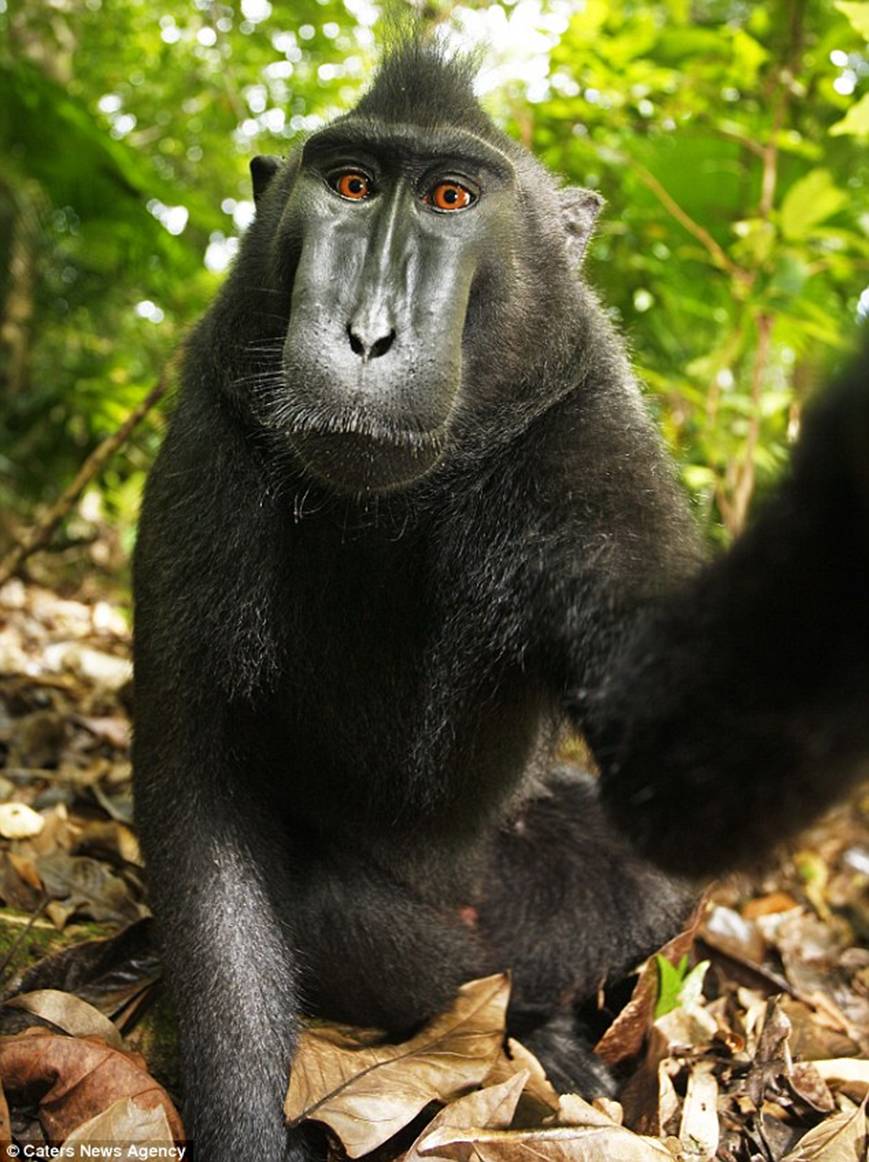
macaque-selfie

Andrew Charlesworth at The Conversation nutshells:

Whilst visiting a national park in North Sulawesi wildlife photographer David Slater had his camera stolen – not by a thief, but by an inquisitive crested black macaque. The resulting selfies are causing controversy and raising questions about the ownership of images on the web. So just who does own the copyright when a monkey gets trigger-happy on your device?

Slater was photographing the endangered monkeys when he left his camera unattended. One of the monkeys began playing with the camera and, fascinated by its reflection and the noise produced when it accidentally took a photo, it snapped hundreds of images of itself. Most were blurred and out of focus, but several of the photos produced unique up-close and personal self-portraits of the rare creature.

But Slater now finds himself in a dispute with Wikimedia, the organisation behind the Wikipedia online encyclopedia. Wikimedia has made the images available online in its collection of royalty-free images without Slater’s permission. It argues that Slater does not own the copyright to the images as he did not take the photos.

Although initial news reports made the photos sound like a lucky accident, Slater now says he deliberately created the circumstances for the macaques to snap the photos.

In either case, if we must have copyright law – and I’m not sure we must, but that’s a separate discussion – then it seems clear to me that Slater should own the copyright to these photos.

Even if the macaque taking the pictures was pure luck, in order for that lucky accident to happen Slater had to 1) spend years honing his craft as a nature photographer 2) travel to North Sulawesi 3) spend days traveling with the troop of macaques, making them comfortable both with him and his equipment 4) realize that photos taken by a macaque were of interest and 5) spend the time going through hundreds of macaque-taken photos to find the few that were in focus. ((I’ve seen several news accounts state the photos weren’t “edited” by Slater; I’d argue that going through hundreds of photos to find the best few is a form of editing.)) That David Slater wound up with these photos may have been lucky, but it wasn’t pure chance; Slater put an enormous effort and skill into being in the right time and place to be able to get lucky.

Charlesworth makes an interesting analogy to machine-created artwork:

Another possibility would be to look to the section on computer-generated works in the CDPA. This tells us that if a literary, dramatic, musical or artistic work is generated by a computer, the author is the person who makes the arrangements that are necessary for the work to be created. That might be the computer programmer, for example.

While the act says nothing about animal-generated works, it seems a plausible argument that the owner of the camera, who took his camera into the wild, allowed an animal to handle that camera, recovered the camera and downloaded the pictures, should legitimately be able to claim a copyright, rather than an entity which is unaware that it is exercising any creative function. In other words, animal-generated photography should be treated no differently to machine-generated photography.

As Charlesworth points out, this is a case where the original purpose of copyright law – encouraging artists to create and distribute new work – applies. Because it takes so much effort (and expense) to get macaques to take photographs, it’s important that photographers feel they can profit, so that more of them will go through the trouble and we’ll all be rewarded with more macaque selfies to look at.

For a disagreeing view, see Techdirt.

UPDATE, 8/24/2014: The U.S. copyright office says that a photo taken by a monkey cannot be copyrighted.

Posted in Free speech, censorship, copyright law, etc. | 3 Comments

I’ve Lived Until The End of My Desires

I’ve heard more than a few jokes about men who, after finding the proverbial genie in a bottle, manage to screw up their three wishes. The one that comes to me now involves a man who walks into a bar with another man, who is about twelve inches tall, sitting on his shoulder. Without a word, the first man takes out of a case he is carrying a small piano and a stool that he places on the bar. The foot-high man climbs down from the other one’s shoulder, also without a word, sits down at the piano, and begins to play the most beautiful music that anyone in the place has ever heard. Inevitably someone asks the regular-sized where he found this musical treasure, and he explains that he was walking alone on a beach in the Mediterranean when found a bottle with a genie inside. The genie granted him three wishes. I don’t remember what the first two were, but the last one, the man explains, produced the piano player. Someone asks him why he wished for a twelve-inch tall piano player and he says, “Well, it was just my luck that the genie was hard of hearing. He thought I asked for a twelve-inch pianist.” Ba dum dum.

There’s another one, though I only remember the punchline, where the guy gets turned into a tampon because he doesn’t recognize the ambiguity in how he phrases his desire for heterosexual prowess, and there are at least two more hiding somewhere in the back of my brain, absolutely refusing to let me tease them out, so I’m not sure if they also poke fun at the absurdities of conventional male heterosexual desire or if they just poke fun at greed. I am, however, reasonably certain that their humor lies, just like the two examples I gave above, in marking the difference between asking for what you think will make your life easier or better or more immediately profitable and having the courage and honesty to ask for what you really want.

The thing is, of course, that it’s sometimes hard to tell the difference. A man with a small penis who has endured the teasing and humiliation that will inevitably fall on him in this society may truly believe he needs those twelve inches, if only to silence his tormentors, both past and future. More to the point, though, his desire to silence them, if he allows it to consume him, would very likely blind him to the fact that a large penis would still not guarantee him love or happiness or even good and frequent sex.

I am, though for reasons that have nothing to with sex, confronted with this distinction between what I think I need and what I really want right now. Like almost everyone else I know, I could use more money, not because I want more luxury in my life, but mostly because I have debt that I need to repay. It’s honest debt, in the sense that my wife and I incurred it to pay for things we could not afford at the time but that we could not put off doing any longer; but it is debt nonetheless, and it is heavy, and I spend more time and energy than I would like thinking about what we need to do to get ourselves out from under it as quickly as possible. Inevitably, this thinking leads to fantasies of all the ways that enough money to pay off the debt might fall, or that I might facilitate its fall, into my lap. These are not paralyzing fantasies, by which I mean they do not prevent me from doing what I need to do to pay the debt off responsibly, but I am conscious of how frequently they grow beyond the goal of balancing our budget to become stories about how “if only we had enough money, all our problems would be solved.”

Continue reading

Posted in Iran, Writing | 11 Comments

Rob Hayes Is In Jail, And Would Like To Hear From People

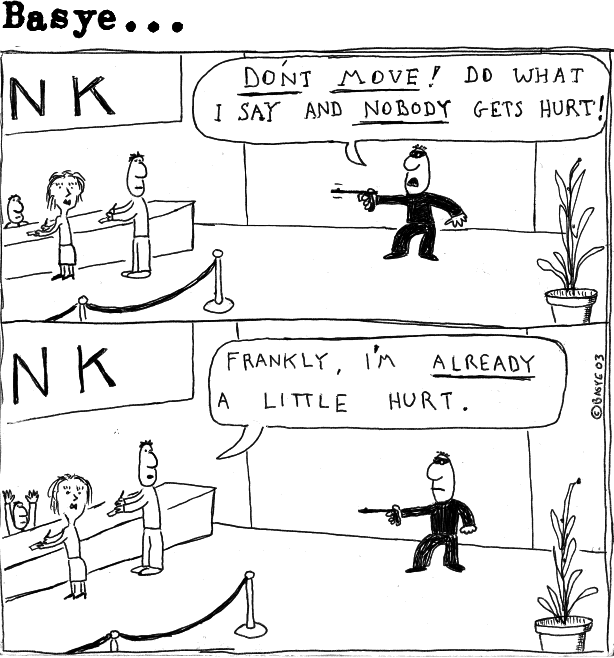
bank_robbery

(Honestly, I would rather have illustrated this post with this cartoon. But it looks like that cartoonist hates having his cartoons reproduced, so…)

Several “Alas” folks have asked me if my old college friend and frequent “Alas” comment-writer Rob Hayes is all right.

I’m sorry to say, Rob’s in bad shape. He’s had ongoing problems with money (or, more precisely, with lack of money) and with drug addiction, and in May was arrested for bank robbery.

Yes, you read that correctly. It took me a while to believe it, too. (Insert joke about the free market not being that free here.) It’s worth noting, if you missed it when you read that article, that this wasn’t armed robbery; no weapon was involved.

Rob will be in the system for a while – if all goes well for him, I’m told he could be out in a year – and I hope will get the help he needs. Meanwhile, I’ve been in touch with a friend of Rob’s, and she thinks it would help Rob a lot if people would write him. I know that Rob is fond of the “Alas” community, and I’m sure he’d enjoy hearing from us.

So please use the comments here to post well-wishes or comments to Rob, or even to find some old comment of his you disagree with and give him a counter-argument (If I were Rob, I’d love a good argument.) Short comments are welcome, too. I will print out the comments and mail them to Rob, and I’ll also post any responses I receive from Rob.

Please keep in mind that the usual civility rules of “Alas” remain in effect!

Posted in Bob Behind Bars, Prisons and Justice and Police | 20 Comments

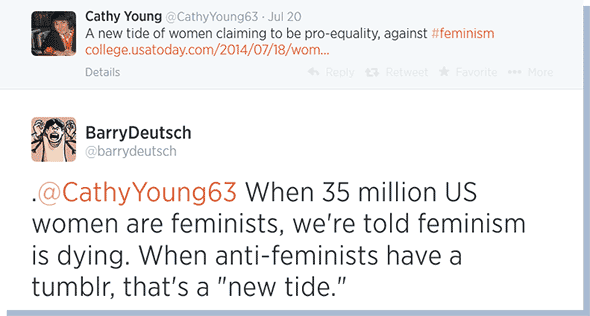
One In Four Americans Is A Lot Of Feminists

cathy-young-new-tide

According to a new Economist/Yougov poll, “Just one in four Americans – and one in three women – call themselves feminists today.” I have no idea how reliable the methodology is, but I’m intrigued by the use of the word “just” in their report – as if “one in four” is a small number. ((YouGov asked a follow-up question, defining “feminist” as “someone who believes in the social, political and economic equality of the sexes,” and then asks people if they self-identify as a feminist. Unsurprisingly, asking the question this way leads to much larger numbers identifying as feminist. I’m not convinced that’s a meaningful result, so I haven’t focused on those numbers in this post.))

Andrew Sullivan seems to agree, linking to the survey while saying “not many Americans” are feminists. And whenever a survey like this comes out, anti-feminists rush to gloat.

Which makes me wonder: Since when is a quarter of the country “not many Americans”?

To put that number in perspective, The Big Bang Theory, the most popular TV show in America, is watched by 23 million Americans, or 7%. The World Cup Final was watched by 26.5 million Americans – a little over 8%.

If this poll is accurate, about 60 million Americans self-identify as feminists. ((60 million excludes the 23% of Americans who are under age 18, since the YouGov poll was of Americans age 18 and up. 25% of all Americans, including those under 18, would be about 78 million.)) With all respect to Andrew Sullivan, I’d call that a lot of Americans.

* * *

Interestingly, according to the Economist/Yougov poll (see page 35 of this pdf file), 41% of Americans age 18-29 consider themselves feminists. I doubt that’s a result my friend Cathy Young will be reporting anytime soon. (Update: Cathy says she’ll cover it.)

So what about other polls?

Another YouGov poll (pdf link), conducted in 2013, found that 20% of Americans – about 48 million – call themselves feminists. This poll is interesting because it asked respondents to choose between feminist, anti-feminist, and neutral.

feminist-or-anti-poll

Notice that in this poll, young people weren’t more likely to identify as feminists.

A 2005 CBS poll found that 24% of US women identify as feminist.

Various Gallop polls from 1991 to 2001 found that between 25% and 33% of Americans self-identify as feminist.

Finally, a Ms Magazine poll of voters found that a little over half of female voters identify as feminist. (Note that this is a poll of voters, not of Americans in general.)

* * *

Although it’s comforting to think of there being 60 million feminists in the US alone, it’s a mistake to focus too much on these numbers. Feminism’s victories aren’t in how many Americans call themselves feminist; they’re in the ways feminism has changed America.

Posted in Feminism, sexism, etc | 51 Comments

The Viper Strikes, and Lives

I have been fascinated by metaphor since I was an undergraduate linguistics major, when one of my professors assigned parts of Metaphors We Live By, by George Lakoff and Mark Johnson. In that book, Lakoff and Johnson argue that, as human beings, we use metaphor to give structure to the world around us. They point out, for example, that we describe the process of having or making an argument the same way we describe war. As examples, they offer this list of expressions:

  1. Your claims are indefensible.
  2. He attacked every weak point in my argument.
  3. His criticisms are right on target.
  4. I demolished his argument.

Lakoff and Johnson don’t stop there, though. They go on to show that we don’t just talk about argument as if it were war; we actually experience it that way as well. Like wars, for example, arguments are won or lost; and the people on either side of an argument behave in some ways as if they are doing battle with each other, taking different lines of attack, or surrendering some points in the hopes of gaining others that will lead to victory. To illustrate by way of contrast, Lakoff and Johnson ask us to

imagine a culture where argument is viewed as a dance, the participants are seen as performers, and the goal is to perform in a balanced and aesthetically pleasing way. In such a culture, people would view arguments differently, carry them out differently, and talk about them differently. But we would probably not view them as arguing at all: they would simply be doing something different. (5)

Other examples abound. One of my favorite classroom exercises is to ask my students to list all the slang expressions they know for for getting drunk and/or high (the latter, of course, being a metaphor in itself). Here are some of the more common ones they come up with:

  • wasted
  • bombed
  • annihilated
  • blasted
  • blitzed
  • polluted
  • shitfaced
  • embalmed
  • hammered
  • pickled
  • plastered
  • smashed

Inevitably, my students are surprised not just at how violent the list is, but at the way these expressions portray getting drunk or high as violence one does to oneself–a way of structuring what it means to alter one’s consciousness that is very different from cultures that use such substances in religious or other spiritual rituals.

The story from Golestan that I have chosen for this week’s Sa’di Says is about the structure of power in a monarchy, and I think the metaphors that Sa’di uses in telling this story are fascinating. Before you read it, you need to know that Hormuz was the son of King Nushirvan, whose name is synonymous with what it means to be a wise and just ruler. Hormuz, on the other hand, was cruel and tyrannical. Here is the story:

When he was asked what crime his father’s viziers had committed, Hormuz replied, “None. I put these men in jail because they feared my power without respecting it. I knew that to protect themselves from the capriciousness they saw in me and the harm they thought might come to them because of it, they might try to kill me. So I had no choice. I took the advice of the sages, who said:

The power to wipe out a hundred men
should not replace your fear of one who fears you.
Watch when a cat is fighting for its life;
it plucks the tiger’s eyes out with its claws.
To stop the stone the shepherd might throw down
to crush its head, the viper strikes, and lives.

Hormuz is unapologetic in his explanation, but you have to wonder just how aware he is of how much his metaphors reveal about him. Look closely at the metaphor in those last two lines. By having the king compare himself to a viper, while at the same time comparing his father’s viziers to a shepherd, Sa’di uses Hormuz’ self-justification to reveal not just the fear and weakness at the heart of any tyrannical rule, but also something about the nature of power itself. The shepherd’s authority to kill the viper comes from his role as protector of the flock, though he can choose not to use that power if he doesn’t have to. (Hence, “the stone the shepherd might throw down.”) The viper, on the other hand–and I am following here the logic of the metaphor, not commenting on the behavior of actual snakes–because of the poison that defines it and the threat it poses to those around it, cannot afford to wait for the shepherd to make that choice. It must assume that the shepherd has assumed that it will attack and so it has no alternative but to defend itself accordingly.

The viper’s power, in other words, is defined by its fear of the world, its sense that the world is arrayed against it, while the shepherd’s power is defined by the choice that is available to him. Not that the fact of this choice will make the shepherd a good and wise ruler by definition; but it does seem to me that awareness of the choice is a prerequisite for a wise and benevolent rule.

The cool thing about a metaphor is that no single reading will ever capture its entire meaning, and so I know the reading I have presented here is a partial one at best. I’d love to hear what you think.

Cross-posted.

Posted in Iran, Writing | 18 Comments

I Can’t Think of a Better Reason to Write

You never know how people are going to find your work, and you never know how it’s going to touch them or why. Earlier this month, a man contacted me asking for a copy of the uncorrected proof of my Selections from Saadi’s Gulistan, which I make available through my website to anyone who asks for it. All I ask in return is that they tell me a little bit about why they want it and how they intend to use it. I’ve gotten these requests from a wide range of people, including graduate students in Iran who are working on their MA in translation studies to people, a scholar in Russia who was preparing a multilingual anthology of selected works of classical Iranian literature, and several people from India who were studying Sa’di for their own purposes and preferred my translation to the ones that were available in their country.

The most touching request for a copy of this PDF, however, came this month from a man who, as he wrote, “happened upon [My Companion’s Scent Seeped Into Me] while reading The Male Privilege Checklist on Alas! A Blog.” I featured that poem on my blog on June 27th. Here it is again:

I held in my bath a perfumed piece of clay
that came to me from a beloved’s hand.
I asked it, “Are you musk or ambergris?
Like fine wine, your smell intoxicates me.”
“I was,” it said, “a loathsome lump of clay
till someone set me down beside a rose.
Then my companion’s scent seeped into me.
Otherwise, I am only the earth that I am.

That poem, he went on, “is a reflection of what happened to me.

I am a 46 year old male. I have recently been reunited with my ex-wife who I hadn’t spoken with for over twenty years. It has been a wonderful experience of learning and enlightenment thus far. She gave me a book to read by Don Miguel Ruiz called The Four Agreements which has had a profound impact on my life and the way I live it.  It is a book of wisdom. I would like to reciprocate by sharing this with her.

To know that my book has been a part of the experience this man describes–well, I can’t think of a better reason to write.

If you’d like to read this week’s “Sa’di Says,” it’s called “Creation Kills What It Was Made to Love.”

As usual, I’d love to know what you think.

Cross-posted.

Posted in Iran, Writing | 2 Comments