Becky Hawkins and I have posted the first page of our new webcomic “SuperButch!” It’s about a lesbian superhero in the 1940s protecting the bar scene from corrupt cops. We’re really excited about this!
I’m writing, and Becky’s doing art – although we both get in each other’s business a lot. :-) We’ll be posting a new page every Tuesday.
There’s also a complete 16-page prelude story up, “First Glance,” which can be read here.
There’s been a map floating around the internet claiming to show the election outcome if only millennials had voted; but it’s based on October polls, not on actual exit polling. “Alas” moderator and commentator Charles, understandably (if pedantically) ((As a bit of a pendant myself, I relate to this.)) annoyed by this, decided to make a couple of maps based on exit polls, and kindly said I could post them here.
As the husband of a Muslim woman and the father of a son whose name marks him as foreign even though he was born in the United States, I have been reading with care, gratitude, and a welcome sense of solidarity the posts in my Facebook feed about how important it is not to despair now that Trump has been elected president; and I have been thinking about the role I might play in helping to make sure, as much as possible, that all of those targeted by the hatred at the heart of Trump’s campaign nonetheless feel their presence in this country to be welcomed and safe and respected and valued.
I have also been heartened and affirmed by how many of the posts I’ve read make a point of naming the specific groups in need of our support, because each of them is the object of a hatred directed specifically at it, and that hatred needs to be understood and opposed on its own terms. I have, however, also noticed the conspicuous absence of the group to which I belong, the Jews, from most of those lists-of-the-vulnerable. (Here is one example.) We may be the one group (as far as I can tell) that Trump himself did not name specifically, but his alt-right and KKK and neo-Nazi and white supremacist supporters sure as hell named us when they attacked Jewish journalists who criticized Trump; and the classically antisemitic, right-out-of-The-Protocols-of-the-Elders-of-Zion, “global-conspiracy-that’s-bleeding-us-dry” rhetoric that he embraced towards the end of his campaign, in his speeches and perhaps especially in his final campaign video (complete with images of the prominent and wealthy Jews who are doing “the bleeding”), was sure as hell a way of naming us without naming us:
Do I think, therefore, that the rounding up of Jews is imminent? No. Do I think the people who would support and participate in the rounding up of Jews have been inspired, empowered, and legitimized by Trump’s campaign? Absolutely. The image at the top of this post, for example, of antisemitic graffiti written on a storefront in Philadelphia the day after the election, is from the Anti-Defamation League’s Twitter feed:
It’s worth noting that it almost certainly was not lost on the people who put that graffiti on storefronts that they were doing so on the anniversary of Kristallnacht. To put it another way, I think it is to be willfully blind not to see parallels between the dynamics of Trump’s campaign and the dynamics at play at the beginning of Hitler’s Germany, or of any of the other periods in history when the Jews have been targeted as some version of “the global conspiracy.”
Back in July, a woman named Carly Pildis wrote an essay that, if you care about the integrity of what it means to be anti-racist/anti-oppression, you should read. It’s called “I Am Woke: Why I Am Finally Raising My Voice Against Jewish Erasure in the Anti-Racism Movement.” (The link takes you to a recent repost of the article in Tablet.) The following paragraph struck me in particular. It appears after a section in the essay where Pildis quotes examples of some particularly offensive tweets she received for pushing back ever so gently against what she saw as a simplistic #BlackLivesMatters portrayal of the Palestinian Israeli conflict.
I am not asking the anti-racism movement to join AIPAC. I am asking that it apply the same values to Jews as it does other marginalized or oppressed groups. I am asking that the movement put a parenthesis around its twitter handles and stand in solidarity with me and my family. I am saying that if the rule of this community is that those with lived experience should be heard the loudest, then hear the Jews among you. If those who have experienced oppression should never be doubted in their experience, then stop saying I am a not a real minority, or that anti-Semitism isn’t real. If anti-oppression work must be intersectional, then that intersectionality can no longer end when the word Jewish is uttered. If communities that are affected by policy must always be consulted and in the forefront of policy discussions, stop telling Jewish Americans we have no right to be included in your conversations about Israel, or that our views on the physical safety of our families are not welcome to be discussed, struggled with or even acknowledged.
When I started this post, I thought of it as an expression of how vulnerable the antisemitism in Trump’s campaign has made me feel. I did not imagine I would also be writing about how what Pildis called “Jewish erasure” among progressives—a term I had not heard till I read her piece—makes me feel perhaps even more at risk. But it does. I know what to expect, and to expect no better, from the people who spray painted those swastikas. Their actions do not constitute a betrayal. Failing to include the fight against antisemitism in a response to Trump’s presidency, however—especially given its explicit expression during his campaign and, now, after his victory—most certainly does.
So I guess I have come to see this post as a challenge. If you are one of the people or organizations talking about how we need to organize not just against the hatreds Trump’s campaign stood for, but also affirmatively in support of the specific groups that were—and are still being—targeted, have you done, are you willing to do, the work of including antisemitism in your analysis? To paraphrase Pildis, intersectionality is either fully intersectional or it isn’t. If it is, then it must include antisemitism among the oppressions it confronts. If it isn’t, if it doesn’t, then why should I see it as anything other than good-old-fashioned, left-wing antisemitism using the fight against other oppressions as camouflage?
Rhetoric like “ Hillary was a complete non-starter for the working class“ and “given the importance of the blue collar vote“ ignores an important point – which is that not all working-class people who are white. And although I don’t have data to offer (none of the exit polls I’ve seen have broken down data by income and race together), it seems very likely that Trump lost badly among non-white working-class voters. (75% of non-white voters without college degrees voted for Hillary). (Source).
The same exit poll indicates that Clinton won among voters with less than $49,000 a year incomes – and her strongest group was those with incomes less than $30,000 a year. Trump won among all economic groups over $50,000 a year. (Possibly a lot of that is because people of color are more highly concentrated among lower income voters).
US median income is about $52,000, btw; so it’s basically accurate to say that Hillary Clinton won a majority of voters with below-average incomes, while Trump won a majority of voters with above-average incomes.
• White voters, who make up 69% of the total, voted 58% for Trump and 37% for Clinton. Non-white voters, who make up 31% of the electorate, voted 74% for Clinton and 21% for Trump.
• White men opted 63% for Trump and 31% for Clinton; white women voted 53% for Trump and 43% for Clinton.
• Among non-college-educated whites, 67% voted for Trump – 72% of men and 62% of women.
• Among college-educated whites, 45% voted for Clinton – 39% of men and 51% of women (the only white demographic represented in the poll where the former secretary of state came out on top). But 54% of male college graduates voted for Trump, as did 45% of female college graduates.
• More 18- to 29-year-old whites voted for Trump (48%) than Clinton (43%).
I think that “working class” and “blue collar” are in effect code; at least when discussing voters, it’s a word people when they mean “white.” Or if that’s not their intention, it’s certainly the effect.
So I got on a plane in Texas feeling optimistic, checked the news once the plane landed in Portland, and… wow. I go offline for five hours and everything goes south.
I really think I’ve had too much faith in the intelligence and good will of Americans.
I really hope that, just as I was radically wrong about who’d win this election, I’ll turn out to be radically wrong about the consequences of President Trump.
I really hope that the people who voted for Trump had more in mind than sticking their middle fingers to the establishment.
I really hope that RBG makes it another four to eight years.
I really hope things don’t go horribly for everyone who’s not straight, not cis, not white, etc.
I really hope I still have health insurance a year from now.
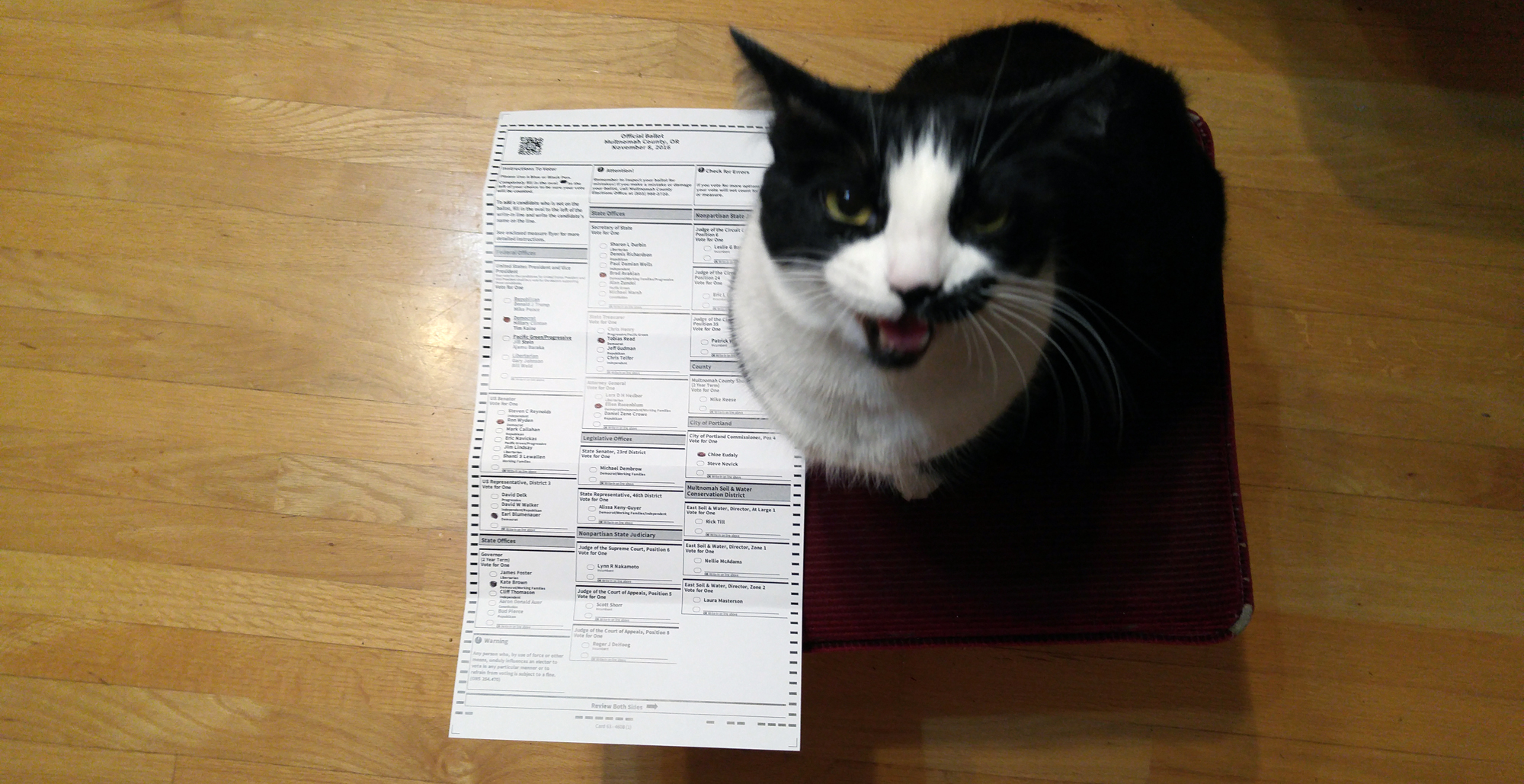
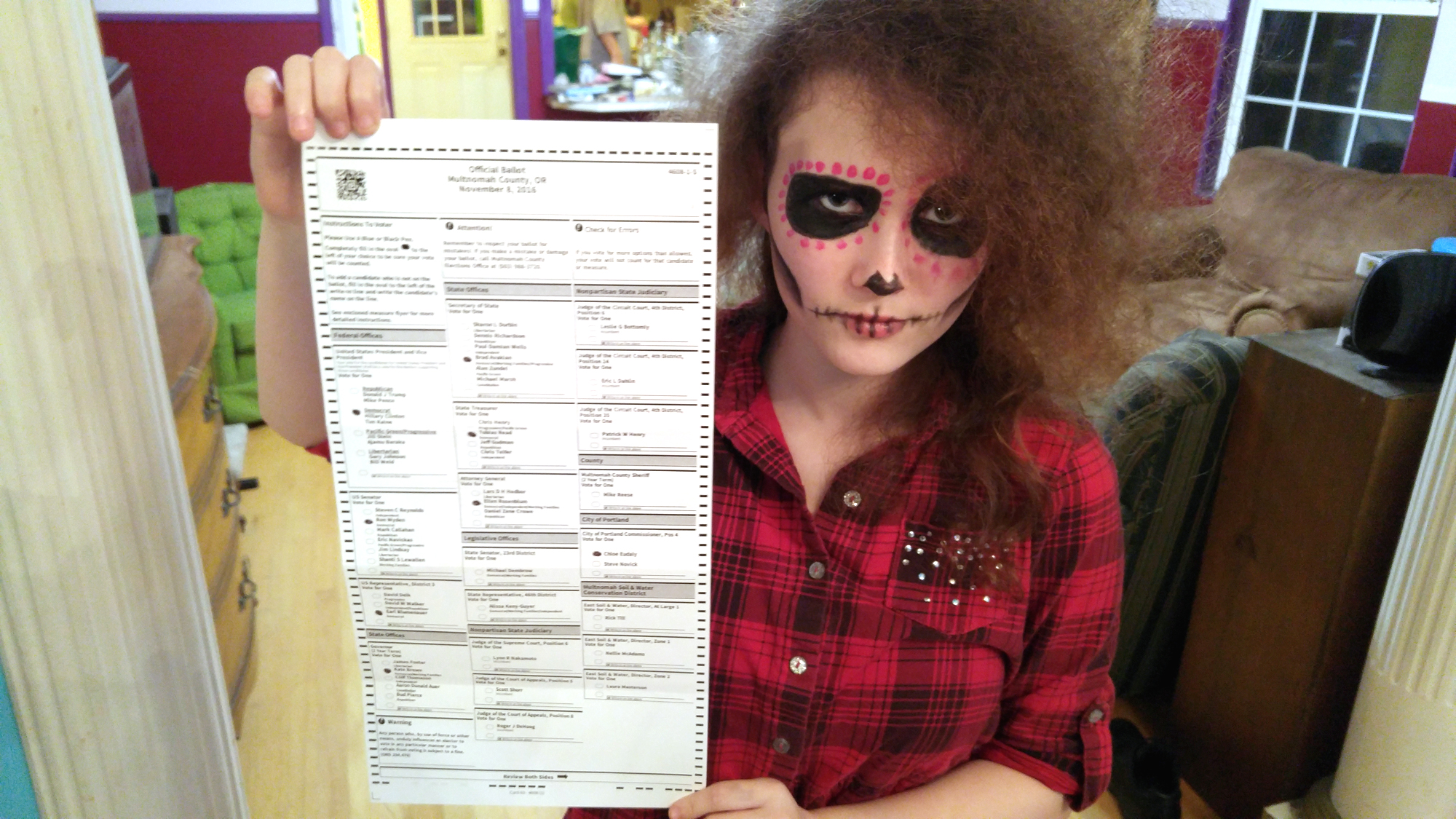
Here’s how I’m voting this year…. this post list my votes for the candidates. I’ll do a follow-up post with the ballot measures. Thanks for Sydney for posing for the photo. (She did her own makeup.) Continue reading →
So gamer “HitmanNiko” modified Grand Theft Auto to add in a new weapon: A Samsung Galaxy Note 7, which can be thrown like a grenade. (It replaces a weapon called “the sticky bomb.”) Some folks uploaded videos of themselves using the new weapon, because hell, it’s funny.
And then Samsung used DMCA notices against these videos, in at least one case successfully.
Something like these videos – which combine parody with commentary on a major current news story – are obviously fair use. But a censorship-loving company like Samsung has no reason not to abuse copyright laws in this way. As EFF notes, there’s a possibility of that changing:
If it doesn’t have a viable copyright claim, why did Samsung send DMCA takedown notices? We asked Samsung’s counsel (the notices were sent on Samsung’s behalf by the 900-lawyer firm Paul Hastings LLP) but received no response. It appears that Samsung took the easy path to removing content it did not like by making a copyright claim where none existed. DMCA takedown notices are, by far, the quickest and easiest way to get speech removed from the Internet. That makes them irresistible for companies, individuals, and even governments eager to censor online speech.
DMCA abuse flourishes because, in practice, companies that send improper notices don’t face sufficiently serious consequences. This issue is currently before the Supreme Court in Lenz v. Universal. In that case, EFF represents Stephanie Lenz who posted a short video to YouTube showing her toddler son dancing to a Prince song. After Universal sent a takedown notice, Lenz sued arguing that the video was clearly fair use and the notice was sent in bad faith. Last year, the Ninth Circuit ruled that copyright holders must consider fair use before sending a takedown notice. Unfortunately, the appeals court also set a very high bar for enforcing that standard. It held that senders of false infringement notices could be excused so long as they subjectively believed that the material was infringing, no matter how unreasonable that belief. Lenz has asked the Supreme Court to review that aspect of the ruling.
In the next week or two, the Supreme Court will decide whether or not it will hear Lenz’s appeal.
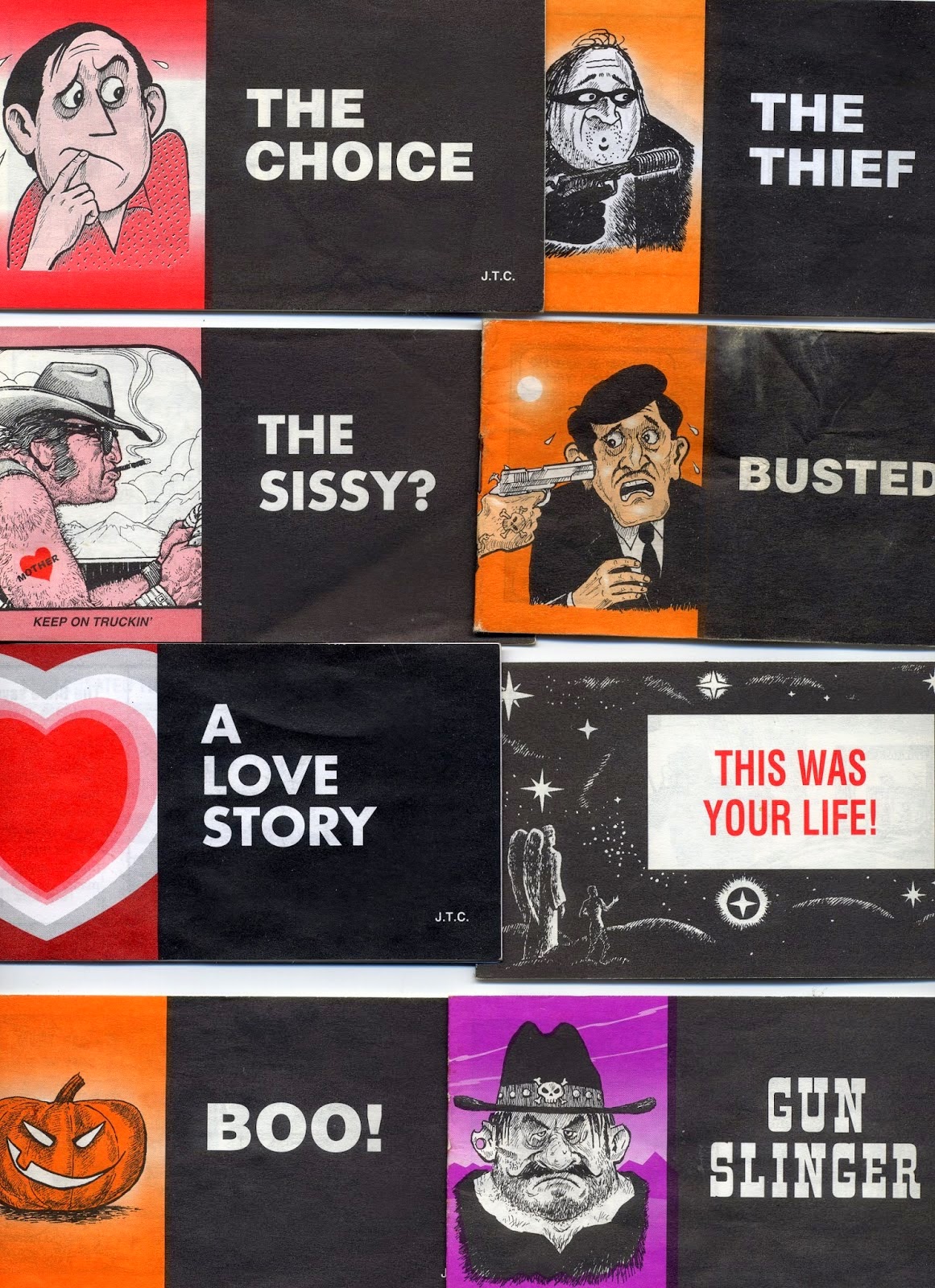
Jack Chick, arguably one of the most widely-read cartoonists in the world, has died.
He was in his nineties. If you’re not familiar with Chick Comics (those tiny little comics fundamentalist preachers give out on street corners), here’s a fairly typical example, giving Jack’s view on rock music. And of course, his comic about Dungeons and Dragons is a classic.
Check out this Marvel-comics-inspired parody of Chick comics: GALACTUS IS COMING!






@beth: Thank you