Kind Words for My Stories

Thank you to the reviewers.

Quicksip reviews writes about “Love Is Never Still:”

It’s mythic in its scope and in its characters but there’s also something deeply human about it (something that can be said about a lot of Greek mythology, I suppose), something that shows how love can lift up and love can shatter. The characters are compelling even as they are presented in breathes, brief touches that become a tapestry of longing and violence and design. The two storylines balance each other quite nicely, showing love as pursued, and women especially as objects that aren’t really considered people, are there to be fought over or prayed for.

John Wiswell writes about “Between Dragons and Their Wrath:”

No short story has haunted me more in the last month than this. The dragons are a metaphysical terror, casting a shadow of mutations across the landscape of two absolutely lovely characters. With scenes whipping by, each has a punch, even in the last line.

Reviewing The Nebula Showcase 2015, Craig Owen Jones writes that “The Nebulas are not about elitism, but about giving a platform to good sci-fi stories.”

As usual, there’s much here of worth. The winner of the Best Short Story category, Rachel Swirsky’s ‘If You Were a Dinosaur, My Love’, is a moving and elegiac tale of lost love. Elegantly expressed and formally perfect, it builds delightfully to its poignant climax.[.]


Posted in Fiction | Tagged | Comments Off on Kind Words for My Stories

Anti-Trump protests and the free speech argument

trump-protester

[This is a post by occasional “Alas” comment-writer Lirael, reprinted with permission from their excellent blog NowFaceNorth. Thanks, Lirael! –Amp]

There’s a lot of interesting arguments going around in the wake of the cancelled Donald Trump rally in Chicago. One of them is that the protesters violated Trump’s First Amendment rights to free speech, or his supporters’ First Amendment rights to free assembly. These arguments are wrong, and I want to take a look at why that goes beyond the refrain of “freedom of speech doesn’t mean freedom from consequences” (which is technically true, but I think it’s a flippant and overused argument).

The really obvious problem is that the First Amendment regulates the behavior of the state. The only First Amendment issues you could raise in this situation involve the actions of law enforcement, regarding their attacks on and arrests of protesters and a reporter outside – I would really, really like some of these defenders of free speech to show more concern about that part of what went down in Chicago – or if you don’t think they were legally justified in clearing the arena. The actions of private citizens have nothing to do with the First Amendment.

What people are somtimes trying to get at when they make this argument is that a society that values freedom of speech enough to protect it from government coercion in the constitution, ought to value it enough to guard against or avoid other kinds of coecive behavior in relation to speech. This is what people mean, I think, when they talk about “a culture of free speech.” And while this argument has gotten a bad rap on much of the left these days because we’re so used to it being taken to ridiculous extremes (“How dare you ban me from your website for racist comments? What about the culture of free speech?”) or to claim that criticism of one’s argument is anti-free-speech, it’s an argument that’s worth reckoning with. To understand why, I strongly, strongly recommend reading Chris Bertram, Corey Robin, and Alex Gourevitch’s essay Let It Bleed: Libertarianism and the Workplace, which takes libertarianism to task for its failure to “come to grips with the systemic denial of freedom in private regimes of power, particularly the workplace.” I don’t think the left in general, or the social-justice-oriented left in particular, should be jumping to fall into the libertarian failure mode, into the idea that state coercion is the only kind of coercion worth caring about or opposing. We should give some thought to free speech as a norm, if you will, and not just free speech as a freedom. This is why I don’t much care for, say, campaigns to get rank-and-file workers fired for saying racist, sexist, or other oppressive crap in their private lives. It’s not a violation of their First Amendment rights, but it’s also not good.

That said, not all kinds of exercises of power around speech are equal (I give some more examples in the next paragraph). State coercion actually is different – you can be arrested, subject to invasive searches of your person, have property confiscated, have to appear in court repeatedly, be forced to pay a lot of money, be incarcerated. You can lose much of your liberty. And the First Amendment regulates that kind of coercion, and I’m pretty fervent about the First Amendment. Once you get beyond that near-absolute, you have to make judgments about what kind of coercion, if any, is happening, and what kinds of effects it’s likely to have. And since none of the parties involved is the state, you have to consider the competing rights of private citizens (e.g. giving a speech is a speech act, and so is petitioning to stop a speaker’s appearance or heckling them), and the competing principles that many of us look to in governing human interaction (the idea that people should be able to express their views is a valuable one – so are anti-racism, feminism, affirming that marginalized people are welcome in your communities, and a lot more, and sometimes those come into conflict with people being able to express whatever views, wherever they want). You have to actually make some kind of evaluation about how far is too far for what principle and how to resolve competing needs. The Constitution won’t help you. And free speech advocates aren’t all going to draw all the lines in the same places – for instance, when it comes to speech and higher education, you have advocates like Angus Johnston (who you should all be reading) and advocates like FIRE, and they draw the lines in sufficiently different places that they’ve had public debates about it. I sometimes change my mind about situations that are sufficiently close to my personal lines, and my personal lines sometimes move a little bit as I think situations over (the anti-Trump protest in Chicago did not cross my personal lines). I don’t think you’re a better civil libertarian for having your lines in a different place than someone else, because civil liberties are about the individual’s relationship to the government.

For an average person who has to make a living, the employer has very strong coercive power, possibly more than any other institution except the state, but this power is much less for, say, executives, who have more power in the workplace, usually more financial resources, and probably more ability to get a new job easily. Because Facebook and Twitter are such huge platforms, they have a lot of power to control what ideas get out there and how (by taking action, or for that matter, by not taking action, such that people get threatened and harassed until they abandon the platform in stress and fear). The book-publishing industry has a lot of power over authors, but will be using that power against a whole lot of speech by definition, because they don’t publish every single author who submits something. The blogger who bans you from their comment section has almost no coercive power. The student who asks for trigger warnings both has little coercive power and is not stifling you in any meaningful way (oh no, you’re being asked to say a couple of extra words – I don’t buy that you can even call that an infringement on either speech OR the related but different norm of academic freedom, unless you think that profs being required to issue course syllabi at many schools is also an infringement). There’s also the issue of what kind of platform someone has – Donald Trump gets news coverage if he sneezes, he has one of the largest platforms in the country, the idea that protesting a rally such that he decides to cancel it is stifling him is laughable.

There are also ways in which the situation of Trump’s rallies is unusual. There’s the thing where Trump has encouraged his supporters to physically attack protesters. Like, earlier that day he had said to his rally in St Louis that that one guy getting sucker-punched is the kind of thing they need to see more of, not to mention his previous comments offering to pay the legal fees of people who hit protesters. He’s creating violent spaces at his rallies, not in the “frame everything as violence” sense that you see in certain kinds of activist discourse, but in the literal, physical, interpersonal violence sense. Even if you think that people should not try to shut down other people’s rallies as a matter of principle, “space where you’re encouraged to beat people up who disagree with you” is not usually what a rally is, and it doesn’t strike me as unreasonable that people would want to shut down such a space in their community, especially when it involves racists having such a space at a majority-people-of-color university.

A last bit of the argument that I want to address is the “Well now right-wingers will disrupt Sanders and Clinton events and then you’ll be sorry” argument. My answer is, maybe they will. Protest/counterprotest situations aren’t exactly uncommon. Primarily as a street medic, I’ve been in protest/counterprotest settings that were nonviolent and quiet, nonviolent and loud, and (on at least part of one side) not nonviolent. The first big protests I ever went to were protest/counterprotest situations around same-sex marriage in Massachusetts, when I was 18. Big loud crowds on both sides, people crossing the street to mess with each other, people milling around mixing, most peaceably if noisily, a few less so. I befriended a gay 13 year-old goth who rather hilariously photobombed some homophobes getting interviewed by TV news, and then got kicked in the leg while crossing the street. Also before I started street medicking, I was at a Planned Parenthood rally where the counterprotesters were mostly peaceful but a few of them were trying to tear down people’s signs, shove them around, and rush the stage. I’ve medicked some nontrivial number of Israel/Palestine protests/counterprotests that have covered the whole range of conditions that I listed above. I’ve seen a couple of white supremacists counter the Ferguson protesters I was medicking for, I’ve medicked LGBTQ and anti-fascist counterprotests of a Tea Party rally featuring vicious homophobe Scott Lively, I’ve medicked a pro-Syrian-refugees-coalition vs militia protest/counterprotest (that ended up being very mellow as the militia people decided to go march elsewhere). It’s just not that novel, oppostion happens when you do politics. Violence and threats, obviously, are different matter, but if right-wingers start loudly-but-nonviolently protesting Clinton or Sanders rallies, I’m sure that everyone can manage and it is not like anyone won’t be able to access Clinton’s or Sanders’ opinion on the issues of the day if they want it.

Posted in Free speech, censorship, copyright law, etc. | 33 Comments

2015 Science Fiction and Fantasy Graphic Novel Recommendations, Part 3: Crossed + One Hundred, and, Stand Still, Stay Silent

Previously, I reviewed The Sculptor and Beautiful Darkness, and then Curveball and Nimona. There’s also a summary post, including my list of notable SFF graphic novels of 2015.
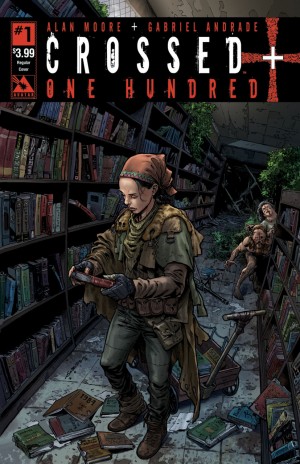

crossed-plus-100-coverCrossed + One Hundred, by Alan Moore and Gabriel Andrade.

Although he has created original works, Alan Moore is the comics medium’s greatest reinterpreter of existing creative properties. The British writer first became famous in the U.S. for his reinvention of DC Comics’ Swamp Thing title, in a run that both completely reinvented the character and incorporated all the character had been before. Other major Moore reinterpretations include Miracleman, The League of Extraordinary Gentlemen (featuring, among other famous characters, Captain Nemo, The Invisible Man, and Jeckyl/Hyde), and Lost Girls (an erotic comic featuring grown-up versions of Alice of Wonderland, Wendy from Peter Pan, and Dorothy of Oz). My favorite Moore book, From Hell, is based on already-existing Jack The Ripper lore. Even Watchmen, Moore’s most famous original work, started out as reinventions of the Charlton superhero characters.

Moore returns to the reinvention game with Crossed + One Hundred, a new graphic novel set in Garth Ennis’ awful Crossed universe. Crossed was Ennis’ attempt to make the zombie genre more disturbing and violent: the premise is that most of humanity population gets infected with a mysterious disease that turns them into torturing, murdering, rape-happy idiots. In many ways Crossed is the comics equivalent of the Saw movies; cheap, gratuitous, and compelling.
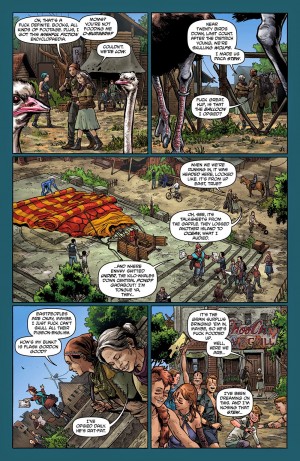
crossed-plus-100-pageMoore and his collaborator Gabriel Andrade get away from all that by leaping a hundred year into the future. A century after civilization ended, the remaining humans have banded into settlements; the “Infected,” being idiots with no instinct for self-preservation, have mostly died out. The protagonist, Future Taylor, has never seen an Infected firsthand; she’s an “archivist” who takes expeditions into the wreckage of the collapsed human civilization, attempting to regain lost knowledge. All the characters speak in a version of English that has evolved in the century since civilization collapsed – but not so far that they can’t be understood. (By the time I was at the end of the first chapter, I could read the odd dialog – “See it is, Planboss Monroe didn’t want infecteds audying in and getting learn on our sweep” – effortlessly). The language is just one of many convincing details of life a hundred years after civilization’s collapse.

Of course, this is a Crossed comic – so I don’t think it’s giving away much to say that violence, and tragedy, lurks in this story. But this is the first Crossed story I’ve read that seems to believe that humans actually have some worth. And although there are depictions of sick violence, including sexual violence, that’s not the focus. The most notable sex scene is an explicit sequence featuring Future and her lover – and, in what might be a first in the Crossed universe, it’s just joyful, ordinary, eagerly consented-to sex.

I haven’t opsied – sorry, seen – Brazilian artist Gabriel Andrade’s work before, but he’s marvelous on this project. His ability to draw fully realized environments, including crowd scenes that must have taken him forever, is essential to making the + One Hundred world feel satisfyingly detailed and fleshed out, whether it’s on a wooden ship, in the lush greenery that’s overgrown human cities, or in the wreckage of Elvis’ Graceland mansion. Andrade draws in a conventional realistic comics style – with more European than American influence, hence the detailed environments – but he does it well, and he concentrates on good storytelling rather than flashiness.

I understand that there is now a sequel to Crossed + One Hundred, by a different creative team (although working with world notes left by Moore). Nonetheless, this book tells a complete story that comes to a satisfying (if downbeat) ending.

From a diversity perspective, most of the characters in this book are white (there are two Black characters, one of whom is a major character), which makes sense, since it’s set in the remains of Tennessee. A couple of characters, including the main character’s lover, are Islamic (a liberalized Islam seems to be the only surviving human religion). I’m honestly not sure if the main character is white or Latina. There are plenty of female characters of various ages in this book, who are shown as being equal participants in society.
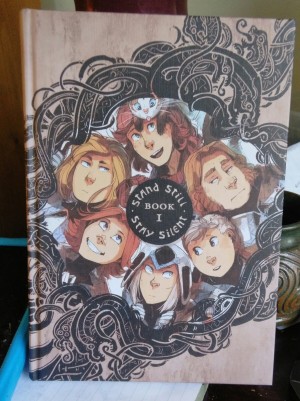

ssss-book-1Stand Still, Stay Silent volume 1, by Minna Sundberg. (Disclosure: I’m still reading this comic.)

This is another post-apocalyptic graphic novel, but it could not be less like Crossed + One Hundred. It begins with a series of vignettes, set in the Nordic countries, showing the rapid collapse of society under the onslaught of a deadly plague. (Although the comic doesn’t show the sickness itself, instead focusing on various people fleeing the sickness.) Ninety years later, Iceland – which closed its borders (sometimes violently) to protect itself from the plague – holds the largest surviving community of humans. There’s magic (including mages, and intelligent cats).

The story involves a crew of explorers – “a poorly funded and terribly unqualified crew, but a crew nonetheless” – who set out from Iceland to explore the remaining world. This is a comic for the worldbuilding fans; for the folks who want to see maps of the known world, and costume designs of Mages from each culture. And despite the underlying tragedy, there’s a laid-back wackiness to this series which is just plain fun.
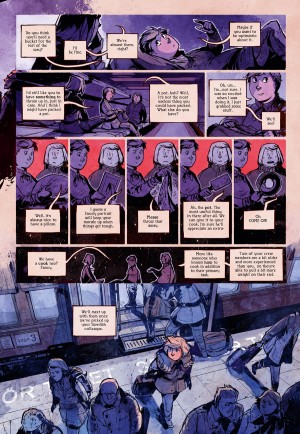
SSSS-page-95Also fun is Sundberg’s art, which is unique and charming, and features some really striking uses of limited color palettes. She’s especially adept and drawing rains, storms, ships and the sea, all of which show up a lot in Stand Still, Stay Silent. And her faces, which are in a style of drawing that I think owes more to children’s illustration than to mainstream comics, are very animated and appealing to look at.

On the down side, Stand Still, Stay Silent is quite slow-paced – one of my housemates tells me that he gave up on it for that reason. And this is one of the whitest comics I’ve ever read; I didn’t notice a single non-white character, not even in the backgrounds. (In real life, Iceland is mostly white, but not 100% white). Female characters in SSSS fulfill important roles in the story and are treated as equals in the society.

I should mention that, although a paper version of SSSS volume one was self-published, it is currently out of print. However, you can buy an ebook version, and the entire (still ongoing) story is posted as a webcomic.
Posted in Cartooning & comics, Comics I Like, Comics other than Hereville!, Recommended Reading | 5 Comments

“Love Is Never Still” featured in Mary Robinette’s My Favorite Bit

My short story “Love Is Never Still” is featured today on Mary Robinette Kowal’s blog. For the My Favorite Bit series, authors write short essays about their favorite parts of their work.

I cheated a little, but only because it’s honestly true: “My favorite bit about “Love Is Never Still” is probably also my least favorite bit: the complex layers I built in over the course of four months of intense revision.”

In the essay, I discuss the techniques I used to layer complexity into the prose so that the sentences were densely packed with multiple meanings and purposes. I’m really proud of how the story came out, but it was a lot of work.

Read the essay here: http://maryrobinettekowal.com/journal/my-favorite-bit/favorite-bit-rachel-swirsky-talks-love-never-still/

Posted in Uncategorized | Comments Off on “Love Is Never Still” featured in Mary Robinette’s My Favorite Bit

On Hulk Hogan and Free Speech

hulk-hogan

From CNN:

Jurors in the Hulk Hogan sex tape case ignored a plea for mercy Monday and added another $25 million to the $115 million they already awarded ex-wrestler Hulk Hogan.

The jury deliberated nearly four hours before deciding on the punitive part of the case.

Hogan had sued Gawker, founder Nick Denton and former editor A.J. Daulerio for violating his privacy by posting a snippet of a sex tape.

1. A $140 million dollar award seems ridiculously high, and may well be a threat to free speech. However, I’d be willing to bet $100 (donated to charity of the winner’s choice) that the award will be enormously lowered by a higher court – or overturned entirely.

2. Unless you’re arguing that high damages should never be awarded in any case where  a press outlet is sued, the overly high jury award is a different issue from the question of whether or not the first amendment protects publishing nine seconds of video of people having sex, when not everyone in the video has consented to have the video made public. ((Actually, Hogan claims that he didn’t even know the video was being made, although other parties dispute this.))

3 The fact that only nine seconds of sex tape were published without consent, rather than a longer clip, does not make publishing nine seconds okay.

4. This case is fundamentally about free speech vs the right to privacy. It is possible to think this case was rightly decided (other than the amount of the damages award), and still be in favor of free speech, because what we have is a matter of weighing two conflicting interests. If you don’t see any interest at all at stake here other than free speech, then I’m confused.

5. There was a case recently where a female sports broadcaster was filmed nude through a peephole in a hotel room, without her consent. She sued the hotel and won.

But suppose she had earlier given an interview in which she said that her job had really stringent appearance requirements, and she had to have a body as good as any swimsuit model’s in order to be a TV journalist; and then suppose Gawker had published the nude video. In that case, would the folks now arguing that Hogan’s right to privacy was lost the moment he publicly discussed his sex life, now be arguing that she lost her right to privacy the moment she publicly discussed what her body looked like? If not, what’s the difference?

6. No one is arguing that Gawker didn’t have the right to report on what the content of the sex tapes are. Gawker’s right to report is not at issue here; only Gawker’s right to publish a sex tape without the consent of all the people in the sex tape.

7. Erwin Chemerinsky, Professor of First Amendment Law at the UC Irvine School of Law, wrote:

1st Amendment absolutists will worry about the “chilling effect” the verdict may have on speech, and will claim it’s impossible to draw a line between permissible and impermissible expression. Speech is speech.But I can imagine a clear rule: No videos of people having sex should be made public unless all of the participants consent. I think the media will survive the restriction.

We have many legal limitations on  free speech – some of which I disagree with (such as many applications of copyright law).

But there are some legal limitations on free speech which don’t substantially impede anyone’s right to politic, to create, or to report. For example,, my right to free speech doesn’t extend to making a political speech in Sean Penn’s living room if Penn didn’t invite me in. Yet, that legal restriction hasn’t turned this country into Orwell’s 1984. We can have reasonable restrictions on speech – including admitting that all people, even celebrities, have some privacy rights – without putting all free speech under threat.

Given that, I don’t understand why so many people – including smart people I admire – consider a “No videos of people having sex should be made public unless all of the participants consent” rule to be a burden that free speech can’t survive.

Posted in Free speech, censorship, copyright law, etc. | 7 Comments

The Mail Man

Mail Man

“Leaps tall mailboxes in a single bound”

Posted in Drawing | 1 Comment

Fan art: My Goodbye to Old Man’s War

My favorite part of the Old Man’s War series is listening to Scalzi tell stories and make jokes. He has a clear and polished voice and a great sense of comic timing which are disarming to “listen” to, on his blog or in his books.

Because John’s books are easy reads, and his prose relatively simple, I’ve heard people call his prose “transparent.” I think I’ve said it, too, actually. But on reflection, Scalzi’s prose is not transparent–although it’s easy to read, it’s also calibrated to catch the reader’s attention at one point, distract at another, deliver a punchline at a third. The prose isn’t just a mirror you look through to get to the story. It’s a calculated part of the reading experience.

I think of John Scalzi as belonging to a category of “storytelling” writers–writers whose authorial voices are the disarming strength of their work, like Neil Gaiman and Ursula Vernon.

A few weeks ago, I wrote Scalzi and asked if he had any directions for drawing a picture of Old Man’s War’s main character, John Perry. Scalzi said he’d imagined Perry with Caucasian features, but otherwise, I should go for it. I didn’t even manage to follow that trivial note.

In case you haven’t read the series, the main character, John Perry, is an old man who is uploaded and reborn into a fit young body in order to fight a dangerous space war. A fit, young green body.

That’s right. Kermit said it first.

It isnt easy being green

It isn’t easy being green.

Thank you. I’ll be here all night.


Posted in Fan art, Recommended Reading | Comments Off on Fan art: My Goodbye to Old Man’s War

Martin Van Dogen

Last Thanksgiving, there was a dog.

Martin Van Dogen

In 1837, the United States had a president named Martin van Buren.

MartinVanBuren

You must admit a resemblance.

SamTheVanBurenDogThanksgiving2015

Posted in Cats | 2 Comments

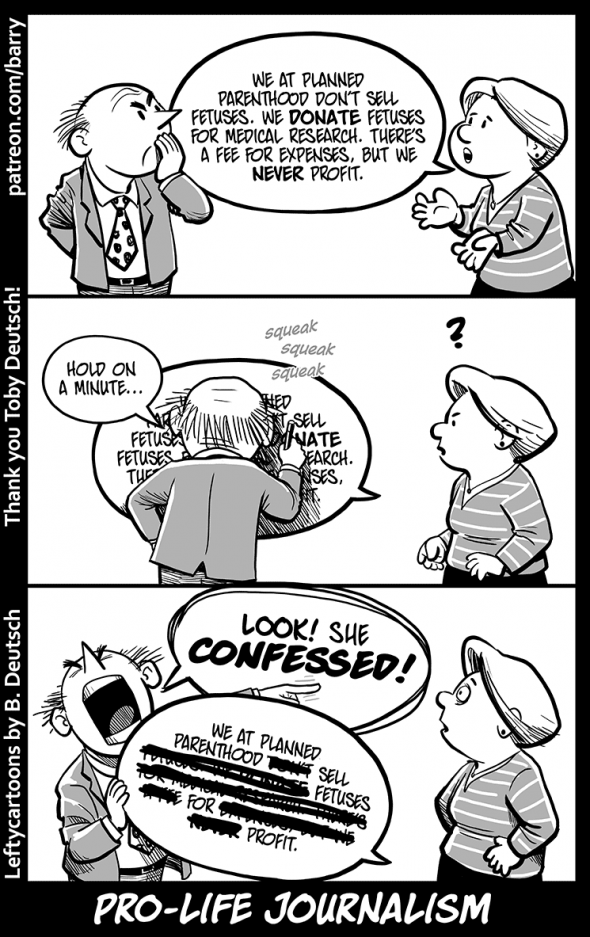
Cartoon: Pro-Life Journalism

pro-life-journalism

Transcript of cartoon:

PANEL 1
A man in a jacket and tie is listening to a woman in a striped shirt speak.
WOMAN: We at Planned Parenthood don’t sell fetuses. We donate fetuses for medical research. There’s a fee for expenses, but we never profit.

PANEL 2
The man turns his back towards the viewer and is facing the woman’s word balloon from panel 1, which has remained in the cartoon, but is now mostly hidden by the man stepping in front of it. He has produced a magic marker and is making marks on the woman’s word balloon; the marker makes a “squeak squeak squeak” sound effect. The woman is puzzled by this development.
MAN: Hold on a minute…

PANEL 3
The man has turned back towards the viewers, and is holding up the woman’s word balloon from panel one. He has crossed off most of the words on the balloon; the remain words read “We at Planned Parenthood… sell… fetuses… for… profit.” He is pointing an accusing finger at the woman while yelling. The woman looks very surprised.
MAN: LOOK! SHE CONFESSED!


From the Wikipedia page about the so-called “Center for Medical Progress” videos:

The CMP presents the videos as evidence of Planned Parenthood engaging in the illegal sale of fetal tissue and organs, and their dummy corporation Biomax offered one clinic US$1,600 for liver and thymus tissue, but the affiliate declined the offer. The New York Times has characterized the offer as an attempt to “trap the affiliate in the act of accepting a high payment for fetal tissue”.

In the unedited version of the first video, PPFA staff repeatedly state that the organization makes no money from tissue donations, and that the US$30–100 charge only covers procurement costs.[1] PPFA have said they may donate fetal tissue at the request of a patient, but such tissue is never sold. At one point in the video, a PPFA staffer states “nobody should be ‘selling’ tissue”, and “that’s just not the goal here”.

Posted in Abortion & reproductive rights, Cartooning & comics | 43 Comments

Attending ICFA March 16-20

We’re heading out to Orlando tonight for the International Conference of the Fantastic Arts. We get there laaaate, but we’ll be there through Sunday.

I’m starting out the weekend with a work-related bang, as I do a Thusday reading at 8:30am (5:30 pacific…) and then host one at 10:30. After that, I’ll have to suffer some terrible, terrible relaxing in the awful, no-good pool, and perhaps the forlorn hot tub.

awful, no-good pool

I don’t have any events besides those two planned at the convention, but I’ll be around for chatting.


Tagged | Comments Off on Attending ICFA March 16-20