Publication News: Two Days Left to Preorder Veils, Halos & Shackles

vhsI am normally more on top of these things, but somehow the email letting me know about the special pre-order discount ($14.95, which is $10 off the cover price) on Veils, Halos & Shackles: International Poetry on the Oppression and Empowerment of Women, got buried in my inbox, so I didn’t post this notice as early as I should have. The book, in which a poem of mine appears, will be published in April by Kasva Press, which has graciously extended the discount until Saturday so I could tell you a little bit about this important volume. The number of preorders will help determine the size of the print run, and so I hope you will consider ordering a copy for yourself, your friends, and/or for classes you might be teaching.

Conceived by editors Charles Adés Fishman and Smita Sahay in response to the December 2012 rape and murder of Jyoti Singh Pandey by six men in New Delhi, Veils, Halos & Shackles collects work specifically addressing violence against women by poets from more than two dozen countries, a scope which I believe makes it the first-of-its-kind. The poem of mine that Fishman and Sahay included–which is also the title poem of my upcoming chapbook, to be published in April by Ghostbird Press–is “For My Son, A Kind of Prayer.” I am happy that my voice is part of the chorus of voices for which Veils, Halos & Shackles provides a platform. Fishman and Sahay spent three years gathering these poems from around the world and their labor has borne exceptional fruit.

You can read more about the editors and a few sample poems from the book in the media kit. Here is one by Allene Rasmussen Nichols called “Chorus:”

They will say the sky is not for you,
that the blue in your eyes is a reflection
of the shattered china on the floor
or that the scarlet stains on the counter
are your shackles or that if you die
often enough, your children will be free.

You must come to know the lie, to name your
bruises and broken bones, to call
these walls a prison, to make your voice
like steel, not to break when struck,
but to reverberate until this house
falls down.

You must teach yourself that you were born
to risk it all, not the next time you fall,
but today, while your breath reeks of poetry
and the sky beckons, and the sun itself
proclaims the promise that your body
can be strong and that your words
can bear the holy seal of joy.

If you’re reading this, chances are you believe poetry does important work in the world. It can only do that work, however, if poems find their way to the people who need them. Preordering a copy of Veils, Halos & Shackles will help make that happen.

Posted in Feminism, sexism, etc, literature, Rape, intimate violence, & related issues, Writing | Comments Off on Publication News: Two Days Left to Preorder Veils, Halos & Shackles

Why Feminists Shouldn’t Use “Neckbeard”

My newest “Everyday Feminism” cartoon.
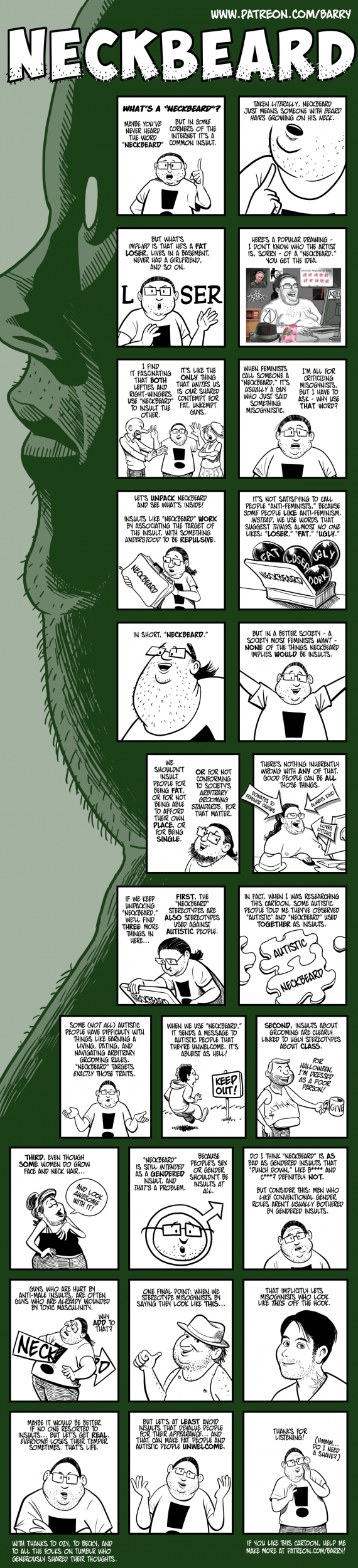
TRANSCRIPT OF CARTOON

(At the top of the cartoon, large cartoon-style letters spell out “NECKBEARD.” Each letter is growing stubble hairs out of its lowest third.)

(Behind all the panels is a large drawing of a fat person, mostly in darkness. The person has an exaggerated neck, and has stubble covering their lip, chin, and neck.)

Panel 1

(BARRY – a fat white man with glasses, pulled-back hair in a ponytail, and a t-shirt with an exclamation point on it, is speaking directly to the reader. Barry’s face has a lot of stubble.)

CAPTION: What’s a “Neckbeard?”

BARRY: Maybe you’ve never heard the word “neckbeard.”

But in some corners of the internet, it’s a common insult.

Panel 2

(A close-up on Barry’s neck shows a lot of stubble growing there.)

BARRY: Taken literally, neckbeard just means someone with beard hairs growing on his neck.

Panel 3

(The word “loser” appears floating in the air around Barry’s head, with Barry’s head taking the place of the “O.”)

BARRY: But what’s inplied is that he’s a fat loser, lives in a basement, never had a girlfriend, and so on.

Panel 4

(A full-color drawing, drawn in a different style than the rest of the comic, is shown in this panel. The drawing depicts a fat, unshaven, shirtless man sitting in a windowless room that feels like a basement, laughing as he types on his computer. A poster in the background says “Internet Arguments Won” and has fifty handdrawn checkmarks; other decorations include a picture  of Richard Dawkins, a fedora lying on the desk, a My Little Pony figurine, and a few atheist logos.)

BARRY (off-panel): Here’s a popular drawing – I don’t know who the artist is, sorry – of a “neckbeard.” You get the idea.

Panel 5

(Barry stands between a bald man with a van dyke beard and a young woman with fashionable hair; they appear to be yelling at each other.)

BARRY: I find it fascinating that both lefties and right-wingers use “neckbeard” to insult the other.

It’s like the only thing that unites us is our shared contempt for fat, unkempt guys.

Panel 6

(Barry, now alone, addresses the reader directly, with an “asking a question” expression.)

BARRY: When feminists call someone a “neckbeard,” it’s usually a guy who just said something misogynistic.

I’m all for criticizing misogynists, but I have to ask – why use that word?

Panel 7

(Barry is holding up a suitcase. The suitcase is labeled “neckbeard.”)

BARRY: Let’s unpack neckbeard and see what’s inside!

Insults like “neckbeard” work by associating the target of the insult with something understood to be repulsive.

Panel 8

(A close-up of the “neckbeard” suitcase shows it standing open. Four blobs, labeled “fat,” “loser,” “ugly,” and “dork” are emerging from the suitcase.)

BARRY (off-panel): It’s not satisfying to call people “anti-feminists,” because some people like anti-feminism. Instead, we use words that suggest things almost no one likes: “loser,” “fat,” “ugly.”

Panel 9

(A close-up of Barry, drawn to exaggerate his unshaven neck.)

BARRY: In short, “neckbeard.”

Panel 10

(Barry spreads his arms wide to make a big point.)

BARRY: But in a better society – a society most feminists want – none of the things neckbeard implies would be insults.

Panel 11

(Barry speaks to the viewer, but his neck – and only his neck – is now covered by a thick beard.)

BARRY: We shouldn’t insult people for being fat, or for not being able to afford their own place, or for being single.

Or for not conforming to society’s arbitrary grooming standards, for that matter.

Panel 12

(Once again we see the popular drawing of a “neckbeard” that appeared in panel 4. But this time he’s been drawn in a style that matches the comic strip. Three arrow captions point to him.)

BARRY (off-panel): There’s nothing inherently wrong with any of that. Good people can be all those things.

ARROW CAPTION 1: Donates to feminist causes.

ARROW CAPTION 2: Always kind.

ARROW CAPTION 3: Loves kittens.

Panel 13

(Barry leans over to look into the inside of the “neckbeard” suitcase.)

BARRY: If we keep unpacking “neckbeard,” we’ll find three more things in here…

First, the “neckbeard” stereotypes are also stereotypes used against autistic people.

Panel 14

(A shot of two jigsaw puzzle pieces, which fit together perfectly. The pieces are labeled “autistic” and “neckbeard.”)

BARRY (off-panel): In fact, when I was researching this cartoon, some autistic people told me they’ve observed “autistic” and “neckbeard” used together as insults.

Panel 15

(Barry addresses the reader directly, his hands in front of him in an “explaining” gesture.)

BARRY: Some (not all) autistic people have difficulty with things like earning a living, dating, and navigating arbitrary grooming rules. “Neckbeard” targets exactly those traits.

Panel 16

(A person with dark, springy hair jumps back from a sign which says “keep out!” in big letters.)

BARRY (off-panel): When we use “neckbeard,” it sends a message to autistic people that they’re unwelcome. It’s ableist as hell!

Panel 17

(A grinning white dude is wearing a “poor person” costume, which consists of a sleeveless white shirt with a pillow shoved under it to make him appear fat. He has makeup on his face and neck to simulate heavy stubble, and is holding out a cup with “give” written on it.)

BARRY (off-panel): Second, insults about grooming are clearly linked to ugly stereotypes about class.

GRINNING DUDE: For Halloween, I’m dressed as a poor person!

Panel 18

(A smiling, confident-looking woman with a full beard and her hair in a bun puts her hand on her chest in a “I am awesome” gesture.)

BARRY(off-panel): Third, even though some women do grow face and neck hair…

WOMAN: And look awesome with it!

Panel 19

(Barry is drawn to be a circle-and-arrow “male” symbol.)

BARRY: “Neckbeard” is still intended as a gendered insult, and that’s a problem.

Because people’s sex or gender shouldn’t be insults at all.

Panel 20

BARRY: Do I think “neckbeard” is as bad as gendered insults that “punch down,” like b**** and c***? Definitely not.

But consider this: Men who like conventional gender roles aren’t usually bothered by gendered insults.

Panel 21

(Barry now has a huge arrow symbol piercing his chest. The arrow is labeled “neckbeard.”)

BARRY: Guys who are hurt by anti-male insults are often guys who are already wounded by toxic masculinity.

Why add to that?

Panel 22

(An unshaven fat man with a dorky grin, wearing a fedora hat and a sleeveless white shirt, points to himself with his thumb.)

BARRY: (Off-panel) One final point: When we stereotype misogynists by saying they look like this….

Panel 23

(A conventionally handsome man, with “good” scruffy stubble and a neck tattoo, smiles out at the viewer.)

BARRY: That implicitly lets misogynists who look like this off the hook.

Panel 24

(For the final three panels, Barry speaks directly at the viewer. In this panel, he looks a bit angry)

BARRY: Maybe it would be better if no one resorted to insults… But let’s get real. Everyone loses their temper sometimes. That’s life.

Panel 25

(Barry, no longer looking angry, shrugs.)

BARRY: But let’s at least avoid insults that devalue people for their appearance… and that can make fat people and autistic people feel unwelcome.

Panel 26

(Barry, smiling, lifts his left hand to feel his cheek.)

BARRY: Thanks for listening!

(Hmmm… Do I need a shave?)
Posted in Cartooning & comics, Disabled Rights & Issues, Fat, fat and more fat, Feminism, sexism, etc, Gender and the Body, Men and masculinity, Sexism hurts men | 42 Comments

I’ll be appearing at Wizard World in Portland today and all weekend

This is an actual screenshot taken from the Oregon Convention Center's webpage.

This is an actual screenshot taken from the Oregon Convention Center’s webpage.

I’ll be at the Oregon Convention Center for Wizard World today, tomorrow and Sunday. I’m in artist’s alley, at table B33, selling copies of Hereville and First Glance (and I do free sketches for anyone who buys a Hereville). If you’re going to be there, please come and say “hi” – and tell me you read “Alas,” I love that.

Posted in Cartooning & comics | Comments Off on I’ll be appearing at Wizard World in Portland today and all weekend

Open Thread and Link Farm, Dancing Bond Villain Edition

prez-8

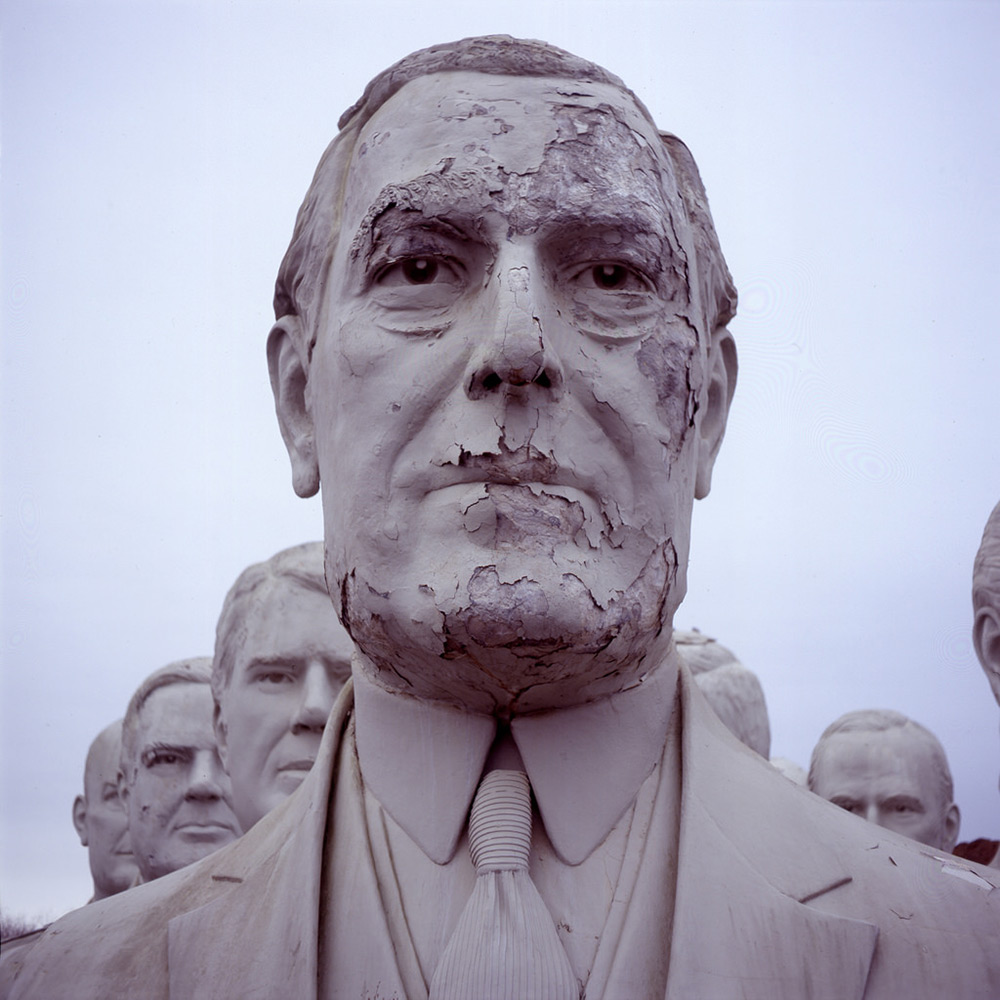
  1. Why Dozens of U.S. President Statues Sit Deteriorating in a Rural Virginia Field | Colossal
  2. I don’t know how long this video of the Hamilton cast performing for the Grammy Awards will be online. So watch it while you can.
  3. Black Workers Really Do Need to Be Twice as Good – The Atlantic
    “Only in instances where black workers are monitored and displayed a significantly higher skill level than their white counterparts would they stand a significant chance of keeping their jobs for a while, the researchers found.”
  4. An alphabetical The Wizard Of Oz recut is both orderly and chaotic · Great Job, Internet! · The A.V. Club
    It’s called “Of Oz The Wizard,” of course.I didn’t watch all of it, but I watched some, and it’s oddly fascinating for a few minutes.
  5. Everyone’s offended these days / fuzzy notepad
    On Stephen Fry’s departure from Twitter, being offended, and twitter mobs.
  6. Department of Irony: Thousands of legal Hispanic residents are becoming U.S. citizens from Nevada to Florida and Colorado because of Trump.
    “There is a measurable, substantial increase in Latino voter registration and voting when there is a clear villain perceived as anti-Latino.” Thanks to Ben.
  7. An Open Letter To Gloria Steinem Regarding Young Women Who Don’t Support Hillary Clinton – Sarah Grey
  8. The Ecstasy of Influence | Harper’s Magazine
    A long but excellent article by Jonathan Lethem about copyright, plagiarism, creativity, and influence. Nice twist at the end, too.
  9. The 5 Best Punctuation Marks in Literature — Vulture
    “(picnic, lightning)”
  10. 20 People Now Own As Much Wealth as Half of All Americans
    If it could be somehow shown that the worst-off people in America are better off with wealth divided this way than they would be under any other conceivable system, then this is justifiable. I’m pretty sure, however, that it’s not.
  11. Diets do not work: The thin evidence that losing weight makes you healthier.
  12. This Transgender Girl Scout Stood Up To A Bully By Selling Thousands Of Cookies – BuzzFeed News
  13. Hillary Clinton Has a Henry Kissinger Problem
    “The point I’m making here is not, [Glenn Greenwald voice] HILLARY CLINTON SUPPORTS A WAR CRIMINAL. (Trust me, I know Kissinger isn’t moving many votes in New Hampshire.) It’s that Hillary Clinton exists in a world where “Henry Kissinger is a war criminal” is a silly opinion held by unserious people. Her problem? Lots of those silly and unserious people want to wrest control of the Democratic Party away from its current leadership, which is exemplified by people like Hillary Clinton.” Thanks to Closetpuritan.
  14. Why Hillary Clinton’s Gender Matters
    Thanks to Lee1 for this link.
  15. Attack of the Hillary Bros: This is What Happens When a Woman Supports Bernie Sanders Online — Medium
  16. Yes, I’m Fat. It’s O.K. I Said It. – NYTimes.com
    Op-Ed in the New York Times (!) by fat-positive activist Sarai Walker, author of the novel Dietland. As I type this link, there aren’t yet any comments, but I sort of dread the comments to come.
  17. The A Word: Jughead of “Archie” comics self-identifies as “asexual” for the first time.
  18. When life gives you lemons, make science
    A blogger compiles statistics – and makes graphs! – of where the assholes in her his comments are coming from.
  19. Disabled People Need Not Apply – Discrimination and Disadvantage
    ” It’s reasonable for a job involving manual labor to require lifting. Making that 25-pound standard universal, though, excludes a huge class of people.”
  20. FBI Arrests Nearly Every Single Elected Official In A Texas Town | ThinkProgress
    Six of the town’s eight elected officials were arrested on bribery-related charges. “Those arrested in Crystal City, Texas include the mayor, the city attorney who is also the city manager, two current councilmen, and a former councilman.”
  21. Reps introduce bill requiring women to register for draft | Fox News
    It would be better to get rid of selective service registration altogether; but if that isn’t on the menu, then this is the way to go.
  22. Anti-transgender bathroom bills are clearly unconstitutional.
    FWIW, “Scott Skinner-Thompson is an acting assistant professor at NYU School of Law.”
  23. This Is How Hillary Clinton Gets the Coverage She Wants
    I’m not posting this as an anti-Clinton thing, since I’m sure a lot of politicians do the same thing. But the press shouldn’t be acting like this.
  24. Feminism Finally Destroyed After YouTuber Posts 478th Video Criticising It
  25. Why Hamilton is the Perfect Mashup for Every Fandom | Tor.com


Posted in Link farms | 52 Comments

Neb Recc Catch-Up List

I’ll be releasing my full list of short fiction recommendations later, but here’s a quick catch-up on a couple things I liked recently.

Novel

Here’s a link to my recommendations for 2015 novels. My favorite was Fifth Season by N. K. Jemisin.

I didn’t put Ann Leckie’s Ancillary Mercy on that list because it slipped my mind–repeatedly. I put it in my notes, even, but then not in my entry. That’s because I read the book early and keep forgetting it was published in 2015. I recommend it.

Novella

E. J. Fischer’s “The New Mother” is the best riff on “disappearing male” stories I’ve ever seen, a smart story that accomplishes both literary and speculative goals in a sharp, well-characterized, traditionally “what if?” SF way. My point of comparison in Nancy Kress.

Will McIntosh’s “A Thousand Nights Till Morning” is about a psychiatrist with an anxiety disorder who is on a Mars expedition when they receive the news that Earth has been conquered by aliens, possibly with no survivors. An adventure story with traditional SF elements and Will’s smart voice.

Caren Gusoff’s “Three Songs for Roxy” (Aqueduct) is a three-part, beautiful tale, about strange aliens coming to earth. The lives she writes about are delicately, beautifully rendered, and startlingly unusual. In terms of odd character detail, it’s like a tender Pahlaniuk–a really lovely and unique read.

Novelette

Sarah Pinsker’s “Our Lady of the Open Road” will resonate better with people who have a strong interest in the music scene, but is a meaty science fiction story with very strong characters which has been recognized highly by the Asimovs readership and the Neb recommended reading list.

Short Story

Charlie Jane Anders’ “Ghost Champagne” is another remarkable piece from this author, combining her humor and warmth of perspective with reflection on important life questions. It tells the story of a struggling young comedian who lives under the shadow of the disapproving, silent ghost of her own dead self.

Mary Robinette Kowal’s “Midnight Hour” takes standard fantasy set pieces, including a mad king and cursed queen, to render an intimate portrait of two characters struggling together, with significant emotional breadth that it will take me some time to unpack (and which I suspect will vary from reader to reader).

Norton Award

Here’s a link to my recommendation post for 2015 Norton candidates. There are a number of books on this list that I absolutely loved, and it’s simplistic to call out only one or a couple, but I’m going to take the opportunity to link one more time to Nova Ren Suma’s The Walls Around Us.

I hope people enjoy their reading, from 2015, 2016, or whenever.


Posted in Mandolin, Recommended Reading, Reviews and Criticism | Comments Off on Neb Recc Catch-Up List

Neb Recc Catch-Up List

I’ll be releasing my full list of short fiction recommendations later, but here’s a quick catch-up on a couple things I liked recently.

Novel

Here’s a link to my recommendations for 2015 novels. My favorite was Fifth Season by N. K. Jemisin.

I didn’t put Ann Leckie’s Ancillary Mercy on that list because it slipped my mind–repeatedly. I put it in my notes, even, but then not in my entry. That’s because I read the book early and keep forgetting it was published in 2015. I recommend it.

Novella

E. J. Fischer’s “The New Mother” is the best riff on “disappearing male” stories I’ve ever seen, a smart story that accomplishes both literary and speculative goals in a sharp, well-characterized, traditionally “what if?” SF way. My point of comparison in Nancy Kress.

Will McIntosh’s “A Thousand Nights Till Morning” is about a psychiatrist with an anxiety disorder who is on a Mars expedition when they receive the news that Earth has been conquered by aliens, possibly with no survivors. An adventure story with traditional SF elements and Will’s smart voice.

Caren Gusoff’s “Three Songs for Roxy” (Aqueduct) is a three-part, beautiful tale, about strange aliens coming to earth. The lives she writes about are delicately, beautifully rendered, and startlingly unusual. In terms of odd character detail, it’s like a tender Pahlaniuk–a really lovely and unique read.

Novelette

Sarah Pinsker’s “Our Lady of the Open Road” will resonate better with people who have a strong interest in the music scene, but is a meaty science fiction story with very strong characters which has been recognized highly by the Asimovs readership and the Neb recommended reading list.

Short Story

Charlie Jane Anders’ “Ghost Champagne” is another remarkable piece from this author, combining her humor and warmth of perspective with reflection on important life questions. It tells the story of a struggling young comedian who lives under the shadow of the disapproving, silent ghost of her own dead self.

Mary Robinette Kowal’s “Midnight Hour” takes standard fantasy set pieces, including a mad king and cursed queen, to render an intimate portrait of two characters struggling together, with significant emotional breadth that it will take me some time to unpack (and which I suspect will vary from reader to reader).

Norton Award

Here’s a link to my recommendation post for 2015 Norton candidates. There are a number of books on this list that I absolutely loved, and it’s simplistic to call out only one or a couple, but I’m going to take the opportunity to link one more time to Nova Ren Suma’s The Walls Around Us.

I hope people enjoy their reading, from 2015, 2016, or whenever.


Source: Rachel Swirsky’s blog

Posted in Mandolin, Recommended Reading, Reviews and Criticism | Tagged | Comments Off on Neb Recc Catch-Up List

Antonin Scalia, 1936-2016

scalia

I can’t say I feel sad that Scalia died – I feel sympathy for those who loved him, because they must be sad today, but that’s it.

Nor do I feel happy, although pragmatically of course I’m pleased that the prospects for some important issues now look a tiny bit better.

Mainly, I’m fascinated by how this will change the shape of the election. I could be wrong, but I don’t think the Republicans will approve any nomination before the election; even if the nominee is one that seems very good for them – e.g., as “centrist” as a Democratic President can nominate – in the end Senators are answerable to their base, not to their party, and I think accepting any Obama nomination would infuriate their base.

Presidential elections are always about “who will choose the next Supreme Court nominee(s),” but usually the mainstream media ignores that. They won’t be ignoring it this election. And if a Clinton or a Sanders chooses Scalia’s replacement, that will enormously change the landscape for a host of crucial progressive issues, possibly for a generation.

As for Scalia himself… I used to admire him. I thought of him as a man who I disagreed with, but who nonetheless acted out of deep principle, not partisan bias. My rosy view of Scalia was ended by the Bush v Gore decision, which revealed him as unprincipled, partisan, and contemptuous of democracy. (If Scalia is reading this blog from the afterlife – which he is not, because first there is no such, and second if there were he’d have much better things to do than read this blog, but if, he’d no doubt say “get over it!”).

Anyway, feel free to use this post to discuss anything Scalia-related; to facilitate, here’s some Scalinks:

What Scalia’s Death Means For Cases Currently In Process

  1. What happens to this Term’s close cases? : SCOTUSblog
    Scalia’s votes on unannounced decisions are now void, turning some 5/4 decisions into 4/4 undecided cases.
  2. The Simply Breathtaking Consequences Of Justice Scalia’s Death | ThinkProgress
    Similar to the previous link, but lists a couple of additional cases.
  3. What Antonin Scalia’s death means for Obama’s climate plans – Vox

    Politics, politics, politics.
  4. Supreme Court vacancies in presidential election years : SCOTUSblog
    Save you a click: There’s no tradition of not nominating or confirming Justices in the last year of a President’s term.
  5. OTOH, the argument over recess appointments to the Supreme Court has come up before: Flashback: Senate Democrats in 1960 pass resolution against election-year Supreme Court recess appointments – The Washington Post
  6. Will the G.O.P. Response to Antonin Scalia’s Death Hand the Election to the Democrats? – The New Yorker
    The title is hyperbolic, but – especially if Senate Republicans refuse to confirm any Obama nominee, which seems likely – there’s no question that this election will be, to a significant extent, about The Supreme Court. (Really, it always was about The Supreme Court – but now the mainstream media, and presumably large sections of the public who get their info from the media, will realize that’s what it’s about.)

    Remembering Scalia and his legacy

  7. How Antonin Scalia Changed America>
    A symposium of brief comments from notable Scalia admirers, critics, and in-betweens.
  8. Remembering Antonin Scalia: His 7 Most Hateful and Homophobic Remarks – Towleroad
  9. Top 5 Scalia Rulings that helped Progressives | Informed Comment
  10. Scalia-Ginsburg friendship bridged opposing ideologies – CNNPolitics.com
    “Ginsburg and Scalia were also the subject of an opera ‘Scalia/Ginsburg’ composed by Derrick Wang that had its debut last spring.”
  11. The sarcastic lines that made Justice Scalia the king of Supreme Court sarcasm – The Washington Post
  12. Justice Antonin Scalia’s 10 most memorable lines – CNNPolitics.com
Posted in Supreme Court Issues | 61 Comments

If There Were A Prize For Terrible Homophobic Logic, We’d Name It The John C Wright Award

I don’t usually write “look at this stupid thing this guy said” comments, but this comment by John C. Wright is too jaw-dropping not to share with someone (I cannot bear this burden alone!).

Not just because Wright equates homosexuality with bestiality, pederasty, and necrophilia; that Wright has terrible, indefensible opinions is not news. But his actual argument would be the star exhibit in a museum of terrible logic. Here, read this, and keep in mind, it’s all one sentence: (Edited: Nope, two sentences! I missed a period in there, somehow.)

The first step was to agree to cease to fight over religion, but to hold all religions opinions as being private, therefore too private to be discussed; then society agreed religion was irrational hence not able to be discussed at all; then society agreed that, since religion was irrational, any moral rules not grounded in pragmatic experience were nonbinding, a matter of private opinion; then society held that one’s opinion of pragmatism, or one variations of experience, eliminated even the possibility of a consensus on these points, and that even the contents of reality were a matter of opinion; and then it was held that to believe reality was real equaled making a judgment equals being judgmental equal being prejudiced equaled being bigoted equaled being racist equaled being a genocidal maniac on par with Hitler. Hence, to observe that men should act with self control in the sexual area became the same as promoting the mass extermination of the Jews: and so every children’s book character or cartoon character, from Dumbledore to Avator Korra to Batwoman to the characters in Order of the Stick to each and every character from each and every episode of DOCTOR WHO that is revealed as being a pervert, or revealed as approving wholeheartedly of perversion, is another Jew whom the leftist, seeing himself as Schindler, allows to escape from the death camp.

This is in the comments to a post in which Wright seems (as best as I can make out through the thicket of overwrought prose) to be arguing that, data be damned, it’s just not possible that most Harry Potter fans are liberals, because liberals would hate any narrative in which the Death-Eaters don’t win.

Posted in Conservative zaniness, right-wingers, etc. | 14 Comments

Huge Corporation Attempts To Censor One-Woman Feminist Play

thatswhatshesaid

Once again, copyright is used by wealthy corporations to censor independent artists – and in this case, to muzzle a feminist critique of the most powerful and popular playwrights in the country.

From a review of the experimental play Thatswhatshesaid:

[Playwright Courtney Meaker] compiled lines from only the female characters in American Theater’s list of the 11 most-produced plays of the 2014—2015 season. Only two of these plays were written by women. According to Meaker’s script, these plays contain 74 total roles, 34 of which were written for women. Of those 34 roles, 28 were written by men. […]

Meaker splits the hour-long play into two acts. In Act I, she presents the lines and stage directions written by men. In Act II, she presents the lines and stage directions written by women. Each scene is composed of lines thematically bound by behaviors the culture polices the most in women. We see woman as sex object and temptress. Woman as angel. Woman as angry witch. The girl, the woman-hating woman, the woman who asks questions and apologizes for everything.

You get the big-picture point pretty early: society forces women to conform to certain harmful and paradoxical gender stereotypes, and America’s most popular plays reflect those stereotypes. Playwrights perpetuate the patriarchy by creating roles for women that reduce them to one version or another of male fantasy or fear, and playhouses make sure those plays have a home.

So it’s a play that remixes parts of 11 plays into a new play with an entirely different message, for the purpose of satire and commentary. That certainly sounds like “fair use” to me – and, more importantly, like the sort of political commentary and experimental art that shouldn’t be censored. I don’t think the law says Thatswhatshesaid should be censored – but if that is what the law says, then the law is pro-censorship and wrong.

(Incidentally, my fellow musical theater fans, the only musical among the 11-most-produced is “Into The Woods.”) ((A blast of facts from Matthew Everett’s very helpful review: “The most produced plays last year were: Vanya and Sonya and Masha and Spike by Christopher Durang; Outside Mullingar by John Patrick Shanley; Bad Jews by Joshua Harmon; Other Desert Cities by Jon Robin Baitz; Around the World In 80 Days, adapted by Mark Brown and Toby Hulse from the novel by Jules Verne; Peter and the Starcatcher, adapted by Rick Elice from Dave Barry and Ridley Pearson; The Whipping Man by Matthew Lopez; Into The Woods, book by James Lapine, music and lyrics by Stephen Sondheim; Venus In Fur by David Ives. The two women who break into the top 11 are: Nina Raine’s play Tribes, which I wrote about on “Alas” back in March; and Amy Herzog’s play 4,000 Miles. From these 11 plays, there were 74 roles total. 31 of these roles were written for women. Of the 31 female roles, six were written for women by women.”))

But Samuel French, the theatrical publishing company which publishes Bad Jews and a few other plays quoted in Thatswhatshesaid, doesn’t see it that way, and about an hour before the show’s opening sent a cease-and-desist notice, demanding the play be stopped. And then Bruce Lazerus, the executive director of Samuel French, left a legally threatening message on Erin Pike’s voicemail, promising to “go after” not only Pike, but also “the presenter and the theater and all the folks connected to it.”:

[soundcloud url=”https://api.soundcloud.com/tracks/246038069″ params=”color=ff5500″ width=”100%” height=”166″ iframe=”true” /]

The venue, understandably not wanting to be sued, told Pike that if Pike defied the C&D they wouldn’t allow the performance to go on. Pike went on anyway, after playing Lazerus’ voicemail to the audience – but mimed all the parts from Bad Jews, while an offstage voice shouted “redacted.” It sounds like a memorable night of theater.

And then came a second cease and desist letter from Samuel French, this time over The Whipping Boy – a play that, due to having no female characters, is never once quoted in Thatswhatshesaid.

Aaargh.

A few points.

1) It’s interesting that a feminist critique of a male-dominated art form, is being treated this way. It’s an illustration of how the power of wealth and the power of male dominance often work together – in this case, they’re virtually indistinguishable.

2) I wish I could comment more on the feminist message of Thatswhatshesaid, but I can’t really, because I haven’t seen it. Pike has said that there will be a video, but that was before Samuel French began making legal threats, so now: who knows? If the end result of this is that the play isn’t made available on video, then Samuel French will have succeeded in censoring Thatswhatshesaid.

3) There’s very little question that this falls under “fair use.” The eleven plays (ten, if we don’t count The Whippping Boy) are being substantively transformed.

4) In Blanch v. Koons – Koons, a painter, was sued by the photographer Andrea Blanch, because he used one of her photos in one of his paintings – Koons’ affidavit said: ((I came across Blanch v Koons in this article by Brian Boucher.))

My paintings are not about objects or images that I might invent, but rather about how we relate to things that we actually experience. .. Therefore, in order to make statements about contemporary society and in order for the artwork to be valid, I must use images from the real world. I must present real things that are actually in our mass consciousness.

The ruling, which was in Koons’ favor, said:

The painting’s use does not “supersede” or duplicate the objective of the original, but uses it as raw material in a novel context to create new information, new aesthetics, and new insights. Such use, whether successful or not artistically, is transformative.

That seems very applicable to the case at hand.

4) But it probably won’t matter, because it’s unlikely that anyone involved with Thatswhatshesays has the financial means to allow themselves to be sued if there’s any alternative. Which is the fundamental corruptness of the copyright system – for pragmatic purposes, very often the right of fair use is worthless, because very often the cases involve people with truckloads of money threatening to sue people with none.

Posted in Free speech, censorship, copyright law, etc. | 14 Comments

Celebrating Mary Robinette’s Glamourist Histories

I wanted to make a post celebrating Mary Robinette’s Glamourist Histories because it is one of the few more-than-three-book series that I’ve read to the end. Actually, all of those series ended last year, so I was going to do tributes to all of them. I still may, but I wanted to start with Mary Robinette because this is her birthday.

So, in honor of Mary Robinette’s birthday, I present a short post about the book.. and some fan art.

The Glamourist Histories take place in an Austen-inspired world where it’s possible to weave illusions out of the ether. The protagonist, Jane (as a nod to Austen), is quite a skilled glamourist, but women’s dabbling in glamour is considered frivolous. Jane is set up in a similar position to the protagonist of Pride & Prejudice — and sure enough an arrogant nobleman shows up. He is one of the most talented glamourists in England, and while he is initially grumpy toward Jane, they eventually follow the P&P path, fall in love, and get married.

One thing that’s true of all the series that I have continued to the end is that the books often improve over the course of the series. Sometimes the first book is still the strongest, but the second book probably isn’t weak, and the third book might be even better than the first. (For me, the real dealbreaker with a series is if the books go constantly downhill, no matter how high the starting point.)

One of the things I like best about the Glamourist Histories in particular is how much the setting, characters, and voice developed over the course of the series. For me, book one was fun, but so heavily like Austen that she seemed to loom over the story. Book two was a radical departure, taking these Austen-like characters and Austen-like setting and shaping them into new things. It’s not that the series loses the sense of or tribute to Austen. It just gains its own charm.

Over the series of the novels, the theme of pride and prejudice continues to be explored. Jane must face a series of prejudices (beginning with prejudice against the Irish, which seems quaint to us now, but.) until, in the final book, she end up at an Antigua plantation owned by her husband’s family. (Spoilers on the treatment of race in rot13: Fur’f abg n juvgr fnivbe. Fur’f n juvgr nffvfgnag, naq n juvgr trnef-ternfre, ohg fur’f abg gur juvgr ynql jub pnzr va gb fnir gur urycyrff fynirf.) In real life, I respect Mary Robinette for her dedication to making our own world better; Jane, too, is learning about her world so that she can dismantle her prejudices and help people where she can.

In a way, the progression of the books can be read as a criticism of Austen–after all, Austen’s heroines are firmly rooted where they are, when they are–and especially in what class they are. I see criticisms of Austen from time to time essentially asking why the ladies from P&P etc. don’t go work in a hat shop or as ladies’ maids because clearly their concerns are frivolous. (I don’t have the feeling that men’s narratives of wanting to succeed are treated the same way, but maybe I’m wrong.) I don’t read the series that way, however. I think this is one of the ways where Mary Robinette is adding her own perspective to Austen’s, thus making it her own. Austen was writing social commentary on her time, within her time, and within those constraints–both physical and ideological. Mary Robinette’s character Jane gains exceptional freedom to travel and move between social circles which would almost certainly not have been available to Austen’s heroines.

The social commentary in the books is also modern. It should be. The books are modern. Mary Robinette is writing social commentary on our time, set in Austen’s.

I’ve looked forward to getting a new Glamourist History on my kindle every year for a while now, and I’ll be sorry to let them go, although there’s a stipulation at the end of the last book suggesting there might be further adventures from Jane in the future. I hope there are.

I’ll close with one my favorite memories relating to the series: When the first book, Shades of Milk & Honey, was nominated for the Nebula Award, Mary Robinette attended the ceremony in a beautiful, handmade regency gown with period undergarments. How cool is that?

Now, some fan art: Jane Austen enjoys reading Of Noble Family.

Austen reads Kowal

(I’m learning what I can do with Paper with my new stylus, so that’s why there are like 8 different techniques in there. Her face is based on the famous portrait. The tea pot and tea cup are shaped like things I found when I google image searched “regency tea pot/cup” and the regency wallpaper was inspired by a similar search.

Not pictured: Karen Joy Fowler’s Jane Austen’s Book Club, waiting by her bedside for a cozy reread.)

Posted in Fan art, Mandolin, Recommended Reading, Reviews and Criticism | Comments Off on Celebrating Mary Robinette’s Glamourist Histories