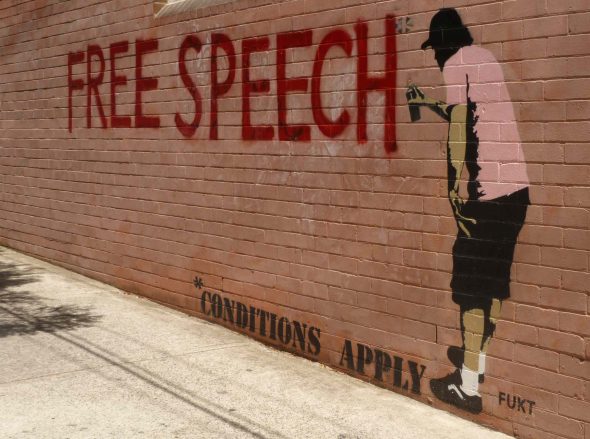
(Although she may not agree with everything I wrote here, I want to acknowledge that this post was improved by a discussion I had with Jaz Twersky. Thanks, Jaz!)
Four stories that I’ve run across recently:
1. Attacks on Tenure. (Coming from elected Republicans.)
Judge José A. Cabranes, in the Washington Post, writes:
Academic tenure is essential to democracy itself. A free society “depends upon the free search for truth and its free exposition,” as the American Association of University Professors noted in 1940. Tenure allows professors to pursue the truth and teach it without fear of retaliation.
Until recently, attacks on tenure came mostly from the political right. […] The tables have turned. Academic freedom now attracts opposition largely from the left…
Cabranes is right to say that tenure is essential to academic freedom – but wrong to imply that tenure is no longer under attack from the right. Like so many of our current free speech defenders, Cabranes gives right-wing attacks on free speech – even attacks on tenure, which Cabranes claims to be especially concerned about – a pass.
Lawmakers in two states this week introduced legislation that would eliminate tenure for public college and university professors. A bill in Missouri would end tenure for all new faculty hires starting in 2018 and require more student access to information about the job market for majors. Legislation in Iowa would end tenure even for those who already have it.
The bills, along with the recent gutting of tenure in Wisconsin and other events, have some worrying about a trend.
The Missouri, Iowa and Wisconsin legislatures are all controlled by Republicans. As far as I know, there is not a single example of a Democratic legislature trying to destroy tenure.
2. Legislators censoring courses and classes they don’t like. (Coming from elected Republicans).
“At least three times in the past six months, state legislators have threatened to cut the budget of the University of Wisconsin at Madison for teaching about homosexuality, gender and race.”[…]
A state representative heading a committee that oversees higher education asked for the cancellation of a course that examined white identity called “The Problem of Whiteness” and the dismissal of its instructor. The representative, Dave Murphy, said the course was “adding to the polarization of the races in our state.” If the university “stands with this professor, I don’t know how the university can expect the taxpayers to stand with U.W.-Madison.” Mr. Murphy also promised to direct his staff to screen courses in the humanities “to make sure there’s legitimate education going on.”
Meanwhile in Arizona: “Rep. Bob Thorpe, is proposing a far-reaching law in Arizona, House Bill 2120, banning virtually every college event, activity or course which discusses social justice, skin privilege, or racial equality.” Thorpe’s bill could become Arizona law – as an earlier law banning Mexican-American studies in Arizona public schools did.
There is no more problematic and extreme form of censorship than the government literally telling academics what they can or cannot teach. But those people who claim to be concerned about free speech on campus rarely focus on legislative censors – for example, they were for the most part silent when South Carolina Republicans attempted to punish a university for teaching Alison Bechdel’s lesbian coming-of-age memoir Fun Home. They seem so wedded to the “left wing censors” narrative that they’re essentially given Republican lawmakers a free pass to censor as much as they want without facing sustained criticism.
3. Physically preventing a lecture at UC Davis by blocking the entrances. (Coming from lefty student activists.)
This just happened at UC Davis, where professional loathsome bigot scumbag (cw: transphobia) Milos Yiannopoulos was prevented from speaking.
I’ve written that “no-platforming” is not censorship. Students have a free speech right to give their opinions on who invited speakers should be, including asking that some speakers’ invitations be rescinded. But preventing a lecture by physically blocking the entrances to a hall is another matter entirely; that’s the use of force to prevent speech. It may not be coming from the government, but as far as I’m concerned, it’s censorship.
To tell the truth, I don’t give a fuck about Milo Yiannopoulos’ speech rights, beyond favoring them as a matter of principle. The fact is, nothing campus protestors do will change that Yiannopoulos has a platform that gives him far more ability to speak and be heard than anyone short of the most famous celebrities and politicians.
But nor do I trust lefties – not even myself – to never make mistakes in their judgements of whose speech does and does not have value. Remember when NOW tried to exclude lesbians? Being a progressive activists is not a guarantee against being wrong. Today’s campus activists aren’t going to make that specific mistake, but they’ll make others (see below).
In addition to being ethically wrong, this is tactically awful; the UC Davis activists essentially gave a huge gift to the alt-right, in exchange for which they’ve gained nothing of substance. Yiannopoulos benefits more from leftist students blocking his speech, than he would from delivering the speech; he will receive more news coverage (and look more sympathetic) compared to if he had simply given his speech. There are other forms of protest and resistance that wouldn’t have helped Yiannopoulos this much, that should have been used instead.
(BTW, the protesters have also been accused of more extreme forms of violence, including using hammers and breaking windows, but campus police say those reports are not true.)
Some folks argued that the UC Davis students were acting in defense of local trans students; Milo recently used a campus appearance as a forum for singling out and verbally attacking a local trans student, which led to her dropping out of college. Her access to free speech was injured in a much more meaningful way than Yiannopoulos’ has been. But where have any of the well-known critics of campus misbehavior condemned Yiannopoulos’ disgusting behavior? (Conor? Christina? Jonathan? Get on that any time now.)
I have a lot of sympathy for the argument that the UC Davis activists were acting in defense. But I think it’s still bad tactics, because I don’t see how it can work. Yiannopoulos is not dependent on speaking at UC-Davis to have a platform; on the contrary, the few hundred students he might have spoken to there are a tiny fraction of his actual audience. If he decides to continue using his platform to single out trans students for attacks, unfortunately neither blocking this speech, nor any other action I can think of, can stop him. And in the long run, actions like what happened at UC-Davis make Yiannopoulos’ platform even bigger, enabling him to do more harm in the future.
4. Using misogyny to attack a groundbreaking queer filmmaker. (Coming from lefty student activists)
And a local story: “Reed students protested a talk by the director of Boys Don’t Cry by putting up posters stating ‘Fuck this cis white bitch.'”
This is the most marginal form of censorship on this list; I wouldn’t call it censorship at all, really. The protest was not intended to stop Kimberly Peirce from speaking at all, and she did speak, and also did a Q&A with students afterwards. But it’s still disheartening (as one Reed student wrote); the Reed activists, by and large, come off as intellectually rigid and uninterested in hearing Peirce’s point of view. That some (not all) of them embraced crass misogyny is a pretty clear example of why we shouldn’t assume campus activists won’t screw up.
Nigel Nicholson, dean of faculty at Reed, noted, I think correctly, that this sort of activism has a chilling effect on speech:
The actions that I saw were not animated by the spirit of inquiry or the desire to learn that usually animates Reed audiences. The students had already decided what they thought, and came to the question-and-answer session to make their judgments known, not to listen and engage. Some brought posters bearing judgments and accusations. Others asked questions, that, while grammatically questions (that is, they ended with question marks), were not animated by a genuine desire to explore a question, but rather sought to indict the speaker. It felt like a courtroom, not a college.[…]
What happened that night will undoubtedly reduce intellectual traffic and exchange on this campus for the future unless we can swiftly repair the community’s confidence that our guests will be treated well. Outside speakers may or may not learn about what happened, but people within the community will rightly think twice about inviting speakers, given what this speaker was subjected to. People will surely particularly avoid speakers who engage with identity politics and other topics and questions that are especially politically charged.
Speaking of chilled speech, a genderqueer Reed student, writing anonymously in the student newspaper, described feeling silenced by the activists:
I believe that what transpired last Thursday was disheartening. I feel silenced by the very people who I thought I could turn to against the backdrop of a horrifying national climate, and know that if I addressed this with my name attached I would either have to declare my gender identity or have my opinion tossed aside as another unsympathetic cis person.
There are legitimate criticisms to be made of Boys Don’t Cry; but the approach of some Reed activists was misogynistic, bullying, and deeply unhelpful. And it silences people – including some of the people these actions are supposed to help.
* * *
Here are some more examples right-wing attacks on academic freedom, that many free-speech writers like Judge Cabranes are bizarrely unwilling to acknowledge. This isn’t even close to a comprehensive list:
- Professor Watchlist Is Seen as Threat to Academic Freedom – The New York Times
- Science under Attack: Legal Harassment of Climate Scientist Michael Mann by the Attorney General of Virginia | Union of Concerned Scientists
- Top scientists accuse House panel of harassing climate researchers | Science | The Guardian
- Settlement Reached in Case of Professor Fired for “Uncivil” Tweets | Center for Constitutional Rights
- Right-Wing Media Misquoted a Gay University Official and Tried to Get Him Fired – WATCH – Towleroad
- Thousands of People Sign Petition Trying to Get Professor Fired After His Husband Confronted Ivanka
That’s quite a list. And most of it isn’t coming from teenage activists or online petitions; it’s mostly coming from powerful, wealthy people, and even from elected politicians. It’s plausible that the government harassment of academic speech is going to get worse during a Trump administration.
And yet most pundits who write about campus speech – even putative liberals like Jonathan Chait – routinely ignore right-wing attacks on campus speech, or only mention them in a CYA manner before going back to their real concern, which is attacking left-wing campus activists. And of course, a disproportionate number of those activists are from marginalized communities; many are black, many are trans. An enormous discourse machine of well-placed individuals like Chait and Judge Cabranes seem convinced that campus activism is the only threat to campus speech worth responding to. Or even acknowledging.
In some cases – such as the claim that trans activists at Southwestern caused the cancellation of a production of the Vagina Monologues canceled – the alleged left-wing censorship turns out to be a complete fabrication. But I still see that story uncritically brought up again and again, in significant outlets like the National Review. In other cases, a trivial incident – like a handful of Oberlin students complaining about the inauthenticity of Asian food in Oberlin’s dining hall – becomes, bizarrely, national news.
Meanwhile, a far more serious and frightening form of censorship – censorship by legislators, who are using their governmental powers to get rid of books and classes they have ideological disagreements with, and often specifically targeting lgbt and minority subject matter – is all but ignored. That’s very out of balance.
 I am very happy that Flatbush Review, a new and exciting online literary magazine, has published two of my poems, “Clean,” and “Not Yet The Women They Would Grow Up To Be.” Interestingly, they both take place in the rain. Hence, the image accompanying this post. The poems are from a manuscript called Words for What Those Men Have Done that I am sending around to publishers, and I am happy they have found a home, since they deal with aspects of sexual violence and sexual desire that I think we don’t often speak openly about. Here are a couple of excerpts: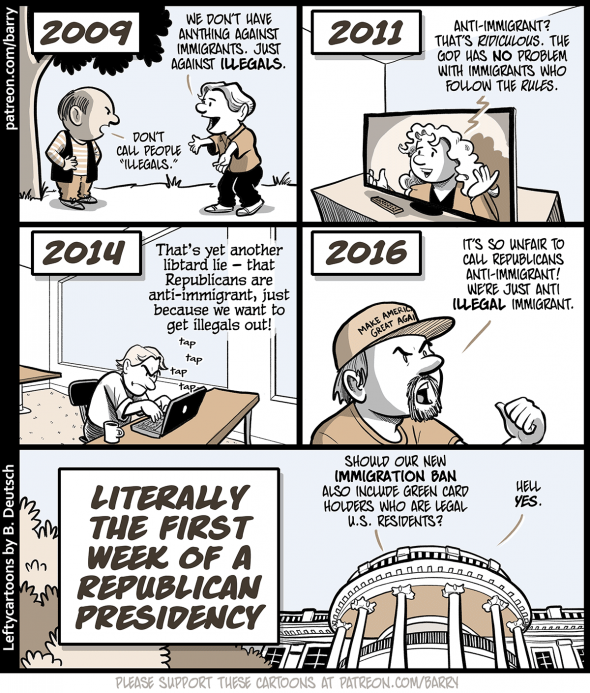
 Written by Rozina Ali, the article is called “





@beth: Thank you