
Joss Extravaganza – The problem with the comics

I’ve really enjoyed the Buffy comics, even though I stopped reviewing them. After a while there are so many ways you can say “It’s great that Buffy had sex with someone that I don’t hate so much I would like to pickle them in brine, but do they have to draw all the women looking the same?”

What draws me back to talking about the Buffy comics isn’t the series itself (although it’s getting really interesting and exciting), but the letters column at the back of last month’s issue (the Harmony issue for those who subscribe). The last letter in the column said:

I’m not loving the way the characters are drawn. I know they’re comics and that’s how men typically draw women in comics, but why does Buffy have such a tiny waist and such large breasts? Seeing the way she was drawn in #10 was a real let down; Buffy looked more like Heidi Montag of Jenna Jameson than Buffy. I don’t have anything against a tiny Waist (I have one myself!) or large breasts (okay, those I don’t have, as most women with tiny waists don’t have naturally. But it was disappointing to see Buffy have an unrealistic, unattainable, Barbie-esque body type. I don’t understand why Buffy’s looks are clearly modeled after Sarah Michelle Gellar, but someone decided to inflate her chest.

I wish I had a scanner so I could show you the image she was talking about, but I’m sure you can imagine it. [I’m guessing this is the panel you would have inserted –Amp.]

I want to draw attention to how specific the author’s point is. You could write, but all she is saying that in the comics female character’s waists have got smaller and their breasts have got larger.

You can tell the reply is going to be full of weaseling because Scott Allie immediately turns over the reply to one of the few women who work on the comics. ((There have been eleven men and one women involved in producing the art of the comics (that’s pencils inks colours and letters) and five men and one woman have written scripts. Jo Chen does most of the covers, and the designer has always been female. Listed in the front is three editorial staff and a publisher. The Publisher and Editor are both male, but usually one of the editorial staff is female. I say this not because I necessarily think the comics would look any different if they had more women involved in their creation, but to point out that given how few women are involved in producing the comics to put one forward to justify the way women’s bodies are drawn is tokenism of the worst sort.)) Sierra Huhn an assistant editor spends the first few sentences blathering on about how Buffy is much better than other comics, because the women don’t have big breasts and itty-bitty waists (she clearly didn’t look at the first frame of #10 before she wrote that).

She ends with the mealy mouthed “The last thing we want is for anyone who reads this comic, or works on this comic, to feel like we’re in the business of exploiting women” (actually the last thing she says is ‘yay Buffy means more women read comics,’ which is so irrelevant that I’m ignoring it). Which is nice side-stepping what was actually brought up (the original letter didn’t mention exploitative). It’s also an interesting rhetorical technique when the facts are against you (the way women look in the comics is limited and emphasizes extreme hour glass figures) you say “I don’t mean to make people feel that way” – shifting the topic from what exists to other people’s feelings.

But it’s in the middle that she gets really offensive:

It’s true most of the characters are attractive (have you seen the show?), and thin (Slayers have to follow a pretty strenuous exercise program…just sayin’…), and sometimes Buffy may be more buxom from one issue to the next. It happens. But not unrealistically so, and not all the time.

Because we all know training regimes give women large breasts and small waists (you think slayers spend hours doing the “I must, I must, I must, increase my bust arm thrusts?). It’s a ridiculous and insulting answer to a serious question.

That’s not even what I object most to what she says. It’s that she’s stepping on the greatest moment of the history of TV.

Those of you who watched the show will remember Buffy’s last speech. For those who don’t Buffy is talking about doing a spell to share her slayer power, with all the potentials all around the world (it’s way cooler than I can make it sound in a sentence). And as she was doing this there is a series of images of girls becoming slayers, at school, at home, and on a baseball diamond. It means a lot more if you’ve watched the show, but you get the idea.

One of the slayers is fat. She isn’t not-skinny, she isn’t Hollywood fat, she isn’t a size twelve, she takes up space. And she stands up and uses her body and her strength to stop stops the man who is trying to hurt her. Meanwhile we hear Buffy’s voice saying “Everyone who can stand up; will stand up.” ((Random piece of Buffy trivia – that was the last shot of Buffy Joss ever shot.))

Why haven’t we seen her in the Season 8 comics yet? Don’t tell me that she started a strenuous exercise programme and now she’s got a tiny waist (her boobs would presumably be the same size) and is one of the many identical looking slayers you see in the background, because I will hurt you.


[Image curtsy: Screencap Paradise.]
Posted in Buffy, Whedon, etc., Cartooning & comics, Fat, fat and more fat, Feminism, sexism, etc, Gender and the Body, Syndicated feeds | 10 Comments

If racism is the worst accusation that can ever be made, how do we discuss minor racist slights?

In comments at the Daily Cartoonist, regarding the Sean Delonas cartoon, I wrote “I don’t think it matters what was in his heart. What matters is what’s in the cartoon. And it’s a racist cartoon.”

RS Davis responded in comments (click through to read his entire comment):

Apparently, the all knowing, all seeing judges of humanity on this topic can see straight through the hearts of man and judge them as blatant racists, no matter WHAT they actually did. […]

How Orwellian. We can twist what you did, no matter what your intent or who you are, we can judge you as a racist and you’re too stupid to know it, or you’re a racist because we say so, even if you’re not.

…Where was the howling when cartoonists drew Condi Rice as Aunt Jemima?

My response to RS:

Please reread what I wrote, because you seem to have read exactly the opposite of what I said. I’m not judging whether or not the cartoonist is a racist. I’m not condemning him or saying he should never work again.

I don’t know or care if he’s a racist. I’m critiquing the cartoon, not the cartoonist.

And since you asked, I have criticized racist images of Condi Rice in cartoons. I’ve also criticized anti-semitic images in left-wing cartoons. And I said the same thing then that I’m saying now: it’s about what’s in the cartoon, not about what’s in the cartoonist’s heart.

Delonas maybe be guilty of a lame cartoon, but those screaming one of the worst accusations that can be made, racism, over it, REGARDLESS of who the man really is, his intentions or his past work, is far more frightening and a bigger crime that anything he did.

No one has said Delonas committed a crime.

I also don’t agree that racism — especially racism that’s quite likely inadvertent — is “one of the worst accusations that can be made.” Thinking of it that way is a mistake, because it makes it impossible to talk about minor racist slights. If someone tells me “I think that this cartoon is kind of racist,” that’s not at all the same as them saying “you’re a KKK member!” And if I take it as if they’ve accused me of being a monster, then all I do is guarantee that no productive discussion can take place.

Two links I’d recommend you read:

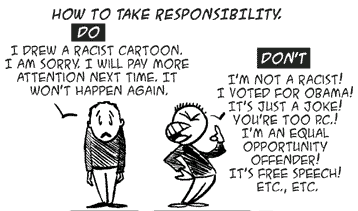
First, directly related to this controversy, Kevin’s newest cartoon, “Racism 101 for White Cartoonists,” which is brilliant.

And second, RS, I’d recommend you read this post I wrote a couple of years ago: How Not To Be Insane When Accused Of Racism.

Posted in Cartooning & comics, Race, racism and related issues | 23 Comments

Racism 101 For White Cartoonists

Brilliant cartoon by Kevin Moore, commenting on some recent, racist political cartoons (including the Delonas cartoon Jeff critiqued here). That’s just one panel — click through to read the whole thing.

Posted in Cartooning & comics, Race, racism and related issues | 2 Comments

Peace Pulse

The Israel Policy Forum has set up camp in the blogosphere with its new venture, “The Mideast Peace Pulse”. The IPF states its mission as “to promote active U.S. engagement to achieve a two-state solution to the Israeli-Palestinian conflict and peace and security for Israel with the Palestinians and the Arab states.” Along with J Street, the IPF is a leading element of the burgeoning set of institutions pressing for a “pro-Israel, pro-Palestine, pro-peace” position (via the Z-Word).

I am also heartened to see that the Peace Pulse will apparently include posts by Ghassan Khatib, former Palestinian Authority Minister of Planning and Labor, and Ziad J. Asali, head of The American Task Force on Palestine and former president of the American-Arab Anti-Discrimination Committee. There are unfortunately far too few forums where pro-Israel and pro-Palestine voices feel comfortable sharing a space, much less working together productively in hopes of a shared future and a peaceful tomorrow. Without these circles of engagement, however, the prospects for advancement look dim. I’m a pleased the the Peace Pulse will provide one of those spaces, and I look forward to reading the contributions of all its contributors.

Welcome to the ‘sphere!

Posted in Palestine & Israel | Comments Off on Peace Pulse

Eric Holder Says Americans Are Cowardly on Race Issues

I don’t agree with every little tidbit of his speech, but I do think he’s right.  The deny, avoid, ignore pattern is so prevalent when it comes to race, and it doesn’t serve the interest of racial justice at all.

Here’s a quote about Holder’s speech, and a link to the entire article:

In a speech to Justice Department employees marking Black History Month, Holder said the workplace is largely integrated but Americans still self-segregate on the weekends and in their private lives.

In the speech, Holder urged people of all races to use Black History Month as a chance for honest discussion of racial matters, including issues of health care, education and economic disparities.

“Though this nation has proudly thought of itself as an ethnic melting pot, in things racial we have always been and I believe continue to be, in too many ways, essentially a nation of cowards,” Holder said.

Race issues continue to be a topic of political discussion, but “we, as average Americans, simply do not talk enough with each other about race.”

Holder’s speech echoed President Barack Obama’s landmark address last year on race relations during the hotly contested Democratic primaries, when the then-candidate urged the nation to break “a racial stalemate we’ve been stuck in for years” and bemoaned the “chasm of misunderstanding that exists between the races.” Obama delivered the speech to try to distance himself from the angry rhetoric of his former pastor, the Rev. Jeremiah Wright.

Holder cited that speech by Obama as part of the motivation for his words Wednesday, saying Americans need to overcome an ingrained inhibition against talking about race.

“If we’re going to ever make progress, we’re going to have to have the guts, we have to have the determination, to be honest with each other. It also means we have to be able to accept criticism where that is justified,” Holder told reporters after the speech.

Posted in Whatever | 72 Comments

Privilege Illustrated

So apparently in New York City last week a chimpanzee attacked a woman, and was shot and killed by police. It’s not particularly surprising; I think Dennis Leary covered the absurd ways that one can die in New York City in No Cure for Cancer, and having a crazed chimp attack you is frankly less odd than getting hit by a poodle dropped from fifty stories.

Anyhow, the editorial cartoonist from the New York Post decided to take this incident and use it to comment on the authors of the economic stimulus package.

If you’re remembering that our president is African-American, you’re ahead of Sean Delonas:

stimulus-bill.jpg

Now, do I think Delonas thought about the racist history of comparing African-Americans to monkeys? No, I don’t. Do I think he further thought about the history of police killing African-Americans — and it’s not exactly ancient history? No, certainly not.

But that’s because he didn’t have to think about it. It isn’t a part of his life. It isn’t a part of his experience. He may know these things, in an academic sense, the way I do — but they aren’t a part of the fiber of his being. He hasn’t seen illustrations from a hundred years ago showing his people are more like apes than the purer, smarter, obviously more civilized race. He hasn’t had to worry that an encounter with a cop on a train platform could lead to his death. These things aren’t a part of his existence — nor mine, for that matter.

That’s what privilege is — the privilege not to have to deal with the thousands of little degradations that others deal with.

But being a decent human being in 2009 means being aware that one is privileged. Being a decent human being in 2009 means putting yourself in the shoes of someone else, and trying to see the world through the filter they do. And with our nation’s first African-American president now firmly ensconced in the Oval Office, that’s something everyone who comments on politics for a living needs to do — look at the metaphors they use, the imagery they pick, and understand that not all metaphors and images are created equal.

A failure to do that turns a legitimate (if, IMHO, incorrect) argument — that the stimulus was bad and foolish public policy — into an image that causes people to draw up short, and see not that argument, but the hundreds of years of racism that stain our nation’s soul.

Do I think Delonas intended to draw a racist cartoon? No, I don’t. But intention doesn’t enter into it. The fact is that through his blindness to his own privilege, he created a cartoon that was racist. It would be nice if he’d learn from this, take his lumps, and if we could all use this as a learning experience. Of course, given the way our country discusses race, I’m guessing that he’ll sniff that he wasn’t racist at all, and after a lot of heat and no light, we’ll move on to the next topic. That would be a failed opportunity, of course, but it wouldn’t be the first, and it won’t be the last.

Posted in Cartooning & comics, Race, racism and related issues | 28 Comments

J.D. Hayworth: Anti-Semite

Trust me, we’ll all be in agreement about this former Arizonia Congressman.

Posted in Anti-Semitism | Comments Off on J.D. Hayworth: Anti-Semite

Suheir Hammad, A Poet Whose Work You Should Probably Know

Given some of the discussion generated by Jake’s comment on David’s Breaking The Seals post, I thought people here might be interested to know about (if you don’t already) the work of Palestinian poet Suheir Hammad. I wrote about her second book of poetry, Zaatar Diva, and a little bit about her first, Born Palestinian, Born Black on my blog here. It’s a review of two books of poetry, but some of what it says is germane to what we are talking about here.

Posted in Anti-Semitism, International issues, Jews and Judaism, literature, Palestine & Israel | 1 Comment

Is there a "firewall" between anti-Semitism and criticism of Israel?

Allen Hertz, writing in the Jerusalem Post, says no. He’s not arguing that all criticism of Israel is anti-Semitic. He’s arguing against the idea that the two activities (“anti-Semitism” and “anti-Israel”) can be hermatically sealed off from each other. The big focus of his argument is disproportionality and bias — even criticisms which may individually fair and valid can still, taken together, be demonstrative of anti-Semitism when they are disproportionate to the alleged offense, or when they articulate a standard that other countries are not held up to.

For example, imagine 20 people arrested for robbery, 10 White and 10 Black, and we charge all 10 of the Black persons but only one White. It might be true that all of the Black defendants are fairly and objectively worthy of prosecution. But that wouldn’t make the prosecutions just, even if taken individually and isolation from the other prosecutorial decisions they are, because the distribution is all askew. Since 2003, the UN directed more of its human rights actions towards Israel than any other country, and more than Sudan and the D.R. Congo (ranked #2 and #3, respectively) combined. The former was busy carrying out a genocide which has a six-figure death toll, whereas the latter was embroiled in a civil war whose casualty rate has easily crossed into the millions. Even if every one of its criticisms were meticulously fair, the distribution is still worthy of concern — why Israel gets taken in for so much more criticism against countries whose behavior seems objectively worse, or whose situation seems objectively more dire.

Similarly, one can articulate a defensible moral principle that, applied fairly, would represent a valid critique of Israel. But if the principle is only applied against one party, but not others similarly sitauted, that’s problematic as well too. For example, it is a defensible moral principle to say: countries engaged in counter-insurgency operations are morally responsible for the safety and wellbeing of the civilian population in these territories. And this would be a moral principle that Israel is not fulfilling. But neither is Sri Lanka in its operations against the Tamils. Neither is Sudan in Darfur. Neither is either Rwanda or the Congolese government in D.R. Congo. If Israel seems to be the only country asked to meet this obligation, or comes in for far heavier criticism when it fails to do so, it’s fair to wonder why that is.

What makes this difficult is that it has to do with net effects and the broader distribution of our arguments. A UNHRC report heavily critical of Israel might not be identifiably anti-Semitic taken in isolation, but it’s not in isolation — it’s part of a pattern wherein the UNHRC criticizes Israel far more frequently than any other country or in accordance with any reasonable standard of priorities. The problem is that it is impossible for any one person to change the pattern, and this raises the question of what happens when we concede that system-wide Israel is being unfairly and disproportionately “targeted”, but we also believe that our individual crticism is fair, valid and important (the criminal justice system prejudicially targets Black men, but what do we do when we have a Black man, arrested due to the functioning of that system, whom we never the less have good evidence showing that he is a murderer? Individual justice here clashes with systematic justice).

It’s a difficult question. I’m not sure how to answer it. But it does indicate that at some level it is inadequate, in my view, to simply frame the question “is this individual criticism anti-Semitic, is that specific report anti-Semitic”, when often the issue is not individual acts, but how when combined together and viewed as a whole they comport with our general articulations of moral principles and ethical priorties.

Posted in Anti-Semitism | 32 Comments

The Trouble With Roland

So back in January, when now-ex-Illinois-Gov. Rod Blagojevich, D-Joliet, appointed Roland Burris to the Senate, I had this to say:

Burris’ appointment is offensive, and it should be fought until it can’t be fought anymore.

Let’s not mince words. Rod Blagojevich was arrested for trying to sell this appointment. Nobody — not Abraham Lincoln, not Mahatma Gandhi, not Jesus Christ — can be appointed to this seat by Blagojevich without being tainted by that very fact. That Burris doesn’t appear to have given Blagojevich money is beside the point; nobody can be appointed to this seat without being fatally compromised.

Burris, of course, should have done the honorable thing and refused the appointment, but like all politicians, he’s got an ego, and he wants to believe that his wonderfulness can somehow remove the taint of the appointment. It can’t. Indeed, by accepting the appointment of an accused felon, Burris has proven that he does not have the moral or ethical judgment to be a United States Senator.  (That others, like Ted Stevens and Larry Craig, also do not is no reason to accept Burris’ shortcomings.)

Now, at the time, some of my ideological cohort challenged me on that. After all, there was no specific evidence of wrongdoing on Burris’ part; Blagojevich was a bad guy, but maybe Burris was okay. And besides, wasn’t it a good idea just to get this over with, rather than dragging things out for a fight that would only end up making the Democrats look bad? Wasn’t it better to get Burris in the Senate to have his vote?

Well, until Al Franken is seated, no, it wasn’t, but that’s beside the point. The point was that Burris had already demonstrated that he was a bad guy; he took the appointment of an accused felon, a man who had been arrested for trying to sell that very appointment to the highest bidder.

Which is why the latest revelations about Sen. Burris are not surprising in the least:

The benefit of the doubt had already been stretched thin and taut by the time Roland Burris offered his third version of the events leading to his appointment to the U.S. Senate. It finally snapped like a rubber band, popping him on that long Pinocchio nose of his, when he came out with version four.

Let’s see if we have it right: Burris had zero contact with any of Gov. Rod Blagojevich’s cronies about his interest in the Senate seat being vacated by President Barack Obama— unless you count that conversation with former chief of staff Lon Monk, and, on further reflection, the ones with insiders John Harris, Doug Scofield and John Wyma and, oh yeah, the governor’s brother and fund-raising chief, Robert Blagojevich. But Burris didn’t raise a single dollar for the now ex-governor as a result of those contacts because that could be construed as a quid pro quo and besides, everyone he asked refused to donate.

That’s the long and the short of it. Burris was more than happy to provide quid to Blago, if only he could find some; he tried to raise money despite being aware that Blagojevich was facing jail time. He was more than willing to participate in the selling of the Senate seat once held by the President of the United States — on the purchasing end.

And given how many times his story has changed, it’s not out of the question to wonder just what price Burris paid.

Burris is now facing a probe in Illinois regarding whether he perjured himself in testimony to the impeachment panel. He’s a laughingstock. He’s going to damage the Democrats’ chances to hold the seat in 2010 no matter what he does. And this is going to happen precisely because the Democrats were too eager to hold the seat in the short term to risk a special election for the seat.

Unfortunately, it’s now too late for the Senate to play for time while the Illinois legislature puts together a special election; Burris is in the Senate, and while an ethics probe is probably waiting for him, it’s likely that action will be delayed pending the perjury probe. If the Ted Stevens precedent is still in effect — and it is — the Senate will hold its collective breath and hope that they don’t have to do anything rash like expelling the junior senator from the Land of Lincoln. They’ll hope that he just decides not to stand for election, and that they can simply watch him walk out the door two years from now.

But until the day he walks out the door, he’ll be a reminder that the Democrats had a chance to stand for ethics above all else — and failed, for simple, short-term partisan gain. That’s the kind of thing that leads to long-term partisan damage.

Posted in Elections and politics | 17 Comments