Surgery and Mental Health

Trigger warning: graphic descriptions of medical procedures.

As my Facebook friends are no doubt sick of hearing, I have a blocked tear duct. Turns out you really need your tear ducts! Give them a hug, because they are important! If they’re not working right, then tears that would normally drain through your throat run down your face and grow stagnant in your sinuses and breed bacteria, which leads to swelling and pain all around inside your head. My ophthalmologist thinks that when I broke my nose in high school colorguard fifteen years ago (yes, I was a flag team geek), some debris made its way into the duct and led to scarring, which eventually closed it up. That’s causality for you.

Over the past few years, I’ve been growing steadily more exasperated with my body – my creaking, grinding, breakable body, my body with its killer monthly cramps and its wild hair that got me picked on in school and its hunched shoulders and crooked nose (my mom claims, bizarrely, that a nose job should solve my tear duct problem) and its spazzy brain (since I’m no longer cross-posting on a site with my full name, I feel safe saying that the “chronic pain” I mentioned a while back is depression/anxiety with OCD) and its tear ducts that have now pooped out. I feel like my 2001 Saturn – every day a new issue. It wasn’t until very recently that I learned not to blame my body for its problems, but I still feel off-kilter in that mode of thinking. It’s so much easier to be mad at my body.

I’ve already had one procedure to try and open the duct. The doctor, dressed in full surgical scrubs while I sat in a chair in my street clothes, numbed the area between my eye and nose and proceeded to jab at the inside of me with a tiny flexible rod. At one point he punctured a membrane and my nose started bleeding. At another point I had to ask him to take the thing out because I feared I would throw up from the trauma of it. Finally I felt something give in one duct and he irrigated it; water flowed down my throat as he emptied a syringe into the tiny hole in the corner of my eye. The other duct, though, remained blocked.

When I got home, my eye swollen almost shut and splotched with red, I joked around with my husband and ate some dinner and then let my guard down and shook and cried for the rest of the night. I’d neglected to mention the anxiety disorder before the doctor started. I really should have.

The next step is surgery: dacryocystorhynostomy, or the creation of a new duct. Sometimes it works like an ear piercing; you put a thing in there and eventually it stays open. Other times they have to insert a tiny, permanent tube. In the operating room, the surgeon will make an incision between my nose and eye so that he can access the intricacies underneath the skin. It’s a relatively minor surgery, just a small thing, in and out of the hospital in a few hours’ time. But I keep thinking about the scar. Will my glasses cover it? Will people see? After decades of being told I was ugly, I finally consider myself pretty-in-a-way, and I’m scared that a scar on my face will obliterate my modest progress.

I’m also afraid of general anesthesia, which I’ve never had. When I was a kid, I prayed I’d never have to have my tonsils removed because I was afraid people would laugh at me while I was asleep, or that I’d lose control of myself before or after and blurt out all my secrets. All my life, I’ve kept myself under tight control, never letting people in, hating myself for moments of weakness. I hate myself when I have cramps and I ask my husband for tea. I hate myself when he cooks dinner because my back is out again or I’m too depressed to move. I’ve always been irrationally annoyed by people with lots of little health problems, because I’m disgusted by that aspect of myself. I hate feeling fragile and weak. I hate fearing that I’m acting like a baby.

My biggest fear, though, is waking up to pain. This blogger had the same surgery that I’ll have and she says they put a tube down her throat while she was under, and that afterwards her throat hurt. I came across a picture showing how deep these tubes go – boy, that was a mistake. I’m terrified of the violence of modern medicine: needles and tubes and catheters and monitors and machines. (I had a catheter once and it was awful.) At some point in my life, I became terrified of harsh touches, so much so that sometimes my husband can barely touch me without triggering some ancient, objectless fear. After the tube and the incision and God knows what else, I’ll have to wear a stent for three months before the doctor snips a knot and I blow it out through my nose. The pre-op anxiety has triggered the worst of my mental health problems. I don’t think we as human beings have the instincts to really deal with phenomena like this.

Then there’s the money. Lord, I can’t even think about that right now.

I feel like at some point, I and others around me were trained to be blasé about minor surgeries, to brush off the fear, to treat them like nothing special. There’s no room for the profundity of willingly forfeiting your free will to someone you’ve barely met so that they can hurt you. Even this post feels like a frightful indulgence, considering all the bloggers who have written about cancer, about childbirth, about experiences I can’t imagine.

I feel like I’ve been given no room to really deal with the effects of modern medicine on my mental health.

So I’ll ask you: what are your thoughts on surgery? What are your experiences (especially those of you who deal with anxiety or OCD)? What have you felt and learned? I’d love some reassurances here. People, I’m serious about the mental health thing – I’ve been in a continual state of panic (shaking hands, tears, racing heart) for five days now, and the surgery is almost two weeks away. I don’t know how my body can keep this up. When I say anxiety, I mean ANXIETY. When I say obsession, I mean OBSESSION. When I say disorder, I mean that things that are supposed to be in order are not in order at all.


Posted in Whatever | 15 Comments

The Democrats Are Now The Home Of Market-Based Solutions

(Crossposted on “Alas” and on “TADA.”)

In an op-ed in the Boston Globe, Richard Schmalensee and Robert Stavins (of MIT and Harvard, respectively) lament the Republican Party’s newfound opposition to market-based environmental solutions.

LAST WEEK, the Senate abandoned its latest attempt to pass climate legislation that would limit carbon dioxide emissions, putting off any action until the fall at the soonest. In the process, conservative Republicans dubbed the cap-and-trade system “cap-and-tax.’’ Regardless of what they think about climate change, however, they should resist demonizing market-based approaches to environmental protection and reverting to pre-1980s thinking that saddled business and consumers with needless costs.

In fact, market-based policies should be embraced, not condemned by Republicans (as well as Democrats). After all, these policies were innovations developed by conservatives in the Reagan, George H. W. Bush, and George W. Bush administrations (and once strongly condemned by liberals).
In the 1980s, President Ronald Reagan’s Environmental Protection Agency successfully put in place a cap-and-trade system to phase out leaded gasoline. The result was a more rapid elimination of leaded gasoline from the marketplace than anyone had anticipated, and at a savings of some $250 million per year, compared with a conventional no-trade, command-and-control approach.

In June 1989, President George H. W. Bush proposed the use of a cap-and-trade system to cut by half sulfur dioxide emissions from coal-fired power plants and consequent acid rain. An initially resistant Democratic Congress overwhelmingly endorsed the proposal. The landmark Clean Air Act amendments of 1990 passed the Senate 89 to 10 and the House 401 to 25. That cap-and-trade system has cut sulfur dioxide emissions by 50 percent, and has saved electricity companies — and hence shareholders and ratepayers — some $1 billion per year compared with a conventional, non-market approach.

Frankly, in the 1980s the Republicans were right. All else held equal, it’s better to use market mechanisms to cut carbon (or other needed changes) rather than issuing inflexible and crude regulations. The government can, and should, decide on overall goals such as “we need a big cut in sulfur dioxide emissions.” But the market is much better than government at finding the most affordable and efficient ways to achieve such goals.

Unfortunately, today’s conservatives no longer believe in market-based solutions; instead, they believe in denying that problems exist at all. We’ve seen this in health care, when a market-based approach to universal healthcare that conservatives favored in the 1990s has been overwhelmingly rejected by conservatives. And we’ve seen this in the conservative argument that cap-and-trade isn’t needed, because global climate change is probably just a conspiracy of liberal climate scientists, or even if it does exist then it’s not worth spending any money to mitigate.

Incidentally, the result of conservatives opposing market-based approaches isn’t that nothing will happen on carbon. It’s that instead of market-based approach like cap and trade, we’ll have direct “command and control” regulations from the EPA. Is there any conservative who thinks that we’re better off with more EPA regulations than we would be with a market-based approach?

Ezra points out that this sort of thing is the inevitable result of obstructionism and a routine super-majority requirement to pass any legislation through the Senate. When Congress is made useless and incapable of action, other, less democratic agencies take over.

This is, more often than people realize, the end game of the filibuster: It’s not that the issue is tabled, but that it is handed over to the executive branch, or an independent agency, or the courts. It is handed over, in other words, to an institution free from the filibuster.

Posted in Conservative zaniness, right-wingers, etc., crossposted on TADA, Environmental issues, In the news | 4 Comments

Comic-Con vs The Westboro Baptist Church

Comics Alliance has a lot of fun photos from the counter-protest against the homophobic, America-hating, horrible-in-every-way Westboro Baptist Church, which was in San Diego briefly to protest Comic-Con.

Posted in Cartooning & comics, crossposted on TADA, Homophobic zaniness/more LGBTQ issues | 2 Comments

Mandolin’s First Collection, “Through the Drowsy Dark,” Is Out!

Aqueduct Press — a small publisher that specializes in “bringing challenging feminist science fiction to the demanding reader” — has published “Through the Drowsy Dark,” a collection of poetry and short fiction by Rachel Swirsky, also known to “Alas” readers as Mandolin.

Congratulations, Mandolin! This is Mandolin’s first published book (although clearly it will not be her last).

Here’s how Aqueduct describes the 146-page paperback book:

Through the Drowsy Dark collects ten stories and nine poems by Nebula- and Hugo-nominee Rachel Swirsky, “a terrific writer who’s been making a name for herself with a string of intelligent, perceptive stories,” as critic Jonathan Strahan characterizes her. In Through the Drowsy Dark, Swirsky’s characters struggle with too much and too little emotional control, with heartbreak, with grief that has gone deep underground; they search for nothingness, for difference, for oneness. One commits a terrible crime because she believes it’s the moral thing to do, while another digs up a dead dog because the very thought of kissing it on the lips makes her clitoris throb. Swirsky’s explorations of the heart and mind are fearless—and dangerous fictions indeed.

You can purchase Through the Drowsy Dark on the Aquaduct Press website, Amazon, and many other booksellers.

By the way, the cover illustration was drawn by me. Here’s a big version of it, if you’re interested:

Posted in Mandolin's fiction & poems | 5 Comments

The Democratic Tax Plan Versus The Republican Tax Plan (with pictures!)

(Crossposted on “Alas” and on “TADA.”)

Things are still in flux, but it seems likely that Republicans are going to coalesce around extending the Bush tax plan (the legislation Republicans wrote a decade ago created temporary tax cuts, so they’ll need to be actively extended by Congress in order to continue). Democrats seem likely to propose letting the Bush tax cuts expire for households with over $250,000 in income (about 2% of taxpayers), but cutting taxes for many with household incomes under $250,000.

The Wall Street Journal helpfully charts the competing proposals:

The only persuasive argument for the Republican plan is that it’s foolish to let tax cuts expire during a recession. But tax cuts as stimulus are most effective when the people getting the tax cuts aren’t rich (since poor people are more likely to spend the money immediately, and more consumer spending is the one thing our economy most desperately needs). By moving the tax cuts from the rich savers to middle-class and lower-class spenders, Obama’s tax plan may well be more stimulative.

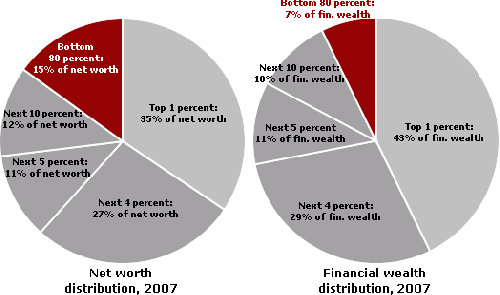
An argument we’re likely to hear from conservatives is that the top 2% of earners already pay a huge portion of federal income taxes, relative to the rest of the country.. That’s true, but they also own a huge proportion of the country’s wealth — most of it, in fact.

It’s not unjust that the people who own most of everything should also pay most of the taxes. (And in fact, the rich are not as paying as large a portion of taxes as some conservatives claim, once all the other taxes Americans pay — not just Federal income taxes, but payroll taxes, sales taxes, state and local taxes — are included.)

Finally, some Conservatives are going to voice a philosophical objection to the idea that some Americans will wind up paying no taxes at all. But again — we’re just talking about Federal income taxes here. There are plenty of other taxes, especially payroll taxes, that are paid for by a broader slice of Americans.

UPDATE: Actually, the Obama administration has proposed not extending the Bush tax cuts for individual filers making $200,000 or above, and joint filers making $250,000 or above. That’s a bit different from what I claimed above; sorry for my mess-up.

Posted in crossposted on TADA, Economics and the like | 39 Comments

On Being A Considerate Parent

on-being-a-considerate-parent

So there’s this post on Feministe about “shorter, cuter, more honest people”. I have a lot of issues with this post. A lot. Starting with the fact that the author wants to make this a childfree vs. parent issue. Then there’s a little jab at American cultural values, and we round it out with this idea that it’s a good thing to have your toddler in a bar all night. So, where to start? Heck, I’ll just cover the spread. First up, let me just speak up as someone who was that kid in the bar in the middle of the night. The child isn’t having fun. No, not even if they get up and start spinning in circles. They’re not spinning in circles, whining, breaking things, or screaming because they enjoy being dragged from pillar to post while you ignore even the most basic concept of respecting their needs. They’re (at best) overstimulated. More likely they’re tired, cranky, scared (especially by the drunk people), and really in need of someone to step in and put their needs first. That person should be their parent. Be considerate of your child. They are indeed a person and as the one responsible for their well being you should treat them as one.

Now, in the interests of full disclosure let me just say that I am a parent. I have been a single mom in the past. I am a married mother of two now. I know all about the sacrifices of parenting. And yes, I think little kids are awesome. They’re sweet funny people that make me want to kiss their cheeks all the time. They’re at their cutest when they are well fed, well rested, and engaging in age appropriate activities. This is not a “Kids should be seen and not heard” post. I think it’s great to take kids on trips abroad, to museums, to the park, to nice restaurants, to festivals, and even concerts that don’t involve a single Disney character. I think that all of those trips should be made when they can be comfortable and enjoy the experience. Kids that are enjoying an experience generally aren’t crying, yelling, or pouting. They’re happy to be there, they may well want to dress in special clothes, and they are at their best when they have time to process what is going on around them and feel safe doing it. Protip: They don’t tend to feel safe when every adult around them is out of control. *hint hint* Drunk people are not in control. They often say things that small people do not need to hear, and frequently do things that small people do not need to see.

Parenting is work. Like any job it can swing the gamut from rewarding to frustrating, but it is a job in which you need to put forth your very best effort. It’s the hard parts of parenting that often matter the most precisely because you’re the ultimate authority in that child’s life. This argument that adult specific places are about isolating women or not treating kids as human might work better if we didn’t go out of our way to make kids comfortable in most situations. Granted, not all. But enough that I can’t buy any claims that they are being oppressed by not being welcome in a bar at 4 am. Children have very different biological and social needs than adults. They need more sleep, and aren’t as capable of processing input in social situations without a competent guide. Yes, that means giving up some experiences once you have a child. Does that mean you can’t still have a social life? No. It’s fine for you to go out. Have a blast. I’ll even buy you a drink. But, only if you get a sitter so your kid can have a good night too. Can’t get a sitter? Might be time for a night in. This isn’t about American values vs. the world. This is about basic child development and loving this sweet funny person enough to do right by them even if it means you miss out on watching the sunrise with an alcoholic beverage in hand. Sometimes sacrificing your fun is the biggest part of being a good parent.

As for the idea that other people can’t say something is bad parenting? Yes, yes we can. You know why? Because kids are vulnerable people. They need someone to step up for them at all times, but especially when their parent is failing to do right by them. This is not about a harmless parenting choice. This is about neglect, possibly abuse, and acting in the best interests of the child. That’s the criteria that counts here. Do I love it when a kid flips out in the grocery store? No. But I get that sometimes such things happen. However, there’s a huge difference between a grocery store where you need to be in order to get food and a bar where you want to hang out and get inebriated. Social services agencies geared toward protecting the welfare of children exist for a reason. That reason isn’t that becoming automatically makes you a good decision maker. If it did? Legions of folks wouldn’t be bearing the internal and external scars of no one putting their needs first.

On Being A Considerate Parent — Originally posted at The Angry Black Woman

Posted in Syndicated feeds | 67 Comments

compost catastrophe

So I’ve been keeping a worm bin (a compost bin that uses worms to turn food scraps into fertilizer) for about two years now. For the first year or so, I kept the bin in the garage, but that made it too easy to ignore; the food scraps would pile up in the bag in the corner of our kitchen and start to smell, and the worms would tunnel sadly for weeks through their own poop, hoping against hope for a delivery of broccoli stems and wilted chard. Mold would grow. Sprouts would become seedlings and then die from lack of sunlight. So I moved the bin indoors, which led to much better care of the worms and somewhat better care of my plants, too, since I was harvesting the castings more often. But it also led to a pretty harrowing fruit fly problem. So back down to the garage it went.

The city of Long Beach – or, at least, our block – has a giant cockroach problem, by which I mean that both the problem and the cockroaches are giant. A few months ago I caught our cat sniffing and pawing the wall of our living room; I thought he was communing with ghosties and laughed it off, but after the roaches started getting into the apartment, I realized that he was probably hearing and smelling them in the walls. For awhile, my husband and I would come out each morning to find roach parts lying here and there on the carpet, along with the occasional pile of cat puke. The exterminator said they were probably coming in from outside the building. We would see them crawling around on the wall of the garage when we came home from work.

Yes, the garage – where I moved the compost bin. Spoiler alert?

After I moved it back down, I promptly went back to my old habits. It wasn’t until I noticed that my jasmine buds were dying before they bloomed that I realized I couldn’t remember the last time I’d fertilized it. I hurried to the garage, held the bin close to my body as I maneuvered it around the car, and opened it in the shade of the garage door.

Whatever substance was in there was definitely not compost. It was swampy. It smelled like a ripe sewer. The worst part, though, were the three-inch-long cherry red cockroaches that covered the surface of it. I don’t think I’ll ever forget the way they looked as they crawled on top of each other and scurried around the sides of the bin.

My husband heard me scream and came down. We moved it to the sun and kicked it a couple of times, but most of the roaches stayed. To make a long story short, we decided that the worm bin was kaput and the least terrible course of action was to just dump its contents in the garbage. If we’d been thinking more clearly, we would have tried to get it in a bag first; as it was, though, I was panicked and on the verge of dry heaving, so we each grabbed a handle, ran it to the dumpsters, and did our best to pour it in. There were a few worm survivors at the bottom. We paused while I tried to think of a way to save them, but putting them in one of the dusty planters would probably kill them, and keeping the compost bin would only invite more cockroaches. We dumped them. Situations like this are why I observe Yom Kippur.

While we were dealing with this, a guy from next door came out of his gate and sat silently on his bike, not quite staring at us, but making it clear that he was interested. Finally he said, “Not very neighborly, is it?”

“Huh?” we said.

It turned out that we were dumping our catastrophe into his building’s trash can. Or, rather, it had our address written on it, but it was a wee bit closer to his building than it was to ours, so obviously it was his.

“Does it really matter?” we asked.

“Just doesn’t seem very neighborly to me,” he said.

We had to apologize twice, and then remind him that we’d apologized twice, to get him to go away. What I felt genuinely terrible about later, aside from the worms, was dumping without a bag.

I still have a couple of unanswered questions about the whole fiasco. First off, my neglect of the worms wasn’t any worse than it had been in the past. What went wrong this time? Secondly, worm bins are designed to keep out larger animals. How did the giant roaches get in? I have some theories, but honestly, I’m still too revolted to start researching. In any case, we’re moving in a month, so the worm bin is on hiatus until we get settled in our new place – which, according to the UCLA student housing office, will have a balcony.

How are your DIY urban homestead endeavors going? Consider this a place to gripe, whine, and vent about those veggies that are dying, that bread that isn’t rising, and other projects that have gone awry.

Posted in Whatever | 8 Comments

"The Stable Master's Tale," by Rachel Swirsky

Fantasy Magazine has posted Mandolin’s short story “The Stable Master’s Tale” on their website. Here’s how it begins:

I was born a baron’s daughter in a kingdom that no longer exists.

My father’s stables were the most important part of his holdings. By the time I had ten summers, I could soothe a panicked stallion and help birth a breech foal.

By the time I was fifteen, I’d realized I didn’t want to marry into some tedious house where I’d be expected to dedicate my life to child-rearing and embroidery. I knew this fate would inevitably befall me if I stayed, and so I packed a few things and snuck away in the night.

Head over to Fantasy Magazine’s site to read the entire story! And they also have a brief interview with Mandolin about the story.

Posted in About the Bloggers, Mandolin's fiction & poems | 1 Comment

A Strange and Bitter Fruit

Jeffrey Lord has good news, America. You may have thought that Emmett Till and those like him who were killed by extrajudicial mobs were lynched. Killed in an effort not just to exact some sort of perverted justice, but to terrorize people, people whose skin happened to have a somewhat higher concentration of melanin than most Caucasians have.

But Jeffrey Lord has it straight, America. You see, Till was beaten, tortured, and murdered, as were a number of others throughout America in our long period of racial apartheid. But Till wasn’t hung — just like Bobby Hall, a relative of the recently vilified Shirley Sherrod, he was beaten to death. And that means that he wasn’t lynched.

And that makes Shirley Sherrod a lying lying liar who totally lied in her speech when cited Hall’s lynching in her speech to the NAACP.

Of course, here on planet Earth, people actually know the definition of lynching does not include hanging. True, hanging was a very common method of lynching, and it is perhaps the image that first springs to mind when one thinks of the terroristic act.

But lynching doesn’t require a rope. It just requires punishment to be extrajudicial and carried out by a mob — to be done without legal sanction. Beating someone to death for allegedly whistling at a white woman, or for stealing a tire? That’s lynching.

Of course, even if Lord was right, and lynching required hanging, few would quibble with her saying her relative’s beating death at the hands of police officers rose to the level of lynching. Few would argue that such a misstatement would rise to the level of a lie, or even a misstatement. Any decent human being, with a heart not made of stone and without a desire to punish Sherrod for the crime of being a black woman who won a battle with a white man — any decent human being, in other words — would view this not as a hook to hang a column on, but at best, a minor misstatement.

But of course, Sherrod made no mistake — none at all. She was telling the absolute, precise truth when she said that Bobby Hall was lynched at the hands of those police officers who took him into custody, killed because he was black at a time when such things were acceptable. And Lord, in his zeal to catch Sherrod in a lie, to prove that she is the real racist in all of this…well, once again, we are shown exactly where racism lies. Not in the woman whose family history is scarred by lynching, but in those who seek to minimize the vast horror of lynching to find a way, somehow, to paint whites as the true victims.

Posted in crossposted on TADA, Race, racism and related issues | 7 Comments

On "Hey Baby" And The Invisibility Of Managing Sexual Harassment (Invisible To Men, I Mean)

[Crossposted on “Alas” and on “TADA.” The discussion on “Alas” is open only to feminists.]

Bean emailed me a link to this article about the game Hey Baby, a first-person shooter game intended to educate men about street harassment of women.

The game is pretty unplayable as a game — it’s an exceptionally poorly made first-person shooter (“rubbish“). But that’s not the point. Laurie Penny wrote:

Hey Baby taps into the everyday violation of private space that is part of the lives of most women living in cities.

The most subversive aspect of the game is the way it translates what men often see as individual compliments or comments into an atmosphere of sustained threat not so different from that of most first-person shooter simulations, where players understand that violent monsters might lurk around every corner.

Seth Schiesel at the New York Times also found the game to be more of a statement than a game:

At first I found myself somewhat offended. In Hey Baby a man says, “Wow, you’re so beautiful,” and that is license to kill him. It should be obvious that a video game in which you play a man who can shoot only women would be culturally unthinkable, no matter the circumstances.

But as I played on, I came to realize that it is equally unrealistic and absurd to suppose that saying, “Thank you, have a great day” is going to defuse and mollify a man who screams in your face, “I want to rape you,” with an epithet added for good measure.

And that is the point of Hey Baby. The men cannot ever actually hurt you, but no matter what you do, they keep on coming, forever. The game never ends. I found myself throwing up my hands and thinking, “Well what am I supposed to do?” Which is, of course, what countless women think every day.

I can already vividly imagine various anti-feminists focusing on the double-standard (“a video game in which you play a man who can shoot only women would be culturally unthinkable”) and ignoring the rest. But of course, the double-standard in gaming exists because a double-standard exists in real life. Men simply do not get sexually harassed on the street in anything like the way women do. A sex-reversed “Hey Baby” would be pointless and contextless, because it wouldn’t be a statement about an actual, real-life problem; it would just be an excuse to blow away women.

My favorite part of the article Bean emailed me wasn’t about “Hey Baby,” but about a consciousness-raising exercise.

One particular sexual ethics program directed at football players asks them to write on whiteboards what they do each day to avoid being sexually harassed. Most stand around scratching their heads.

Random women are then brought into the room and asked the same question. Furious scribbling ensues. “I stand at the back of the lift to avoid being pinched on the bottom.” “I sit in the back of the taxi and pretend to be on a mobile phone.” “I always scan the train carriage and try to sit with women.” “I wear baggy jumpers and pants when walking my dog — even in the heat of summer.” And on and on it goes.

The women are usually shocked to realise the extent to which they have internalised sexual threat as inevitable and omnipresent. The men are shocked to realise the extent to which women have learnt to manage their safety — almost unconsciously.

For men, this is invisible. For women, it’s so omnipresent it’s routine.

When that double-standard is gone, complaining about the double-standard of “why can’t we have a video game in which men shoot no one but women!” might make sense. Certainly not until then.

Posted in crossposted on TADA, Rape, intimate violence, & related issues | 14 Comments