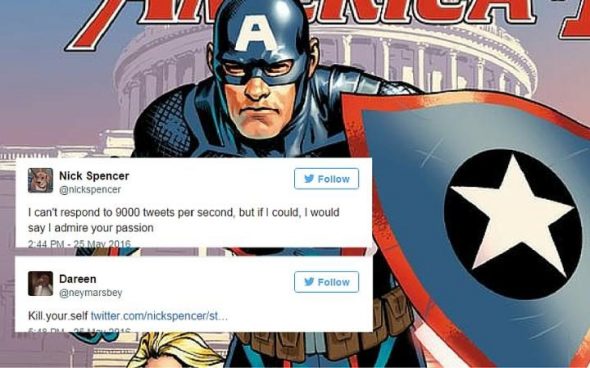
So far, Nick Spencer’s Captain American run is not my favorite work of his – I don’t think it’s nearly as interesting as Superior Foes of Spider-Man. But I don’t see it as antisemitic.
(A quick recap for those of you who don’t follow comics controversies: Nick Spencer is the current writer of the Captain America comic book. He’s writing a story in which Captain America has had his memories altered by villain The Red Skull so that Cap now believes that he’s a loyal sleeper agent of a terrorist organization called Hydra. Hydra is not technically the same as the Nazis, but it’s often been associated with or allied with Nazis in the comics. Since Captain America was created by two Jewish cartoonists, Jack Kirby and Joe Simon, who showed Captain America punching out Hitler months before the US joined WW2, many readers have argued that to have Captain America become a Nazi is disrespectful to the creators, and some have argued that the plotline is anti-semitic. Longer summary here.)
To me, the first issue of Spencer’s CA is about how many heroic qualities – like making sacrifices for the greater good, making the tough calls, being steadfast, and idealism – can also be a part of evil. Given a different set of memories, the same qualities that make Steve Rogers so heroic can also make him a convincing villain.
The first issue’s compassionate depiction of the suicide bomber’s backstory also fits with this theme. (Nick Spencer certainly isn’t the first person to explore this theme, but that’s okay.)
I know other Jewish readers have found the story hurtful and even antisemitic. Speaking for myself, I didn’t have that reaction.
Pop culture has always explored fascism and evil. I can understand why this can be seen as trivializing historic monsters like the Nazis. But I see it as one of the major ways our culture talks to itself about the problem of evil. Spencer’s CA is part of that dialog. (At least, so far it is. It remains to be seen where the story is going).
Because Cap is the most idealistic major character in the Marvel universe, it makes sense to use him as a vehicle to explore issues of idealism and evil.
I do have criticisms of the story – perhaps not deliberately, it comes off as saying poverty causes terrorism. But it’s my understanding that research has shown that poverty and becoming a terrorist aren’t nearly as connected as many liberals believe.
I also have concerns about where the story is going – will the murder Cap committed at the end of issue one just be brushed off?
(And I know that many people have criticisms, not so much of the story itself, as of how the editors and writer have talked about the story, and reactions to the story, in public. It’s legitimate to criticize that, of course, but my interest is in the comic itself, which at least for me is separable from how Spencer and others have talked about it.)
Returning to Jewish fans who are offended by the story, if they say they’re offended, then they are offended. But I have concerns.
I’m not comfortable with the argument that this Cap plot is “spitting in the face” of Cap’s Jewish creators. Kirby himself did a story in which Cap was hypnotized and saluted Hitler (in the end, of course, Cap recovered). Kirby was a lifelong fan of melodrama and stories that painted with big strokes; saying that Kirby would have found this plot repugnant seems to be to be projection.
More importantly, I don’t accept Captain America as an emblem or representation of Judaism in comics. Because Cap is not Jewish. And Cap couldn’t have been Jewish, because antisemitism in publishing at the time Cap was created never would have permitted that. And if a Jewish Captain America had somehow been published, the public wouldn’t have embraced the character.
To me, that Captain America is a creation of an antisemitic system – one that never would have let Simon and Kirby create a Jewish hero – seriously undercuts his value as a symbol of anti-antisemitism.
I’m not saying only Jewish characters can be anti-antisemitic. I am saying that the fact that no major superheroes of Cap’s era were Jewish isn’t a strange coincidence. It’s a result of an anti-Semitic culture in which mainstream comics publishers didn’t publish Jewish heroes. (The Spirit was Jewish, but – like Dumbledore being gay – we only know that because Eisner mentioned it years later.)
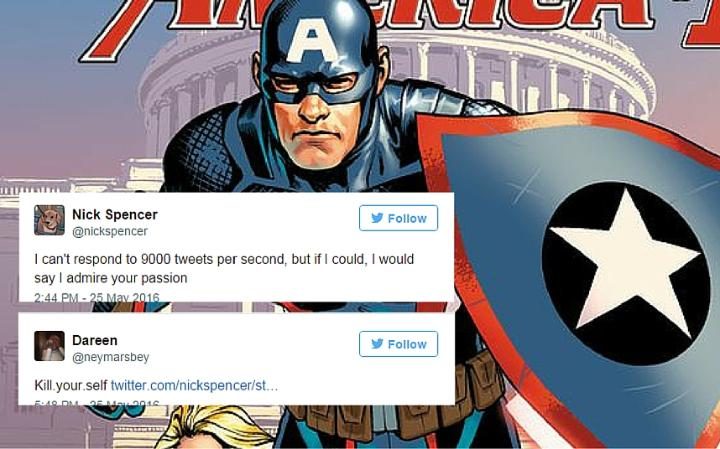
Exploring the nature of evil – including of Nazism, or of pop culture stand-ins for Nazism – is a legitimate thing for popular art to do. That’s what this story (so far) is doing. It’s completely fair to criticize the story if you don’t like how it came out. But I think that some of the criticisms, in this case, have been over-the-top – i.e., suggesting that Nick Spencer is himself an antisemite, or telling people that no one should buy any Spencer comic, or even telling Spencer to kill himself. In some cases, a line has been crossed between criticizing the story, and trying to punish Nick Spencer.
Again, everyone’s got a right to their own interpretation. For me, I don’t see the story as an insult to Jewish readers or creators.











@beth: Thank you