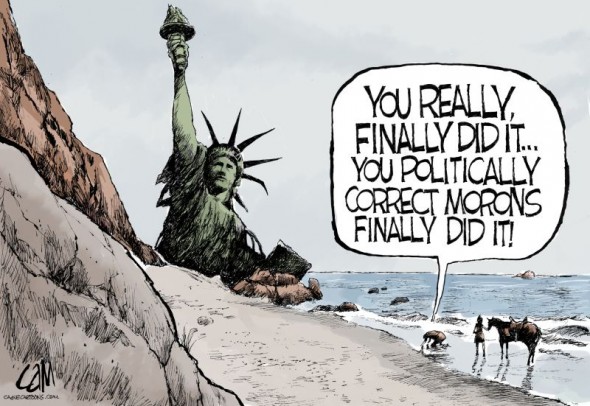
Jonathan Chait’s attack against “Political Correctness” is the talk of the interwebs.
He mixes a few examples of genuinely bad, but also rare and unrepresentative, anti-speech efforts (MacKinnon in 1992 (!), a student whose anti-feminist article led to his apartment getting egged, a professor who stole a pro-life display) with a laundry list of people – well, progressives – using their free speech to protest or criticize:
You may remember when 6,000 people at the University of California–Berkeley signed a petition last year to stop a commencement address by Bill Maher, who has criticized Islam (along with nearly all the other major world religions). Or when protesters at Smith College demanded the cancellation of a commencement address by Christine Lagarde, managing director of the International Monetary Fund, blaming the organization for “imperialist and patriarchal systems that oppress and abuse women worldwide.” Also last year, Rutgers protesters scared away Condoleezza Rice; others at Brandeis blocked Ayaan Hirsi Ali, a women’s-rights champion who is also a staunch critic of Islam; and those at Haverford successfully protested former Berkeley chancellor Robert Birgeneau, who was disqualified by an episode in which the school’s police used force against Occupy protesters.[…]
Stanford recently canceled a performance of Bloody Bloody Andrew Jackson after protests by Native American students. UCLA students staged a sit-in to protest microaggressions such as when a professor corrected a student’s decision to spell the word indigenous with an uppercase I — one example of many “perceived grammatical choices that in actuality reflect ideologies.” A theater group at Mount Holyoke College recently announced it would no longer put on The Vagina Monologues in part because the material excludes women without vaginas. These sorts of episodes now hardly even qualify as exceptional.
Ken White once called this argument “The doctrine of the Preferred First Speaker“:
The doctrine of the Preferred First Speaker holds that when Person A speaks, listeners B, C, and D should refrain from their full range of constitutionally protected expression to preserve the ability of Person A to speak without fear of non-governmental consequences that Person A doesn’t like. The doctrine of the Preferred First Speaker applies different levels of scrutiny and judgment to the first person who speaks and the second person who reacts to them; it asks “why was it necessary for you to say that” or “what was your motive in saying that” or “did you consider how that would impact someone” to the second person and not the first. It’s ultimately incoherent as a theory of freedom of expression.
There are responses to speech that I think are genuinely anti-speech – harassment (Anita Sarkeesian recently posted the harassing comments she gets on Twitter in a single week – extreme trigger warning on that link), threats, attempts to get people fired. ((Scott Alexander discusses this in more detail.)) But Chait’s examples of unreasonable speech are… well, just unreasonable. More often than not, Chait objects to people using their free speech to criticize what others have said. It’s hard to make what he’s saying into anything principled or even coherent.
Chait sometimes attacks the kinds of political arguments we should value the most. For instance, Chait puts on his laundry list “Stanford recently canceled a performance of Bloody Bloody Andrew Jackson after protests by Native American students.”
The real event was much more complex. For one thing, no protests took place; for another, it was voluntarily cancelled by the student thespians themselves, not cancelled by Stanford. ((To be fair, if the production had gone ahead, there would probably have been protests.)) Instead, Native American students met with the theater students and had a series of long discussions in which the groups tried to resolve their differences.
“[‘Bloody Bloody Andrew Jackson’] more or less uses Native Americans as a prop to tell the story of Andrew Jackson and his controversial presidency,” Brown said. “It uses Native people as a foil, or a backdrop to tell his story, which we felt took away from the legitimacy and historical narrative that is very real and exists for a lot of Native students on this campus.”
Stern and her team proposed a variety of potential solutions to ensure that a positive dialogue came out of the show, including cutting certain songs and making small script changes, or finding a show written by a Native American author to be funded by ATF and put on in conjunction with “Bloody Bloody Andrew Jackson.”
After a month of meetings, which included Stern, the co-producers, SAIO, ATF and various faculty moderators, it became clear that the problems of representation in “Bloody Bloody Andrew Jackson” could not be fixed.
This process – in which two groups that disagreed sat down for in-depth discussions – is exactly the kind of free speech that we should admire. When they walked away from the table, the two groups still didn’t fully agree with each other – but they both praised the other sides’ good intentions and willingness to talk.
When a local newspaper, The Fountain Hopper, published an article making a Jonathan-Chait-like article about freedom of speech under threat, one of the theater students objected:
Knarr expressed equal frustration with the article.
“No one from the Fountain Hopper contacted anyone from our team,” she said. “I think the whole process does bring up questions about, ‘When is it okay to say that something artistic should not be put up?’ but I did not come away from this process feeling like my freedom of speech had been restricted.”
I’m not saying what went on at Stanford was perfect in every way. But it was good enough so we should consider it an example of conflict and speech to strive for – and Chait should explain why this is the sort of speech he wants less of.
Angus Johnson makes a similar point:
When someone protests a campus speaker, they’re engaging in an act of speech. When they complain about microagressions, they’re engaging in an act of speech. When they challenge their professors, or trend a hashtag on Twitter, or write trigger warnings into their syllabi, or accuse each other of racism, or criticize our country’s conception of free speech, they’re engaging in acts of speech.
Isn’t that what they’re supposed to do? Isn’t that what [Chait’s] looking for?
A quote from Chait:
Under p.c. culture, the same idea can be expressed identically by two people but received differently depending on the race and sex of the individuals doing the expressing.
What I find interesting about this quote is that it remains perfectly true even if the first three words are deleted.
Some good blog responses to Chait I’ve read, in arbitrary order:
- Chait Speech I’d call this a “steelmanning” of Chait’s position; that is, it restates Chait’s argument in a way that is stronger. (And much shorter.)
- What exactly do you want, Jonathan Chait?
- Jonathan Chait and the New PC | The Nation
- All politics is identity politics – Vox
- ECHIDNE OF THE SNAKES: The Language Police Is Coming To Get You
- The truth about “political correctness” is that it doesn’t actually exist – Vox
- Some Thoughts on White Anti-Racists and Angry Black People |
- Amanda Marcotte: P.C. Policeman Jonathan Chait Can Dish It Out, But He Can’t Take It
- But Wait…There’s More! — Crooked Timber







Am I the only one who read "Beware the narcoterrorists" and thought "beware the jabberwock"?